The Quick Answer: Yes, in small measured portions — a whole medium peach has 12-13g of net carbs, which is workable on a liberal 50g/day keto plan but eats up over 60% of a strict 20g/day budget. Half a small peach, weighed and paired with fat, is the practical rule for strict keto. Canned, dried, and juiced peach are all off the table regardless of your daily limit.
Introduction

It was the fourth week of my keto experiment, and everything was going well by most metrics. My energy had stabilized, my clothes fit differently, and I had reconciled myself by giving up bread, rice, and most fruits without too much trouble. Then came July, the farmers’ market was filled with peaches, and I found myself standing at a stall, where the aroma of the best ripe stone fruit I’d caught in years was emitted. My brain was already calculating carbs before I consciously asked the question: can you eat peaches on a keto diet, or is this diet going to ruin a summer vacation I really cared about?
I went home, still bought peaches, and looked at the actual figures. What I found was more complicated than a simple yes or no, and it comes down to the same number that most articles misstate or never explicitly mention. The honest answer to can you eat peaches on a keto diet is not straightforward. But it’s not free either. It’s the data-driven answer I wish I had stood at this market stall.
What surprised me the most wasn’t the number itself — but how different the number comes in, depending on what kind of keto version you’re following. Most fear-based “not at all” content online distinguishes between rigid and liberal practices, and that’s what causes unnecessary fruit anxiety more than a carbohydrate count.
Table of Contents
Why the Peach Question Feels Different from Other Fruit on Keto
Giving up bananas and grapes at the start of keto was relatively painless for me. The carb numbers are unambiguous, the seasonal attachment is minimal, and both are available year-round in a way that makes the sacrifice feel less pointed. Peaches are different. They’re seasonal, they appear for a few months, and they carry a specific emotional weight most fruit doesn’t — eating a properly ripe peach in July feels like a summer experience, not just a nutritional transaction. Getting the ripeness right matters here too, which I went into properly in my guide on getting peaches to peak ripeness, since a fragrant, perfectly ripe half peach is far more satisfying than a full unripe one, and that difference matters a lot more when you’re only allowed half.
That’s why so many keto dieters find themselves at a market stall doing the same mental arithmetic I was doing, trying to work out whether the numbers can somehow be made to work. The good news is that with peaches, unlike bananas or mangoes, the numbers genuinely are workable under the right conditions. Understanding exactly what those conditions are is what the rest of this article is about.
A friend who’d been doing keto far longer than me put it well when I mentioned my dilemma at the market: “Keto isn’t a list of banned foods, it’s a budget. Spend it where it actually matters to you.” That reframing stuck with me more than any nutrition chart did, and it’s basically the philosophy behind everything in the rest of this article.
Can You Eat Peaches on a Keto Diet? The One Number That Decides
Net Carbs — The Only Metric That Matters
The most important thing to understand before any keto food decision is the difference between total carbohydrates and net carbohydrates. Total carbs include dietary fibre. Net carbs subtract fibre from the total, because fibre passes through the digestive system unabsorbed and doesn’t raise blood glucose or trigger an insulin response. Net carbs are what actually matters for maintaining ketosis. For a strict ketogenic diet, the daily limit is typically 20 grams of net carbs; for a liberal low-carb approach, it’s often closer to 50 grams. That daily budget is the one number the whole peach question depends on.
The Exact Net Carb Numbers for Fresh Peach
Here are the actual numbers, sourced from USDA data and confirmed across multiple nutrition databases:
- Per 100g fresh peach: approximately 8.0 to 8.6 grams of net carbs
- One small peach (approx. 100g): approximately 8 to 9 grams of net carbs
- One medium peach (approx. 150g): approximately 12 to 13 grams of net carbs
- Half a medium peach (approx. 75g): approximately 6 to 7 grams of net carbs
The honest assessment: a whole medium peach consumes 60 to 65% of a strict keto dieter’s entire daily carb budget in a single fruit. That’s a significant allocation for one food.
What This Means for Different Keto Approaches
- Strict keto (20g daily limit): a whole medium peach isn’t viable most days — half a small peach, roughly 40 to 50g delivering 4 to 5 grams of net carbs, is possible on days when every other meal is tightly managed
- Liberal keto or low-carb (50g daily limit): a small to medium fresh peach fits comfortably alongside a balanced low-carb day without extreme restriction elsewhere
Why You Should Not Write Peach Off Completely

The Nutritional Profile That Earns Its Place
One medium fresh peach provides approximately 58 calories, 1.5 grams of protein, and 2.4 grams of dietary fibre, alongside meaningful vitamin C, vitamin A, potassium, and niacin. This isn’t an empty-calorie sweet food — the carbs arrive packaged with real micronutrient value.
Potassium on Keto — Where Peach Earns Extra Credit
If you’ve been on keto more than a week or two, you’ve probably encountered “keto flu” — the headaches, fatigue, and muscle cramps that strike in the early weeks, driven primarily by electrolyte depletion. Potassium is the most commonly depleted electrolyte on keto, and most of the best sources, bananas, sweet potatoes, oranges, are too high in carbs to fit. Peach offers 285mg of potassium per medium fruit at a lower carb cost than almost any comparable food, which makes a carefully portioned peach not just a flavour concession but a genuinely useful tool during keto adaptation.
A Cardiovascular Bonus Worth Noting
Research referenced in keto fruit analyses has linked regular consumption of peaches alongside other flavonoid-rich fruits to improved triglyceride and cholesterol levels. For anyone on a high-fat ketogenic diet monitoring their lipid profile, an occasional carefully portioned peach isn’t just an indulgence — it’s a small cardiovascular investment within an otherwise fat-heavy dietary pattern.
The Peach Formats That Do Not Work on Keto — Be Clear on These
Canned Peaches — Almost Always a Problem
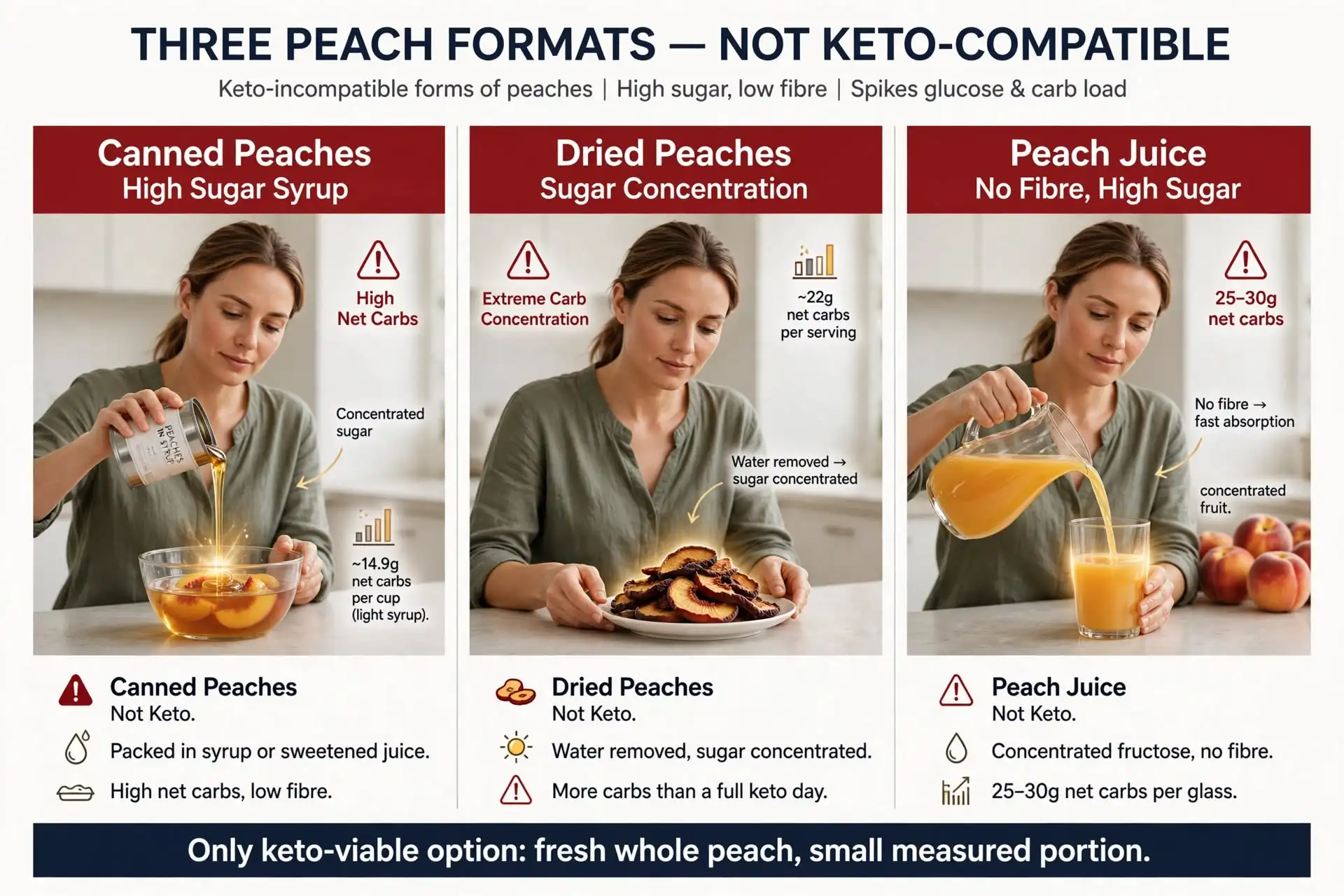
Canned peaches are typically packed in syrup or sweetened juice concentrate, dramatically increasing net carb content. One cup of canned peaches in light syrup can contain approximately 14.9 grams of net carbs before accounting for any added sugar. Even “no added sugar” versions retain the natural fruit sugars in a concentrated format without the fibre buffer of fresh peach.
Dried Peaches — Do Not Attempt This on Keto
Dehydration removes all the water while concentrating every gram of natural sugar. Dried peaches can contain approximately 22 grams of net carbs per serving — more than a strict keto dieter’s entire daily carb allowance in a small portion of a single food.
Peach Juice — Concentrated Sugar, No Fibre
Commercial peach juice concentrates the fructose from multiple peaches while removing the fibre that buffers absorption. A single glass can contain 25 to 30 grams of net carbs with essentially no satiety value, making a strict keto day mathematically impossible if it’s included.
The only keto-viable peach format: fresh whole peach, in a carefully measured small portion, on a day when the rest of your meals are tightly managed. Canned in syrup, dried, and juiced are categorically different foods from a net carb perspective, not slightly worse choices, but genuinely incompatible with ketogenic eating in any practical sense.
How to Actually Make Peach Work on Keto — The Practical Framework
The Half-Peach Rule
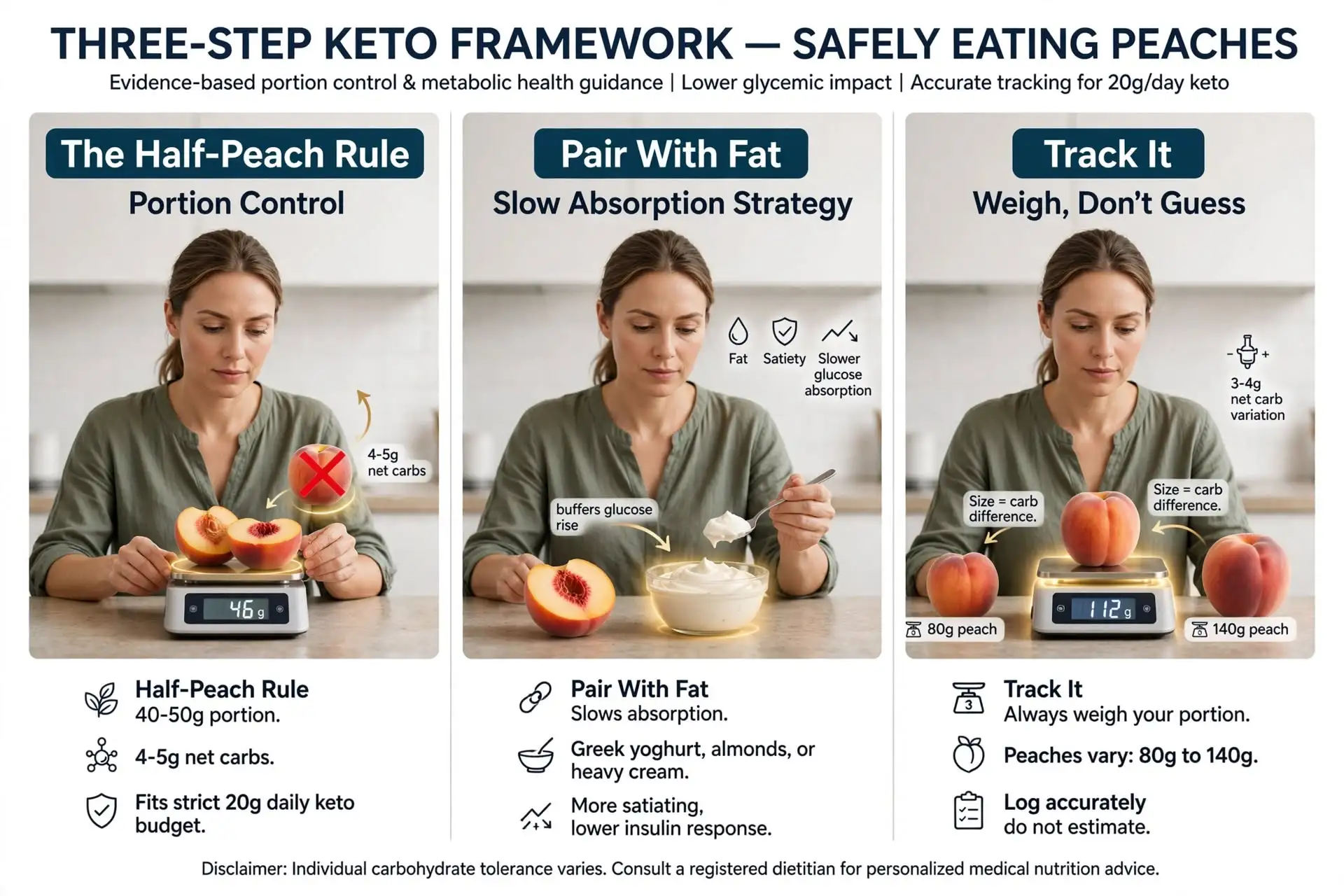
The most consistently suggested approach is half a small peach, approximately 40 to 50 grams, delivering 4 to 5 grams of net carbs. I tested this for the rest of that summer. On days when I’d managed my meals tightly, I’d eat half a small peach in the afternoon. It addressed the craving completely, and the 4 to 5 grams left enough room in my strict 20-gram daily budget to eat properly at dinner without anxiety.
Pair With Fat — The Ketogenic Strategy That Works Here
Pairing your peach with a high-fat, very-low-carb companion slows gastric emptying and buffers glucose absorption, reducing the insulin response and creating a more satiating snack. My personal go-to became half a small peach with a spoonful of full-fat Greek yoghurt — rich enough to feel indulgent, with the protein and fat slowing everything down, and a total carb cost that’s entirely workable on a well-managed keto day. A small handful of almonds or a tablespoon of heavy cream work just as well.
Track It — Measure the Weight, Do Not Estimate
This is where keto dieting either works or falls apart with borderline foods. Peaches vary significantly in size, and a “small peach” can weigh anywhere from 80 to 140 grams depending on variety. That difference translates to 3 to 4 grams of net carbs, meaningful when your daily budget is 20 grams. Weigh your peach portion on a kitchen scale before eating, and log it accurately rather than estimating. Casual estimation of peach portion size is how it stops working. If you’re interested in the fibre side of the equation too, the digestive effects of peach are worth understanding separately, particularly relevant on keto, where constipation is a common early side effect as fibre intake changes.
Better Keto Fruit Alternatives When the Maths Do Not Work
On days when your carb budget simply can’t accommodate any peach, these alternatives deliver sweetness at a lower net carb cost:
- Raspberries: 5.4g net carbs per 100g — exceptional antioxidant profile, high fibre
- Blackberries: 4.9g net carbs per 100g — the lowest-carb common berry
- Strawberries: 5.7g net carbs per 100g — the most popular keto fruit
- Watermelon: 7.2g net carbs per 100g — high water content allows a more generous portion
Fresh peach at 8 to 9 grams of net carbs per 100g sits between blueberries and strawberries in the keto fruit hierarchy — not the most efficient option in pure carb-per-gram terms, but nutritionally richer than most berries and far more seasonally satisfying for anyone who genuinely misses it. I explored the same portion-and-honesty principle for a different fruit in how pomegranate fits into weight management — measured portions and honest carb accounting apply across natural sugars generally, not just peaches. And if you’re timing your portion carefully within the day, when to eat peach for the best results is worth reading — earlier in the day, when you’re most active, typically works best for managing the natural sugar against your daily energy expenditure.
Conclusion
After this summer at the farmers’ market, weeks of testing, and research that confirmed what I was already doing, my answer is decisive and practical. Yes, you can eat peaches on a keto diet, but the word “can” is really working in that sentence. It means a small, measured portion of fresh peaches, on the day when your other foods are really low-carb, combined with fat to slow absorption, to be weighed rather than estimated.
The formats that should be avoided without exception are canned in syrup, dried, and juiced — these aren’t very risky choices, they’re not compatible with a ketogenic diet for the most part, no matter what your daily limit is. My current routine for peach season is simple: I buy one or two small peaches at a time, and when I have 5 to 6 grams of net carbs left in the afternoon, I eat half a small peach with full-fat Greek yogurt and some almonds. It’s really satisfying, doesn’t break ketosis, and that means keto doesn’t feel permanently detached from a food that’s seasonally important to me.
Keto is a statistics game. Here the numbers can be made to work—you have to do the calculations instead of guessing. Now you have exactly the information you need to do this.
If you’re following a ketogenic diet to manage a medical condition such as epilepsy or type 2 diabetes, speak to your doctor or a registered dietitian before adjusting fruit intake, since your carb tolerance and monitoring needs may differ from general keto guidance.
Medical Disclaimer: This article is for informational purposes only and does not constitute medical or nutritional advice. If you are following a ketogenic diet to manage a medical condition such as epilepsy or type 2 diabetes, please consult a qualified healthcare professional or registered dietitian before making dietary changes.
Frequently Asked Questions
Can you eat peaches on a keto diet?
Yes — in carefully measured small portions of fresh peach only, with half to one small peach (40–100g) fitting a liberal keto or low-carb daily budget.
How many net carbs are in a peach?
A medium peach (150g) contains approximately 12 to 13 grams of net carbs, and a small peach (100g) contains approximately 8 to 9 grams.
Will a peach kick me out of ketosis?
A whole medium peach can consume over 60% of a strict keto daily budget, but half a small peach paired with fat is unlikely to disrupt ketosis for most people.
Are canned or dried peaches keto-friendly?
No — canned peaches in syrup and dried peaches contain far too many net carbs, with dried peaches alone often exceeding a strict keto day’s entire allowance.
What is the best way to eat peach on keto?
Half a small fresh peach, weighed on a kitchen scale and paired with full-fat Greek yoghurt, almonds, or heavy cream to slow absorption and improve satiety.
