The Quick Answer: Yes, for most people — a ripe peach eaten 45 to 90 minutes before bed is low-calorie (58 cals), low-GI (28-42), and easily digestible, with magnesium and flavonoids that support sleep and overnight repair. The main caution is its 88% water content, which can contribute to nighttime bathroom trips if eaten too close to lying down.
Introduction

It started on a Thursday afternoon in late July. I was trying to relax after a long day, automatically approached the cookie tray, stopped, and picked up the peaches from the fruit bowl. It was perfectly ripe, soft, and aromatic of summer. I ate it standing on the counter, and it was more satisfying than expected. I did the same the next night, and it quietly became a habit—but the suspicion lingered in the background the whole time. I had heard common warnings about fruits at night: Natural sugar affects sleep, digestion works more, eating near bed is usually harmful. So, I started to think: can I eat peach at night, or am I accidentally harming my sleep with a healthy change?
I didn’t want to guess, so I took a closer look — research, on the actual nutritional profile of peaches, and my several weeks of experience when it became an intentional part of my evening routine. The answer to can I eat peach at night turned out to be far less complicated than the warnings, once you understand what peaches actually do and don’t do in your body before you go to sleep.
Table of Contents
How a Peach Replaced My Late-Night Snacking Habit
For most of the past year, my post-dinner snacking had been driven more by habit than hunger. Somewhere between 9 and 10pm, I’d want something sweet — a few biscuits, a small bowl of cereal, occasionally a leftover slice of cake. None of it was excessive, but none of it was doing me any favours either. The calories were unnecessary, the sugar quality was poor, and I usually felt a bit regretful afterwards in that vague way you do when you eat something for no real reason.
The peach swap happened almost by accident, but once I’d repeated it a few times, I noticed the craving was genuinely satisfied, not just substituted. A properly ripe peach has a sweetness that registers as a real treat rather than a compromise. Getting that ripeness right matters more than people think — a peach pulled cold and underripe straight from the fridge doesn’t deliver the same effect, which is something I went into properly in my guide on getting peaches to the right ripeness, since it’s the difference between the habit sticking and it fizzling out after a week.
What I hadn’t expected was the ritual side of it mattering as much as the taste. Washing the peach, eating it whole over the sink, the juice running down my hand — it felt like a proper ending to the evening rather than mindless snacking in front of the fridge. That small bit of ceremony turned out to be doing more work than I gave it credit for at first, since it replaced not just the sugar hit but the whole wandering-around-the-kitchen behaviour that usually came with it.
The Concerns I Had — And What the Research Actually Says

The Blood Sugar Fear — Does Peach Spike It Before Bed?
The most common concern I’d seen repeated online was that fruit at night causes a blood sugar spike right before sleep, followed by a crash that disrupts rest. The answer depends on glycaemic index (GI). Peaches sit at approximately 28 to 42, firmly in the low GI category — sugar releases slowly and steadily, with no meaningful spike. A medium peach contains around 58 calories and 14 grams of natural sugar, buffered by fibre and water. For context, two digestive biscuits contain roughly 140 calories with a significantly higher GI. The peach was never the blood sugar risk. The biscuits were.
The National Sleep Foundation specifically recommends fresh fruit over processed sugar snacks before bed for exactly this reason — a whole fruit’s natural sugars are buffered by fibre and water, producing a far gentler glucose response than biscuits, cereal, or sweetened yoghurt. Once I actually read that, the vague warning I’d absorbed from nowhere in particular stopped holding up to what the sleep research itself was actually recommending.
The Digestion Concern — Is Your Body Really “Resting” at Night?
The second worry I’d absorbed was that eating close to bedtime forces digestion to work hard while the body is supposed to be winding down. There’s truth in that, but it applies to large, heavy, high-fat meals eaten immediately before lying down, not a single piece of fruit. Peach is one of the most easily digestible fruits available — its 88% water content and modest 2.4 grams of fibre per medium fruit mean it moves through the stomach efficiently without creating a significant digestive burden.
The One Genuine Concern — Water Content and Nighttime Waking
This is the part most articles about peaches at night skip over. Peaches are among the highest water-content fruits available, and some nutrition sources specifically flag high-water fruits, including peaches, melon, and oranges, as potential contributors to nocturia — waking to use the bathroom during the night.
For most people, the fluid in a single medium peach isn’t enough to trigger this. But if you already know you’re prone to nighttime bathroom trips, eating your peach earlier in the evening, 90 minutes to 2 hours before bed rather than right before lying down, is a simple, sensible adjustment. This is the one change I made to my own routine once I read into it — I shifted the peach back by about an hour, kept the ritual, and the minor concern disappeared entirely.
It’s worth saying plainly what this rule actually covers: the blood sugar concern doesn’t apply at this GI level, the digestion concern doesn’t apply at this serving size, and the water content consideration is addressed simply by not eating it immediately before lying down. Once I understood those three things separately, the vague “don’t eat fruit at night” advice stopped feeling like a rule and started feeling like three unrelated half-truths that had been bundled together.
What the Research Actually Confirms
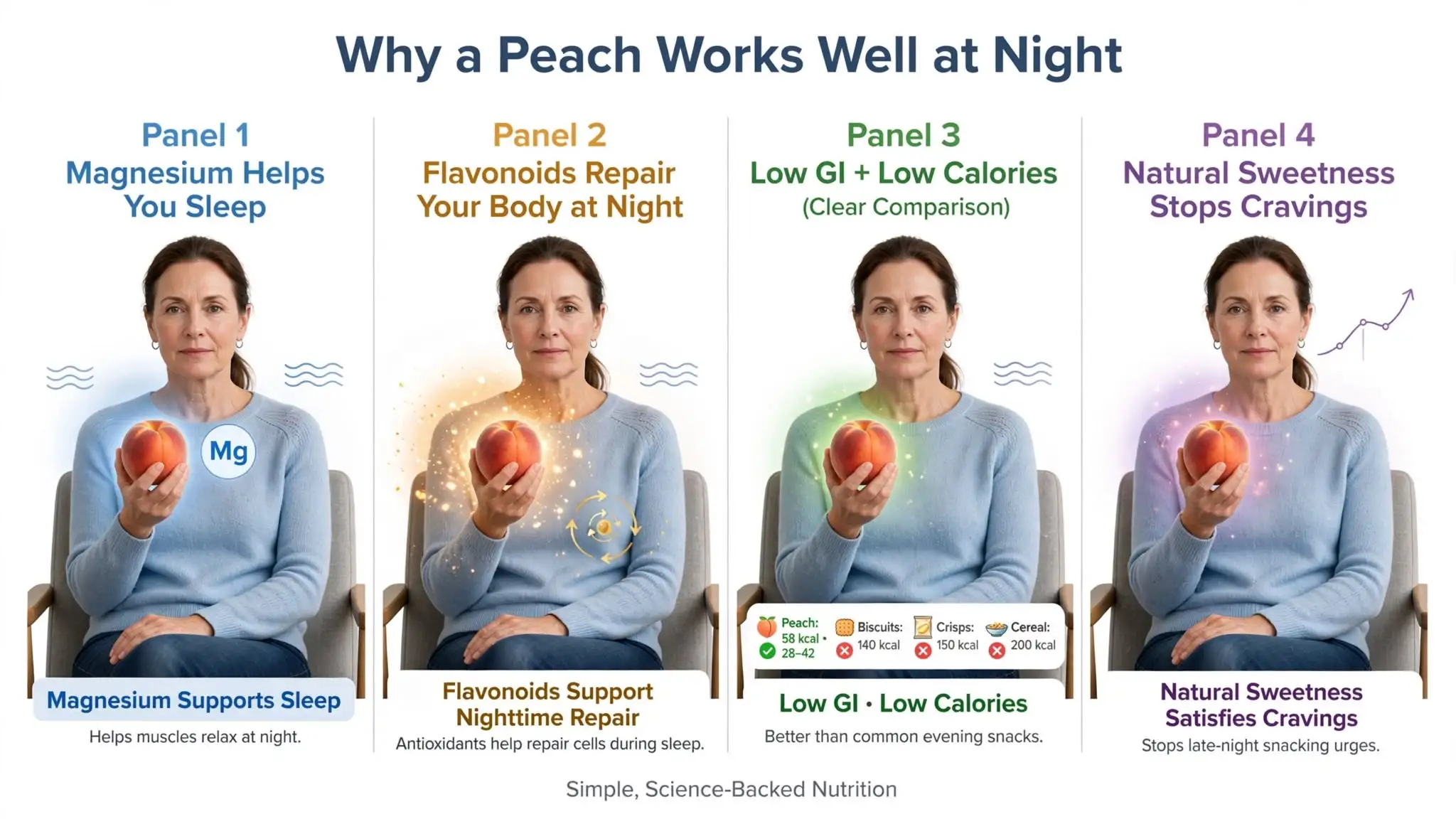
Magnesium — The Sleep Mineral in Your Evening Peach
One of the more interesting findings was that peaches contain magnesium, a mineral with a well-documented role in muscle relaxation and calming the nervous system. Adequate magnesium intake is consistently linked to better sleep quality and reduced nighttime restlessness. A medium peach provides around 9mg of magnesium — modest on its own, but meaningful as part of an evening where other sources, nuts, leafy greens, whole grains, have already contributed to daily intake.
Flavonoids — Antioxidant Repair While You Sleep
Peaches are rich in flavonoids, particularly catechins, quercetin, and chlorogenic acid — polyphenol antioxidants that support the body’s repair and anti-inflammatory processes. Deep sleep is when the body conducts the majority of its cellular repair and antioxidant processing, so eating antioxidant-rich food in the evening means those compounds are bioavailable during that peak repair window rather than sitting unused.
This was the part of the research I found genuinely reframed how I thought about evening eating generally. A peach in the evening isn’t fighting against your sleep physiology — it’s feeding the processes that happen while you sleep, which is a very different relationship to food than the usual “eat before this time or suffer” framing most sleep advice defaults to.
Low Calorie, Low GI — Compared to What You’re Probably Eating Instead
This comparison is the most practically persuasive part of the whole thing:
- Two digestive biscuits: approximately 140 calories, high GI, negligible nutritional value
- Small bag of crisps: approximately 150 calories, high GI, ultra-processed
- Bowl of sweetened cereal: approximately 200 calories, high GI, significant blood sugar spike risk
- One medium peach: 58 calories, GI 28–42, whole food, fibre, vitamins, antioxidants, magnesium
The peach doesn’t just compare favourably on calories — it’s qualitatively different from every processed alternative, doing nutritional work while you sleep rather than simply adding unnecessary calories to your day.
Laid out side by side like that, the comparison stopped being an abstract nutrition lesson and became genuinely persuasive to me on a practical level. It’s one thing to be told a peach is “better than biscuits” in the abstract. It’s another to see that the calorie difference alone is more than double, before you even get to the quality of what those calories are made of.
Natural Sweetness That Genuinely Satisfies the Evening Craving
When you reach for something sweet at 9pm, your brain is mostly looking for a reward signal, not specifically 140 calories of refined carbohydrate. A ripe peach delivers that signal completely — the fragrance, the juice, the sweetness all register as a real treat, and then it stops. There’s none of the wanting-more cycle that processed snacks create, because the fruit doesn’t produce the same artificial dopamine spike. The satisfaction is genuine and complete, which is exactly what kept the habit going for me rather than fading out after a week like most “healthy swaps” do.
I stopped browsing the kitchen at 10pm looking for something else, because the craving had already been properly addressed rather than half-managed. That’s the practical case for the peach habit, not the magnesium content, not the antioxidants — those are a genuine bonus, but the reason it stuck is that it actually worked as a replacement rather than a discipline exercise.
For gut health more broadly in the evening, I’ve also looked at other evening-friendly gut foods worth knowing about, which pair well alongside a peach as part of a thoughtful evening routine rather than replacing it.
What My Evening Peach Ritual Actually Looks Like
The practical details matter more than the general principle for actually making a habit stick, so here’s exactly what I do:
- Bring it to room temperature first: about 30 minutes out of the fridge — cold suppresses the volatile aroma compounds that make a peach taste like a peach
- Eat it about an hour before bed: not immediately before lying down — the adjustment that resolved the water-content concern for me
- Eat the skin: most of the insoluble fibre that supports next-morning digestion is there — on a properly ripe peach the texture barely registers
Who Should Think Twice Before Making This a Nightly Habit
I want to be honest about who this isn’t an automatic yes for, because that’s what makes health content actually useful:
- People prone to nighttime bathroom trips: eat your peach 1.5 to 2 hours before bed rather than right before — for most people this resolves the issue entirely
- People with IBS or fructose malabsorption: peach’s fermentable fibre and sorbitol content can cause gas and bloating — I’ve separately covered the digestive side effects of peaches, which is worth reading if this applies to you
- People with acid reflux or GERD: eating close to bed can aggravate reflux regardless of the food — eating earlier in the evening is advisable
- People managing blood sugar with medication: peach is low GI, but anyone on insulin or blood sugar medication should discuss nighttime fruit snacking with their healthcare provider
The nighttime question comes up across most of the fruit I eat regularly. I asked the same thing about whether pomegranate can be eaten at night, and the answer follows a similar pattern — a qualified yes, with attention to timing and portion rather than a blanket rule either way.
Conclusion
So, can I eat peach at night? For most people, yes, and in a relaxed way. Cooked peaches eaten 45 to 90 minutes before bed bring fewer calories, low GI, easily digestible, and magnesium and flavonoids that work with your sleep physiology, not against it. The fear of blood sugar doesn’t sustain at this GI level. The digestive problem doesn’t apply to this amount. The problem of water intake is solved by not eating before you lie down.
The only people I would really care about are those with IBS, a habit of waking up to go to the bathroom, or a specific medical condition that requires individual guidance. For everyone else, evening peaches are no compromise — it’s a really better choice, better than what most of us want, and better than nothing. I didn’t go back to the cookie tray, and I don’t miss it.
What started as an accidental change on a hot Thursday evening has quietly become one of the most enduring habits of the year, mostly because it never felt like willpower. It seemed like what I really wanted was available all the time.
Medical Disclaimer: This article is for informational purposes only and does not constitute medical advice. If you have a medical condition affecting digestion, blood sugar regulation, or sleep, please consult a qualified healthcare professional before making changes to your evening diet.
Frequently Asked Questions
Can I eat peach at night?
Yes — a single ripe peach eaten 45 to 90 minutes before bed is a sensible evening snack for most people, with a low glycaemic index and only 58 calories.
Does eating peach at night affect sleep quality?
For most people it has no negative effect and may support sleep through its magnesium content, though its high water content can contribute to nighttime bathroom trips if eaten too close to bed.
Is the natural sugar in peach a problem before bed?
No — peach has a glycaemic index of 28 to 42, meaning its natural sugar releases slowly with no significant blood sugar spike.
What is the best time to eat peach in the evening?
Ideally 45 to 90 minutes before bed, which allows light digestion to complete and reduces the chance of the fruit’s water content causing nighttime waking.
Are there people who should not eat peach at night?
People prone to nighttime bathroom trips, those with IBS or fructose malabsorption, and anyone on blood sugar medication should adjust timing or seek individual guidance.

5 thoughts on “Can I Eat Peach at Night? My Evening Ritual Test”