The Quick Answer: No, pomegranate itself doesn’t cause weight gain in normal portions — a whole fruit runs to roughly 130-150 calories and is mostly fibre and water. The real risk factors are pomegranate juice, which concentrates the sugar without the fibre, and treating pomegranate as an unlimited “healthy” add-on rather than a normal portion of fruit.
Introductio
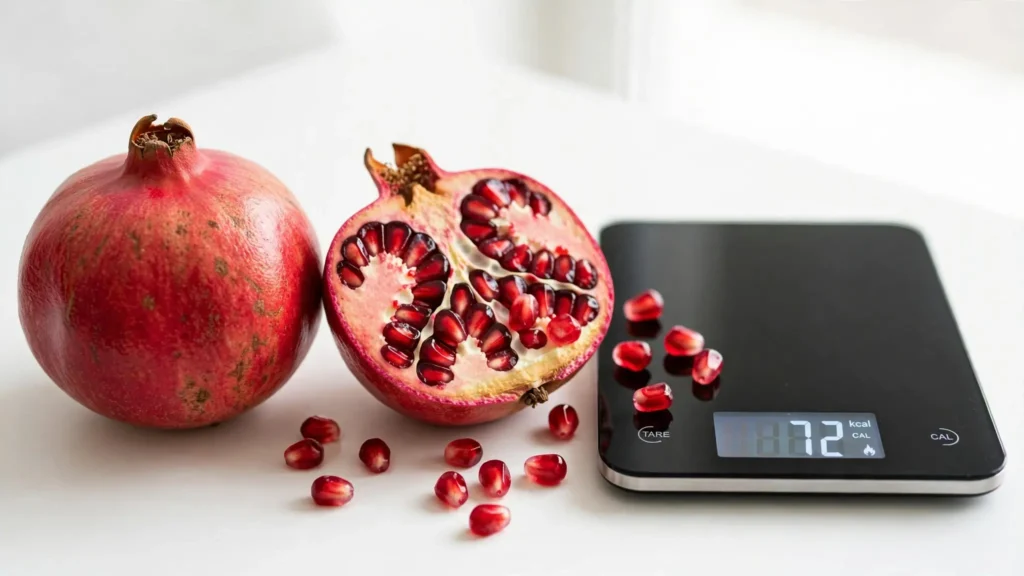
A friend of mine, Sadia, messaged me one evening and asked a question I hadn’t thought about in years: can pomegranate increase weight? She had been keeping a record of her meals for several weeks and noticed that the app was repeatedly marking her lunch pomegranate bowl as having more calories than she expected. She wasn’t nervous about it, just really confused, because she always considered pomegranate to be one of the “safer” fruits.
This conversation put me in the deep pit of research, because can pomegranate increase weight The honest answer is a straight yes or no. It depends almost entirely on how you’re eating it, and Sadia’s situation proved to be an almost perfect example of where this confusion usually comes from.
The thing that took her question seriously was that she wasn’t eating much in any obvious way. She swapped out biscuits for fruit months ago, was completing her step count most days, and still couldn’t understand why her weekly numbers had gone up a bit. Pomegranate was the only element he hadn’t questioned, because it never occurred to him that a fruit marketed as a superfood should have the same amount of restriction as anything else.
Table of Contents
Why I Started Questioning Pomegranate
The Conversation That Started It
Sadia’s food diary wasn’t the problem — she was doing everything right. She just hadn’t accounted for the fact that a full pomegranate bowl, the kind she’d portion out most afternoons, was closer to a serving and a half than a single serving. “I genuinely thought fruit was fruit,” she told me. “I never thought I needed to measure something that came from a plant.”
That line stuck with me, because it’s exactly the assumption most people make about pomegranate specifically. It has a health reputation big enough that portion size rarely enters the conversation — which is precisely where the confusion starts.
The “Sugar vs Fibre” Confusion Most People Have
Pomegranate arils are sweet enough that people assume they’re sugar-heavy in the way a dessert is. What’s actually happening is that the natural sugar is bound up with fibre, which slows down how quickly it hits the bloodstream. That’s a very different metabolic event to the same amount of sugar in a glass of juice or a handful of dried fruit — a distinction I’d already looked at when weighing up whether fruit sugar in grapes affects weight for a different article. The sugar number on a nutrition label doesn’t tell the whole story on its own.
I explained this to Sadia using a comparison that seemed to land: a can of regular soda and a pomegranate can contain a similar amount of total sugar, yet they behave completely differently in the body. The soda’s sugar is absorbed almost immediately, spiking blood glucose and leaving you hungry again shortly after. The pomegranate’s sugar is released gradually as the fibre is digested, which is a large part of why whole fruit rarely triggers the same rebound hunger that refined sugar does.
What Pomegranate Actually Contains — The Numbers That Matter
Calories and Macros — Lower Than Most People Expect
A whole medium pomegranate, once deseeded, comes to roughly 130–150 calories, most of it from natural sugars, with a meaningful amount of fibre (around 7 grams) and a small amount of protein. For comparison, that’s less than a single bagel or a standard chocolate bar — context that’s easy to lose when a fruit gets talked about mainly in terms of its antioxidant content rather than its calorie count.
When Sadia and I actually weighed out what she’d been eating, her “bowl” of pomegranate turned out to be closer to one and a half servings rather than the single serving she’d assumed. That difference alone accounted for most of the extra calories her tracking app had flagged — nothing mysterious about the fruit itself, just an underestimated portion, which is one of the most common tracking errors with any fruit that comes pre-separated into small pieces like arils or berries.
The Sugar Question — Natural vs Added
A full pomegranate contains around 24 grams of natural sugar, all of it intact within the fruit’s fibre matrix rather than added or refined. This is the number that alarmed Sadia when she first saw it on her tracking app, without the context that it’s coming from whole fruit rather than a processed source.
Pomegranate Juice — A Different Conversation Entirely
This is where the picture changes. A standard glass of pomegranate juice strips out almost all the fibre and concentrates the sugar from several fruits into one drink — often 150–160 calories and over 30g of sugar per serving, with none of the fullness that comes from chewing the actual arils. Juice, not whole fruit, is where the can pomegranate increase weight question genuinely deserves a cautious answer.
What the Research Actually Says About Pomegranate and Body Weight
Earlier Studies — Mixed and Inconclusive
Early animal studies into pomegranate extract and body fat produced mixed, sometimes contradictory results, and were never designed to answer how a normal portion of the whole fruit affects human body weight in everyday eating patterns. A lot of the alarming headlines around pomegranate and weight trace back to these early, narrow studies being generalised well beyond what they actually showed.
The More Recent Evidence — A Clearer Picture
More recent human research, including findings summarised by the National Institutes of Health (NIH), points toward pomegranate’s polyphenols having a broadly neutral-to-positive relationship with metabolic health markers, rather than promoting fat gain. Nothing in the current evidence base supports pomegranate itself, eaten as whole fruit in normal portions, as a meaningful driver of weight gain.
I sent Sadia a couple of the more recent summaries once I’d read through them, mainly because she’d started second-guessing whether she should cut pomegranate out entirely. Her reaction was the same one I’ve had with most of these fruit-and-weight questions I’ve researched over the years: the fruit was never really the issue, it was the story she’d built around it after seeing one flagged number in an app.
The strongest evidence against pomegranate causing weight gain isn’t a single study — it’s the complete absence of research linking normal whole-fruit portions to fat gain, despite pomegranate being one of the most studied fruits in nutrition science.
The Real Scenarios Where Pomegranate Could Contribute to Weight Gain

Scenario 1 — Eating a Whole Fruit as a Daily Add-On
This was Sadia’s exact situation. She wasn’t replacing another snack with pomegranate — she was adding a full bowl on top of her normal meals most afternoons. Even a genuinely healthy food adds up in a calorie surplus if it’s layered on top of an already-sufficient diet rather than swapped in for something else.
Scenario 2 — The Juice Trap
Swapping water for a daily glass of pomegranate juice, assuming it’s a “healthy” drink choice, can quietly add 150+ liquid calories a day with none of the fullness signal that whole fruit provides. Liquid calories are consistently the easiest ones to overlook.
Scenario 3 — The Health Halo Effect
This is the pattern Sadia’s story captures best. Because pomegranate is marketed so heavily around antioxidants and heart health, it gets mentally filed under “foods I don’t need to measure,” even though it still carries calories and sugar like any other fruit. Once she started measuring her portion properly rather than eyeballing a “healthy” bowl, her numbers made sense again — nothing about pomegranate itself had changed.
It’s worth saying this health halo effect isn’t unique to pomegranate. I’ve seen the same pattern with avocado, nuts, and olive oil — foods with a genuinely strong nutritional reputation that quietly get treated as calorie-exempt. Pomegranate just happens to be one of the more visible examples because its “superfood” branding is so consistent across health media.
What Pomegranate Actually Does Well for Weight Management
It Supports Satiety Better Than Most Snacks
The combination of fibre and water content in pomegranate arils makes them genuinely filling for the calorie cost, particularly compared to processed snack alternatives. It’s a similar principle to why I looked at whether guava can support weight loss in an earlier article — high-fibre, high-water fruit tends to outperform its calorie count on the fullness scale.
The Polyphenol Effect on Metabolism and Inflammation
Pomegranate’s punicalagins have been linked in early research to reduced inflammation markers, which matters because chronic low-grade inflammation is increasingly tied to metabolic dysfunction. It’s not a weight-loss mechanism on its own, but it’s not working against you either.
It Crowds Out Worse Choices
The most practical benefit I took from researching Sadia’s question wasn’t nutritional — it was behavioural. A bowl of pomegranate arils in the fridge, ready to eat, genuinely competes with reaching for something processed. That displacement effect matters more for most people’s weight than the fruit’s exact calorie count.
Sadia mentioned something similar once she’d adjusted her portions — having the pomegranate already deseeded and ready meant she reached for it instead of the biscuit tin at work most afternoons, purely because it was the easier option in the moment. That’s a behavioural win that no amount of calorie-counting alone would have captured.
How I’d Now Recommend Eating Pomegranate Without Worrying About Weight
After walking Sadia through what I’d found, here’s roughly what I suggested, and what I’d pass on to anyone asking the same question:
None of this is complicated, which is partly the point. Sadia didn’t need to cut pomegranate out or start weighing every meal for the rest of her life — she just needed one accurate reference point for what a normal portion actually looks like, and the habit corrected itself within days.
- Treat a half to a full pomegranate as one serving — roughly the same portion logic as any other fruit
- Choose whole fruit over juice whenever possible — the fibre is doing real work
- Swap it in, don’t stack it on — use it to replace a snack, not add alongside a full meal
- Watch for evening habits — worth reading into whether eating pomegranate at night affects digestion if you tend to snack on it late
- Check for bloating patterns too — I’ve separately covered whether pomegranate causes gas or bloating, which can also affect how “heavy” a meal feels afterwards
If you’re buying pomegranates in bulk while they’re in season to make this easier, it’s worth knowing whether pomegranate seeds can be frozen for portioning them out properly rather than eating a full bowl simply because it’s sitting on the counter.
Conclusion
So, can pomegranate increase weight? When it is eaten in normal quantities in the form of a whole fruit, it does not make any sense. What actually moves this number on the scales is the pattern around it—juice instead of fruit, putting an extra bowl on a pre-filled day’s meal, or just because there’s a health aura around the fruit, so never question that part.
Sadia’s situation was resolved within a week when she served her pomegranate bowl as a real portion, not an overly “healthy” breakfast. Nothing changed in the fruit — she knew how much she was eating. That’s actually the whole answer in a habit: pomegranate is not the problem, part blindness.
Medical Disclaimer: This article is for informational purposes only and does not constitute medical or nutritional advice. Always consult a qualified healthcare professional before making significant changes to your diet.
Frequently Asked Questions
Can pomegranate increase weight?
Not in normal portions — a whole pomegranate is roughly 130–150 calories and mostly fibre and water, so it only contributes to weight gain if it’s eaten in excess or on top of an already sufficient diet.
How many calories are in pomegranate?
A medium deseeded pomegranate contains approximately 130–150 calories, with around 7 grams of fibre and 24 grams of natural sugar.
Is pomegranate juice fattening?
It can be more of a concern than whole fruit, since a standard glass strips out the fibre and concentrates roughly 150–160 calories and over 30g of sugar without the same fullness effect.
Does pomegranate help with weight loss?
It can support weight management indirectly through its fibre-driven fullness and by displacing less healthy snacks, though it isn’t a direct fat-burning food.
Is it safe to eat pomegranate every day when trying to lose weight?
Yes, as long as it’s eaten as whole fruit in a normal single-serving portion and treated as a swap for another snack rather than an addition on top of regular meals.

5 thoughts on “Can Pomegranate Increase Weight? What I Found Out”