The Quick Answer:
Yes, for most people with mild to moderate reflux — a ripe, peeled peach eaten in a moderate portion with a meal is generally well-tolerated. Peaches are mildly acidic (pH 3.3-4.0) but aren’t a known LES relaxer like citrus. Timing and skin are the two factors that matter most: eat with food, not alone at night, and peel it if you’re prone to fullness or heaviness after meals.
Introduction
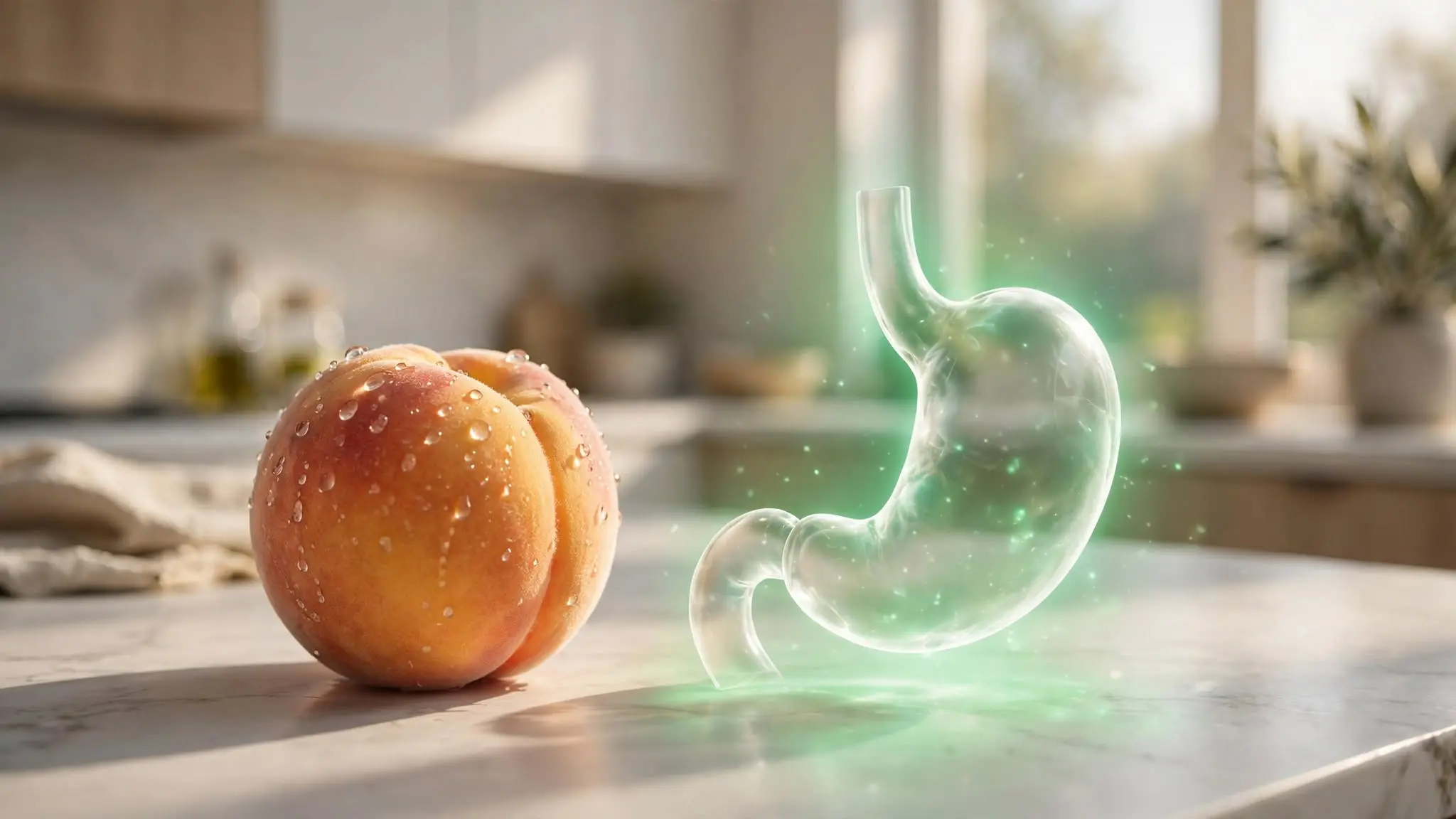
My cousin, Hamza, was diagnosed with GERD last year, after months of burning chest pain that he initially thought was stress. His GP consoled him about the diagnosis but was clearly vague about the diet, except for the usual “avoid sour fruits and fatty foods” list. So when a bowl of peaches came to his kitchen counter on Tuesday afternoon, fresh from the market, he called me, not really sure if eating it would cost him another sleepless night. His question was straightforward: can I eat peaches with acid reflux? Not in theory, but in practice, for someone who really has to live with the condition every day.
Hamza had already mapped out most of his obvious motivations in a difficult way. Even the fruits he considered safe had caught him before — he told me about the mango’s bad reaction, something I later looked into properly after other readers reported similar issues in my piece on whether mango can cause digestive discomfort. Peaches felt different to them — no citrus fruits, no pineapples, to a middle ground that no one had mapped out correctly for them. So I did a thorough research on his behalf. What I found is whether or not you can eat peaches with acid reflux depends on several specific factors, and the answer becomes considerably more manageable when you understand them.
Table of Contents
Understanding Acid Reflux — Why Certain Foods Trigger It
Acid reflux occurs when the lower oesophageal sphincter (LES) — the muscular valve between the stomach and the oesophagus — relaxes at the wrong moment, letting stomach acid flow upward. The result is the familiar burning sensation in the chest and the sour taste in the throat. When this happens more than twice a week as a persistent pattern, it’s classified as GERD (gastro-oesophageal reflux disease), a chronic condition requiring ongoing dietary and lifestyle management, which is exactly the diagnosis Hamza received after a run of symptoms bad enough that he initially worried about his heart.
Certain foods are well-established LES relaxers or acid producers: citrus fruits, tomatoes, chocolate, coffee, fatty and fried foods, alcohol, and peppermint. These are the usual suspects, and avoiding them makes an immediate difference for most people. But fruit beyond citrus, where peaches, mangoes, and pomegranates sit, is far less clearly addressed in standard dietary guidance. One pattern that consistently shows up in the research is that timing matters as much as food type — something I’d already looked at from a different angle in whether pomegranate can be eaten safely at night, and the same principle applies universally: any moderately acidic food eaten close to lying down is a fundamentally different proposition from the same food eaten at midday with a full meal.
Where Do Peaches Sit on the Acid Scale?
The pH of Peaches — Less Alarming Than You Might Expect
Hamza had assumed, without any real basis, that peaches were automatically safe. The reality is more nuanced, but also more reassuring than the worst case he’d been imagining.
| Food | Approx. pH | Reflux Risk Category |
| Lemon juice | 2.0 – 2.6 | Very high — strong LES relaxer |
| Orange juice | 3.3 – 4.2 | High — citric acid trigger |
| Peaches (ripe) | 3.3 – 4.0 | Moderate — context-dependent |
| Tomatoes | 4.0 – 4.4 | High — LES relaxer |
| Apples | 3.3 – 4.0 | Moderate — some tolerate well |
| Ripe pear | 3.6 – 4.0 | Low to moderate |
| Banana | 4.5 – 5.2 | Low — generally well tolerated |
| Melon | 5.5 – 6.5 | Very low — best choice for reflux |
Peaches sit in a similar pH range to oranges, but they don’t carry the same high concentration of citric acid that makes citrus fruits such reliable LES relaxers. This distinction matters clinically — the burning from citrus isn’t just about acidity, it’s about specific compounds that chemically relax the valve. Peaches don’t contain these in the same concentrations, which is why many reflux sufferers tolerate them when they can’t tolerate orange juice at all.
The Fibre Factor — How Peach Fibre May Actually Support Reflux Management
Research published in the World Journal of Gastroenterology found that higher dietary fibre intake is inversely associated with GERD symptoms — people who eat more fibre tend to experience reflux less frequently, likely because fibre supports healthy gastric emptying and reduces backpressure on the LES. Peaches contain both soluble and insoluble fibre, and the soluble fraction acts as a prebiotic supporting a healthier gut environment, the same mechanism I explored when looking at how pomegranate’s fibre content affects sensitive digestion. The gut-microbiome-to-reflux connection is an emerging research area, but the direction is consistently positive.
Can I Eat Peaches with Acid Reflux? The Honest, Evidence-Based Answer
For mild reflux sufferers: ripe, peeled peaches in moderate portions are generally tolerated. They don’t appear on standard GERD “avoid” lists from the NHS or major gastroenterology bodies, because unlike citrus or peppermint, they aren’t reliably triggering across a broad population.
For people with moderate to severe GERD, like Hamza: individual sensitivity varies significantly and unpredictably. Some people with quite significant reflux history tolerate peaches without issue; others find even a small amount sets off a reaction. The most reliable approach is a personal food diary — tracking what you eat, when, and what symptoms follow. Two weeks of consistent logging is usually enough to identify an individual pattern.
The acidity concern is real, but it’s contextual. A peach eaten alone on an empty stomach at 9pm before lying down is a genuinely risky combination. The same peach eaten with lunch, peeled, as part of a mixed meal, is a very different physiological picture. Reflux management is almost always about cumulative context, not individual foods in isolation.
The Skin Question — Does Peach Skin Make Reflux Worse?
This was the finding that most directly changed Hamza’s own peach-eating habit. Peach skin contains significantly more insoluble fibre than the flesh, and while insoluble fibre is generally excellent for digestion, it can slow gastric emptying in certain individuals. Slower emptying means food sits in the stomach longer, and a fuller stomach creates more upward pressure on the LES.
For people with reflux, particularly anyone who notices heaviness or fullness after meals, peeled peaches may be noticeably better tolerated than whole peaches eaten with the skin on. I’ve made the opposite case in other contexts — the full nutritional argument for whether peach skin can and should be eaten shows it’s the most antioxidant-rich part of the fruit. But acid reflux changes the calculation. Here, the skin’s fibre content works against you, and peeling is a simple adjustment that removes the variable without sacrificing the flesh’s nutrition.
Hamza started peeling his peaches for about three weeks while tracking symptoms carefully. “My evenings got noticeably better,” he told me. “I can’t swear it was just the skin, since I’d also started eating earlier in the day, but something in that combination worked.” That honesty about not isolating a single variable is exactly the right instinct — reflux improvement is almost always a combination of small adjustments, not one silver bullet.
How to Eat Peaches More Safely With Acid Reflux

Timing — When You Eat Is as Important as What You Eat
The single most impactful adjustment Hamza made was shifting when he ate fruit. Eating peaches with or after a meal, rather than on an empty stomach, makes an immediate difference, since a stomach that already has food in it buffers the acidity more effectively. More importantly: avoid eating peaches within two to three hours of lying down. When horizontal, gravity stops working in your favour and acid flows back through the LES far more easily — the same timing principle covered from the pomegranate side above, and one that applies to virtually any mildly acidic food.
Ripeness — Always Choose Fully Ripe Peaches
As peaches ripen, their organic acid content decreases and pH rises, meaning a fully ripe peach is meaningfully less acidic than an underripe one. The flesh also softens and digests more quickly, reducing the time acids spend near the LES. Hamza had been eating firmer peaches for the texture; switching to fully ripe fruit made a noticeable difference to how he felt afterwards.
Portion Size — One Peach, Not Three
Reflux management is almost always about cumulative load rather than individual foods. A single medium peach, around 150 grams, is a reasonable portion for most reflux sufferers. Eating three in one sitting triples the acid load, sugar load, and stomach volume, all of which raise reflux risk independently.
Preparation — The Small Changes That Add Up
- Peel the peach: removes the high-insoluble-fibre skin and reduces the gastric-emptying effect — Hamza’s most consistently helpful adjustment
- Never add citrus: lemon juice over peaches adds unnecessary acid from a genuine LES-relaxing source
- Pair with alkaline or buffering foods: plain oat porridge, banana, or plain Greek yoghurt can neutralise some acidity
- Avoid pairing with high-fat foods: fat delays gastric emptying more than any other macronutrient
Hamza now builds his mornings around a peeled peach alongside oat porridge. For anyone also watching how other fruits affect their digestion, whether pomegranate causes gas and bloating covers the FODMAP and fructose sensitivity angle that often overlaps with reflux in people managing multiple food sensitivities.
Fruits That Are Better — and Worse — for Acid Reflux
| Fruit | pH Range | Reflux Risk | Key Notes |
| Melon (honeydew, cantaloupe) | 5.5 – 6.5 | Very low | Best choice — alkaline, gentle |
| Banana (ripe) | 4.5 – 5.2 | Low | Soothing, may coat the lining |
| Ripe pear (peeled) | 3.6 – 4.0 | Low to moderate | Similar to peach — ripeness is key |
| Peach (ripe, peeled) | 3.3 – 4.0 | Moderate — manageable | Timing and portion decide the outcome |
| Apple | 3.3 – 4.0 | Moderate | Some tolerate well; juice worse |
| Orange / grapefruit | 2.9 – 3.5 | High | Strong LES relaxer — usually avoided |
| Pineapple | 3.2 – 4.0 | High | High citric acid — common trigger |
| Lemon / lime juice | 2.0 – 2.6 | Very high | Avoid entirely with active GERD |
Peaches are not in the same risk category as citrus — they sit in the same moderate zone as apples and ripe pears, where individual tolerance and eating habits determine the outcome far more than the fruit itself. Hamza has kept peaches, bananas, and melon in his regular diet throughout his reflux management. Oranges and pineapple went early. Apples he eats occasionally, always peeled, always with a meal, tracking the results.
When to Speak to Your Doctor About Reflux and Diet
There are symptoms that should not be attributed to fruit choices and managed through diet alone. See a GP if any of the following apply:
Reflux symptoms occurring more than twice a week consistently. Difficulty or pain when swallowing. Unexplained weight loss alongside reflux. Persistent chest pain — always rule out cardiac causes first. Symptoms that don’t improve with dietary and lifestyle changes after several weeks. Any of these warrant a GP visit rather than further dietary experimentation.
The NHS recommends lifestyle modifications alongside any medical treatment: losing excess weight if applicable, elevating the head of the bed by 10 to 20cm, eating smaller meals more frequently, avoiding tight clothing after meals, and stopping smoking, all of which affect LES function independently of diet. On dietary timing specifically in other medical contexts, whether peaches are safe to eat before a colonoscopy explores how the same fruit can be restricted or permitted entirely depending on the digestive context, which reinforces how much condition-specific guidance matters over general food rules.
Conclusion
So, can I eat peaches with acid reflux? Yes, with diseases. For most people who experience mild to moderate reflux, eating a decent amount of ripe, peeled peaches is tolerable. These are not on the list of standard GERD preventions, and they are not particularly dangerous fruits — and for those who really love them, this distinction is important.
Hamza now follows the rule: a peeled, cooked peach, eaten with or immediately after a meal, never within two hours of lying down, never on an empty stomach at night, mixed with an alkaline item such as plain yogurt or porridge, never mixed with anything fatty or acidic. It’s not a complicated protocol, but it took months of trial, error and real research to achieve it, which is why it’s important to write it down clearly.
The honest answer is that peach acid can coexist with reflux. It just takes a little more thought, than a person whose esophagus doesn’t feel every wrong move. And, to be fair, most really enjoyable eaters do.
Medical Disclaimer: This article is for general informational purposes only and does not constitute medical advice. If you have been diagnosed with GERD or experience persistent acid reflux symptoms, always consult a qualified healthcare professional before making significant changes to your diet.
Frequently Asked Questions
Can I eat peaches with acid reflux?
Yes, for most people with mild to moderate reflux — ripe, peeled peaches eaten in moderate portions with a meal are generally well-tolerated, though avoiding them on an empty stomach or within two to three hours of lying down reduces risk further.
Are peaches acidic enough to trigger acid reflux?
Peaches are mildly acidic, similar to apples, but unlike citrus fruits they don’t contain the high citric acid levels that directly relax the lower oesophageal sphincter.
Is peach skin worse for acid reflux?
Potentially yes — peach skin is high in insoluble fibre, which can slow gastric emptying and increase reflux pressure, so peeling is a simple adjustment many people find helpful.
What fruits are safest to eat with acid reflux?
Melons, ripe bananas, and ripe pears are the safest choices, being low-acid, gentle on the oesophageal lining, and not known LES relaxers.
Does the timing of eating peaches affect acid reflux?
Yes, significantly — eating peaches with or after a meal, earlier in the day, is often more impactful for reducing reflux risk than switching to a different fruit entirely.

7 thoughts on “Can I Eat Peaches with Acid Reflux? The Real Rules”