QUICK SUMMARY
Knee pain from a desk job usually isn’t about age or wear — it’s about holding the knee bent at the same angle for hours without a break. A short set of desk exercises for knee pain, done every 30 minutes, made a bigger difference than any single long stretch. The five-move routine below takes under ten minutes a day and needs nothing but a chair.
Introduction

I first saw this with Sana, who was sitting two tables away with me. Most days, by noon, she would get up from her chair and move as if she had just come off a long flight—hard, slowly, placing one hand on the table until her knees relaxed. She continued to think of it as a result of age, even though she was still in her thirties. Watching him fight such a simple thing every day made me curious as to what actually caused it. So I looked for desk exercises for knee pain that could really fit for the entire workday, tried their exercises for several weeks that were physiological to her, and the pattern that came out wasn’t what we both expected. Here’s exactly what we found, what helped, and what the research actually says.
Table of Contents
Why Sitting All Day Actually Hurts Your Knees
The 90-Degree Problem Nobody Talks About
When you sit at a desk, your knee stays bent at roughly a 90-degree angle for hours at a time. That position presses the kneecap against the femur underneath it, and the longer that pressure holds, the more it builds. This is called patellofemoral compression, and it’s one of the most common, and most overlooked, causes of desk-related knee pain.
It’s a completely different mechanism from an injury or arthritis, which is exactly why Sana’s knees felt fine on weekends when she was up and moving, but ached predictably by 3pm on a normal workday.
That distinction mattered a lot once we understood it. She’d assumed, reasonably enough, that consistent pain meant something was structurally wrong. But pain that comes and goes with sitting time, and eases with movement, points toward a mechanical, position-related cause rather than an underlying joint condition — which is genuinely good news, because it’s the kind of pain that responds well to changing habits rather than needing medical intervention.
Quads Switch Off, IT Band Tightens
Prolonged sitting doesn’t just compress the joint — it changes how the muscles around it behave. Your quadriceps deactivate from lack of use, which reduces their ability to stabilise the kneecap properly. At the same time, the IT band and hamstrings shorten, pulling on the outer and back of the knee and adding tension exactly where you don’t want it.
Reduced circulation plays a part too. Sitting still for long stretches slows blood flow to the joint, which is part of why knees can feel stiff and swollen by the end of a desk-bound day even without any specific injury. Diet has a role here as well — I’ve written before about how omega-3s and their anti-inflammatory effect support joint health, and it’s worth pairing that with any movement routine rather than relying on stretching alone.
Why I Started Looking for Desk-Specific Knee Exercises
The Moment I Realised It Wasn’t Just “Getting Older”
Sana had convinced herself this was simply what her thirties looked like, the same story I’d heard before from a colleague dealing with chronic knee pain purely from poor movement habits rather than age. I’d already seen, while writing about how bad form quietly wrecks the knees over time, how much knee pain gets blamed on age or bad luck when the real cause is something far more fixable — posture, movement patterns, or in this case, a chair that never changed position for eight hours straight.
That reframing is what pushed us to actually build a proper routine instead of assuming it was something to just live with.
It also explained something that had confused Sana for months: why the pain seemed worse on days she’d had back-to-back meetings, and noticeably better on days that happened to include a walk to a different building or a longer lunch outside. She’d never connected the two, because the pain always showed up hours after the sitting itself, which made the actual trigger easy to miss.
The Desk Routine That Actually Helped
These five moves became the routine Sana actually stuck with. Every one works from a seated or standing-at-the-desk position, takes under two minutes, and doesn’t draw attention in an open-plan office. We tried a longer, more thorough version first, closer to what a physio handout typically includes, and it fell apart within days simply because it needed a private space and ten uninterrupted minutes — neither of which a normal workday reliably offers.
1. Seated Leg Extensions
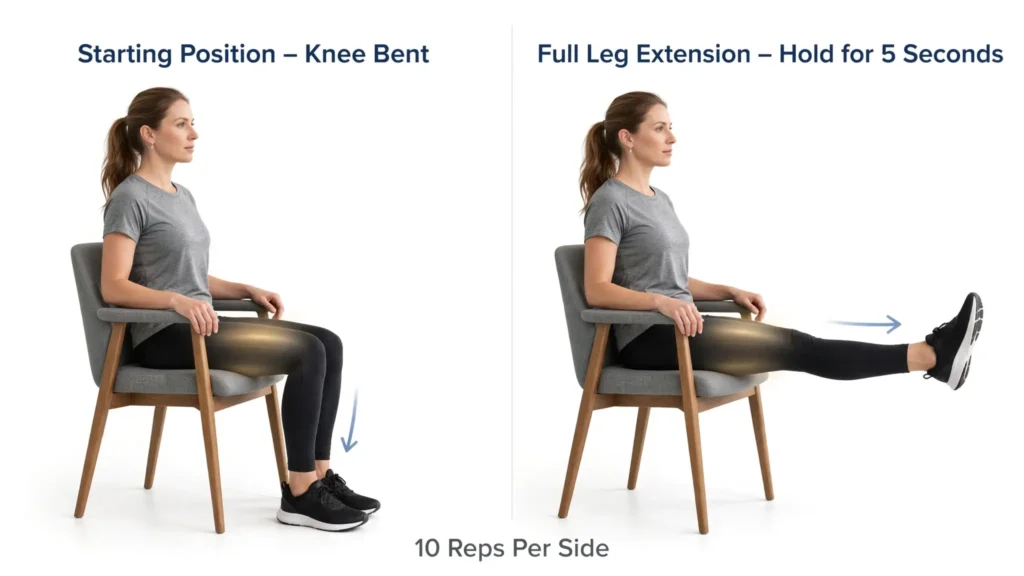
Sitting tall, straighten one leg out in front of you until it’s fully extended, hold for 5 seconds, then lower slowly. Do 10 reps per side. This directly re-activates the quadriceps, which is exactly what stops firing when you sit still for too long.
2. Seated Marches
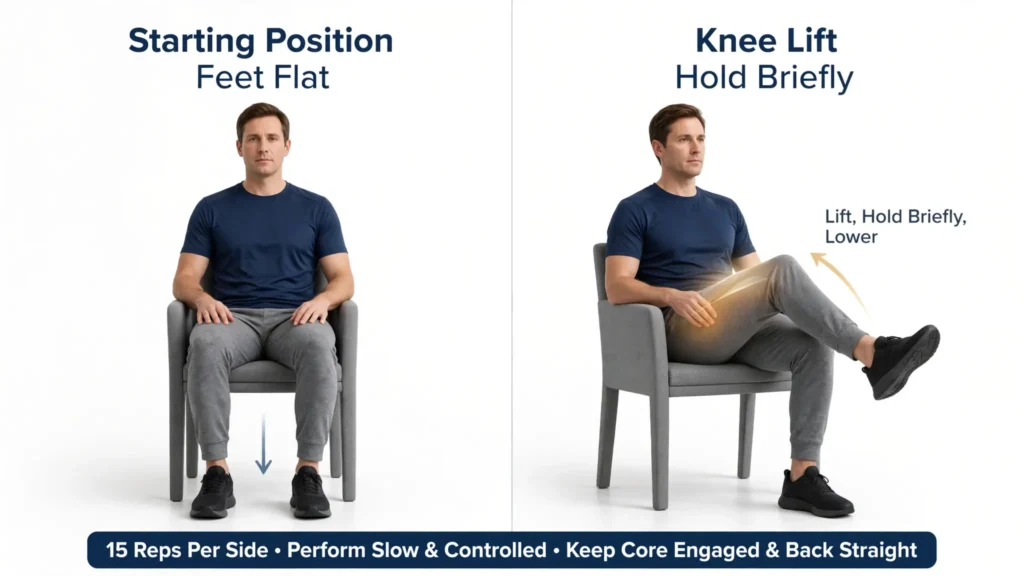
Lift one knee toward your chest, hold briefly, then lower and switch legs, as if marching in place while seated. Repeat 15 times per side. It gets blood moving through the joint without needing to stand up at all.
3. Ankle Pumps and Circles
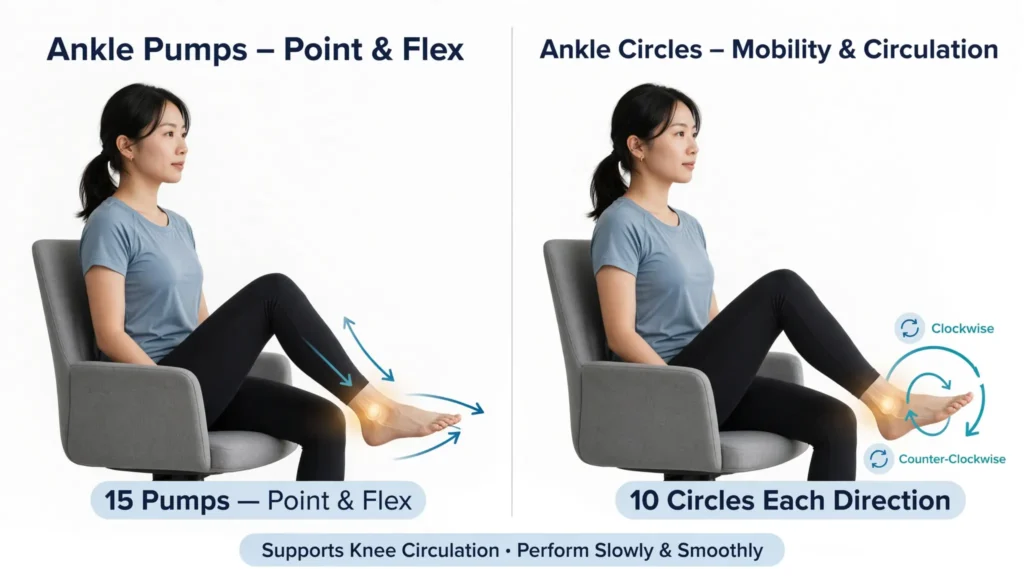
Point your toes away, then flex them back toward you, 15 times, followed by 10 slow ankle circles each direction. It sounds too small to matter, but ankle movement supports circulation all the way up through the knee, which matters more than it gets credit for.
4. Standing Quad Stretch (Chair-Assisted)
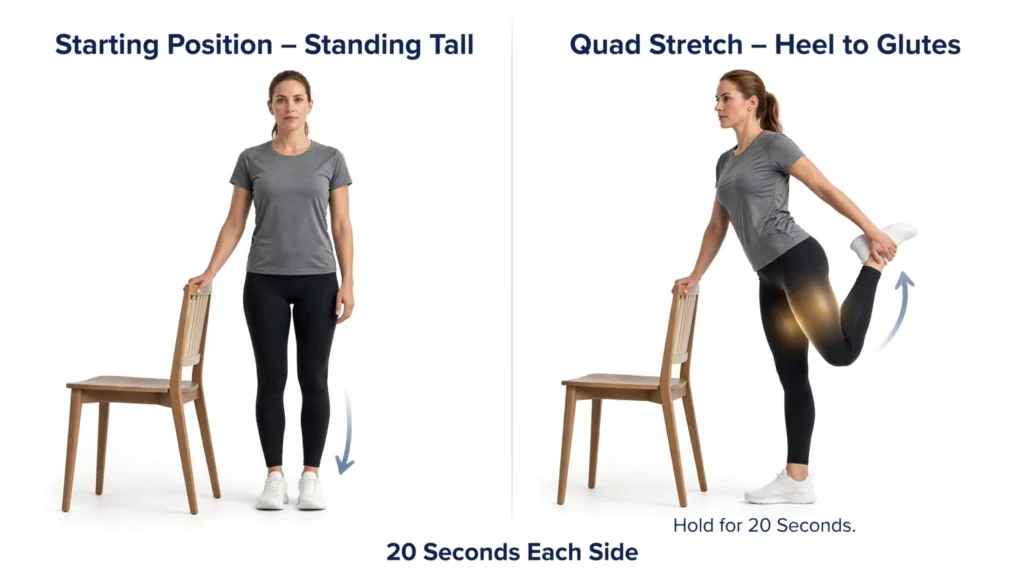
Stand, hold the chair for balance, and gently pull one heel toward your glutes, keeping your knees close together. Hold for 20 seconds each side. This releases the quadriceps and reduces pressure built up against the kneecap from hours of sitting.
5. Standing Hamstring Reach
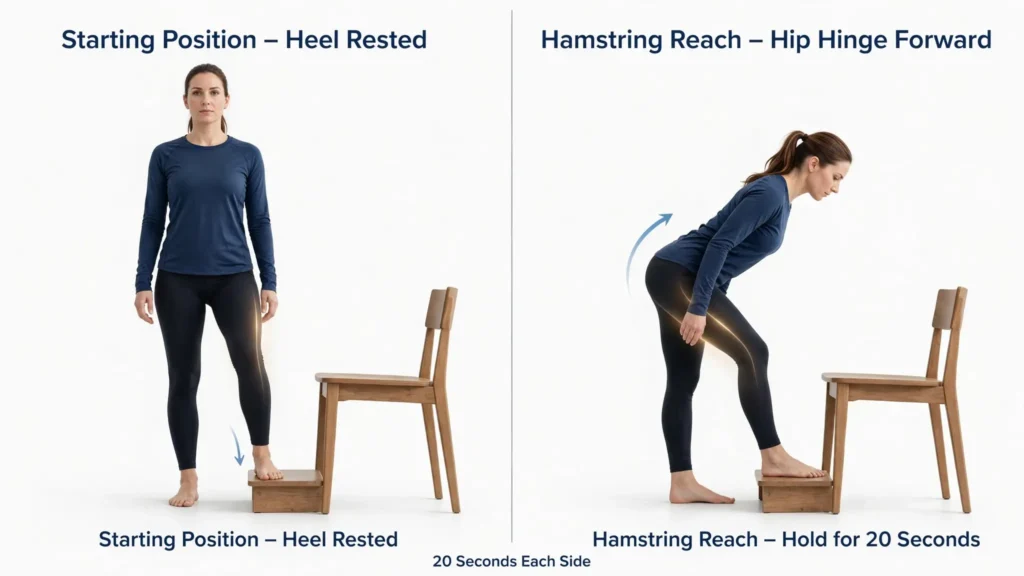
Rest one heel on a low surface or the floor with the leg straight, and gently hinge forward from the hips. Hold for 20 seconds each side. It counters the hamstring shortening that builds up gradually behind the knee throughout a sitting-heavy day.
“The real shift wasn’t the stretching itself — it was getting circulation moving every 30 minutes instead of once a day. The knee responded to frequency, not intensity.”
Quick Reference: The Routine at a Glance
| Exercise | Duration | Best Time |
| Seated leg extensions | 2 min | Every 30–60 min |
| Seated marches | 1–2 min | Mid-morning |
| Ankle pumps/circles | 1 min | Any seated break |
| Standing quad stretch | 1 min | Standing moments |
| Standing hamstring reach | 1 min | Before standing meetings |
Building It Into an 8-Hour Workday
The 30-Minute Standing Rule
A short timer every 30 minutes turned out to matter more for knees specifically than the 60–90 minute intervals that work for other desk-related aches. Patellofemoral pressure builds the longer the knee stays static, so shorter, more frequent breaks made a measurable difference within the first week.
In practice, Sana kept it simple: the timer buzzed, she did seated marches for a minute without leaving her desk, and carried on typing. No one around her noticed most of the time, which is exactly why it survived past the first week rather than fading out like most good intentions do.
Chair Height and Footrest Fixes
Getting the chair height right so knees sit roughly level with hips, with feet flat on the floor or a footrest, reduced the baseline pressure before any exercise even came into it. Posture plays a supporting role here too — the same upright, well-aligned sitting position that protects the spine also keeps weight distributed evenly through the hips and knees instead of concentrated at one joint.
Sana’s chair had been set slightly too low for months, which meant her knees sat higher than her hips and took on more load than they needed to every single time she leaned forward to type. A five-minute adjustment fixed something that stretching alone had never quite resolved.
What Changed Once It Became Automatic
By the second week, Sana wasn’t consciously deciding to do the routine anymore — the timer went off, she moved, and carried on with her day. That’s really the sign a habit like this is going to last: not whether it feels significant in the moment, but whether it survives a genuinely busy week without needing willpower.
Mistakes That Made It Worse Before It Got Better
A few habits actively worked against progress early on, and they’re easy to fall into without realising it, especially once you’re motivated to fix the pain quickly and start doing everything at once.
Crossing Legs Out of Habit
Sana crossed her legs almost automatically while working, without noticing she was doing it. Crossing the legs twists the knee joint and compresses circulation further, which quietly undid a lot of the benefit from the exercises themselves. Switching sides regularly, or keeping both feet flat, made a real difference once she started paying attention to it. It took genuine effort at first — the habit was years old by that point — but a sticky note on the monitor as a reminder was enough to break it within a couple of weeks.
Skipping Warm-Up Before Standing Up
Jumping straight up from hours of sitting, without any brief movement first, was often when the sharpest stiffness showed up. A few seated marches or ankle pumps before standing gave the joint a chance to adjust gradually instead of all at once.
Treating It as a One-Time Fix Instead of a Daily Habit
The biggest early mistake was doing the routine intensively for a few days, feeling better, and then letting it slide. Knee pain from sitting responds to consistency over time, not a short burst of effort. Staying generally active outside of work matters here too — something covered in more depth around why consistent activity protects joints as we get older, which applies just as much to desk-related knee pain as it does to ageing joints generally.
When Desk Exercises Aren’t Enough
Desk exercises help manage day-to-day stiffness and discomfort, but they’re not a substitute for a proper assessment. It’s worth speaking to a GP or physiotherapist if any of the following apply:
- Swelling that doesn’t reduce with rest or movement
- A locking, catching, or grinding sensation in the joint
- Pain that wakes you up at night
- Any visible instability or the knee giving way
“The point where Sana finally booked a physio appointment wasn’t when the pain was worst — it was when she noticed her knee had started clicking on the stairs. That’s usually the real signal to get it looked at properly, rather than something to keep managing alone.”
What Changed After a Few Consistent Weeks
By week three, Sana’s mid-afternoon stiffness had gone from an almost daily struggle to something she barely thought about most days. Standing up from her desk stopped looking like the slow, careful process it used to be.
Neither of us treated this as a cure. It’s a management routine — realistic enough to actually get done during a normal working day, which is the part most generic knee-pain advice online tends to skip entirely.
The clearest marker of progress wasn’t the pain scale, it was Sana walking normally to the meeting room without the pause-and-brace routine that used to happen every single afternoon. Small, unremarkable, and exactly the kind of change that’s easy to overlook until you notice it’s been missing for a week.
FAQs
Can desk exercises fix knee pain from sitting all day?
For mild, sitting-related stiffness, consistent desk exercises can meaningfully reduce daily discomfort. Persistent or worsening pain still needs a professional assessment.
How often should I do knee exercises at my desk?
Aim for a short movement every 30 minutes, since knee pressure from sitting builds faster than most other desk-related aches.
What is the fastest desk exercise for knee pain relief?
Seated leg extensions give the quickest relief by re-activating the quadriceps that support and stabilise the kneecap.
Does crossing your legs make knee pain worse?
Yes. Crossing the legs twists the knee joint and restricts circulation, which can add to stiffness from prolonged sitting.
When should knee pain from sitting be checked by a doctor?
See a doctor if there’s persistent swelling, locking or catching in the joint, night pain, or any sense of the knee giving way.
Final Thoughts
None of these require a gym membership or a weekly appointment with a specialist. A few brief, timely desk exercises for knee pain really made a difference for anyone who sits near me every day — and if your knees are starting to feel like a big person by mid-afternoon, it can definitely be a try.
If you take one thing away from it, think of it as a matter of timing, not just one workout: short and repetitive, stretched out into hours of sitting, which actually prevents the stress that builds up in the beginning. Start with just sitting leg stretches and marches, make the timer habit, then add the rest like another task when it feels automatic, instead of having another task on your list.
Knees are rarely the only joint a desk job takes a toll on. If heel pain tends to flare up too, desk exercises for plantar fasciitis runs on the same hourly-movement principle. And for anyone dealing with shooting pain down the leg instead, desk exercises for sciatica pain is built around the exact same approach.
This article is for general information only and is not a substitute for professional medical advice. Please consult a doctor or physiotherapist for persistent or worsening knee pain.

2 thoughts on “Desk Exercises for Knee Pain That Actually Worked”