QUICK SUMMARY
Sitting is one of the worst positions for sciatic nerve pain, because it compresses the nerve right where the piriformis muscle sits. A short set of desk exercises for sciatica pain, done every 30–60 minutes, made a bigger difference than any single long stretching session ever did. The five-move routine below takes under ten minutes a day and needs nothing but a chair.
Introduction

I first felt this with Imran, a friend with whom I used to do carpooling. Around the third month of his new desk job, he began to move in his seat constantly, then stood up during the call because sitting had become unbearable. He described it as a burning, sharp pain that went straight from the lower part of his waist to the back of one leg, occasionally reaching his calf. It’s classic sciatica, and watching him try to spend a normal workday with it took me into a real research pit. What I really wanted were desk exercises for sciatica pain that could fit around meetings and full inboxes—not the physiotherapy sheets you have to do while lying on the mat at home. I did the tests for several weeks that made sense with it, and some of them really made a significant difference. Here’s exactly what we got.
Table of Contents
What Sciatica Actually Feels Like at a Desk
The Shooting Pain Down One Leg
The sciatic nerve is the longest nerve in the body, running from the lower back through the hip and glute, down the back of each leg. When it’s compressed or irritated, the pain doesn’t stay in the back — it travels. Imran’s version showed up as a sharp, electric feeling behind his knee by mid-afternoon, which is textbook for how this condition presents.
It’s usually one-sided, and it often gets worse with prolonged sitting, coughing, or bending forward — all things that are hard to avoid entirely in an office job.
What made Imran’s case easy to overlook at first was how ordinary it looked from the outside. He hadn’t lifted anything heavy, hadn’t had an accident, and wasn’t particularly unfit. He was simply sitting through long, uninterrupted stretches of desk work, which turns out to be one of the most common and most under-discussed triggers for sciatic nerve irritation in people who otherwise think of themselves as healthy.
Why Sitting Is the Worst Position for the Sciatic Nerve
This part genuinely surprised me. Sitting puts more pressure through the lower spine and discs than standing does, and it also shortens the piriformis muscle, a small deep muscle in the glute that sits directly over the sciatic nerve in many people. When that muscle tightens from hours of sitting, it can press on the nerve and trigger exactly the pain Imran was describing.
Healthy nerve function also depends on nutrients that support muscle relaxation and nerve signalling, magnesium being one of the more overlooked ones. I’ve covered magnesium-rich foods that support muscle and nerve function in more detail separately, and it’s a sensible pairing alongside any stretching routine.
Why I Went Looking for Desk-Specific Relief
The Meeting That Changed How I Saw It
There was one specific afternoon that made this feel urgent rather than just uncomfortable. Imran was mid-presentation, stood up to point at the screen, and visibly winced hard enough that two colleagues asked if he was okay. He brushed it off in the moment, but afterwards admitted the pain had been building for weeks and he’d been quietly rearranging his whole day around it — taking the long way to the printer, avoiding the low chairs in the meeting room, anything to reduce how much sitting he had to do. He’d also started skipping the second half of his lunch walk, worried that too much movement in one go would set it off again, which if anything seemed to be making the stiffness worse by the time he sat back down.
That’s what pushed us to actually build a routine instead of hoping it would settle on its own. I’d already learned, while rethinking how I fit movement into an office routine, that small and frequent beats occasional and intense. Sciatica turned out to respond to exactly the same logic.
The Desk Routine That Actually Helped
These five moves became the routine Imran actually stuck with. Each one works from a seated or standing-at-the-desk position, takes under two minutes, and doesn’t require changing clothes or finding a private room.
1. Seated Figure-4 Piriformis Stretch

Sitting upright, cross one ankle over the opposite knee to form a figure 4 shape, then gently lean forward from the hips. Hold for 20–30 seconds each side. This directly targets the piriformis muscle, which is one of the most common sources of sciatic nerve compression from sitting.
2. Seated Spinal Twist

Sit tall, place one hand on the back of the chair, and gently rotate your torso toward it. Hold for 20 seconds, then switch sides. This relieves pressure through the lower spine and keeps the discs mobile during long sitting stretches.
3. Nerve Glide (Seated Sciatic Flossing)
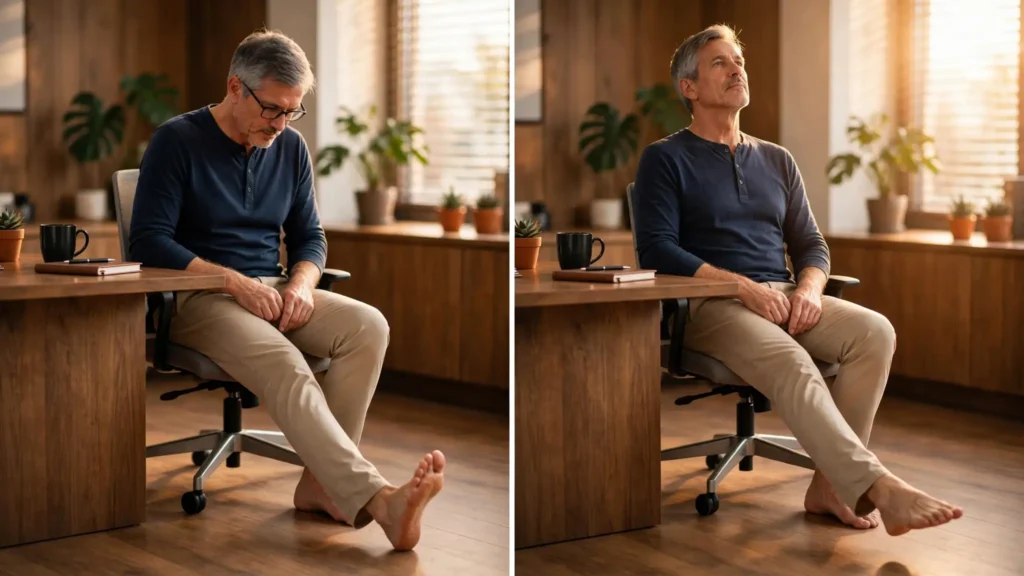
Sit with one leg extended, then slowly flex and point your foot while gently moving your head down and up. This is a gentle nerve mobilisation, not a stretch — the goal is movement, not tension, so it should never feel sharp or painful.
4. Glute Bridge Break (Standing-Assisted)

Stand, hold the back of your chair for balance, and squeeze your glutes while gently pushing your hips forward. Hold for 5 seconds, repeat 10 times. A stronger glute reduces how much load the lower back and piriformis take on during a normal seated day.
5. Pelvic Tilts Between Calls

Sitting upright, gently tilt your pelvis forward to arch your lower back slightly, then backward to flatten it. Repeat 10–15 times. It keeps the spine actively supported rather than locked into one static position for hours.
“The real shift wasn’t any single stretch — it was doing something small every 30 to 60 minutes instead of one long session once a day. Frequency mattered more than intensity, every time.”
Quick Reference: The Routine at a Glance
| Exercise | Duration | Best Time |
| Seated figure-4 stretch | 1–2 min | Every 60 min |
| Seated spinal twist | 1 min | Mid-morning |
| Nerve glide | 2 min | Any seated break |
| Glute bridge break | 1 min | Standing moments |
| Pelvic tilts | 1 min | Between calls |
Building It Into an 8-Hour Workday
The 30–60 Minute Movement Rule
A quiet phone timer every 30–60 minutes was what made this routine actually happen, rather than staying a good intention. That’s a tighter interval than most general stretching advice, but sciatica responds well to shorter, more frequent breaks from sitting than most other desk-related aches do.
In practice, Imran kept it deliberately low-key: the timer buzzed, he did a seated figure-4 stretch without leaving his chair, then carried on typing. No one around him noticed most of the time, which mattered, because a routine that draws attention in an open-plan office rarely survives past the first awkward week.
Fixing the Chair Before Fixing the Muscles
No amount of stretching fully offsets a chair that’s actively causing the problem. Getting the seat height right so knees sit level with hips, and making sure the lower back is actually supported rather than just resting against a flat panel, made a bigger baseline difference than we expected. Posture work generally supports this too — the same upright alignment that reduces strain through the spine also takes pressure off the sciatic nerve over a full working day.
A rolled-up jumper wedged behind the lower back worked as a temporary fix before Imran got a proper lumbar cushion sorted. It’s not elegant, but it’s the kind of small, immediate adjustment that buys relief while the bigger fixes — a better chair, a standing option, consistent stretching — have time to actually take effect.
What Changed Once Consistency Became the Habit
By the second week, Imran wasn’t thinking about the routine as much — the timer would go off, he’d do the movement without breaking focus, and move on. That’s really the marker of whether a routine like this survives: not whether it feels significant, but whether it becomes automatic enough to outlast a genuinely busy week.
Mistakes That Made It Worse Before It Got Better
None of this went smoothly from day one. A few habits actively slowed things down before we figured out what was going wrong, and they’re easy mistakes to make without realising it, especially when you’re motivated to fix the pain quickly.
Stretching Through Sharp Pain
Imran’s first instinct was to push each stretch a little further whenever it felt tight, assuming more intensity meant more progress. With nerve-related pain specifically, that’s the opposite of helpful — any sharp, shooting, or electric sensation is a signal to ease off immediately, not push through. A gentle pulling feeling in the muscle is normal; anything that reproduces the shooting leg pain itself is a sign to back off and try again more gently, or skip that particular move for the day.
Ignoring Form on the Basics
Rushing through the glute bridge and pelvic tilts without proper control reduced how effective they were and occasionally aggravated things further. Form matters just as much in small seated movements as it does in a full gym session — something that came up clearly while writing about how poor form quietly causes lower back problems, which applies just as directly here.
Only Moving Once a Day Instead of Often
A single longer stretching session before bed felt productive, but it did far less than shorter, more frequent movement spread across the actual sitting hours. Frequency during the sitting itself is what interrupts the compression pattern, not stretching afterwards.
When Desk Exercises Aren’t Enough
Desk exercises help manage day-to-day discomfort, but sciatica always deserves a proper assessment if it’s ongoing. It’s worth speaking to a GP or physiotherapist if any of the following apply:
- Pain that keeps worsening despite several weeks of consistent movement
- Numbness, tingling, or weakness spreading further down the leg
- Pain severe enough to disrupt sleep or daily walking
Important: sudden numbness around the inner thighs or groin, or any new difficulty controlling the bladder or bowel alongside back and leg pain, needs same-day medical attention. This combination, though rare, can signal a serious nerve emergency and should never wait for a routine appointment.
Being aware of activity’s role here matters too — something I explored in more depth around why staying active protects against back and joint pain later in life, which lines up closely with what a physiotherapist would tell you about sciatica as well.
What Changed After a Few Consistent Weeks
By week three, Imran’s shooting pain had gone from an almost hourly interruption to something he barely noticed most days. It didn’t disappear entirely, and we never expected it to from stretching alone, but the difference between a genuinely bad flare-up and a manageable working day became clear and consistent.
Neither of us treated this as a fix. It’s a management routine — low-effort enough to actually survive a real workday, which is the part most generic sciatica advice online seems to overlook.
The clearest sign of progress, oddly, wasn’t the pain itself — it was watching Imran sit through a full hour-long meeting without shifting or standing up halfway through. That’s the kind of small, unremarkable change that’s easy to miss day to day, but it’s exactly the outcome this routine was built around.
FAQs
Can sciatica be relieved with desk exercises alone?
For mild to moderate cases, consistent desk exercises can meaningfully reduce daily discomfort. Persistent or worsening pain still needs a professional assessment.
How often should I do sciatica stretches while sitting?
Aim for a short movement every 30–60 minutes throughout the day, rather than one long session at the end of it.
What is the fastest desk exercise for sciatica relief?
The seated figure-4 piriformis stretch tends to give the quickest relief, since tight piriformis muscles are a leading cause of sciatic compression while sitting.
Can sitting all day make sciatica worse?
Yes. Sitting increases pressure on the lower spine and shortens the piriformis muscle, both of which can compress the sciatic nerve further.
When should sciatica pain be checked by a doctor urgently?
Seek same-day medical attention for sudden bladder or bowel changes, saddle-area numbness, or rapidly worsening leg weakness.
Final Thoughts
None of these require a gym membership or a daily physiotherapy appointment. A few short, timely desk exercises for sciatica pain really made a difference for the person I watched go through it week after week — and if that sharp pain in the leg has become familiar to you, it’s beneficial to incorporate it into your workday.
If you take one thing from it, make it a matter of timing, not a single stretch: Short and repetitive, stretched over the hours of sitting, is what actually breaks the pain pattern. Start with just one or two moves from the above routine, build the habit around a timer rather than willpower, and add the rest when the first few movements feel automatic.
Sciatica is rarely the only thing a desk job aggravates. If heel pain tends to show up alongside it, desk exercises for plantar fasciitis follows the same hourly-movement principle. And for anyone whose knees stiffen up by mid-afternoon instead, desk exercises for knee pain is built around the exact same logic.
This article is for general information only and is not a substitute for professional medical advice. Please consult a doctor or physiotherapist for persistent or worsening sciatica symptoms.

2 thoughts on “Desk Exercises for Sciatica Pain That Finally Helped”