THE SIMPLE ANSWER
Yes, you can eat orange after eating fish, and there’s no scientific evidence the combination is harmful. The warning I grew up hearing from Uncle Rashid traces back to a specific 1980s laboratory study involving conditions no normal meal ever recreates, and the actual nutrition shows the pairing may even be beneficial.
Introduction
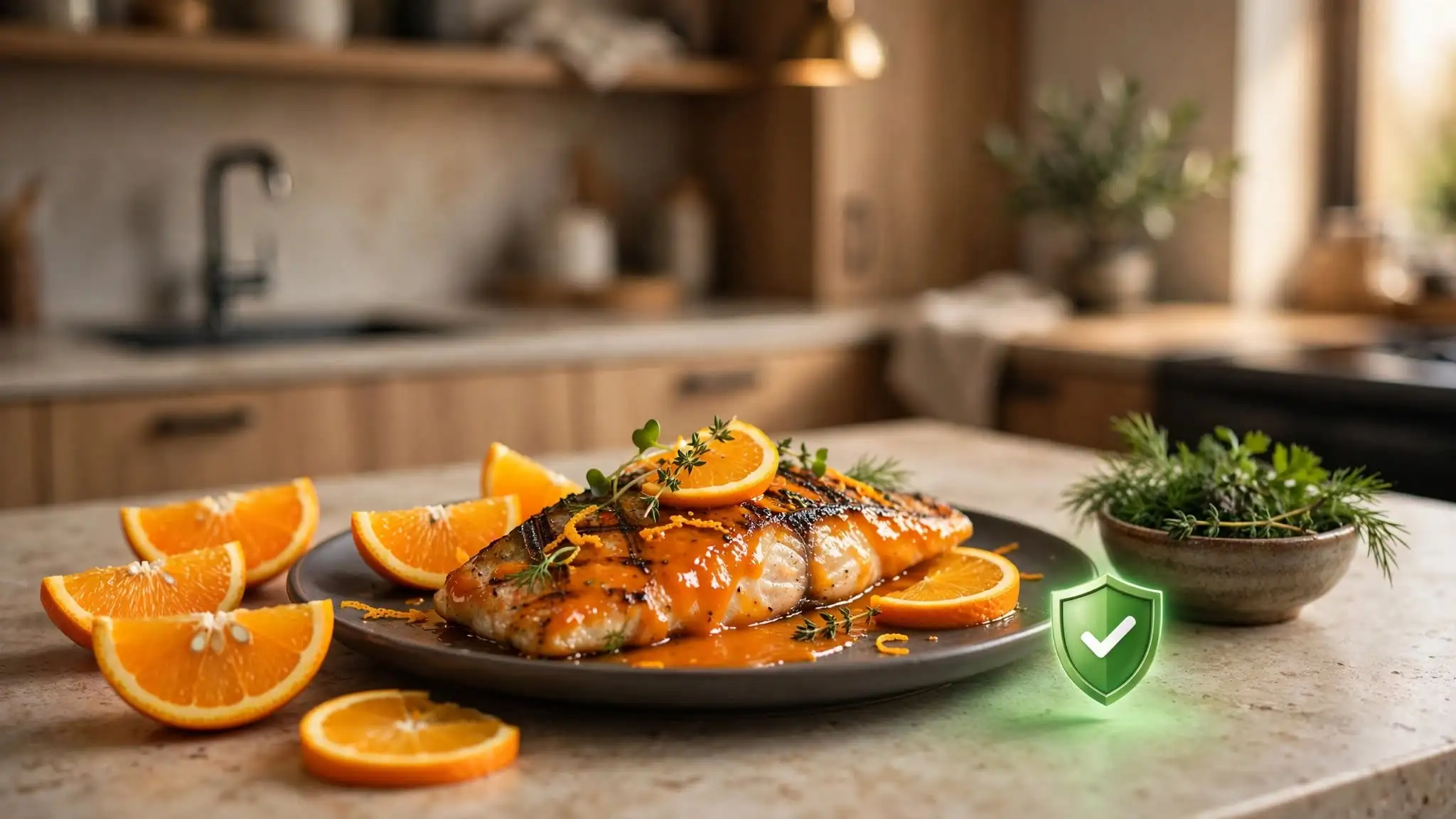
I was eight or nine years old, trying to get an orange from a bowl of fruit immediately after eating fish, when Uncle Rasheed’s hand caught me before I could reach it. He was not a blood relative, just a family friend whom everyone always called Uncle, and his domestic principles were never questioned. “Not after the fish,” he said. There was no explanation. There was no expectation. I preserved it as children hide rules from trusted adults, and for the next twenty years lived with it without question, never once wondering whether you could actually eat orange after eating fish, or if I had adopted a rule that no one had ever tried. When I finally researched it thoroughly, the answer to can you eat orange after eating fish turned out to be one of the more interesting food-myth stories I’ve come across.
Table of Contents
The Rule Uncle Rashid Delivered Without Explanation
In our household, the rule was never framed as a suggestion. It was stated as fact, the same tone used for “wash your hands before eating.” Not after fish. No qualifier, no explanation, no room for exceptions. The authority behind it came from the weight of it being repeated by someone older and trusted, not from any source either of us could have named, and that was enough for a child to accept it completely without ever thinking to push back.
It sat alongside a wider set of food-combining beliefs that existed in our house without much scrutiny. Certain fruits after certain proteins. Milk after fish. Cold water after fatty food. None of it had ever come from a doctor, but it carried the texture of medical knowledge simply because it had been repeated with such confidence for so long, by people who clearly believed it themselves and had no reason, as far as I could tell, to make any of it up.
Where the Warning Came From — And Why It Felt So Unquestionable
This pattern isn’t unique to one household or culture. Confidently transmitted food rules with no scientific grounding show up across South Asian, East Asian, Middle Eastern, and Mediterranean cooking traditions, usually rooted in some genuine observation even when the specific claim doesn’t hold up. It’s the same pattern I found while looking into a completely different inherited food fear, on whether guava seeds are actually dangerous to swallow, which turned out to carry far less basis than the certainty it was delivered with.
Can You Eat Orange After Eating Fish? What the Science Actually Says

The answer, before the explanation: there is no scientific evidence that eating an orange after fish is harmful. The Environmental Literacy Council states plainly that the notion is a widespread myth with no scientific basis. Multiple food scientists and dietitians confirm there’s no known biochemical mechanism by which eating orange after properly cooked fish causes toxicity or digestive harm in healthy people.
The combination isn’t just harmless, either. It’s actively celebrated across culinary traditions. Fish with citrus sauce, lemon-cured salmon, orange-and-ginger fish dishes, these exist in French, Mediterranean, Japanese, and South American cuisine because fish and citrus taste genuinely excellent together. If the combination were harmful, these traditions wouldn’t have survived intact for generations.
Where the Specific Fear Originated — The 1980s Arsenic Study
The most traceable origin is a study from the 1980s. Researchers found that very high doses of vitamin C could theoretically convert arsenic pentoxide, a relatively harmless arsenic compound found in some shellfish, into arsenic trioxide, a considerably more toxic form. That finding was real, and it was published, and over the following decades it travelled through popular culture in a dramatically simplified form until it became the blanket warning so many of us grew up hearing without any of the original context attached.
But it involved three specific conditions that rarely, if ever, align in normal eating: megadoses of vitamin C far beyond a single orange’s roughly 70mg, often many times higher through supplementation; shellfish with abnormally high arsenic content rather than the salmon, mackerel, or white fish most people actually eat on a regular basis; and controlled laboratory conditions rather than the variable environment of a full, normal human meal. The leap from “megadose vitamin C plus high-arsenic shellfish under lab conditions” to “never eat orange after any fish” is a cultural extrapolation, not a scientific conclusion. The warning wasn’t invented from nothing, but it was stretched far beyond anything the original research actually justified.
The Ceviche Argument — Two Thousand Years of Evidence
Sometimes the best evidence against a food myth is culinary history rather than a laboratory. Ceviche, raw fish marinated in citrus juice, has been eaten across South America for over 2,000 years, a cornerstone of the diet in Peru, Ecuador, and Mexico specifically. If citrus and fish caused consistent, meaningful harm, populations eating this way across generations would have noticed and adjusted long before anyone published a study about it. The absence of harm isn’t proof of benefit on its own, but it’s genuinely strong evidence against the myth. It’s a similar tension to one I found researching a completely different topic, on the specific disease claims made about pomegranate, where tradition often gets the broad direction right even when the exact mechanism people cite for it turns out to be wrong.
What Actually Happens Nutritionally When You Eat Orange and Fish Together
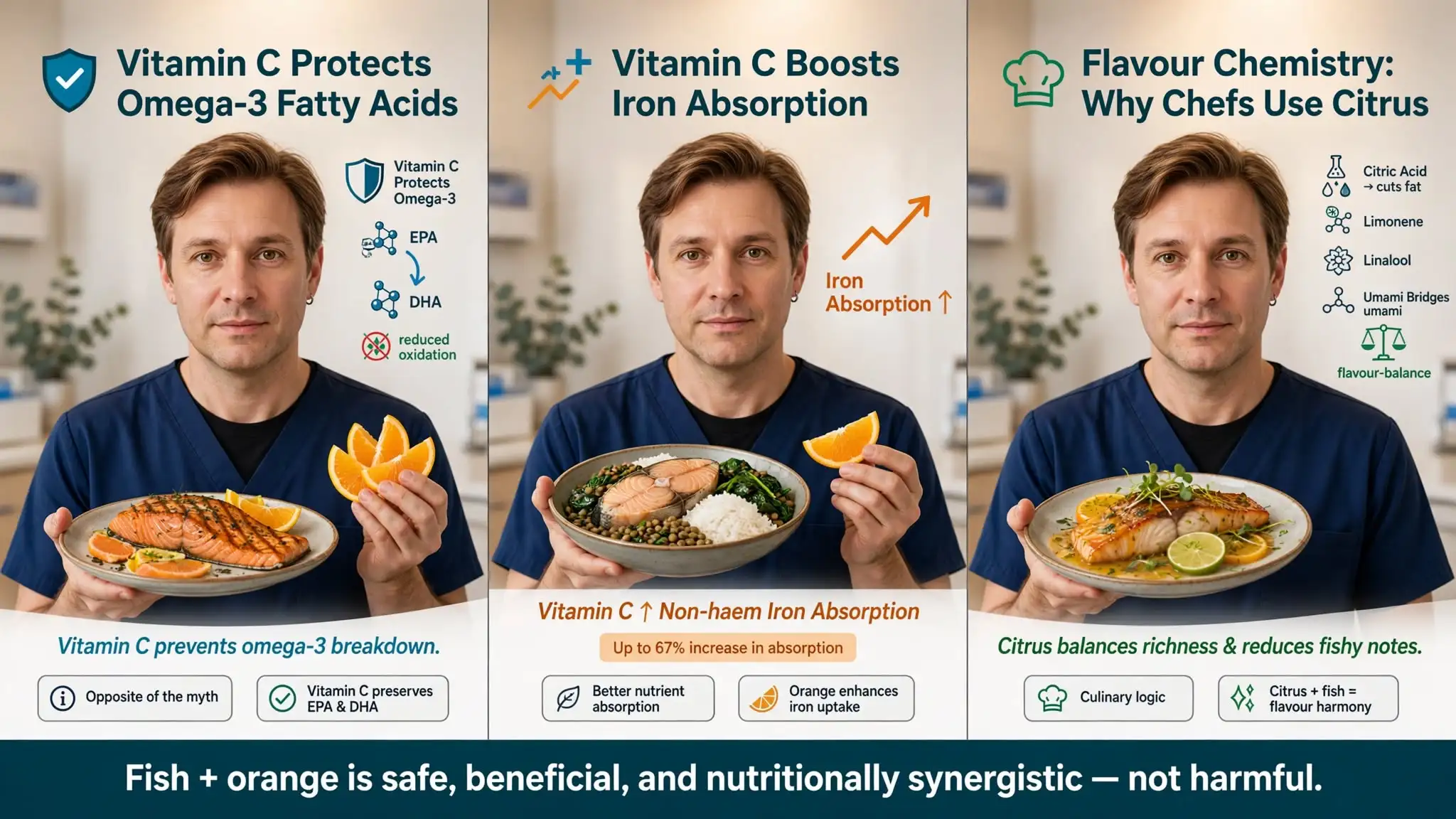
Here’s where it gets genuinely surprising. The nutritional picture doesn’t just clear the combination of any wrongdoing, it suggests the pairing may be actively beneficial, working in a direction almost exactly opposite to what the myth claims.
Vitamin C Protects Omega-3 Fatty Acids From Oxidation
Fish, particularly oily fish like salmon, mackerel, sardines, and trout, is one of the richest dietary sources of omega-3 fatty acids, specifically EPA and DHA. These are polyunsaturated fats, which makes them inherently susceptible to oxidative damage both before and during digestion, and oxidation reduces both their bioavailability and their anti-inflammatory benefit. Vitamin C is one of the most potent dietary antioxidants known, and research confirms it can protect omega-3s from oxidative breakdown during absorption and metabolism, potentially preserving more of their cardiovascular and anti-inflammatory benefit than would otherwise survive digestion intact.
THE COMBINATION DOES THE OPPOSITE OF WHAT THE MYTH CLAIMS
Rather than harming your digestion of fish, the vitamin C in an orange may actively protect the omega-3 fatty acids in the fish from oxidative damage during absorption. The nutritional interaction is potentially beneficial, not dangerous — about as far from the original myth as it’s possible to get.
Vitamin C Dramatically Boosts Iron Absorption From the Whole Meal
Fish contains haem iron, which the body absorbs efficiently regardless of what else is eaten. But a fish meal rarely arrives alone, and the sides, rice, lentils, spinach, contain non-haem iron, far less bioavailable without help. Vitamin C is the most potent dietary enhancer of non-haem iron absorption, and one study found 100mg alongside an iron-rich meal increased absorption by 67 percent. A medium orange provides roughly 70mg. This is the same mechanism I came across researching a completely different food, on whether pomegranate’s vitamin C content explains its effect on blood health, where the same iron-absorption principle does most of the work.
The Flavour Science — Why Chefs Have Always Known This
The pairing of citrus and fish isn’t just culturally widespread, it’s chemically logical too. Citric acid cuts through the fat in oily fish, balancing richness and reducing the intensity of the fishy flavour compounds some people find overpowering. Aromatic compounds in orange, like limonene and linalool, create complementary flavour bridges with the umami compounds naturally present in fish. Professional chefs haven’t been quietly ignoring a dangerous myth for generations while serving citrus-glazed fish on their menus. They’ve simply been following what actually happens on the palate, which turns out to line up with the underlying chemistry rather than against it.
What Uncle Rashid Said When I Finally Asked Him About It
I brought the research back to Rashid directly rather than just quietly changing my own habit and leaving it at that. He listened carefully, the way he always had when I was younger, and asked a few genuinely good questions about the arsenic study specifically, wanting to understand the actual mechanism rather than just accepting that I’d looked into it. “I never actually knew why,” he admitted eventually. “I just knew it was the rule.” That admission stuck with me more than the research itself did, if I’m honest. The rule had persisted for decades not because anyone had evidence for it, but because nobody in the chain of people repeating it had ever thought to ask where it came from.
I don’t think that makes Rashid wrong to have caught my hand all those years ago. He was passing on the best information available to him at the time, filtered through his own upbringing and whatever he’d been told as a child, and the intention behind it, protecting someone he cared about from something that might cause harm, was correct even where the specific instruction wasn’t. Updating the information doesn’t require dismissing the intention behind it, and I was careful to make that distinction clear when we talked.
Should Anyone Be Genuinely Cautious About This Combination?
A few genuine scenarios are worth naming honestly, rather than waving away every concern entirely just because the main myth doesn’t hold up. People eating very large amounts of high-arsenic shellfish alongside megadose vitamin C supplements remain in the original study’s theoretical territory, though this describes essentially no normal meal anyone actually eats. People with GERD or citrus sensitivity may react to the acidity of oranges specifically, a concern about the oesophagus rather than any interaction with fish at all, and one I’ve gone into in more depth separately when looking at whether certain fruits genuinely worsen digestive issues for sensitive people. People with fish allergies should avoid fish itself for entirely separate reasons, with the orange being completely irrelevant to that particular concern. And for everyone else, the overwhelming majority of people asking this question, there’s no evidence-based reason to avoid the combination at all.
Timing relative to sleep is a more relevant variable than timing relative to fish, something I’ve explored separately in a piece on eating oranges at night. And for the fuller picture of which foods genuinely earn their place in a health-conscious diet, both orange and fish feature among the foods worth actively building a routine around.
What I Do Now — And What I’ve Told My Own Circle
I eat orange after fish without a second thought now, occasionally with deliberate intention, since the brightness of citrus after a rich fish meal is genuinely one of the better parts of the meal. I mentioned the research to Rashid, and separately to a few others in my circle who’d grown up with the same rule. Nobody made a dramatic announcement about changing their mind. The next time I had dinner at Rashid’s, there was a bowl of orange segments on the table afterwards. Neither of us mentioned it. It didn’t need mentioning.
That’s how inherited food wisdom tends to update at its best, not through confrontation, but through quiet revision once better information is actually available.
My Honest Final Answer — Can You Eat Orange After Eating Fish?
Yes, without hesitation. The study of arsenic from the 1980s is a fact, but it describes a specific laboratory scenario involving high amounts of vitamin C and shellfish high in arsenic, which no ordinary food reproduces. Two millennia-year cevaches and centuries of sour fish pairings in world cuisine are practical evidence against this misconception. And actual nutrition is quite the opposite: Vitamin C can protect the omega-3s present in fish from oxidation and significantly increase iron absorption from the rest of the food.
The principle that Rashid gave me was not based on malice or negligence. It was an inherited precaution without its actual context, just as food myths usually spread. I’m glad I finally asked the reason, and am glad that Rashid’s meal now ends with a bowl of orange slices that no one feels the need to explain.
Medical Disclaimer:
This article is for informational purposes only and does not constitute medical advice. If you have a diagnosed food allergy, digestive condition, or specific health concern about dietary combinations, please consult a qualified healthcare professional or registered dietitian.
Frequently Asked Questions
Can you eat orange after eating fish?
Yes — this is a widespread food myth with no scientific basis, and there is no biochemical mechanism by which eating orange after properly cooked fish causes harm.
Why do people say you shouldn’t eat orange after fish?
The belief traces to a 1980s study suggesting megadose vitamin C could convert arsenic compounds in shellfish into a more toxic form under lab conditions that don’t apply to a normal meal.
Does eating orange after fish cause food poisoning?
No — food poisoning from fish results from bacteria or improper storage, not from citrus eaten afterwards, and there is no toxic interaction between vitamin C and fish in normal dietary amounts.
What are the nutritional benefits of eating orange after fish?
Vitamin C from orange may protect the omega-3 fatty acids in fish from oxidation and can increase non-haem iron absorption from the rest of the meal by up to 67 percent.
Is the lemon and fish combination also safe?
Yes — lemon, lime, and orange share similar vitamin C and citric acid profiles, and fish with citrus is one of the most universally used pairings in global cuisine, including 2,000 years of ceviche.

4 thoughts on “Can You Eat Orange After Eating Fish?”
Comments are closed.