QUICK SUMMARY
An ankle that keeps giving way weeks after a sprain usually isn’t weak — it’s lost its sense of position, called proprioception. Balance exercises after ankle injury, done in the right order, rebuild that sense far more effectively than strength work alone. The four-phase progression below takes under ten minutes a day and needs nothing more than a wall, a folded towel, and patience with the order.
Introduction

I saw the incident with Bilal, a friend of my five-player football group, about six weeks after he sprained his ankle on his way to a header. The swelling had long since subsided, the wounds had gone, and by every visible indication he appeared to be fully healed. Then, while walking through a perfectly flat car park, his ankle bent to one side without warning. No trips, no uneven terrain, nothing. That moment forced me to consider balance exercises after ankle injury, because it was clear that the deeper problem than swelling or pain had not yet been resolved. I researched the original rehabilitation science, worked with it for several weeks to test its progress, and what we learned changed my perspective on recovery from a joint injury. Here’s exactly what we got.
Table of Contents
Why an Ankle Keeps “Giving Way” Long After the Swelling Goes Down
It’s Not Weakness — It’s Proprioception
When ligaments are sprained, it’s not only the tissue itself that’s damaged. The nerve endings woven through that tissue, responsible for a sense called proprioception, get damaged too. Proprioception is what tells your brain, without you consciously thinking about it, exactly where your ankle is in space and how much it’s tilting on uneven ground.
When that feedback loop is disrupted, your brain reacts slightly too late to correct a wobble. That delay is often the real reason an ankle rolls a second time, sometimes on ground far gentler than whatever caused the original injury.
What made this hard for Bilal to accept at first was how invisible it all was. Nothing showed up on a scan, nothing looked structurally wrong, and by every outward measure his ankle had healed. Proprioceptive deficits don’t show up as swelling or bruising — they show up as a split-second delay in reaction that only reveals itself when the ground genuinely challenges it, which is exactly why so many people assume they’ve fully recovered when they haven’t.
Why Strength Alone Doesn’t Fix It
Bilal had been doing calf raises and resistance band work diligently for weeks, assuming strength was the missing piece. It wasn’t, not on its own. A strong ankle with poor proprioception can still give way, because strength and balance are genuinely different systems. Balance-specific training is where most standard advice quietly falls short, and it’s why balancing exercises show up again and again in posture and stability work — the same neuromuscular control applies well beyond just the ankle joint.
Why I Took Balance Training Seriously
The Moment “Almost Fine” Turned Out to Be a Warning Sign
That car park moment could easily have been dismissed as bad luck. But it happened again two weeks later on a set of stairs, and by then the pattern was too obvious to ignore. Bilal wasn’t reinjuring the ankle through carelessness — the ankle simply couldn’t be trusted to correct itself quickly enough anymore.
It reminded me of something I’d seen before while writing about how poor movement patterns quietly cause injuries over time — the underlying problem is often invisible until it’s specifically tested for. Pain and swelling resolving doesn’t automatically mean full function has returned, and that gap is exactly where a repeat injury tends to happen.
Bilal had, understandably, followed the standard advice: rest, ice, gentle stretching, and a gradual return to walking. All of that is genuinely useful for the tissue itself. What it doesn’t automatically address is the nervous system’s side of the injury — the part responsible for reacting to a wobble before it turns into a full roll. That’s a separate thing to train, deliberately, and it doesn’t happen just from waiting for pain to fade.
The Balance Progression That Actually Rebuilt Stability
This is the exact four-phase progression Bilal worked through, moving to the next phase only once the current one felt genuinely stable, not just tolerable. Rushing the order was the single biggest mistake we corrected along the way. Each phase builds directly on the one before it, and skipping ahead because a phase feels easy after a few days is exactly how the underlying deficit gets missed rather than fixed.
Phase 1 (Days 3–7): Gentle Reawakening
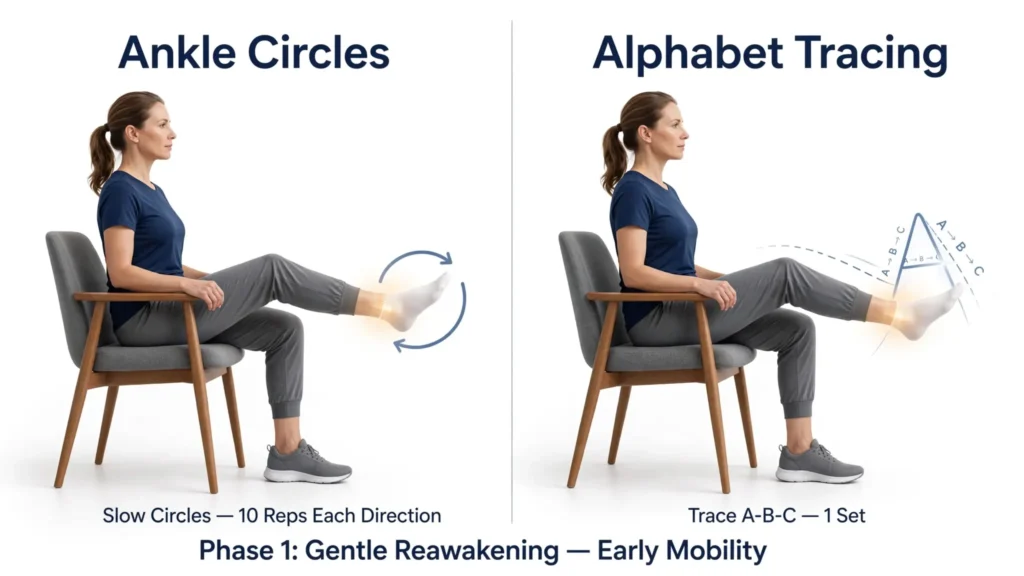
Ankle circles, alphabet tracing with the foot, and towel scrunches with the toes. None of these challenge balance directly — they keep the nerve pathways active and maintain range of motion while the tissue itself is still settling.
Phase 2 (Week 2 Onward): Double-Leg to Single-Leg Standing

Starting with both feet, gradually shift weight until you’re balancing fully on the injured side, holding the wall or a chair for support. Work up to 30 seconds of stable single-leg standing before progressing further. This is often the phase people rush through fastest, simply because standing on one leg doesn’t feel especially demanding — but the 30-second benchmark exists because shorter durations don’t reliably challenge the proprioceptive system enough to rebuild it.
Phase 3: Single-Leg Balance With Eyes Closed

Once single-leg standing feels solid with eyes open, close them. This removes visual compensation, forcing the ankle’s own proprioceptive feedback to do the work instead of your eyes quietly correcting for it.
Phase 4: Unstable Surface Training
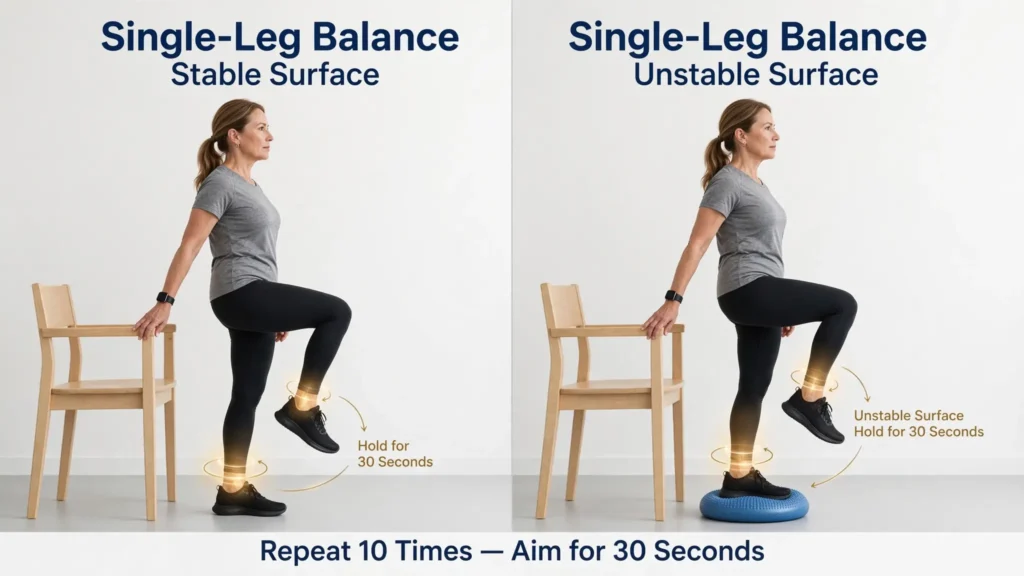
Standing on a folded towel, a pillow, or a wobble cushion adds genuine instability underfoot. This is the phase that most closely mimics real-world surfaces like uneven pavement or grass, which is exactly where re-injuries tend to happen. It’s also the phase where a lot of people notice, for the first time since the injury, a genuinely different quality of stability compared to before — not just less pain, but a foot that reacts to instability the way it used to.
“The real turning point wasn’t any single exercise — it was refusing to move to the next phase until the current one felt boring rather than wobbly. Rushing the order was what had gone wrong the first time round.”
Quick Reference: The Progression at a Glance
| Phase | Focus | Progress When… |
| Phase 1 | Gentle mobility | Pain-free full range of motion |
| Phase 2 | Single-leg standing | 30 sec stable, eyes open |
| Phase 3 | Eyes-closed balance | 30 sec stable, eyes closed |
| Phase 4 | Unstable surface | Confident on towel/cushion |
Building the Routine Into Daily Life
How Often Balance Work Actually Needs to Happen
Short daily sessions, roughly 8–10 minutes, worked far better than longer sessions a few times a week. Proprioception rebuilds through frequent, repeated exposure, not occasional intense effort, which mirrors how balance training tends to work for most joints, not just the ankle.
Bilal fit his sessions in straight after brushing his teeth, mostly because it was already a fixed daily habit he wasn’t going to skip. Attaching the routine to something that already happened reliably every day did more for consistency than any reminder or tracking app could have.
Supporting Recovery Through Diet Too
Reducing inflammation around the healing ligament matters alongside the exercises themselves. I’ve written before about how omega-3s carry a genuine anti-inflammatory benefit worth knowing about, and it’s a sensible addition to a recovery routine rather than something that replaces the balance work.
What Changed Once Confidence on the Ankle Came Back
By week four, Bilal stopped visibly checking the ground before stepping off a curb, something he’d been doing without even realising it since the second rolled ankle. That unconscious hesitation disappearing was the clearest sign the proprioceptive gap had actually closed.
It’s a strange thing to notice in someone else before they notice it in themselves. I pointed it out to him one evening, and he genuinely hadn’t clocked that he’d been doing it — the small pause, the quick glance down, the slightly shortened stride near kerbs and steps. Once it was gone, it was gone completely, rather than fading gradually, which suggests the balance system doesn’t so much improve bit by bit as it does click back into place once it’s had enough consistent input.
Mistakes That Slowed Recovery Down
A few habits actively worked against progress early on, and they’re easy mistakes to make when you’re eager to get back to normal activity and the pain has already settled down.
Rushing Back to Full Activity Too Soon
Bilal returned to five-a-side within three weeks, well before the balance work was anywhere close to finished. That’s exactly when re-injury risk is highest, because pain-free doesn’t mean the proprioceptive deficit has resolved. Football specifically involves sudden direction changes on uneven pitches, which is close to the worst-case test for an ankle that hasn’t finished rebuilding its balance response.
Stopping Once the Pain Was Gone
Pain disappearing felt like a natural stopping point, but it isn’t one. Balance and coordination take considerably longer to rebuild than pain takes to settle, and stopping early is one of the most common reasons ankles stay chronically unstable.
Skipping the Eyes-Closed Progression
It’s tempting to skip straight from single-leg standing to unstable surfaces, missing the eyes-closed step in between. That step specifically trains the ankle’s own feedback system rather than letting vision quietly compensate for it. Staying consistently active in general also supports this kind of recovery — something covered in more depth around why ongoing activity protects joint stability as we get older, which applies just as directly to post-injury recovery as it does to long-term joint health.
When Balance Exercises Aren’t Enough
Balance training supports recovery, but it isn’t a substitute for a proper assessment when something more serious might be going on. It’s worth speaking to a doctor or physiotherapist if any of the following apply:
- Inability to bear weight for more than 48–72 hours after the injury
- Visible deformity or a joint that looks out of place
- Numbness or tingling in the foot
- Repeated giving-way episodes despite consistent balance training
- Swelling that keeps worsening rather than gradually improving
“The point where Bilal finally booked a physio assessment wasn’t the first rolled ankle — it was the second one, on completely flat ground. Repeated instability despite consistent effort is usually the real signal to get it properly assessed.”
What Changed After a Few Consistent Weeks
By week five, Bilal was back on uneven ground — a gravel path he’d been deliberately avoiding — without the ankle giving him any trouble. The difference wasn’t dramatic day to day, but looking back over the full progression, it was unmistakable.
Neither of us treated this as an instant fix. It’s a structured rebuild — slower than most people expect, but far more reliable than jumping straight back into activity and hoping the ankle holds up on its own.
What surprised me most, watching from the outside, was how little of this had to do with pain management at all. By the time we started the eyes-closed phase, Bilal wasn’t in pain and hadn’t been for weeks. The entire second half of his recovery was about a system that doesn’t register as pain, swelling, or stiffness — which is exactly why it’s so easy to assume you’re done recovering long before you actually are.
FAQs
How soon after an ankle injury can you start balance exercises?
Gentle mobility work can typically begin within 3–7 days, with single-leg balance progressing from around week two, depending on injury severity and medical guidance.
Can balance exercises prevent another ankle sprain?
Yes. Restoring proprioception through structured balance training is one of the most effective ways to reduce the risk of repeat ankle sprains.
What is the best beginner balance exercise after an ankle injury?
Single-leg standing with support nearby, working up to 30 seconds, is the standard starting point once gentle mobility work is comfortable.
Why does my ankle still feel unstable even after the pain is gone?
Pain resolves faster than proprioception rebuilds, so an ankle can feel unstable or give way even once swelling and soreness are gone.
When should ankle instability be checked by a doctor?
See a doctor for inability to bear weight past 48–72 hours, visible deformity, numbness, or repeated giving-way episodes despite consistent balance training.
Final Thoughts
None of them require a physiotherapy clinic or specialist equipment. A systematic set of balanced exercises after an ankle injury, done in the right order and given enough time, really made a difference for someone I’ve seen struggle with the same ankle twice—and if your own ankle still can’t be trusted, it’s beneficial to take it seriously.
If you take one thing from it, think of it as a sequence, not a single exercise: proprioception is recreated step by step, and progression usually comes back from the beginning. Give each stage the time it really needs, even if it feels sluggish than you’d like, and treat the work of the closed and unstable surface as non-negotiable, not as extras when the pain is gone.
This article is for general information only and is not a substitute for professional medical advice. Please consult a doctor or physiotherapist before starting rehabilitation exercises after an ankle injury.

1 thought on “Balance Exercises After Ankle Injury: What Helped Most”