The Quick Answer
Yes — ripe mango is safe and genuinely beneficial during pregnancy for most women, in moderation (roughly 200g, or one medium mango, per day). The “mango generates body heat” warning has no clinical basis. The real considerations are natural sugar content, choosing naturally ripened fruit, and rare latex-related sensitivity, all covered below trimester by trimester.
The Worried Email That Started This

A reader wrote to me some time ago, clearly frightened. She was seven weeks pregnant, had just eaten a bowl of fresh mangoes, and her mother-in-law had told her that she had done something dangerous — that mango “generate heat in the body” and could harm the baby.
She was scared and confused, and to be honest, I understood why. During pregnancy, every meal decision feels overwhelming, and one doesn’t need utterly contradictory, unfounded advice that would make them doubt something as ordinary as a bowl of fruit.
That’s why I decided to do proper research on can I eat mango during pregnancy — not based on opinions circulating in WhatsApp groups, but on peer-reviewed studies, NHS dietary guidance, and clinical evidence. What I’ve found is that mangoes aren’t just safe for most women during pregnancy — they can be one of the most nutritionally valuable fruits for pregnant mothers to add to their diet. But as with most pregnancy nutrition questions, the full picture matters: the real benefits, the few real risks that are worth addressing, and several persistent misconceptions that should be properly retired.
I want to explain everything to you every quarter, just as I finally explained it to him.
Table of Contents
What Does Mango Actually Contain? The Nutritional Case for Pregnant Women
The Full Nutrient Profile
Before addressing safety, it’s worth understanding what mango actually brings to the table — because the nutrient profile is genuinely impressive for pregnancy specifically.
One cup of fresh mango (approximately 165g) provides:
- Folate — critical for neural tube development, especially in the first trimester
- Vitamin C — around 67% of the recommended daily intake, supporting immunity and iron absorption
- Vitamin A (as beta-carotene) — essential for fetal eye, skin, and immune system development
- Vitamin B6 — clinically linked to reduced nausea and morning sickness
- Potassium — helps regulate blood pressure and reduces leg cramps
- Magnesium — supports bone formation and healthy nerve function
- Fibre — relieves the constipation that affects so many pregnant women
What the Research Shows
A large study drawing on data from 16,744 women of childbearing age found that those who regularly included mango in their diet scored roughly 16% higher on the Healthy Eating Index than those who didn’t — with notably better intake of folate, fibre, magnesium, vitamin C, and vitamin E. That’s not a trivial finding. It suggests mango isn’t merely safe — it actively contributes to a higher-quality pregnancy diet overall.
When I eventually explained this to the reader who’d emailed me, I made a point of being specific: folate from whole foods like mango works alongside — not instead of — a folic acid supplement. The NHS recommends 400 micrograms of folic acid daily through at least the first 12 weeks of pregnancy. Mango simply adds natural folate on top of that, which only helps.
Can I Eat Mango During Pregnancy? The Direct Answer
Yes — And Here’s Why the “Body Heat” Myth Doesn’t Hold Up
Yes. Ripe mango is safe to eat during pregnancy. Multiple nutrition bodies and clinical studies confirm that consuming approximately one medium mango — around 200g, or one cup diced — per day is a healthy, beneficial choice for most pregnant women. There is no credible medical evidence that moderate mango consumption causes harm to a mother or her developing baby.
The confusion largely traces back to traditional beliefs — particularly the idea that mango “generates body heat” and triggers complications. I looked into this carefully, and there is simply no peer-reviewed evidence supporting that claim. Genuinely thermogenic foods — those that measurably raise metabolic heat — include things like very spicy chillies, large quantities of ginger, or strong herbal stimulants. A piece of ripe mango doesn’t belong in that category.
What Actually Matters Instead
What genuinely matters is how much you eat, which type of mango you choose, and where you are in your pregnancy. That’s where the real nuance lives, and it’s the part most WhatsApp-forwarded warnings skip entirely.
Mango During Pregnancy — Trimester by Trimester
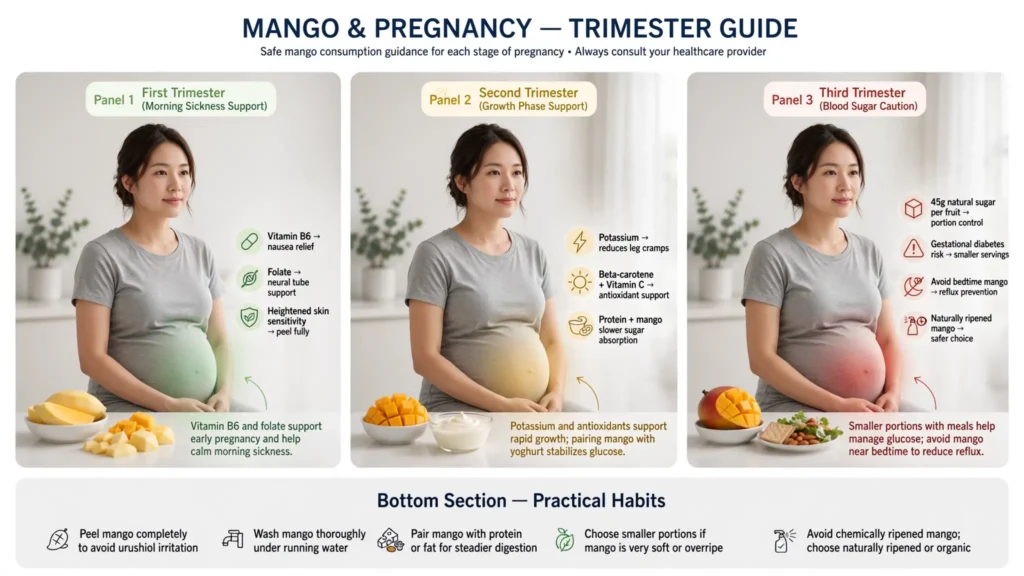
First Trimester: Can Mango Help With Morning Sickness?
The first trimester is, for many women, the hardest — nausea, exhaustion, and anxiety often arrive all at once. This is precisely where mango can genuinely help.
Vitamin B6 in mango has been linked in clinical research to reduced nausea and vomiting during early pregnancy — the same mechanism behind the B6 supplements doctors sometimes prescribe for severe morning sickness. A few slices of cold mango in the morning can have a real, evidence-backed calming effect on a nauseated stomach.
The folate content matters just as much right now. Neural tube formation — the earliest development of a baby’s brain and spinal cord — happens in weeks three through eight, often before many women even know they’re pregnant. Getting additional folate from whole foods like mango meaningfully supports this window.
Safe daily amount in the first trimester: 100–200g, roughly one small to medium mango. Always peel the mango completely and wash it thoroughly under running water first — the skin contains urushiol, the same compound found in poison ivy, which can cause irritation, particularly for women already experiencing heightened skin sensitivity during pregnancy.
Second Trimester: The Growth Phase and What Mango Supports
By the second trimester, morning sickness has usually eased and appetite often returns with a vengeance. This is also when the baby is growing rapidly and nutritional demand increases significantly.
Potassium from mango becomes particularly valuable now. Leg cramps are one of the most common second-trimester complaints, and potassium deficiency is a key contributor. Including mango regularly during this period can genuinely help.
The antioxidants in mango — including beta-carotene and vitamin C — also help protect against free radical damage while the immune system naturally adapts to accommodate the pregnancy.
Safe daily amount in the second trimester: up to 200g, roughly one cup diced or one medium mango. A practical tip worth passing on: pair mango with Greek yoghurt. The protein slows the absorption of mango’s natural sugars, preventing a sharp glucose spike — a combination that tastes excellent and is genuinely smarter nutritionally. If smoothies are your preference, I’ve put together a full guide to healthy smoothie recipes that work beautifully with mango as a base.
Third Trimester: When to Exercise More Caution
The third trimester requires the most mindfulness around mango — not because it suddenly becomes dangerous, but because blood sugar management becomes more critical as gestational diabetes risk rises in late pregnancy.
Mango contains roughly 45g of natural sugar per fruit. In a healthy pregnancy with no blood sugar concerns, that’s entirely manageable within a balanced diet. But if gestational diabetes has been diagnosed, or a midwife has flagged elevated glucose levels, portion control becomes essential.
Safe daily amount in the third trimester: around 100g, or half a cup, and always as part of a balanced meal rather than eaten alone as a snack. It’s also worth avoiding mango close to bedtime in the third trimester — acid reflux and heartburn are already common in late pregnancy, and mango’s acidity can aggravate both.
Naturally ripened mangoes are identified by uneven skin colour, a natural fragrance at the stem end, and a gradual firm-to-soft texture. Some commercially ripened mangoes are treated with calcium carbide, which releases traces of arsenic and phosphorus during ripening — worth being especially careful about during pregnancy. When in doubt, buy organic.
| Trimester | Safe Daily Amount | Key Priority |
| First | 100–200g (1 small mango) | Folate + B6 for neural development and nausea relief |
| Second | Up to 200g (1 medium mango) | Potassium + antioxidants for rapid fetal growth |
| Third | ~100g (½ cup) if managing blood sugar | Blood glucose control; avoid eating at night |
The Real Risks of Mango During Pregnancy (And How to Manage Them)
Being honest about risks matters as much as being honest about benefits, so let’s go through the genuine concerns — not the myths, the real ones.
High Natural Sugar Content
Mango is sweet, and its sugar content is real. Overconsumption — two or three mangoes a day — can contribute to elevated blood glucose, unwanted weight gain, and digestive discomfort. One medium mango per day is the threshold most nutritionists consider safe for women without blood sugar concerns.
Gestational Diabetes Risk
To be clear: mango does not cause gestational diabetes. But if it’s already present, or the risk is elevated, mango’s glycaemic load requires careful management. Understanding how different sugars behave in the body is genuinely useful here — I’ve written a more detailed piece on how fructose behaves differently in the body that’s worth reading if the sugar conversation interests you further.
Latex-Fruit Syndrome
A small number of women with a latex allergy may experience a cross-reaction to mango, particularly to the skin. Symptoms include itching or mild swelling around the mouth. Peeling the mango completely removes most of this risk. If a reaction occurs, stop immediately and speak to a doctor.
Digestive Sensitivity
Raw mango is significantly more acidic than ripe mango. It’s safe in small amounts, but eating large quantities of raw mango during pregnancy can trigger heartburn, bloating, or indigestion — symptoms already common without any help. Ripe mango is the better everyday choice for most pregnant women.
5 Myths About Mango During Pregnancy — Debunked
Misinformation in pregnancy communities spreads fast and causes real, unnecessary anxiety, so I want to address these directly.
- Myth 1: “Mango causes miscarriage.” There’s no clinical evidence for this. Miscarriage is caused by chromosomal abnormalities, infections, hormonal issues, and structural conditions — not by eating tropical fruit.
- Myth 2: “Mango creates dangerous body heat.” This is a cultural belief with no scientific basis. No study has linked moderate mango consumption to heat-related pregnancy complications — the exact myth that started this article.
- Myth 3: “Mango causes gestational diabetes.” Mango doesn’t cause gestational diabetes. Overconsumption of any high-sugar food can raise blood glucose in susceptible individuals — the issue is quantity, not the fruit itself.
- Myth 4: “You should avoid mango in the first trimester.” The first trimester is actually when mango’s folate and B6 are most beneficial. There’s no clinical reason to avoid it in early pregnancy.
- Myth 5: “All mango forms are equally safe.” Fresh, ripe mango is the safest form. Commercial mango juices, mango pickles, and preserved mango products contain added sugars, sodium, and preservatives that aren’t appropriate for regular pregnancy consumption.
Making informed choices during pregnancy is one of the most powerful things anyone can do for themselves and their baby. As I discuss in my broader piece on how the choices you make today build or break your health tomorrow, small daily decisions compound over time — and pregnancy is exactly where that truth matters most.
The Healthiest Ways to Eat Mango While Pregnant
Getting the benefits of mango while minimising the risks is mostly about how it’s eaten. Here are the approaches I recommend most:
- Fresh sliced mango with lime — the simplest, most unprocessed option, with no added sugar and maximum nutrients intact.
- Mango and Greek yoghurt bowl — the protein in yoghurt slows sugar absorption, a genuinely smart combination.
- Mango added to oats — the fibre in oats balances mango’s natural sugars beautifully.
- Mango in a fruit salad — mixing mango with lower-sugar fruits like berries dilutes the glycaemic load while maximising nutrient variety.
- Homemade mango lassi, unsweetened — blend fresh mango with plain yoghurt and water, no added sugar. Refreshing and gut-friendly.
What to avoid: commercial mango juice (high in added sugar, no fibre), mango pickle (high sodium), unpeeled mango, and any artificially ripened mango from unknown sources.
Good gut health is the foundation of good nutrient absorption during pregnancy, something worth understanding alongside the mango question specifically. I’ve covered this in detail in my article on foods your gut is actually craving, worth reading alongside this one for a complete pregnancy nutrition picture.
When You Should Speak to Your Doctor
Mango is safe for most pregnant women, but these situations genuinely warrant a direct conversation with a healthcare provider:
- Diagnosed with gestational diabetes — personalised guidance on fruit portions is essential.
- Itching, swelling, or hives after eating mango — a possible allergic reaction.
- A high-risk pregnancy — always follow your obstetrician’s specific dietary guidance.
- Severe bloating, acid reflux, or diarrhoea after eating mango consistently.
This article gives you the research. Your doctor gives you the personalised guidance. Both matter, and neither replaces the other.
Pregnancy is also a time when mental and emotional health deserves as much attention as physical nutrition. I’ve explored the connection between mental wellbeing and pregnancy outcomes in my piece on whether depression can affect early pregnancy, because a truly healthy pregnancy means caring for the whole person, not just the diet.
⚕ When to See a Doctor
If you notice itching, swelling, or hives after eating mango, or if you have gestational diabetes and are unsure how mango fits into your meal plan, please speak with your doctor or midwife directly rather than relying on general guidance alone.
Conclusion — What I’d Tell That Worried Reader Today
If they write to me again tomorrow, I’ll say exactly that: Yes, mangoes are safe during pregnancy, and in moderation it’s really one of the most nutritious fruits available to a pregnant mother. The “body heat” warning that scared her has no basis in the clinical evidence, no matter how sincere her mother-in-law may have said.
The real attention deserves part — about 200 grams on most days, or a medium mango, drops slightly in the third trimester if there’s a blood sugar problem — choosing naturally ripe fruit over artificially cured varieties, and taking care of the sensitivity to the rare latex that some women feel.
In addition, mango provides real, evidence-based support at every stage: B6 and folate in the first trimester, potassium and antioxidants in the second trimester, and manageable natural sugars when given in appropriate amounts in the third trimester. It’s an honest, complete picture — no fear, no folklore, just evidence, quarterly by story.
Medical Disclaimer: The information in this article is intended for general educational purposes only. It is based on personal research and publicly available evidence from peer-reviewed journals, NHS-aligned guidance, and recognised nutritional sources. It is not a substitute for professional medical advice, diagnosis, or treatment. Every pregnancy is unique — please consult your doctor, midwife, or registered dietitian before making significant changes to your pregnancy diet, especially if you have gestational diabetes, a high-risk pregnancy, or any underlying health condition.
Frequently Asked Questions
Is mango safe to eat during pregnancy?
Yes — ripe mango is safe during pregnancy when eaten in moderation, around 200g or one cup diced per day, providing folate, vitamin C, vitamin A, potassium, and vitamin B6.
Can I eat mango in the first trimester?
Yes — mango is particularly beneficial in the first trimester, since its B6 content helps reduce nausea and its folate supports early neural tube development, with portions kept to 100–200g daily.
Does mango cause gestational diabetes?
No — mango does not cause gestational diabetes, though if it’s already present, mango’s natural sugar content means portions should be managed carefully with a doctor’s guidance.
Is raw mango safe during pregnancy?
Yes, in moderation around 100–200g daily, though raw mango is more acidic than ripe mango and may trigger heartburn in some women, making ripe mango the generally better everyday choice.
How much mango can a pregnant woman eat per day?
Most nutritionists recommend up to one medium mango, around 200g, per day for women without blood sugar concerns, reducing to around 100g in the third trimester or if managing gestational diabetes.

3 thoughts on “Can I Eat Mango During Pregnancy?”