The Quick Answer
Yes — mango is not just safe for most women with PCOS, it may be actively supportive, thanks to compounds like myo-inositol, mangiferin, and quercetin that are studied for PCOS management specifically. Sensible portions (around half a mango), firm-ripe fruit, and smart timing are what matter more than avoiding mango altogether. The full picture, mechanism by mechanism, is below.
The Reader Who Missed Her Mango

A reader wrote to me a while back with a question that stuck with me. She had been managing PCOS for three years, had overhauled her diet significantly, and was largely doing well — but she missed mango. Her dietitian had told her to avoid tropical fruits because of the sugar content, and she had followed that advice faithfully.
“I just want to know if I actually have to give it up forever,” she said, “or if I’m avoiding something for no real reason.”
Mango wasn’t just a fruit for her — it had family memories, summers and a flavour that she associates with home. She wanted to know if this avoidance was really necessary, or if there was a way back for her.
The question — can I eat mango in PCOS — really got me involved in the research, and what I found was far more promising than the usual advice. The honest answer is yes, and it’s not in a cautious, hesitant or “a little bit maybe okay” approach. can I eat mango in PCOS? Current evidence shows that mango contains specific compounds that have been actively studied as a treatment for PCOS, including myo-inositol, which is one of the most evidence-based nutraceuticals in the treatment of PCOS. A 2025 clinical study also found that mango consumption increases insulin sensitivity, especially in populations whose metabolic profile is significantly similar to that of PCOS. This evidence doesn’t support the advice of abstinence that many women get — and I want to talk about a thoughtful, informed approach here.
Table of Contents
Can I Eat Mango in PCOS? The Direct, Evidence-Based Answer
Yes — With Informed Portion Control and Timing
The direct answer is yes — mango can be part of a PCOS diet. It’s a nutritious, fibre-rich fruit packed with vitamins, minerals, and bioactive antioxidants that doesn’t belong in the same category as refined sugar or processed carbohydrates. The concern behind mango avoidance is legitimate — insulin resistance is central to PCOS management, and high-sugar foods can worsen it. But mango, eaten whole and in sensible portions, isn’t a high-sugar food in the way a biscuit or a can of fizzy drink is.
In January 2025, researchers at the Illinois Institute of Technology published a clinical study in the journal Nutrients finding that mango consumption was associated with increased insulin sensitivity in participants with overweight, obesity, and chronic low-grade inflammation — the precise metabolic conditions that most closely mirror the PCOS metabolic profile. That’s not an abstract nutrient database finding. It’s clinical evidence connecting mango directly to the central metabolic challenge of PCOS.
This research doesn’t mean unlimited mango is appropriate. Portion size and timing still matter critically for women managing insulin resistance. But it substantially changes the framing — from “avoid because sugar” to “eat thoughtfully because benefit.”
Why the Fear of Mango in PCOS Developed
PCOS affects an estimated 5 to 20 percent of women of reproductive age and is characterised by insulin resistance in a significant proportion of cases. When insulin resistance is the core metabolic challenge, any food with meaningful sugar content can feel like a risk — and mango’s sweetness and tropical reputation made it an easy target for precautionary avoidance.
The problem is that mango was grouped with processed sugars rather than understood as what it actually is: a whole food delivering natural sugar alongside fibre, water, antioxidants, digestive enzymes, and bioactive compounds that fundamentally change how the body processes that sugar. The glycaemic response to a whole mango is substantially different from the equivalent amount of refined sucrose — and mango’s polyphenols add a layer of benefit the “mango is too sweet” narrative ignores entirely.
When I first read the research properly, that was the moment it clicked for me — the reader who’d written to me hadn’t been avoiding a health risk. She’d been avoiding a whole food misfiled under the wrong category.
The PCOS-Specific Compounds in Mango Most People Have Never Heard Of
I expected to find research confirming that mango was neutral for PCOS — tolerable if eaten carefully. What I actually found was evidence that mango contains compounds being actively studied as PCOS treatments. That completely reframed the conversation for me.
Myo-Inositol — A PCOS Treatment Compound Found in Mango
Mango contains meaningful concentrations of myo-inositol — an organic compound in the B-vitamin family and one of the most widely researched, increasingly prescribed nutraceutical interventions in PCOS management.
Myo-inositol isn’t a fringe supplement. It’s used clinically to regulate glucose levels, improve insulin sensitivity, restore ovarian function, support menstrual regularity, and reduce androgen levels in women with PCOS, in some studies performing comparably to metformin, the standard pharmaceutical intervention.
The irony was striking once I saw it clearly: women with PCOS are frequently advised to avoid a fruit that contains a compound being used to treat PCOS. That gap between the advice and the evidence is worth taking seriously.
Mangiferin — Anti-Inflammatory, Antidiabetic, and Metabolically Protective
Mango is one of the richest natural sources of mangiferin — a bioactive compound with documented anti-inflammatory, antioxidant, and antidiabetic properties directly relevant to PCOS. Chronic low-grade inflammation is a core driver of hormonal dysregulation in PCOS — it disrupts ovarian function, worsens insulin resistance, and amplifies androgen excess. Mangiferin’s anti-inflammatory activity addresses this mechanism directly.
Research has found mangiferin can lower cholesterol, triglycerides, and free fatty acids — metabolic markers frequently elevated in PCOS alongside insulin resistance. It has also shown hepatoprotective effects, relevant for women with elevated liver enzymes secondary to insulin resistance.
Quercetin and Gallic Acid — Hormonal and Antioxidant Support
Mango is a rich source of quercetin — a polyphenol with anti-androgenic properties directly relevant to PCOS, where elevated androgens drive some of the most distressing symptoms: acne, hirsutism, and cycle disruption. Quercetin has been shown to inhibit androgen biosynthesis in ovarian cells and reduce circulating testosterone markers in some studies.
Mango also contains gallic acid, an antioxidant with documented activity in reducing oxidative stress in ovarian tissue. The combined polyphenol load of mango — myo-inositol, mangiferin, quercetin, gallic acid — makes it a genuinely bioactive food for PCOS in ways the simple sugar-content conversation completely misses.
The 2025 Insulin Sensitivity Research — What It Means for Women With PCOS
What the Study Found
The January 2025 study from the Illinois Institute of Technology is the most directly relevant recent piece of clinical evidence on mango and the metabolic profile of PCOS. Researchers examined how mango consumption affected insulin sensitivity in participants with overweight, obesity, and chronic low-grade inflammation — a population whose metabolic characteristics closely mirror those of insulin-resistant PCOS.
The results showed mango consumption was associated with increased insulin sensitivity across multiple markers, including HOMA-IR, the Matsuda index, and the insulinogenic index — the same metrics used to assess insulin resistance severity in PCOS. Alongside the insulin data, researchers cited population data showing mango consumers have higher overall diet quality than non-consumers, with younger consumers showing lower body weight and smaller waist circumference.
What This Research Changes for the PCOS Conversation
I want to be transparent about the evidence: this is a study in a population with overweight and chronic inflammation, not a randomised controlled trial specifically in PCOS patients. Direct PCOS-specific clinical trials on mango are still limited. But the metabolic overlap is substantial enough that the findings are meaningfully applicable.
Combine the 2025 insulin sensitivity data with the myo-inositol content, the mangiferin anti-inflammatory properties, the quercetin anti-androgenic effects, and the fibre-mediated glycaemic buffering, and you have a cumulative case for mango as an actively supportive food in PCOS management through several independent, well-evidenced pathways.
The Honest Concerns — When Mango Does Warrant Caution in PCOS
Glycaemic Index, Load, and Individual Insulin Sensitivity
Mango has a glycaemic index of approximately 51 to 60 depending on variety and ripeness — low-to-medium GI, meaningfully lower than white bread, most breakfast cereals, and many “healthy” snack bars freely consumed on PCOS diets without scrutiny. The glycaemic load — which accounts for both GI and actual portion size — increases proportionally with how much mango is eaten.
For women with significant insulin resistance — particularly those with fasting insulin levels above the upper normal range — eating two or three mangoes in one sitting represents a glycaemic load that can produce a meaningful insulin response. This isn’t because mango is harmful; it’s because the portion is large, and insulin resistance reduces the body’s tolerance for that load. Starting with half a mango and working from there is the sensible calibration approach.
Overripe Mango and Mango Juice — Two Forms to Avoid
Not all mango is equal for PCOS management. Overripe mango — soft, intensely sweet, sometimes starting to brown — has significantly higher free sugar concentration than firm-ripe fruit. The starches have fully converted to simple sugars, the fibre is softer and less able to buffer glycaemic impact. For women managing insulin resistance, firm-ripe mango is always preferable to overripe.
Mango juice is the form to avoid entirely. Juicing removes most of the fibre that is the primary mechanism by which whole mango delivers a slower, more buffered glycaemic response. Without fibre, mango juice’s natural sugars reach the bloodstream rapidly and with significant insulin stimulation, behaving more like a refined sugar drink than a whole fruit. Whole mango: yes. Mango juice: no.
If digestive tolerance is also a concern alongside blood sugar, it’s worth reading my separate piece on whether mango can cause gas, which covers that side of the picture in more depth.
How to Eat Mango Safely With PCOS — The Practical Guide
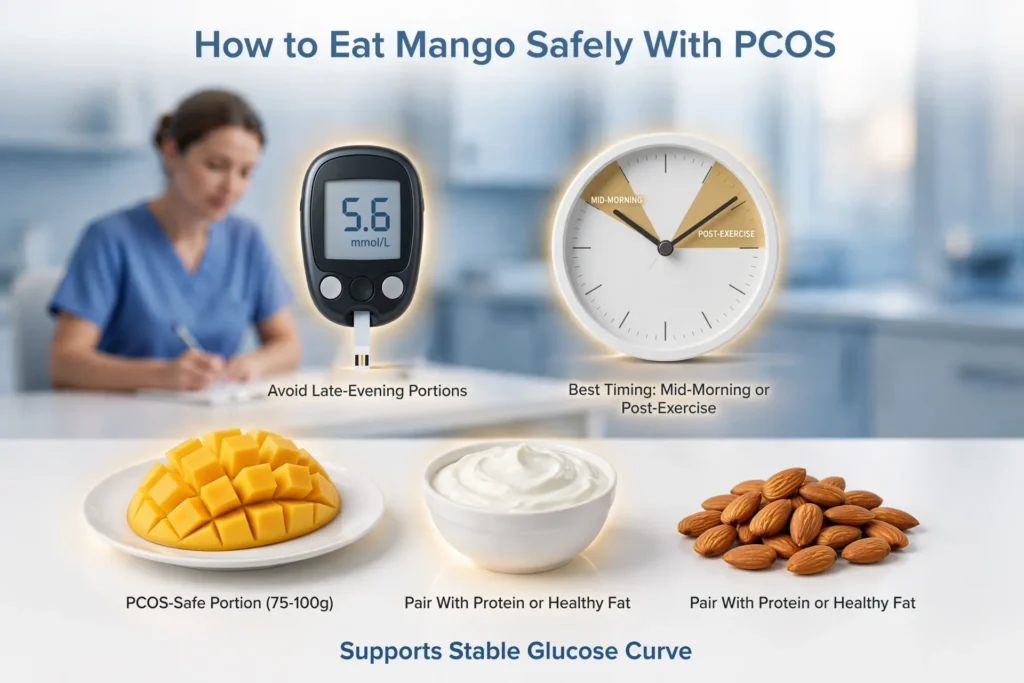
Portion Guidance
Half a medium mango (approximately 75 to 100g) is the recommended starting portion for women managing PCOS. That’s a genuinely enjoyable, satisfying amount — enough to access the myo-inositol, mangiferin, quercetin, and vitamin C benefits without producing a glycaemic load that significantly challenges insulin resistance.
Some women with PCOS manage comfortably with a full medium mango, particularly when eaten with food, at favourable timing windows, or after physical activity. Start with half a mango and pay attention to how you feel in the hour after: stable energy, good satiety, and absence of post-sugar cravings are the signals you’re within your personal threshold.
Timing That Protects Blood Sugar
Mid-morning or mid-afternoon with food are the most favourable windows for mango in PCOS. These timing choices ensure a food buffer is already in the system slowing gastric emptying, rather than eating into a fasted, insulin-sensitive state that amplifies the glycaemic response.
Post-exercise is the single best timing window for women with PCOS who want to eat mango freely. After physical activity, muscle cells have significantly increased insulin sensitivity and glucose uptake capacity — the same glycaemic load produces a meaningfully smaller insulin response. A half mango with yoghurt shortly after a morning workout is a genuinely excellent recovery snack with specific PCOS-supportive properties.
Avoid large portions late in the evening. Insulin sensitivity follows a circadian rhythm, typically lowest overnight, meaning the body is least equipped to process carbohydrate loads at this time.
Smart Pairings for a Flat Glucose Curve
The single most impactful change for PCOS-safe mango eating: always combine mango with protein or healthy fat.
- Greek yoghurt + mango — one of the best PCOS snack combinations available; the protein significantly slows glucose absorption and extends satiety.
- A handful of almonds + mango — healthy fat slows gastric emptying, producing a flatter, more stable glucose curve.
- Cottage cheese + mango — high protein, relatively low carbohydrate, excellent satiety.
- Avoid pairing mango with other high-GI carbohydrates — white rice, white bread, processed cereals — in the same meal.
The approach I now use practically: half a mango, mid-morning, alongside Greek yoghurt. The protein changes the blood sugar dynamics entirely — I feel satisfied and energised, with none of the spike-and-crash I used to notice from eating larger amounts alone on an empty stomach. Knowing the mango contains myo-inositol, an actual PCOS treatment compound, makes the choice feel genuinely intentional rather than merely permissible.
Choose Firm-Ripe, Not Overripe
A firm-ripe mango that gives slightly when gently pressed but holds its shape has a lower free sugar concentration than a very soft, overripe fruit. Choose mangoes that taste naturally sweet rather than intensely sugary. Sweeter, lower-fibre varieties like Alphonso or Ataulfo deliver a faster sugar hit than firmer varieties like Tommy Atkins or Kent — both are fine, the portion guidance applies either way.
Mango as Part of a Broader PCOS-Supportive Diet
A PCOS-supportive dietary pattern is broadly characterised by low-GI foods, anti-inflammatory whole foods, adequate protein, and fibre-rich plant foods — and mango, in appropriate portions, fits within all four. Its fibre supports gut motility and microbiome health; its polyphenols contribute to an anti-inflammatory pattern that supports hormonal regulation; its vitamins A, B6, C, and E support immune and reproductive health; its myo-inositol directly addresses the insulin-signalling pathway central to PCOS.
The gut microbiome connection to PCOS is an emerging area of genuine scientific interest — a healthier, more diverse microbiome is linked to better oestrogen metabolism, lower inflammation, and more stable hormonal cycling. Mango’s prebiotic polyphenols contribute here too. I’ve covered the gut-hormone connection in my article on the foods your gut is begging you to eat, relevant reading for anyone managing PCOS through diet.
For anyone also navigating mango questions around pregnancy, I’ve written a separate guide on whether mango is safe during pregnancy. And if jaundice is a concern alongside PCOS-related liver enzyme changes, my article on whether mango is safe during jaundice addresses that specific overlap.
⚕ A Note for Anyone With Additional Metabolic Concerns
If you have PCOS alongside diagnosed insulin resistance, elevated liver enzymes, or are on medication that affects blood sugar, please check with your doctor or registered dietitian before making significant changes to your fruit intake — individual metabolic responses vary considerably.
Conclusion — So, Can I Eat Mango in PCOS? My Honest Verdict
What I’ll say to the reader who wrote me — and who now has the evidence to back it up — is this: Mangoes don’t have to be absent from your life because PCOS. The advice to complete abstinence that many women receive was based on an imperfect picture. It focused on one number — the amount of sugar — while ignoring the fiber that buffers it, myo-inositol which supports direct insulin signalling in PCOS, mangiferin which reduces inflammation by increasing hormonal irregularities, and quercetin which can gently reduce androgen overload.
The 2025 insulin sensitivity study does not prove that mango is a cure for PCOS. But it adds to the growing evidence that moderate mango consumption is not only safe for women with PCOS — it can also actively contribute to the metabolic and hormonal management of the disease in a number of independent ways. This is a very different conclusion than “avoid tropical fruits”.
Half a mango with Greek yogurt, in the middle of the morning, fits comfortably and intelligently into a PCOS-supported, foodie style, rather than a rigid and full-fledged juice. It’s a complete, evidence-based answer — and that’s the answer I wish he had arrived three years ago.
Medical Disclaimer: This article is for educational and informational purposes only and does not constitute medical advice. PCOS is a complex hormonal condition that varies significantly between individuals. Dietary management should be guided by a qualified healthcare professional or registered dietitian with experience in PCOS. Do not make significant dietary changes based on this article alone without professional consultation.
Frequently Asked Questions
Can I eat mango in PCOS?
Yes — mango contains myo-inositol, mangiferin, and quercetin, compounds studied for PCOS management, and a 2025 study found mango consumption associated with increased insulin sensitivity in a metabolically similar population.
How much mango is safe with PCOS?
Half a medium mango, around 75 to 100g, is the recommended starting portion, with some women comfortably tolerating a full mango when eaten with food.
When is the best time to eat mango with PCOS?
Post-exercise is the most favourable window due to increased insulin sensitivity, with mid-morning or mid-afternoon alongside food as good alternatives, avoiding large portions late in the evening.
Is mango juice safe for PCOS?
No — juicing removes the fibre that buffers sugar absorption, causing a rapid blood glucose and insulin spike, so whole mango is always preferable to juice.
What is the best way to eat mango with PCOS?
Pair half a medium mango with a protein source like Greek yoghurt or almonds, choose firm-ripe over overripe fruit, and eat with or after a meal rather than on an empty stomach.

1 thought on “Can I Eat Mango in PCOS?”