🟢 THE SHORT VERSION
A hot shower makes you tired because it heats your body up, causing blood vessels near your skin to widen. Once you step out, that heat escapes quickly, triggering a rapid drop in core temperature — the same signal your brain uses every night to start the sleep process. It’s not just relaxation. It’s your body’s actual pre-sleep mechanism, triggered early.
Introduction

The first time I really realized, I had a long day, took a hot shower before eating, and slept on the sofa about half a minute later. It wasn’t normal fatigue. It felt heavy, as if my body had made a decision without asking me. That’s why I was forced to think about why does a hot shower make me tired, instead of accepting it as one of those weird things that the body does. When I figured out why does a hot shower make me tired, it stopped feeling random, and I started using it intentionally instead of being confused.
Table of Contents
The Real Reason a Hot Shower Makes You Tired
It’s tempting to assume this is just relaxation, the mental unwinding of standing under warm water after a stressful day. That’s part of it, but it’s not the main mechanism, and understanding the difference is what makes this actually useful rather than just interesting.
What surprised me most was realising this isn’t a side effect of the shower at all, it’s your body doing exactly what it’s designed to do when it gets too warm, just compressed into a much shorter window than it would normally happen over.
It’s not the heat itself, it’s what happens after you step out
Hot showers don’t make you sleepy while you’re in them. The tiredness is a delayed effect that kicks in once you’ve dried off and the temperature-regulation process that the shower set in motion starts working its way through your body.
Vasodilation: how hot water pulls blood toward your skin
When hot water hits your skin, blood vessels near the surface widen significantly, a process called vasodilation. This pulls blood, especially toward your hands and feet, closer to the surface of your body, which is your body’s way of trying to release excess heat.
This is the same basic mechanism behind why your face flushes when you’re overheated, just happening across much more of your skin at once because you’re standing in hot water rather than exposed to a single hot environment.
The rapid core temperature drop that follows
Once you step out of the shower, all that blood sitting near your skin’s surface starts releasing heat rapidly into the cooler air around you. Your core body temperature, which had risen during the shower, now drops faster than it would have on its own, and that faster drop is the real trigger for the sleepiness.
Research on bathing and thermoregulation has found that a core temperature increase of roughly 0.9°C from warm water exposure produces a noticeably faster and steeper cooldown afterward, compared with no shower at all.
Why That Temperature Drop Feels Like Sleepiness
Your body already does this every night before bed
Your core body temperature naturally follows a daily rhythm, peaking in the late afternoon and dropping gradually by around half a degree as night approaches. That decline is one of the strongest signals your brain uses to start the sleep process, regardless of whether a shower is involved.
A hot shower artificially speeds up a signal your brain already recognises
A hot shower essentially fast-forwards this process. It heats you up first, giving your body more thermal energy to shed, so the drop that follows is faster and steeper than the one that would naturally happen an hour or two before bedtime. Your brain reads that steep drop the same way it reads the natural one — as a cue that it’s time to slow down.
💡 WHAT THE RESEARCH SHOWS
A meta-analysis of thirteen trials found that warming the body with hot water for as little as ten minutes shortened the time it took participants to fall asleep by roughly 36 percent, when timed correctly before bed.
The Evening I Finally Understood Why This Kept Happening to Me
For a while, I assumed the post-shower heaviness was just fatigue catching up with me, unrelated to the shower itself. I started noticing it more specifically once I paid attention to the pattern: it happened almost every time I showered in the evening, and almost never after a quick morning shower before work.
One night, after nearly dozing off mid-dinner following an evening shower, I started timing things properly. Hot shower around 8pm, noticeable heaviness by roughly 8:20, and if I gave in and sat down, I’d often be genuinely drowsy within half an hour. It wasn’t every single evening, but it was consistent enough, over a couple of weeks of paying attention, that I stopped writing it off as coincidence.
It fit into the same evening-routine thinking I’ve written about before — the idea that what you do and when you do it in the evening genuinely shapes how your body winds down, not just what you eat or how long you sleep.
It’s Not Just Temperature, Your Nervous System Is Involved Too
The shift toward rest and digest mode
Your autonomic nervous system runs on two main settings: the sympathetic system, which drives alertness and action, and the parasympathetic system, which handles relaxation, digestion, and recovery. Warm water on your skin activates sensory nerves that send calming signals toward the parasympathetic side, nudging your whole system toward that slower, restful state.
This is worth knowing because it means the tiredness isn’t purely mechanical. Your nervous system is actively participating in the process, not just responding to a temperature change after the fact.
Blood pressure changes and why they add to the fatigue
Vasodilation doesn’t just move blood around, it also causes a temporary drop in blood pressure, since your blood vessels have widened and there’s less resistance in your circulatory system overall. That dip is part of why you can feel briefly weak or heavy after a hot shower, similar in feeling to how cortisol dropping later in the day contributes to winding down in the evening, just through a different mechanism.
Why very hot water can backfire
Water that’s too hot, generally above about 42°C or 108°F, can tip your body into the opposite response, triggering a mild stress reaction rather than a relaxed one, temporarily raising your heart rate and blood pressure instead of lowering them. This is part of why scalding showers don’t necessarily make the sleepy effect stronger.
Does Dehydration Make It Worse?
A hot, steamy shower makes you sweat more than you’d expect, even though you’re standing in water. That mild fluid and electrolyte loss can compound the tired, slightly foggy feeling that vasodilation and blood pressure changes already produce. If you want to look at the hydration side of this in more depth, it’s worth a quick glass of water after a long, hot shower, particularly if you tend to take longer ones.
This effect is usually mild for a typical ten-minute shower, but it becomes more noticeable the longer and hotter the shower runs, which is part of why a quick rinse and a lingering, steamy soak can leave you feeling quite different afterward, even at a similar water temperature.
What I’ve Noticed in Other People
A friend of mine has joked for years that she can’t take an evening shower without ending up asleep on the sofa within the hour, long before she ever looked into why. Once I explained the temperature and blood pressure mechanism, she said it finally made sense why it never happened after her quick morning showers, only the longer evening ones.
A colleague, on the other hand, uses this deliberately. He takes a hot shower specifically around an hour before bed on nights he’s struggling to wind down, treating it as a tool rather than something that just happens to him. Neither of them needed anything complicated to notice the pattern, just a bit of attention to when it happened and when it didn’t.
A neighbour of mine mentioned something slightly different, that she’d always assumed her post-shower tiredness in the evening meant she was simply more exhausted than she realised, until she noticed the exact same heaviness on days she’d had an easy, low-stress day too. That was what convinced her it was about the shower itself, not just accumulated fatigue catching up with her.
How to Use This on Purpose, Instead of Being Confused by It
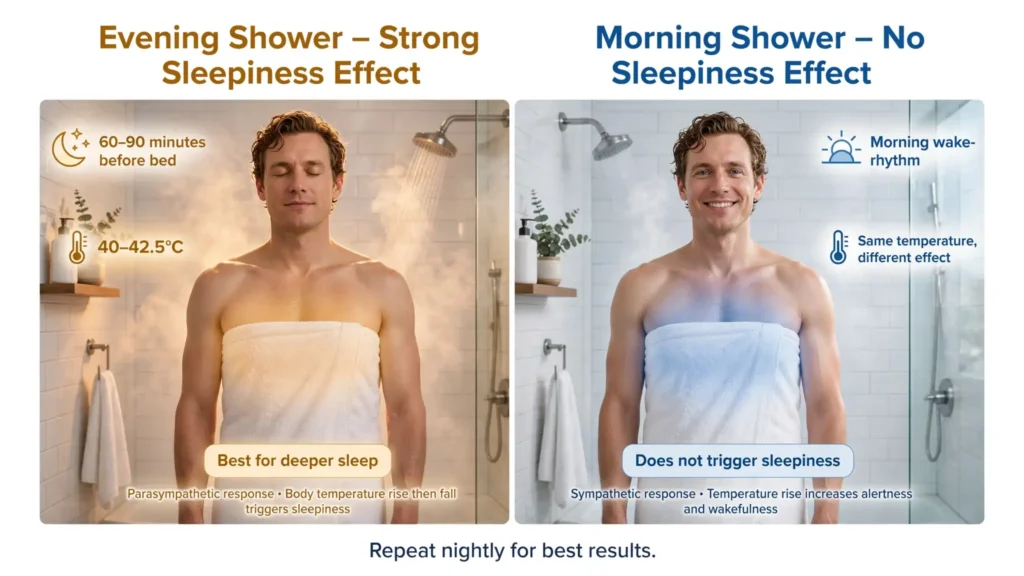
Once you understand the mechanism, the practical part is fairly simple, and it comes down to working with your body’s timing rather than against it.
Best timing: roughly 60 to 90 minutes before bed
This window gives your core temperature enough time to rise and then fall, so the steepest part of that drop lines up with when you’re actually trying to fall asleep, rather than happening too early or too late to help.
Ideal water temperature range
Comfortably hot, somewhere around 40 to 42.5°C, tends to produce the strongest sleepiness effect without tipping into the stress response that scalding water can trigger.
Why a hot morning shower doesn’t have the same effect
In the morning, your body is already moving in the opposite direction, core temperature naturally rising as part of your wake-up rhythm, and there’s usually a longer gap before you’d actually want to fall back asleep. The same shower, at a different point in your daily rhythm, simply doesn’t line up with a sleep signal the same way.
| Water Temperature | Nervous System Effect | Best Used For |
| ~40°C (104°F) | Parasympathetic “rest and digest” activation | Evening wind-down, better sleep |
| 40–42.5°C (104–108.5°F) | Strongest sleepiness effect | 1–2 hours before bed |
| Above 42°C (108°F) | Can trigger stress response instead | Best avoided close to bedtime |
A Word of Caution
🔴 IMPORTANT
Very hot water isn’t right for everyone. If you have low blood pressure, are pregnant, or have a cardiovascular condition, sudden vasodilation and blood pressure drops can cause dizziness or fainting, so it’s worth keeping showers warm rather than scalding and standing up slowly afterward. If post-shower dizziness, fatigue, or lightheadedness is severe, persistent, or happens with cool showers too, that’s worth mentioning to a doctor rather than assuming it’s normal — it could also relate to the well-documented two-way link between poor sleep and low mood, which is worth ruling out if fatigue is a wider pattern for you.
My Honest Evening Shower Routine Now
- I aim to shower around 7:30 to 8pm if I’m hoping for an earlier night, roughly 60 to 90 minutes before bed.
- I keep the water comfortably hot rather than as scalding as I used to have it.
- I drink a glass of water afterward, especially after a longer shower.
- I pair it with a simple five-minute noticing exercise instead of immediately picking up my phone.
- On mornings, I keep showers shorter and slightly cooler, since I’m not trying to trigger the same effect.
Final Thoughts
When you know why does a hot shower make me tired, there’s a real, traceable answer, it stops feeling like your body’s weird habit and feels like you can work on it. It is not a vague rest, but rather a specific chain that mimics the dilatation of blood vessels, changes in blood pressure, and the body’s pre-sleep signals. If you work at the right time, it will work for you instead of suddenly catching you on the sofa.
I still don’t take a hot shower and don’t expect anything to happen later. Now I plan accordingly, rather than marveling at it, which has made my evenings a little more predictable than before.
Frequently Asked Questions
Why does a hot shower make me tired instead of energised?
Because it triggers vasodilation and a rapid core temperature drop once you step out, which mimics your body’s natural pre-sleep signal rather than an energising one.
Is it bad that hot showers make me sleepy?
No, it’s a normal physiological response. It can even be useful if you time your shower in the evening to support falling asleep faster.
What temperature shower is best for sleep?
Around 40 to 42.5°C (104 to 108.5°F) tends to produce the strongest sleepiness effect without triggering a stress response from water that’s too hot.
How long before bed should I take a hot shower?
Roughly 60 to 90 minutes before bed, which gives your core temperature time to rise and then drop right as you’re trying to fall asleep.
Can a hot shower make you tired the next day too?
Not typically on its own, but a very long or very hot shower combined with mild dehydration can leave some residual grogginess, especially if it disrupted your usual sleep timing.
Medical disclaimer: This article is for general information only and is not a substitute for professional medical advice. Please consult a qualified healthcare provider for guidance specific to your health.

2 thoughts on “Why Does a Hot Shower Make Me Tired? Real Answer”