QUICK TAKEAWAY
My uncle Zafar spent three years cycling through back pain flare-ups, painkillers, and physio sessions that helped for a few months before the pain crept back in. What actually broke that cycle wasn’t a new treatment — it was a plain, unglamorous daily walk. This is the story of what changed for him, what his physiotherapist explained, and why walking, done consistently, may genuinely reduce back pain recurrence more reliably than anything else he tried.
Introduction

My uncle Zafar has thrown his back out more times than I can count. He runs a small warehouse, and for years his answer to a bad back was always the same: a few days of ibuprofen, lying flat on the sofa, and waiting it out. It always passed. And it always came back — a low hum of recurring pain that everyone around him had quietly stopped expecting to actually go away for good.
After his third flare-up in eighteen months, his physiotherapist told him something that stuck with both of us. She said the missing piece wasn’t more rest, and it wasn’t a stronger core routine either — it was consistency in something as basic as walking, because that was what actually seemed to reduce back pain recurrence in her patients. I remember thinking that sounded almost too simple. Could something so ordinary really reduce back pain recurrence when stretching, painkillers, and even a few weeks off work hadn’t?
Table of Contents
What Changed When My Uncle Actually Started Walking
His Routine Before — Sitting, Lifting, and “Resting” Between Flare-Ups
Before any of this, Zafar’s days looked like most people’s: drive to the warehouse, sit at a desk doing paperwork for an hour, then spend the rest of the shift lifting and moving stock in short, sudden bursts. Long stretches of sitting broken up by heavy effort — exactly the combination his physiotherapist said was setting him up for another flare-up.
What made it worse, looking back, is that his idea of “recovery” between episodes was essentially doing less. After a flare-up settled, he’d go back to work but quietly avoid anything that felt remotely risky — no lifting above a certain weight, no bending if he could help it, and definitely no exercise he didn’t have to do. It felt sensible at the time. In hindsight, it meant his back never actually got stronger between episodes; it just sat there, slightly braced, waiting for the next thing to set it off.
The Turning Point — What His Physio Actually Prescribed
When she first suggested a daily walk, he pushed back. “I don’t have time to just walk nowhere,” he told me over dinner, only half joking. It didn’t sound like treatment to him — it sounded like doing nothing, dressed up as advice.
What Changed by Week Six
The plan she gave him was deliberately unambitious: twenty minutes, most days of the week, at a pace where he could still hold a conversation. No target distance, no app tracking his splits — just showing up for it daily. Six weeks in, he mentioned that his back felt tight in the mornings less often. Two months in, he skipped a walk for a few days while travelling and noticed the stiffness creeping back almost immediately, which told him more than any explanation could have.
Why Doctors Keep Coming Back to Walking for Recurring Back Pain

How Common Recurring Back Pain Actually Is
Back pain is one of the most common reasons people end up seeing a GP or physiotherapist, and for a lot of people it doesn’t just happen once and disappear — it clears up and then comes back weeks or months later [1]. Staying active, rather than resting for long stretches, is consistently the advice given for both easing an existing episode and lowering the chances of another one [2].
The Study His Physio Mentioned
She also mentioned a large trial she’d read about that had followed hundreds of adults recovering from a back pain episode over several years, comparing those given a simple walking programme against those who weren’t. The walking group had noticeably fewer repeat episodes and went longer before pain came back. It was the first time I’d heard “go for a walk” backed by anything more than a physio’s gut feeling, and it’s part of why I stopped treating the advice as an afterthought.
Why Walking Specifically, Not a Gym Plan
What made walking the specific recommendation for Zafar, rather than a gym programme or a class, came down to something his physiotherapist said plainly: it’s the one form of exercise almost nobody fails to keep up with. No equipment, no membership, no session to book. For someone who’d already tried and dropped two different exercise plans, that mattered more than any theoretical benefit.
It also fit around the shape of his actual life, which is something none of his previous attempts had managed. A gym plan meant a drive across town, a specific window of free time, and a routine that fell apart the first busy week at work. A walk before or after a shift needed none of that. It slotted into a life that already existed instead of asking him to build a new one around it.
There’s also a quieter reason his physio gave, one that had nothing to do with his back directly. She said patients who pick an exercise that feels achievable are simply more likely to still be doing it in six months than patients who pick the “ideal” exercise on paper and burn out on it in three weeks. For someone with Zafar’s track record of dropped routines, being realistic mattered more than being optimal.
The Science Behind Why Walking Helps a Struggling Back
Movement, Circulation, and the Spine
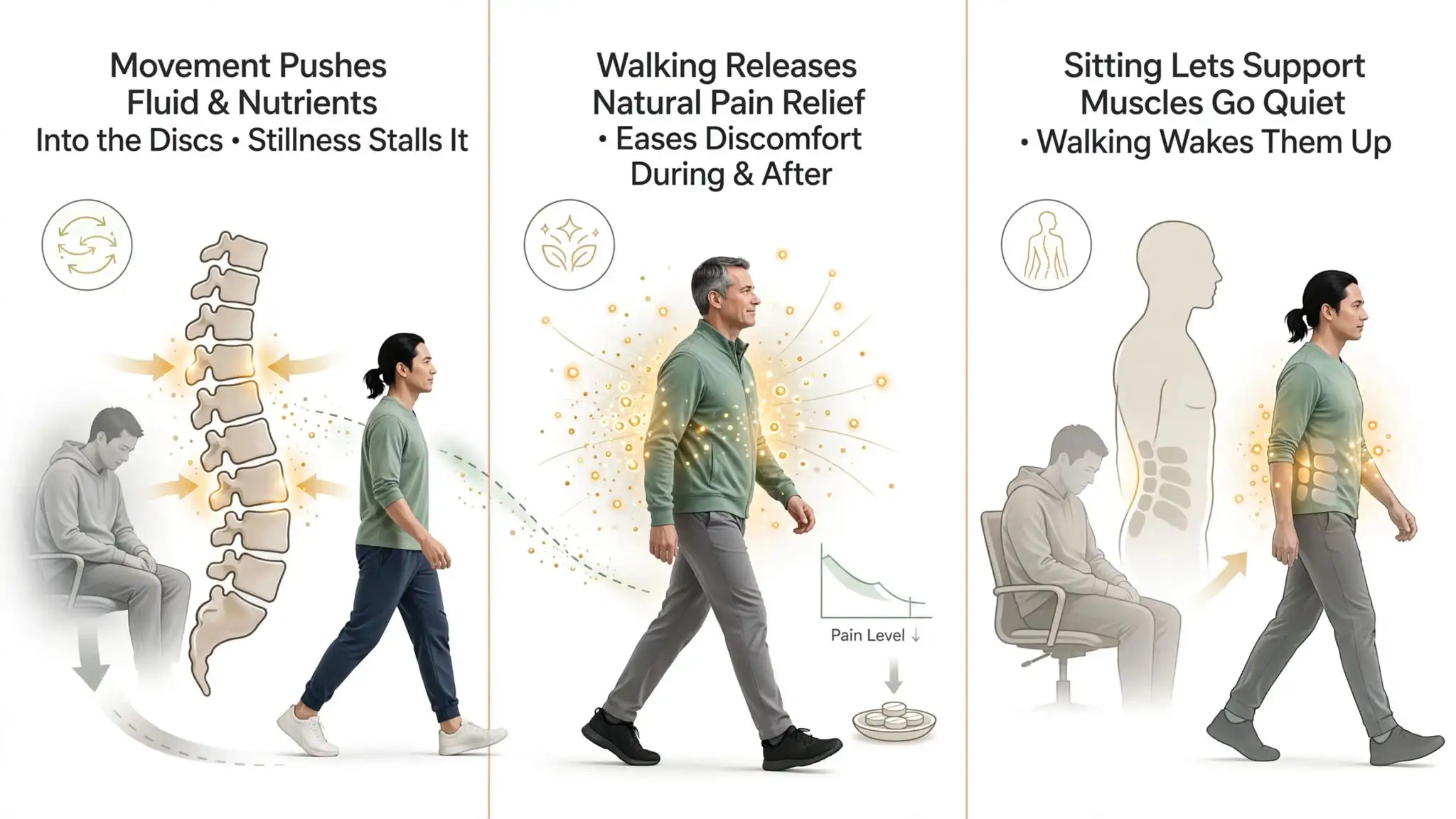
Spinal discs don’t have their own direct blood supply the way muscles do — they rely partly on movement to push fluid and nutrients in and waste products out. Long periods of sitting or lying still, which is exactly what Zafar used to default to during a flare-up, work against that. Gentle, repetitive movement like walking keeps that exchange going instead of stalling it.
This was the part that reframed things for me. I’d always assumed rest was the safe default and movement was the risk. His physio’s explanation flipped that: for ordinary muscular back pain without a serious underlying cause, prolonged stillness is often the thing quietly working against recovery, not the thing protecting it.
Endorphins and the Body’s Own Pain Relief
Walking also triggers the release of endorphins — the body’s own pain-relieving chemicals. It’s not a replacement for medical treatment, but Zafar’s physio pointed out that this is part of why gentle activity often eases pain that feels worse after total rest.
Zafar noticed this in a very unscientific way: he said his back generally felt better by the end of a walk than it had at the start, even on days it had been nagging at him that morning. That lines up with what his physio described — the discomfort easing during and shortly after gentle movement, rather than only ever easing with medication or lying still.
Core and Postural Muscles Waking Back Up
The other piece is muscular. Long stretches of sitting let the muscles supporting the lower back go quiet, and weak support around the spine makes the next strain more likely. Walking reintroduces low-level, repeated engagement of those muscles without the loading risk of heavier training — which is partly why it’s often paired with simple desk stretches for people with back pain who sit most of the day rather than replacing that advice altogether.
What His Physiotherapist Actually Told Him to Do
The Daily Basics — Time, Pace, Surface, Shoes
The instructions Zafar came home with were specific but not complicated:
- Twenty to thirty minutes, most days of the week — five is the rough target, not a hard rule.
- Start on flat, even ground rather than hills or uneven paths while his back was still settling.
- Wear proper supportive shoes, not the flat work boots he’d been wearing on shift.
- If a flare-up hit, shorter and more frequent walks beat one long one.
Why Pacing Mattered More Than Effort
That last point mattered more than it seemed to at first. Zafar is naturally the type to push through things, and his physio was fairly direct that pacing yourself when you’re getting back into exercise after pain or injury is what separates people who stick with a routine from people who reinjure themselves in week two.
None of this was framed as a permanent ceiling, either. The plan was always to build up gradually once his back had settled into the routine — a few extra minutes every couple of weeks, then eventually gentler inclines. The point wasn’t to keep him at twenty minutes forever, it was to stop him doing what he’d normally do, which was jump straight back to whatever felt like “normal” exercise the moment the pain eased off.
The Walking Mistakes That Nearly Set Him Back Again
The Week-Three Setback
He didn’t get it right immediately. In his third week, feeling better than he had in months, Zafar decided to “make up for lost time” and did a much longer, faster walk on uneven ground near a building site. His back seized up that evening, and for a moment it looked like proof that walking hadn’t actually helped at all.
What It Actually Proved
What it actually proved was the opposite: it wasn’t walking itself that caused the setback, it was abandoning the pacing his physio had given him. Once he went back to the slower, shorter, flatter version, the improvement picked back up within a week. A lot of whether a sedentary job ends up straining your posture and back comes down to these small, boring details — surface, pace, and shoes — more than people expect.
Why We Didn’t Just Stick with Walking
The Twice-Weekly Stretching Add-On
Walking became Zafar’s daily habit, but it wasn’t the only thing his physio had him doing. Twice a week she added a short, gentle stretching routine, closer to what you’d find in a beginner-friendly guide to yoga for back pain, aimed at hip and hamstring flexibility rather than strength.
Daily Habit vs. Occasional Extra
The distinction she drew was useful: walking was the daily, non-negotiable habit; everything else was a smaller addition on top of it, not a substitute for it.
A Second Story — My Neighbour’s Experience
The Same Pattern, a Different Job
I mentioned all this to a neighbour a few weeks later, mostly making conversation while we were both out with our bins. It turned out she’d been dealing with almost the same pattern — an office job, long hours at a desk, back pain that flared every few months and settled with rest, only to return. Her GP had told her something almost identical to what Zafar’s physio said: build in a short daily walk before trying anything more elaborate.
What Two Unrelated Professionals Both Said
What struck me listening to her was the same theme coming up twice, from two unrelated healthcare professionals, for two people with very different jobs: it wasn’t the intensity of the exercise that mattered as much as whether it actually happened every day.
Neither of them had been given anything that looked like a serious training plan. No app, no target step count, nothing to compete against. Just a plain instruction to move consistently, at a level their body could tolerate, on the days it would have been easier not to.
When Walking Isn’t Enough — Signs to See a Doctor
Red-Flag Symptoms
⚠ WHEN TO SEEK HELP URGENTLY
Walking is not a substitute for medical assessment when back pain comes with certain warning signs. Seek urgent medical advice if back pain is accompanied by numbness around the genitals, loss of bladder or bowel control, unexplained weight loss, fever, or weakness in both legs — these are not things to try to walk off.
When to Loop In a GP or Physio Instead of Persisting Alone
For everyday recurring back pain without those red-flag symptoms, staying active is the standard first-line advice [3]. But if pain hasn’t eased after a few weeks of a sensible walking routine, or keeps returning despite it, that’s the point to bring it to a GP or physiotherapist rather than persisting alone. Zafar’s own turning point only happened because he had a professional guiding the pacing — knowing when it’s time to talk to your GP about ongoing back pain is as much a part of this as the walking itself.
It’s worth saying plainly: nothing in this article is meant to replace that conversation with a professional. Walking helped Zafar because a physiotherapist first ruled out anything more serious and then built the routine around his specific situation. Skipping that step and self-prescribing “just walk more” for pain you haven’t had looked at isn’t the same thing.
Conclusion — What I’d Tell Anyone Whose Back Keeps Giving Out
It’s been the better part of a year now, and Zafar walks most mornings before he opens the warehouse — rain or shine, twenty-five minutes, nothing dramatic. His back still tightens up occasionally, usually after a long stretch of travel or a few missed walks in a row, but the flare-ups that used to knock him out for a week now settle in a day or two, if they show up at all.
Nothing about what fixed it was clever. It was ordinary, slightly boring, and easy to dismiss as “not really exercise.” But watching him go from three flare-ups in eighteen months to almost none in the last year is the clearest evidence I’ve seen that consistency, not intensity, is what actually helps reduce back pain recurrence over time.
Medical Disclaimer: This article is based on personal experience and general information and is not a substitute for professional medical advice, diagnosis, or treatment. Always consult a doctor or physiotherapist before starting a new exercise routine, especially if you have an existing back condition or ongoing pain.
Frequently Asked Questions
How does walking help reduce back pain recurrence?
Walking keeps the spine moving, supports circulation to the discs, and gently re-engages the muscles that support the lower back, which together lower the chances of another flare-up.
How many minutes should you walk each day to prevent back pain from returning?
Around 20 to 30 minutes on most days of the week is a commonly recommended starting point, building up gradually rather than all at once.
Is walking better than resting when your back is sore?
For most everyday back pain without red-flag symptoms, gentle activity like walking is generally more helpful than prolonged bed rest, which can make muscles weaker and stiffness worse.
Can walking make back pain worse?
Yes, if it’s done too fast, too far, or on uneven ground before your back has adjusted — starting slow, on flat surfaces, in supportive shoes reduces this risk.
When should you see a doctor about recurring back pain?
See a GP if pain doesn’t improve after a few weeks of gentle activity, keeps recurring, or comes with numbness, bladder or bowel changes, unexplained weight loss, or weakness in the legs.

2 thoughts on “Regular Walking Can Reduce Back Pain Recurrence”
Comments are closed.