In Short
Vaping isn’t the harmless alternative to smoking it’s often marketed as — it carries real risks to the lungs, heart, and long-term health, and its nicotine can be just as addictive as cigarettes. Here’s what I learned after watching someone close to me struggle with it, and what the evidence actually shows.
Introduction
My cousin picked up vaping the way a lot of people do — as a way to quit cigarettes. Three years later, he was still vaping daily, convinced it was the safer choice, and slightly annoyed whenever anyone suggested otherwise. Watching that unfold from the outside is what first got me asking is vaping killing slowly, rather than accepting the “it’s basically just water vapour” line I kept hearing repeated back to me.
This isn’t an anti-vaping lecture, and it isn’t me claiming to have lived through it myself. It’s what I found after researching the question is vaping killing slowly properly, and what I watched happen to my cousin, a neighbour, and an uncle along the way.
Table of Contents
Why I Started Looking Into This
The moment that really pushed me to dig deeper wasn’t a headline — it was my cousin coughing through most of a phone call and brushing it off with, “it’s probably just the flavour, I switched brands.” He didn’t connect it to the vape in his hand at all. That casualness is what made me want to actually understand what’s inside these devices, rather than take the marketing at face value.
What struck me afterwards was how normal that reaction seemed to be. When I mentioned it to a couple of other people, at least two of them had similar stories — a persistent cough, a bit of chest tightness, always explained away as something unrelated. Nobody I spoke to had actually looked into what vaping does to the body over years of daily use, myself included, until my cousin’s cough made it personal enough to bother.
I want to be upfront that I’ve never vaped myself, and this isn’t me diagnosing anyone with anything. What follows is what I found when I actually looked into the question properly, cross-checked against what I was watching happen to three different people around me — and where their experiences lined up with the evidence, and where they didn’t.
What’s Actually in a Vape, and Why That Matters

The Nicotine, Chemicals, and Flavourings Most People Don’t Think About
Most vape liquids contain nicotine, along with a base of propylene glycol or vegetable glycerine, plus flavouring chemicals that were mostly tested for safety when eaten, not when heated and inhaled thousands of times a day. My cousin genuinely didn’t know his vape contained nicotine at all when he first started — he assumed the “nicotine-free” claim on the box applied to every flavour he bought, not just some of them.
When I actually sat down and read the ingredient list on his device with him, neither of us could confidently explain what half the listed compounds were, or what happens to them once they’re heated to vaporising temperature rather than left at room temperature. That gap — between a product being legal to sell and a product being fully understood — is a lot of what convinced me this deserved more attention than it usually gets.
Why “Just Water Vapour” Is a Misconception
The cloud from a vape isn’t water vapour — it’s an aerosol made up of tiny particles of chemicals, flavourings, and often nicotine, suspended in the air. That distinction matters, because “aerosol” carries a very different risk profile to something as inert as steam, even though the two look almost identical when exhaled.
It’s a small wording difference that does a lot of quiet work in how vaping gets perceived. “Water vapour” sounds like something you’d get from a kettle. “Aerosol” sounds like something you’d read a safety warning about — and that’s closer to the truth, even if it doesn’t make for as catchy a marketing line.
The Health Risks That Build Up Slowly
Lung and Airway Effects — a Neighbour’s Breathing Trouble
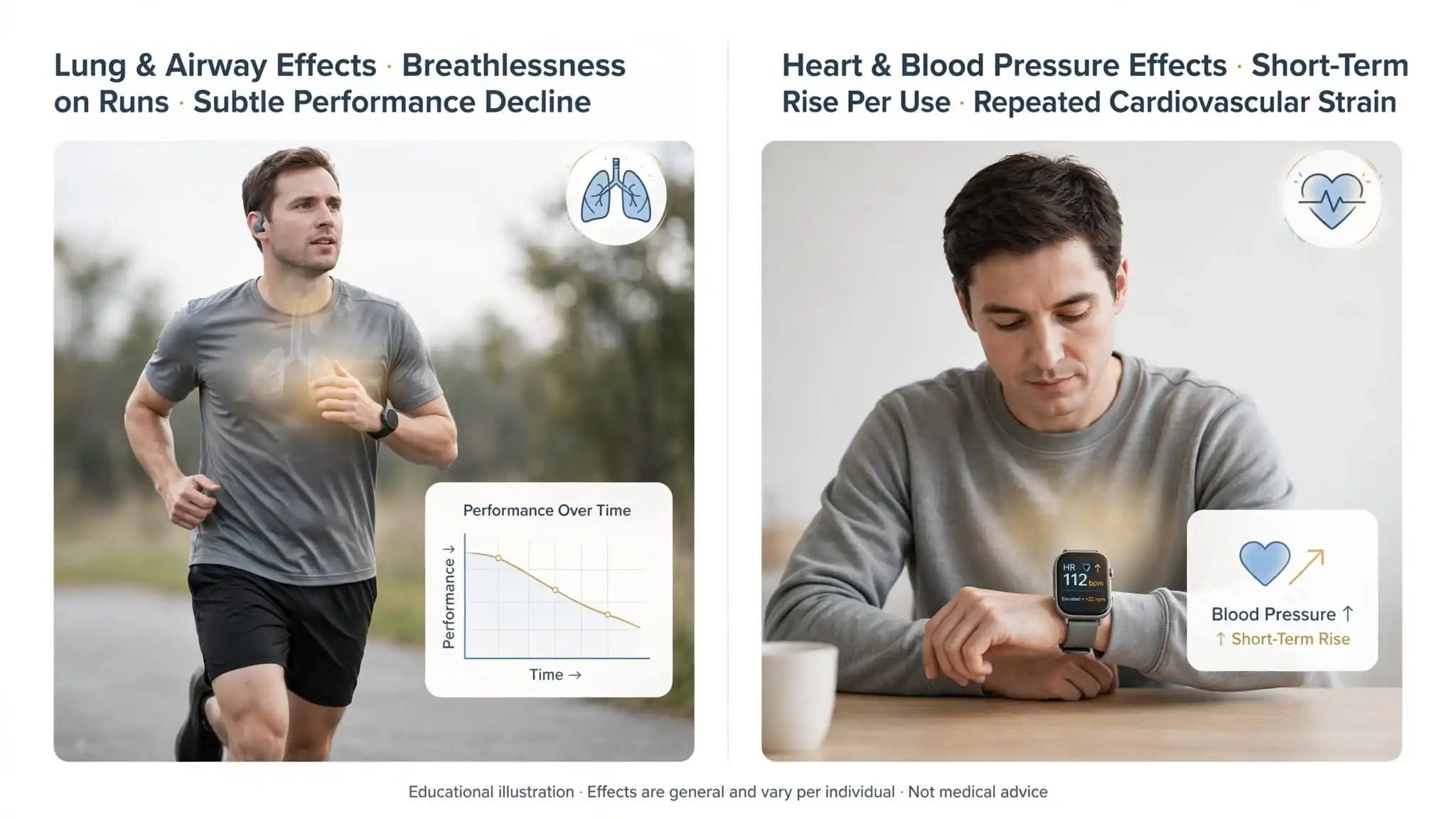
A neighbour of mine, a fairly fit man in his thirties, started noticing he was getting breathless on runs he used to finish easily. He assumed it was age or a lack of training, until a friend pointed out he’d taken up vaping heavily around the same time his running times had started slipping. He hasn’t fully quit, but he’s cut back noticeably since making that connection.
What he described to me was subtle at first — an extra ten seconds on a route he’d run for years, a bit more effort climbing the same hill. He genuinely hadn’t connected it to vaping until someone else pointed it out, which says something about how gradual this particular decline tends to be. It’s rarely a single dramatic moment; it’s a slow erosion of a baseline you stop noticing because it moves so slowly.
Heart and Blood Pressure Effects
Nicotine causes a short-term rise in heart rate and blood pressure each time it’s used, and regular use keeps the cardiovascular system under that repeated strain1. If you’re tracking your own numbers, it’s worth reading what a healthy heart rate looks like at every age for context on where yours should sit.
What I find most concerning about this particular risk is how invisible it is day-to-day. Nobody feels their blood pressure creeping up puff by puff. It only tends to surface later, as a number on a check-up form, by which point the habit has often been running for years.
The Addiction Side Nobody Talks About Enough
An Uncle’s Experience of Nicotine Dependence Through Vaping
My uncle switched to vaping after decades of smoking, expecting it to be an easy off-ramp. Instead, he told me bluntly, “I just swapped one habit for one that’s easier to hide.” He now vapes more frequently throughout the day than he ever smoked, largely because it’s odourless and socially acceptable in more places.
That last point is worth sitting with. A cigarette forces a break — you step outside, you finish it, you go back in. A vape doesn’t ask for any of that. My uncle admitted he now uses his more often precisely because there’s no natural stopping point built into the habit the way there was with smoking, which somewhat undercuts the idea that switching automatically means using less.
Why Vaping Can Be Harder to Quit Than Expected
Many vape products actually deliver nicotine more efficiently than a cigarette, which can make the dependence stronger, not weaker, even though the overall experience feels milder2. If withdrawal-related stress or irritability is part of what’s keeping someone hooked, foods that help with stress relief is worth looking at alongside any quit attempt.
What surprised me most in researching this section was learning how deliberately some devices are designed to deliver nicotine quickly and smoothly, specifically because a harsher hit puts new users off. That design choice, aimed at making the product more approachable, is part of why dependence can build faster than people expect, especially in those who never smoked before and have no baseline to compare it against.
My uncle put it more simply than any of the research did: “cigarettes were harsh enough that I never wanted more than a few a day. This doesn’t push back at all, so there’s nothing stopping you.” That absence of a natural ceiling is, in his view, the real difference — not the chemicals themselves, but how easy the product makes it to keep going.
“Safer Than Smoking” — What That Claim Actually Means
The Nuance Most Headlines Miss
It’s true that vaping exposes users to fewer of the harmful chemicals found in cigarette smoke, which is why it’s sometimes recommended as a stop-smoking aid for people who already smoke. That comparison, though, is often stretched into a much bigger claim — that vaping is safe in its own right — which isn’t the same statement at all.
Why “Less Harmful” Isn’t the Same as “Harmless”
My cousin’s justification for years was exactly this mix-up: “it’s way better than cigarettes, so it’s basically fine.” Better than one of the most harmful consumer products available is a low bar. It doesn’t mean risk-free, and it definitely doesn’t mean suitable for someone who never smoked in the first place.
This is the distinction I now try to make whenever it comes up: for an existing smoker trying to quit, vaping being less harmful is a genuinely useful stepping stone. For someone who never smoked, applying that same “less harmful” logic doesn’t hold up, because there’s no cigarette habit being replaced — there’s just a new one being created from nothing.
Vaping vs Smoking: What’s Actually Different
Since this comparison comes up constantly, here’s a rough breakdown of where the two genuinely differ, based on what I found while researching this.
| Factor | Cigarettes | Vaping |
| Tar and combustion byproducts | Present — a major driver of lung damage | Absent, since nothing is burned |
| Nicotine delivery | Slower, less efficient per puff | Often faster and more efficient |
| Chemical exposure | Thousands of compounds from burning tobacco | Fewer compounds, but still includes heated flavourings and metals from coils |
| Social visibility | Smell and smoke make it hard to hide | Odourless and easy to use discreetly, which can increase frequency |
Reading this table is what finally got through to my cousin more than anything I’d said directly. Seeing “fewer compounds” next to “still includes heated flavourings and metals” made the nuance click in a way that arguing about it over dinner never had.
Signs It Might Be Affecting Your Health
A persistent cough, chest tightness, breathlessness during activity that used to feel easy, or a noticeably faster resting heart rate are all worth paying attention to. My neighbour’s breathlessness and my cousin’s cough are fairly typical early signals — neither felt dramatic enough to act on immediately, which is exactly why they’re easy to ignore.
Because chest tightness can have several causes, it’s also worth ruling out whether anxiety could be contributing to chest pain rather than assuming any one cause automatically.
None of these signs mean something is seriously wrong on their own. What I’d gently push back on is the instinct to explain each one away individually — a cough here, some breathlessness there — without ever stepping back to look at whether they add up to a pattern, the way my cousin and neighbour both did for longer than either would now admit.
A simple habit that’s helped both of them is just writing down anything physical they notice for a week or two, without immediately trying to explain it. Looking back at a written list is a lot harder to dismiss than a string of individually forgettable moments, which is exactly why both of them missed the pattern for as long as they did.
What Actually Helped the Person I Know Quit
My uncle eventually cut down using a structured reduction plan rather than trying to quit outright — fewer puffs per day, tracked deliberately, rather than willpower alone. “Cutting cold turkey never lasted more than a day for me,” he said, “but counting it down did.” Combined with reading into the longer-term risks — including the long-term effects of high blood pressure he was already managing — the health motivation gave the gradual reduction plan enough weight to stick.
He also told me that writing the number down each day, even when it didn’t drop, kept him more honest than simply trying to “use less” in his head. “The moment I stopped counting, I stopped noticing how much I was actually doing,” he said. Small as it sounds, that single habit of tracking rather than estimating seems to have made the biggest difference of anything he tried.
Conclusion
Is vaping killing slowly? Based on everything I’ve read and watched happen to people close to me, the honest answer is: it’s carrying real, cumulative risks that don’t announce themselves loudly, which is arguably more concerning than a risk that’s obvious from day one.
My cousin still vapes, though less than before. My uncle is down to a fraction of what he started with. Neither has an easy ending to their story yet, but both now treat it as a habit worth reducing rather than a harmless one worth ignoring — which is further than either of them had gotten before we started actually talking about it.
If there’s one thing I’d want someone reading this to walk away with, it’s simply permission to question the “it’s basically harmless” version of the story, the same way I eventually did. You don’t need to have all the answers to start paying closer attention to your own habit, or to someone else’s — noticing is usually where the actual change begins.
I’ll admit I went into this research expecting to come out either fully alarmed or fully reassured, and instead landed somewhere more uncomfortable: genuinely uncertain, but far less willing to repeat “it’s basically just water vapour” the next time someone says it to me. That shift alone feels like it was worth the effort of looking properly.
This article is for general information only and is not a substitute for professional medical advice. If you’re concerned about your own vaping or smoking habits, please speak to a doctor, pharmacist, or a stop-smoking service.
Frequently Asked Questions
Is vaping actually less harmful than smoking cigarettes?
Vaping generally exposes users to fewer harmful chemicals than cigarette smoke, but “less harmful” doesn’t mean risk-free, particularly for the lungs and heart.
Can vaping cause long-term lung damage?
Yes — inhaling vape aerosol repeatedly over time can irritate and damage the airways, and long-term effects are still being studied.
What are the early warning signs vaping is affecting your health?
A persistent cough, chest tightness, breathlessness during normal activity, or a faster resting heart rate are common early signs worth taking seriously.
Is nicotine in vapes as addictive as in cigarettes?
Nicotine in vapes can be delivered efficiently enough to create dependence that’s just as strong as, or stronger than, traditional cigarettes.
What’s the best way to quit vaping?
A structured, gradual reduction plan combined with support from a doctor or stop-smoking service tends to work better than attempting to stop abruptly.
