THE SHORT VERSION
A small but well-designed study found pomegranate juice raised testosterone levels by 16 to 30 percent in just two weeks, and watching my uncle test that claim on himself taught me more about why it works than the study alone ever could. Pomegranate does not replace medical treatment for clinically low testosterone, but it appears to lower the everyday stressors — oxidative stress, high cortisol, poor circulation — that quietly suppress it.
Introduction
My uncle Imran is not a man who talks about his health. So, when he mentioned over dinner that his GP had described his testosterone as a “borderline low” during a routine blood test, I knew he had been lying with her for a while before he said something loud. He is 52 years old, still plays badminton twice a week, and has never complained about his energy in more than 20 years. That conversation made me wonder can pomegranate increase testosterone, as it was first mentioned by their GP as a dietary option worth trying, before there was a more clinical approach. I was expecting the exaggeration of the general wellness blog about pomegranates and testosterone. What I found, when I actually read the studies rather than the headlines about them, turned out to be more interesting.
Table of Contents
The Question My Uncle’s Doctor Visit Put in My Head
Imran told me the appointment itself was almost anticlimactic. No alarming diagnosis, no urgent referral — just a number slightly below the expected range, and a GP who said lifestyle and diet were worth adjusting before considering anything further. “She didn’t make it sound dramatic,” he told me, “but she also didn’t tell me to ignore it.” That balance is what stuck with me. It wasn’t a crisis. It was a nudge, and nudges are exactly the kind of thing that get quietly ignored unless someone actually follows through on the research.
He asked me, half-joking, whether I’d come across anything in my work for the site that might actually help rather than just sound good in a headline. I hadn’t, at that point. So I started reading properly, working through the actual studies rather than the summaries of them, and pomegranate kept surfacing in a way that genuinely surprised me.
What Testosterone Actually Does Beyond the Gym
There’s a common assumption that testosterone is mostly a “gym hormone” — something bodybuilders track and the rest of us can safely ignore. That’s not accurate. Testosterone plays a role in energy levels, mood regulation, sleep quality, bone density, cognitive focus, and libido, in both men and women, though men carry substantially higher levels throughout adulthood.
According to the National Institutes of Health, testosterone levels in men begin declining naturally from around age 30, dropping by roughly 1 percent per year. That sounds negligible on its own, but over two decades it adds up in ways most people never notice happening in real time. The symptoms are rarely dramatic. You feel a bit flatter. Workouts feel harder. Recovery takes longer than it used to. None of that sounded unfamiliar once Imran started describing his own past few months to me.
The Science Behind Pomegranate and Testosterone
The Queen Margaret University Study
The study that changed my mind came out of Queen Margaret University in Edinburgh. Researchers had 60 participants drink pure pomegranate juice daily for 14 days, then measured a range of physiological markers before and after. Testosterone levels rose by an average of 16 to 30 percent across the group — a wide range, but a consistent direction.
What made the study more convincing to me wasn’t just that headline number. Participants also showed reduced cortisol, lower blood pressure, improved mood, and decreased anxiety. That matters because it points to a broader hormonal environment shifting, not just one isolated number moving on its own.
My first reaction, honestly, was scepticism. A 16 to 30 percent swing from juice alone sounded generous, and 14 days is a short window for a fairly small sample of participants. But the methodology held up under scrutiny, and the cortisol finding in particular made biological sense once I understood the mechanism behind it.
How Pomegranate May Support Testosterone
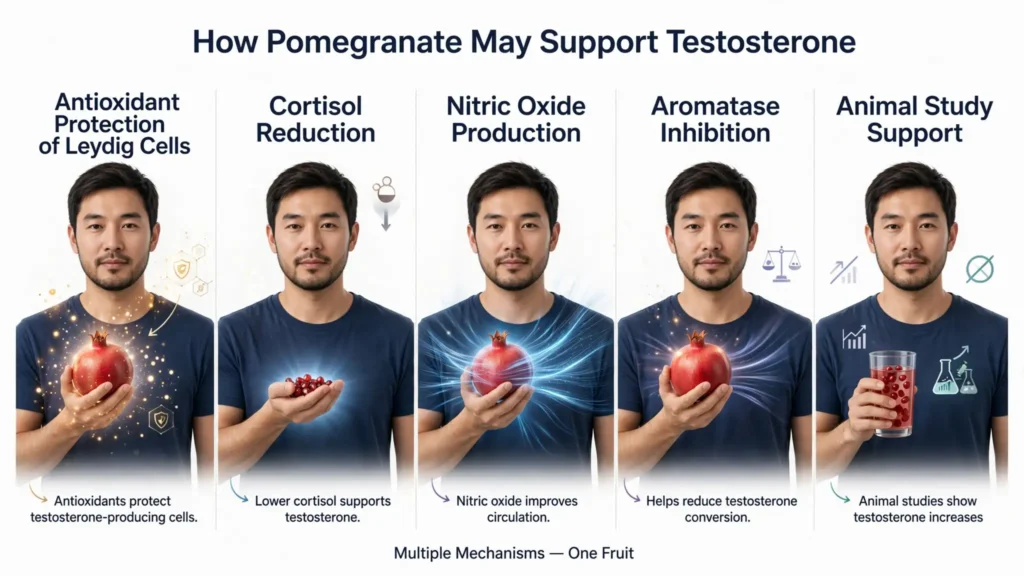
The study itself is one data point. The mechanisms behind it are where the science gets genuinely interesting to dig into.
- Antioxidant protection of Leydig cells: Testosterone is produced mainly in the Leydig cells of the testes, and oxidative stress is known to damage them over time and suppress output. Pomegranate’s punicalagins and ellagic acid are among the most potent antioxidants found in any studied food.
- Cortisol reduction: Cortisol is often described as testosterone’s chemical rival — when cortisol rises, testosterone tends to fall in response. Pomegranate’s polyphenols have been linked across multiple studies to reduced cortisol output, which is arguably the most underappreciated mechanism on this list.
- Nitric oxide production: Pomegranate is one of the best-known dietary sources of nitric oxide precursors, which improve blood flow to reproductive tissue and to the endocrine glands responsible for hormonal signalling.
- Aromatase inhibition: Early research suggests certain pomegranate compounds may inhibit aromatase, the enzyme that converts testosterone into oestrogen, which could help preserve circulating testosterone over time.
- Animal study support: A 2008 study published in Clinical Nutrition and indexed on PubMed found significant testosterone increases and improved sperm quality in male rats given daily pomegranate juice over seven weeks, corroborating the human trial through a separate biological model entirely.
WORTH NOTING
The cortisol angle is the one I keep coming back to when I think about Imran’s situation specifically. When daily stress keeps cortisol chronically elevated, testosterone production gets suppressed at the source. Lowering cortisol through diet isn’t a minor add-on — it addresses one of the most common, correctable causes of low testosterone in otherwise healthy adults.
What the Research Gets Right, and Where It Honestly Stops
I want to be direct here, because intellectual honesty is what separates useful health content from wellness hype, and it’s the standard I try to hold every article on this site to. The evidence for pomegranate supporting natural testosterone is genuinely promising, more so than most food-based interventions I’ve researched for this site. But it has real limits worth stating plainly.
The Queen Margaret study had 60 participants over 14 days — a small sample, a short window. We don’t yet have large-scale, long-duration randomised trials in humans confirming the effect over months or years. Most of the existing research uses 240 to 250ml of pure pomegranate juice daily; results with whole seeds, extract, or lower doses may look different. And pomegranate is not a clinical treatment for diagnosed low testosterone, or hypogonadism. If levels are clinically low, that requires proper medical evaluation, not a piece of fruit, however well-researched it is.
What the evidence does support, reliably, across several independent lines of research, is that pomegranate helps create the biological conditions in which healthy testosterone production is more likely: less oxidative stress, lower cortisol, better circulation, less chronic inflammation.
What Happened When My Uncle Actually Tried It
Imran started with pure pomegranate juice, 250ml every morning before breakfast, matching the study conditions as closely as he reasonably could without turning it into a science project. After the first fortnight, he switched to a mix — juice on weekdays, whole seeds scattered over porridge on weekends when he had more time to prepare food properly. He keeps a batch of frozen seeds ready in the freezer so he’s never without them, an approach he picked up after I sent him my guide on freezing pomegranate seeds so a supply lasts through the working week without spoiling.
Two weeks in, he mentioned something small over the phone: he was waking up before his alarm again, something he told me he hadn’t done in months. By week three, he said his pre-workout energy had noticeably improved. “I’m not dragging myself to badminton anymore,” he told me. “I actually want to go, which hasn’t been true for a while.”
He was honest about the caveats too, and so am I, because that matters more to me than a tidy before-and-after story. Over the same period, he was also sleeping more consistently and deliberately eating more zinc-rich foods, so pomegranate can’t be isolated as the single variable responsible for how he felt. What I can say is that the combination clearly worked for him, and the research gives a reasonable, biologically plausible explanation for why it might have.
How to Add Pomegranate to Your Diet for Hormonal Health
Fresh Juice vs Whole Seeds vs Extract — What Works Best?
| Form | Convenience | Nutrient Density | Sugar Content | Best For |
| Fresh juice (250ml) | Easy | High | Moderate | Daily hormone support |
| Whole seeds/arils | Easy | Highest | Lower (fibre buffers) | Best overall nutrition |
| Pomegranate extract | Very easy | Concentrated | Lowest | Supplemental support |
| Bottled juice | Check labels | Variable | Often high | Avoid added sugars |
Imran’s preference shifted to whole seeds over time. The fibre slows sugar absorption and adds gut health benefits on top of the active compounds already present. Juice is more convenient and still effective, but check labels carefully — many commercial pomegranate juices are diluted with apple or grape juice and loaded with added sugar you don’t need.
The Daily Amount Backed by Research
The Queen Margaret study used 240 to 250ml of pure pomegranate juice daily, roughly equivalent to one whole pomegranate in fruit terms. There’s no definitive research on the best time of day, but Imran found mornings easiest to stick with consistently — it became part of his breakfast routine rather than something he had to consciously remember later in the day.
Pairing Pomegranate with Other Testosterone-Supporting Foods
Pomegranate works best as part of a broader dietary approach rather than in isolation. The foods that complement it most effectively include the following.
- Zinc-rich foods such as pumpkin seeds, beef, and chickpeas — zinc is a direct cofactor in testosterone synthesis, and deficiency is one of the most common, correctable causes of low testosterone. You’ll find practical ideas in my guide on eating more protein day to day.
- Vitamin D sources such as oily fish, eggs, and sunlight exposure — deficiency is consistently linked to suboptimal testosterone in clinical research.
- Healthy fats such as avocado, olive oil, and nuts — testosterone is synthesised from cholesterol, so a diet too low in healthy fats can actively limit production.
- Reduced ultra-processed food and alcohol — both are independently associated with lower testosterone and higher oestrogen levels in men.
If you’re building a broader routine around this rather than just adding one fruit to your morning, my 7-day gym diet plan covers how to structure meals around these priorities without it becoming a second job.
Who Should Be Cautious About Pomegranate?
IMPORTANT Pomegranate can interact with blood pressure medication, statins, and blood thinners in a similar way to grapefruit, amplifying their effects in ways that require medical oversight. Speak to your GP before making it a daily habit if you take any of these.
Beyond medication interactions, a few groups should take extra care. People with diabetes should monitor the natural sugar content in juice specifically — whole seeds with their fibre content are generally the safer choice. Those with kidney conditions should be cautious, since pomegranate is relatively high in potassium, which can be difficult for compromised kidneys to regulate. Pomegranate allergy is rare but documented; discontinue use and consult your GP if you notice itching, swelling, or digestive upset after eating it.
Beyond Testosterone — Why This Fruit Kept Earning Its Place
Even setting testosterone aside entirely, the evidence base for pomegranate is genuinely strong. The heart health benefits are particularly well documented — I’ve covered the specific mechanisms in a full piece on whether pomegranate juice can lower cholesterol, if you want to go deeper into that side of it.
There’s also exercise recovery to consider. Research indexed on the NIH database has found pomegranate extract reduces muscle soreness and oxidative stress after intense exercise, which is directly relevant if you’re using physical training alongside dietary changes as part of a broader testosterone-support strategy.
And pomegranate feeds beneficial gut bacteria. Emerging research increasingly links microbiome diversity to hormonal function, including testosterone regulation, which means the gut may be supporting hormonal health almost as much as anything happening directly in the bloodstream. If you’re curious how pomegranate affects blood health more broadly, I’ve also written about whether it can influence platelet counts, which covers a related but distinct mechanism worth understanding on its own.
My Honest Verdict — Can Pomegranate Actually Increase Testosterone?
Yes, with conditions. Evidence suggests that daily consumption of pomegranate creates a more conducive harmonic environment for testosterone production, as it reduces several factors that are known to suppress it: oxidative stress, high cortisol, poor circulation, and chronic inflammation.
If testosterone is clinically low, it’s not a substitute for medical treatment — the conversation should have taken place with the GP first, as it did for Imran. But as a dietary habit, which sits alongside good sleep, reasonable stress management, and regular exercise, pomegranate is one of the best supported food-based interventions I’ve seen while researching for this site. Imran is still carrying on his daily seeds. I’ve also started keeping a batch in my freezer, mostly out of curiosity, not needed at the moment.
Medical Disclaimer: This article is for informational purposes only and does not constitute medical advice. Always consult a qualified healthcare professional before making significant changes to your diet or if you have concerns about your hormone levels.
Frequently Asked Questions
Can pomegranate increase testosterone in men?
Yes — a Queen Margaret University study found daily pomegranate juice raised testosterone by 16 to 30 percent over 14 days, largely through reduced cortisol and antioxidant protection of testosterone-producing cells.
How much pomegranate should I eat to support testosterone?
Most research uses 240 to 250ml of pure pomegranate juice daily, roughly equal to one whole pomegranate; consistency over several weeks matters more than the exact amount consumed.
How quickly can pomegranate affect testosterone levels?
The Queen Margaret study recorded measurable changes after just 14 days, though individual results depend on baseline hormones, stress, sleep, and overall diet.
Does pomegranate juice increase testosterone in women too?
Most research has focused on men, but pomegranate’s cortisol-lowering and antioxidant effects support hormonal balance in women as well.
Is pomegranate better than testosterone supplements?
No — pomegranate supports the body’s natural testosterone-producing environment but does not replace clinically prescribed treatment for diagnosed low testosterone.

5 thoughts on “Can Pomegranate Increase Testosterone?”
Comments are closed.