In Short: Yes — the gym can genuinely change your face, through five measurable biological mechanisms: better circulation, hormonal shifts, lymphatic drainage, lower inflammation, and facial fat loss. I watched this play out over a few months with my cousin Salman, and this article covers what’s realistic to expect, and what the gym can’t do.
Introduction

Can gym change your face? I found the question a bit odd — until I hadn’t seen my cousin Salman for nearly two months and barely recognized him at a family dinner. It’s not his body. His face. Sharp jaw, glowing skin, something that seemed more awake, though he had told me that he had barely slept this week.
That one dinner really took me on a deeper journey of research, because the honest answer to whether the gym can change your face turned out to be more interesting, and specific than I expected. This article covers the actual biological mechanisms behind it, what Salman experienced month after month, almost no one in the fitness content mentions the risk, and the realistic timeline of what to expect.
Table of Contents
The First Time I Noticed It Wasn’t Just Me Imagining Things
Seeing Cousin Salman After Eight Weeks
Salman had joined a gym near his flat about eight weeks earlier, mostly to deal with stress after a rough patch at work. I hadn’t seen him in that stretch, and when he walked into my aunt’s dining room, I actually did a double take.
His jaw looked more defined. His skin had an evenness to it I hadn’t noticed before — no redness around his nose, no dullness under his eyes despite admitting he’d had a rough week of sleep. When I asked if he’d changed his skincare routine, he laughed and said, “Mate, I haven’t touched my skin. I’ve just been going to the gym.”
The Comment That Made Me Start Looking Into It
That comment stuck with me, mostly because it didn’t fit what I expected. I’d always thought of the gym as something that changed your body — arms, waist, shoulders — not your face. But looking at Salman across the table, it was hard to argue with what I was seeing.
I asked him a few more questions that night, and over the following weeks I started digging into whether there was an actual biological explanation, or whether I was just imagining a difference that wasn’t really there. What I found is that the face isn’t a beauty-treatment target — it’s simply skin and tissue responding to the same whole-body changes the gym produces everywhere else.
My first assumption was that it was just weight loss — Salman had dropped a bit of body fat, so of course his face looked different. That turned out to be part of the story, but only part. The skin brightness, the reduced puffiness, the calmer complexion — none of that is explained by fat loss alone. There were clearly several separate mechanisms at work, not just one.
How Exercise Actually Affects the Face — The Biological Mechanisms

What I found, digging through this properly, is that none of it is mysterious once you break it down. The face is simply skin, muscle and fat responding to the same whole-body processes that training triggers everywhere else — it just happens to be the part of the body we all stare at every morning, so the changes are easier to notice than, say, a slightly improved liver enzyme panel.
Increased Circulation and the Post-Workout Flush
Exercise widens blood vessels throughout the body, including in the skin. That’s the immediate flushed, glowing look you see mid-workout. Over months of consistent training, that improved circulation stops being a temporary bonus and becomes closer to a baseline state — skin cells that are better supplied with oxygen and nutrients renew more evenly.
Hormonal Shifts — Lower Cortisol, More Growth Hormone
Regular training lowers cortisol, the stress hormone linked to inflammation and premature skin ageing, while raising endorphins, growth hormone and testosterone. Each of those shifts has a measurable, positive effect on skin repair and collagen production over time.
Lymphatic Drainage and Facial Puffiness
The lymphatic system has no pump of its own — it relies on physical movement to clear excess fluid and waste from tissue. Regular exercise keeps that system moving, which directly reduces facial puffiness, particularly around the eyes.
Lowered Systemic Inflammation
Chronic low-grade inflammation is a major driver of premature skin ageing, acne and uneven tone. Regular aerobic and resistance training has been shown to reduce inflammatory markers over time, which tends to show up as a calmer, clearer complexion.
Body Fat Loss and Facial Fat Distribution
This is the mechanism with the biggest cosmetic effect. As overall body fat drops, facial fat drops proportionally too — which is what sharpens a jawline, defines cheekbones, and reduces fullness under the chin. It’s not spot-reduction; it’s systemic fat loss showing up on the face along with everywhere else.
The Visible Changes I’ve Watched Play Out
A Brighter, More Even Complexion
By around week six, Salman’s skin tone had visibly evened out — less redness, a more consistent colour across his face. That tracks with what improved circulation and lower inflammation do to skin over a couple of months of consistent training.
A Sharper Jawline as Body Fat Dropped
Salman wasn’t chasing an extreme physique — just consistent training and better eating habits. But as his body fat came down gradually, his jawline sharpened along with it. He hadn’t set out to change his face at all; it came along with everything else.
He told me later that a few colleagues at work had asked if he’d lost weight, before he’d said anything about the gym himself. That’s roughly in line with what tends to happen — the face is often where noticeable fat loss shows up first, simply because facial skin is thinner and the underlying fat pad is smaller, so a given percentage change is more visually obvious there than on, say, the thighs.
Slower Visible Skin Ageing
Consistent training supports collagen and elastin production, the two proteins responsible for skin firmness and elasticity. Salman also started paying more attention to his vitamin D levels around the same time, which matters here too — low vitamin D can undercut the very collagen production that exercise is otherwise supporting.
Clearer Skin — and the Sweat-Related Catch
Salman noticed clearer skin on the days after harder sessions, which fits with lower inflammation and sweat clearing out pores. But he also went through a patch of breakouts along his jawline, which turned out to be dried sweat sitting on his skin too long after training. Washing his face within about 30 minutes of finishing a session solved it.
Reduced Morning Puffiness
The most noticeable early change, according to Salman, was under his eyes. Morning puffiness — the kind caused by sluggish lymphatic drainage — improved within the first few weeks, even on days he trained lightly.
A Better Jaw and Neck Profile From Posture Training
Salman spends most of his working day at a desk, and forward head posture had been quietly flattening his lower face profile for years without him realising. Once his trainer added rows and face pulls to strengthen his upper back, his head position shifted back over his spine — and his jaw and neck profile changed within weeks, from the side especially. It’s a similar mechanism to how posture affects apparent height — the structure looks different before any actual physical change has occurred underneath it.
The Cortisol-and-Skin Connection
Salman had started the gym specifically to manage work stress, which turned out to be relevant here too. Chronic stress and elevated cortisol are linked to visible skin ageing, partly by suppressing collagen production and disrupting sleep. Every session that lowered his stress levels was, in a sense, doing something for his skin as well as his mind.
‘Gym Face’ — The Risk Salman’s Trainer Warned Him About
What Gym Face Actually Is, and Who’s at Risk
About four months in, Salman mentioned that his trainer had brought up something called ‘gym face’ — the ageing effect that can develop in very lean, long-term gym-goers, usually past their mid-30s. When body fat drops too low for too long, the padding that gives the face its youthful fullness thins out too, leaving sunken cheeks, hollow temples and more pronounced nasolabial folds.
Gym face is mainly a risk for dedicated athletes maintaining body fat below roughly 12% (women) or 8% (men) for extended periods — not for recreational exercisers or anyone in a healthy body fat range.
Why This Isn’t a Reason to Avoid the Gym
Salman isn’t anywhere near that extreme, and neither are most people who train regularly. The sweet spot — the one that gives you the circulation, hormonal, anti-inflammatory and structural benefits without the downside — is a healthy, sustainable body composition, not an extremely lean one held for years on end.
What reassured me most, reading around this, is how narrow the risk group actually is. It’s essentially limited to competitive athletes and long-term bodybuilders maintaining stage-lean body fat percentages for months or years at a time — not someone training three or four times a week and eating reasonably, which describes the overwhelming majority of gym-goers, Salman included.
What the Gym Can Change — and What It Can’t
It’s worth being realistic about where the limits are.
| What Gym Can Change | What Gym Can’t Change |
| Skin tone and brightness (circulation) | Bone structure of the face |
| Facial definition and jaw clarity (body fat) | Nose, ear or lip shape |
| Skin texture and pore appearance | Facial symmetry |
| Under-eye puffiness (lymphatic drainage) | Hereditary skin conditions |
| Rate of visible skin ageing (collagen) | Skin type (oily, dry, combination) |
| Acne and redness frequency (inflammation) | Existing scar tissue |
| Side profile through posture correction | Genetic predisposition to wrinkles |
The gym can give you healthier skin, better facial definition, and improved posture. It can’t reshape your bones or change what you were born with — and it’s worth knowing that going in, the same way it’s worth knowing the gym doesn’t stunt growth, another commonly misunderstood claim about what training can and can’t do to your body.
A Realistic Timeline for Facial Changes
| Timeline | What to Expect |
| Week 1–2 | Temporary post-workout glow. No structural changes yet. |
| Week 3–4 | Skin tone starts improving; less morning puffiness. |
| Week 6–8 | Noticeable brightness and texture improvement; slight slimming if body fat is dropping. |
| Month 3–6 | Meaningful facial definition and posture-related profile changes. |
| 6+ months | Full compound effect: skin quality, definition, reduced puffiness and posture together. |
Salman’s own experience roughly matched this. The puffiness improved fastest, the jawline change took the longest, and none of it happened in a dramatic before-and-after way — it was gradual enough that he almost didn’t notice it himself, even though I clearly did.
Simple Habits That Maximise the Facial Benefits of Training
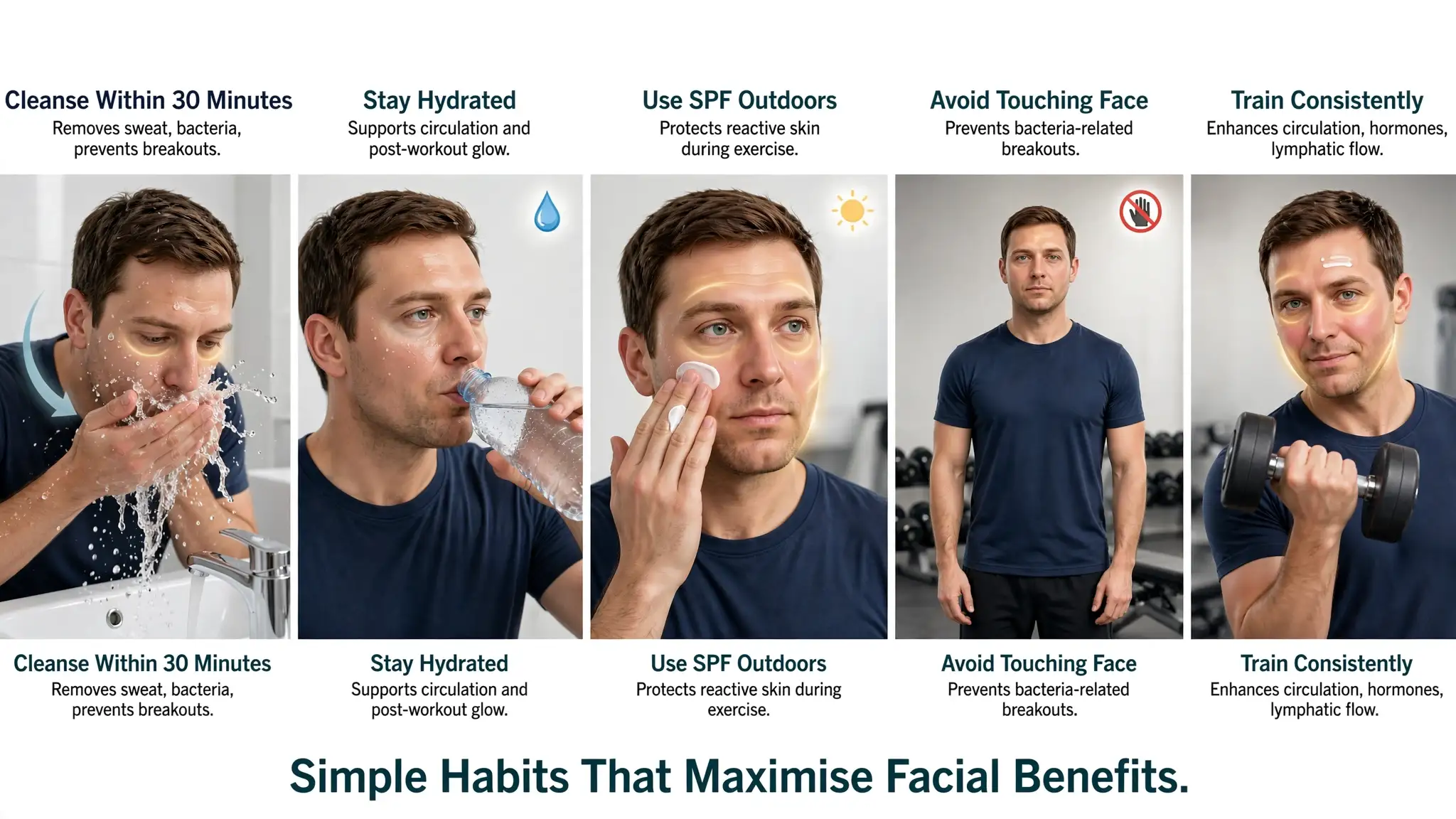
Cleanse Your Face Within 30 Minutes of Training
Sweat opens pores and clears out debris during a workout, but left on the skin too long it becomes a breeding ground for bacteria. Washing within half an hour turned Salman’s jawline breakouts around completely.
Stay Hydrated, Especially Around Workouts
Mild, chronic dehydration shows up on skin as dryness and more visible fine lines, and it blunts the post-workout glow that better circulation is supposed to give you.
Use SPF for Any Outdoor Training
The same increased blood flow that benefits skin during exercise also makes it more reactive to UV exposure. For anything over about 20 minutes outdoors, SPF 30 on the face is worth the thirty seconds it takes.
Avoid Touching Your Face at the Gym
Gym equipment carries a lot of bacteria, and touching your face during a workout — while pores are open from sweating — is one of the more common causes of exercise-related breakouts around the jaw and hairline.
Conclusion
Watching Salman go through all of this for months completely changed the way I think about the gym. It’s not just the physical plan — the same blood flow, hormones, inflammation and fat loss that are bringing changes to other parts of the body are clearly affecting the face as well.
For anyone who is constantly training with a healthy and sustainable body composition, the situation is clearly good: better skin, more clarity, less swelling, with time. The risk of exposure to the gym is real, but it only applies to a few long-term, ultra-lean groups of athletes — not to those who come in a few times a week.
This article is for general information only and is not a substitute for professional medical or dermatological advice. Individual results vary based on genetics, age, and body composition — speak to a qualified dermatologist if you have specific concerns about your skin or facial appearance.
Frequently Asked Questions
Does going to the gym make your face slimmer?
Yes — consistent training combined with a moderate calorie deficit reduces facial fat along with overall body fat, typically becoming noticeable after three to six months.
How long does it take to see facial changes from exercise?
A temporary post-workout glow appears within the first week, skin tone and puffiness improve by weeks three to four, and structural changes like jawline definition usually take six to twelve weeks or more.
Can exercise improve skin quality and reduce visible skin ageing?
Yes — exercise supports collagen and elastin production, reduces inflammation linked to skin ageing, and lowers cortisol, all of which contribute to slower visible ageing.
What is ‘gym face’ and how do you prevent it?
Gym face is premature facial ageing caused by very low body fat over an extended period, and it’s prevented by maintaining a healthy, sustainable body fat range rather than an extremely lean one.
Does sweating at the gym clear your skin?
Partly — sweat clears pores of debris during a workout, but left on the skin afterwards it can cause breakouts, so washing your face within 30 minutes of training is important.

7 thoughts on “Can Gym Change Your Face?”