QUICK SUMMARY
Posture doesn’t break down once a day — it breaks down continuously throughout an 8-hour workday, which means a single morning stretch routine isn’t enough on its own. Desk exercises for posture that work in the middle of a meeting, done entirely from your chair, close that gap. Pairing a few seated resets with a properly set-up desk closed the loop for good.
Introduction

My colleague Adeel found himself bent over during the meeting, his laptop leaning against a pile of books, shoulders as far forward as he could feel in his jaw. He couldn’t do a proper stretching routine while standing on the call in front of six other people, so he quietly straightened up and hoped it would be okay. It didn’t happen, not more than a few minutes. It was that special, meeting moment that prompted me to do some proper research on the desk exercises for posture, as it turned out that the difference wasn’t in his morning routine — but in everything that happened by the end of the day. I tried a complete reset with Adeel for several weeks, revolving around exactly the same moments, and it changed the consistency of it. Here’s exactly what we got.
Table of Contents
Why Posture Needs In-the-Moment Fixes, Not Just a Morning Routine
A Corrective Routine Once a Day Isn’t Enough
A dedicated posture routine done once in the morning is genuinely valuable, and I’ve covered a full resistance band routine built around correcting the underlying muscular imbalance in detail elsewhere. But posture doesn’t hold itself for eight hours afterwards. It degrades gradually across the day, through meetings, deep focus, and the dozens of small moments where nobody is thinking about their shoulders at all.
That’s the actual gap this piece addresses — not another corrective session, but something that works in the exact moment posture starts slipping, without needing to leave your chair or draw attention to yourself.
Adeel had actually been doing the corrective routine reasonably consistently each morning before this. It genuinely helped, for about an hour. By the time his first meeting rolled around, the careful alignment from breakfast had already started drifting, simply because nothing in his day addressed the hours in between the routine and whenever he next remembered to check his posture.
Why the Desk Setup Itself Is Half the Problem
Even perfect posture habits struggle against a desk setup that actively works against them. A monitor sitting too low, a chair with no lower back support, or a keyboard positioned awkwardly all pull the body back toward the same slumped position, regardless of how many reminders you set for yourself.
Adeel’s setup, it turned out, was working against him in a fairly obvious way once we actually looked at it properly. His laptop sat directly on the desk, screen well below eye level, which meant every single seated reset was fighting the same downward pull the moment he looked back at his work. No amount of shoulder blade squeezes fully offsets a monitor that’s actively encouraging the neck to drop forward.
Why I Built a Purely Seated Approach
The Meeting I Couldn’t Just Stand Up and Fix
That meeting moment stuck with Adeel because it highlighted something most posture advice quietly ignores: plenty of the day’s worst posture moments happen in situations where standing up and stretching simply isn’t an option. A call, a meeting, a deep-focus stretch of work — all of it demands something that works discreetly, seated, in seconds.
Building the routine entirely around that constraint, rather than assuming free movement whenever posture needed correcting, was really the whole starting point.
It also meant ruling out anything that required standing, floor space, or equipment of any kind, since the whole point was reliability in situations where none of that was realistically available. A move that only works when you happen to have a private moment isn’t much use for the specific problem of posture slipping mid-meeting, mid-call, or mid-deep-focus stretch of work.
The Seated Reset Routine That Actually Works Mid-Workday
This is the exact routine Adeel started using, every move done fully seated and quiet enough not to draw attention on a call.
Seated Shoulder Blade Squeeze

Sitting tall, gently squeeze your shoulder blades together as though holding a pencil between them, hold for 5 seconds, release. Repeat 8–10 times. This resets rounded shoulders in seconds, without leaving the chair or needing any space at all.
Seated Chin Tuck
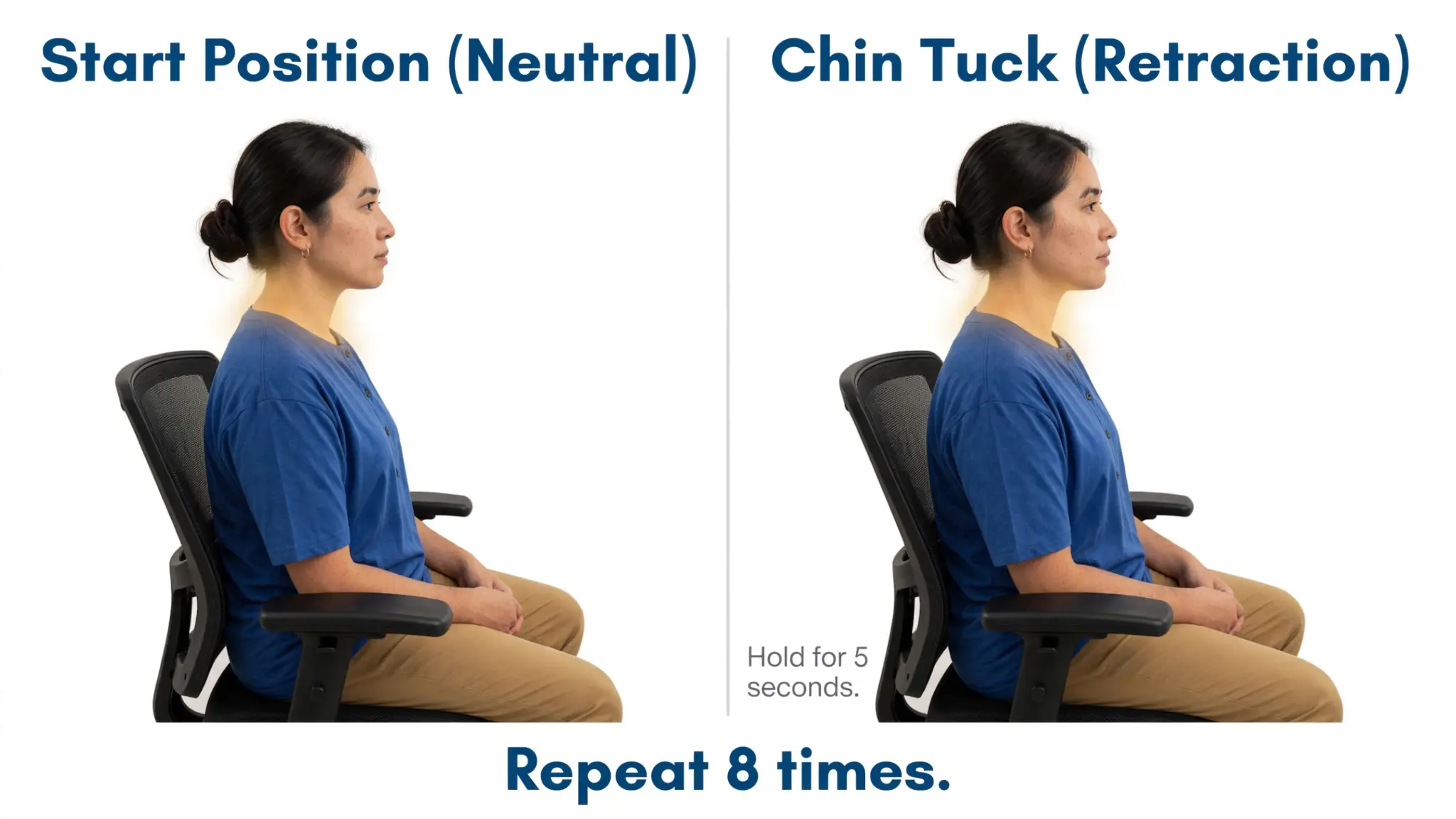
Sitting upright, gently draw your chin straight back without tilting up or down. Hold 5 seconds, repeat 8 times. This corrects forward head posture mid-task, something that creeps in during focused screen work more than almost any other moment.
Seated Spinal Stack
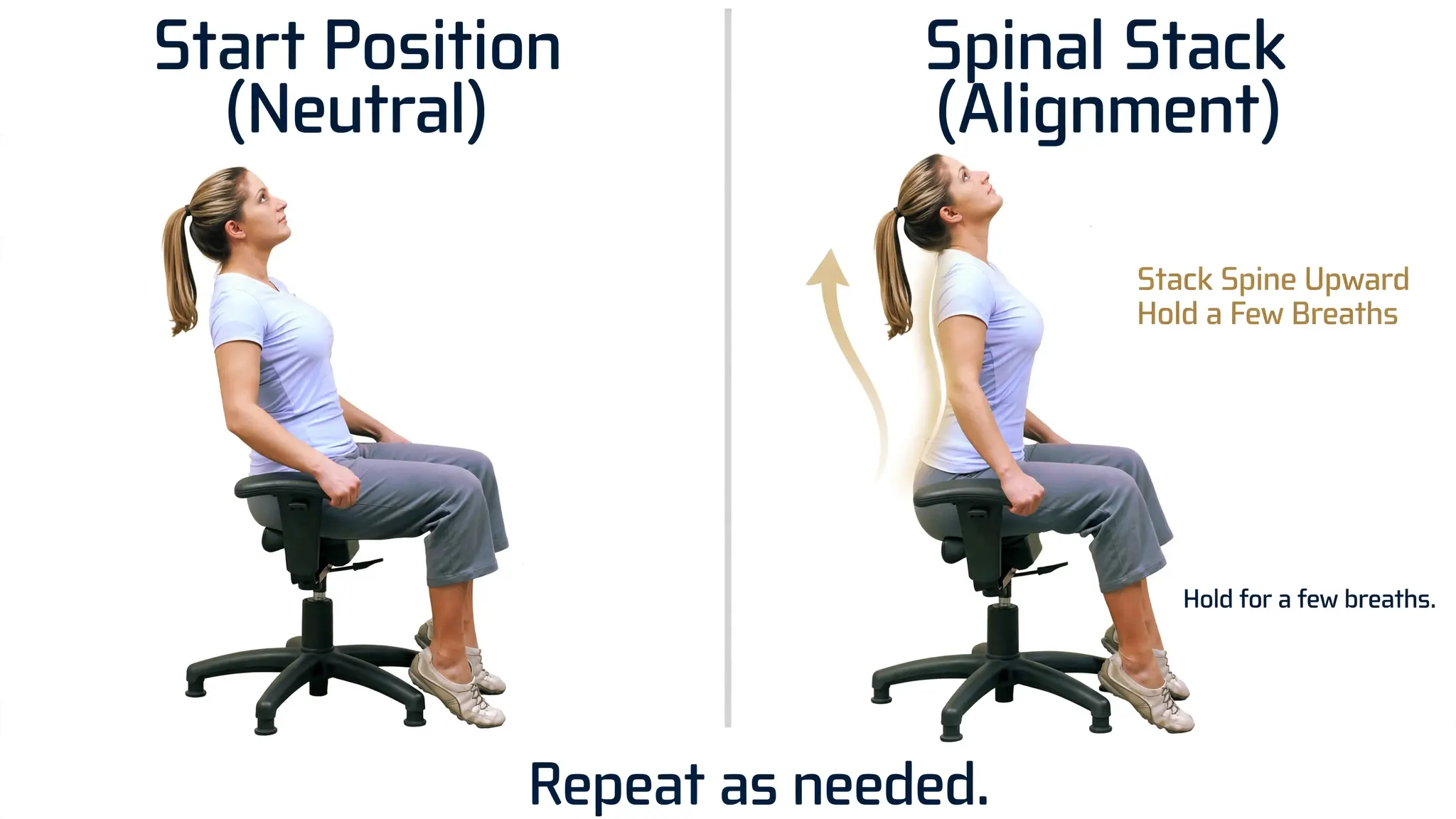
Sitting tall, imagine stacking each vertebra directly on top of the one below, from the base of the spine up through the crown of the head. Hold the position for a few breaths. This resets overall spinal alignment in one deliberate motion, rather than correcting the shoulders and neck separately.
Seated Chest Opener (Arms Behind Chair)
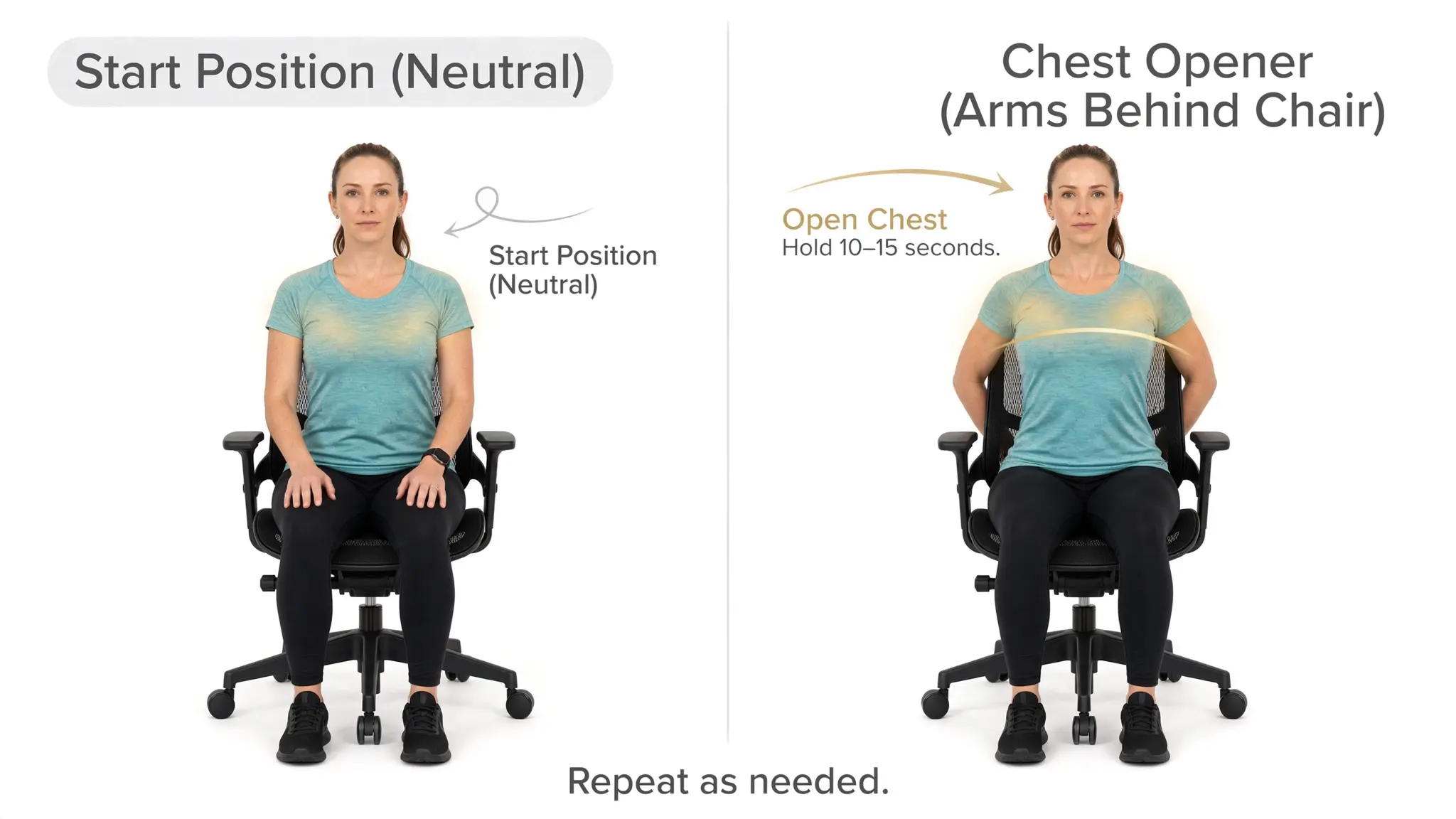
Reaching both arms behind the back of your chair, gently squeeze the shoulder blades and open the chest. Hold 10–15 seconds. This counters the forward pull of typing and screen work without needing to stand up.
The 20-Second Posture Scan

A brief, deliberate check: are the shoulders rounded, is the head jutting forward, is the lower back supported? Simply noticing and adjusting takes under 20 seconds. This builds the awareness that makes the other four moves actually get used throughout the day, rather than forgotten. It’s the least glamorous move in the routine and also the one that made every other move worth doing, since none of them help if the slouching goes unnoticed in the first place.
“The real shift wasn’t a bigger routine — it was having something small enough to actually use in the exact moment posture started slipping, instead of waiting for a break that might not come for hours.”
Quick Reference: The Routine at a Glance
| Exercise | Best Trigger | Duration |
| Seated shoulder blade squeeze | Noticing rounded shoulders | 30 sec |
| Seated chin tuck | Deep focus screen work | 20 sec |
| Seated spinal stack | Start of a meeting | 10–15 sec |
| Seated chest opener | After long typing stretch | 15 sec |
| 20-second posture scan | Every 30–45 min | 20 sec |
Fixing the Desk Setup Itself
Monitor and Chair Height Basics
Raising the monitor so the top of the screen sits roughly at eye level reduced how often Adeel’s neck drifted forward in the first place. Getting the chair height right, with feet flat and lower back genuinely supported, made the seated resets considerably more effective, since they were reinforcing a baseline that was already reasonably close to correct rather than fighting the setup itself. The same posture and stability principles covered elsewhere apply directly to how a desk should be arranged, not just how the body moves within it.
A stack of old books did the job for raising Adeel’s laptop until he sorted out a proper stand, which is worth mentioning because the fix genuinely doesn’t need to be expensive or complicated to make a real difference.
What Changed After a Few Consistent Weeks
By the second week, Adeel’s posture scan had become something he did almost without thinking, particularly at the start of calls. The shoulder blade squeeze became his most-used move by far, mostly because it fit into so many ordinary pauses throughout the day — waiting for a page to load, between sentences while writing an email.
None of these moments felt significant individually. Collectively, across a full 8-hour day, they added up to something that actually mattered — dozens of small corrections rather than one big one that had to somehow last the whole day on its own.
Mistakes That Undo Good Desk Posture
A few habits quietly worked against progress early on, and they’re easy mistakes to make even once the seated routine itself is working well, mostly because they involve assumptions that feel perfectly reasonable at the time.
Fixing Posture Once and Forgetting About It All Day
Adeel’s first instinct was to do a solid posture correction first thing in the morning and assume it would hold. It never did, simply because posture degrades continuously throughout the day regardless of how strong the starting position was. Treating the morning routine as a complete solution, rather than a starting point the day would then chip away at, set expectations that were never going to match reality.
Ignoring Rounded Shoulders or Forward Head Specifically
The seated resets covered here work well for maintaining posture throughout the day, but they’re not a substitute for properly correcting an existing muscular imbalance. If rounded shoulders are a persistent, underlying pattern rather than an occasional slip, a dedicated bodyweight routine for rounded shoulders addresses that directly. If it’s specifically the head jutting forward that keeps returning, a neck-specific routine built around that exact pattern goes considerably deeper than a quick chin tuck ever could on its own.
Adeel’s shoulders, once we looked closely, had drifted into a genuinely rounded resting position over the years, not just during stressful meetings. The seated squeeze helped him notice and correct it in the moment, but it took the more dedicated routine, done separately, to actually shift that underlying baseline rather than just interrupting it repeatedly throughout the day.
When Desk Posture Fixes Aren’t Enough
Seated resets and a properly arranged desk help maintain good posture throughout the day, but they aren’t the right response to every case. It’s worth speaking to a doctor or physiotherapist if any of the following apply:
- Numbness or tingling in the arms or hands
- Persistent pain that doesn’t ease with consistent adjustment
- Restricted range of motion that doesn’t improve over time
- A known structural condition such as scoliosis or a previous spinal injury
“Adeel didn’t have any injury history, but anyone with a previous neck or back issue should check with a physiotherapist before relying on any posture routine, seated or otherwise, as their main fix.”
What Changed After a Few Consistent Weeks
By the end of the first month, Adeel’s colleagues on video calls stopped seeing the slow, mid-meeting slump that used to creep in by the thirty-minute mark. He wasn’t doing anything dramatic — just a quiet shoulder blade squeeze here, a posture scan there — but it added up to a genuinely different baseline by the end of a normal workday.
Neither of us treated this as a replacement for deeper corrective work where it’s actually needed. It’s the missing piece that keeps a good posture routine from quietly unravelling over the course of an ordinary 8-hour day, which is the part most posture advice assumes will just take care of itself.
What made the biggest difference, looking back, was simply having something ready for the exact moments posture actually fails — not a plan for an idealised, uninterrupted stretch of free time that rarely shows up in a real working day. Building around the actual constraints of an 8-hour workday, rather than around an imagined version of it, was the entire shift that made this stick where the morning-only routine hadn’t.
FAQs
Can posture be fixed without leaving your desk?
Day-to-day posture can be genuinely maintained through seated resets. Correcting an underlying muscular imbalance usually benefits from a dedicated routine alongside them.
What is the fastest desk exercise for posture?
The seated shoulder blade squeeze gives the quickest reset, taking under 30 seconds to visibly correct rounded shoulders.
How often should I check my posture during work?
A quick posture scan every 30–45 minutes is generally enough to catch slouching before it becomes the default position for the rest of the day.
Does desk setup matter as much as exercises for posture?
Yes. A properly arranged monitor and chair reduce how often posture slips in the first place, making any seated exercises considerably more effective.
When should desk-related posture problems be checked by a doctor?
See a doctor for numbness or tingling in the arms, persistent pain, restricted range of motion, or a known structural spinal condition.
Final Thoughts
None of this means you should leave your desk, buy stuff, or find a private moment where you can pull in. A short desk exercise for posture, which is used at the very moment when the posture really slips, really made a difference for the person I watched quietly straighten up during the meeting and hoped it would last—and if your own posture is scattered somewhere between your morning routine and the end of the day, it’s worth trying.
If there’s one thing you can learn from it, it’s that maintenance is better than a correction: using a few seconds throughout the day, just as the posture starts to slip, can do more than one solid stretching every morning. Start by pressing the seated shoulder blade and scanning the 20-second posture, as this pair captures most of the tilt that would form on a typical workday, and add the rest when both are automatic.
This article is for general information only and is not a substitute for professional medical advice. Please consult a doctor or physiotherapist if you have persistent pain, numbness, or a known spinal condition.
