QUICK SUMMARY
Rounded shoulders don’t need a resistance band or gym equipment to fix — the same tight-chest, weak-upper-back imbalance responds just as well to bodyweight moves done consistently at home. Exercises for rounded shoulders at home work because they remove the one barrier that stops most people from starting at all: needing to buy something first. The five-move routine below needs nothing but a wall, a floor, and a doorway.
Introduction

My friend Zara had been talking about fixing her posture for months without starting. Every conversation would end the same way — she’d read something about resistance bands, add it to an online cart, then close the tab and forget about it entirely. Meanwhile, her shoulders continued to stretch a little more each month, especially when she started working full-time from home. Watching this cycle repeat month after month, I began to thoroughly research the exercises for rounded shoulders at home, as it turned out that the equipment was never necessary — it was just an excuse that kept getting in the way over and over again. I tried a full bodyweight routine with Zara for several weeks, and the fact that she could start the same evening, without any orders or waits, made a huge difference. Here’s exactly what we got.
Table of Contents
Why Rounded Shoulders Don’t Need Equipment to Fix
The Same Imbalance, a Different Toolkit
Rounded shoulders come from the same underlying pattern regardless of what tools you use to fix them — tight chest and neck muscles paired with a weak, underactive upper back, sometimes called upper crossed syndrome. Bodyweight exercises can strengthen the weak side and stretch the tight side just as effectively as equipment-based ones, because the muscles involved don’t actually require external resistance to be trained properly at a beginner level.
What changes with bodyweight training isn’t the effectiveness — it’s the ceiling. Resistance bands let you keep adding load as you get stronger, which matters more for long-term progression than it does for someone just starting to correct the imbalance in the first place.
That distinction mattered a lot to Zara, who had assumed bodyweight training was somehow a lesser, beginner-only version of “real” posture correction. It isn’t. For the specific goal of reactivating weak upper back muscles and releasing a tight chest, bodyweight resistance is genuinely sufficient — the ceiling only becomes relevant once someone’s already made significant progress and wants to keep building strength beyond that initial correction.
Why “At Home” Usually Means “I Never Actually Start”
Zara’s pattern wasn’t unusual. Needing to buy, receive, and remember to use a piece of equipment adds several points where a good intention quietly dies before it ever becomes a habit. Removing that step entirely, and starting with exercises that use nothing but a wall or a doorway, closes that gap completely. For anyone who does want to add resistance later on, once the basics are comfortable, I’ve covered a dedicated resistance band routine built around this exact same imbalance separately — it’s a natural next step, not a requirement to get started.
Why I Built a No-Equipment Version
The Friend Who Kept Postponing Because of a Missing Resistance Band
The turning point was a fairly ordinary evening. Zara mentioned, again, that she still hadn’t bought a band, and almost as a test I asked her to just try a doorway stretch right then, using nothing but the door frame she was standing near. She did it, admitted it felt genuinely good, and did two more moves before we’d even finished the conversation.
That was the entire insight, really. The exercises themselves were never the obstacle — the perceived requirement for equipment was. Once that assumption was removed, starting stopped being a decision that needed planning and became something she could just do.
It’s a pattern I’ve noticed well beyond posture specifically. Plenty of genuinely good health habits get delayed indefinitely, not because the person doesn’t want to start, but because some small perceived prerequisite — the right shoes, the right app, the right piece of equipment — quietly turns into a reason to wait. Removing that one barrier is sometimes the entire intervention needed.
The At-Home Routine That Actually Corrected It
This is the exact bodyweight routine Zara worked through, using nothing but a wall, a doorway, and floor space. Each move takes under two minutes.
Doorway Chest Stretch
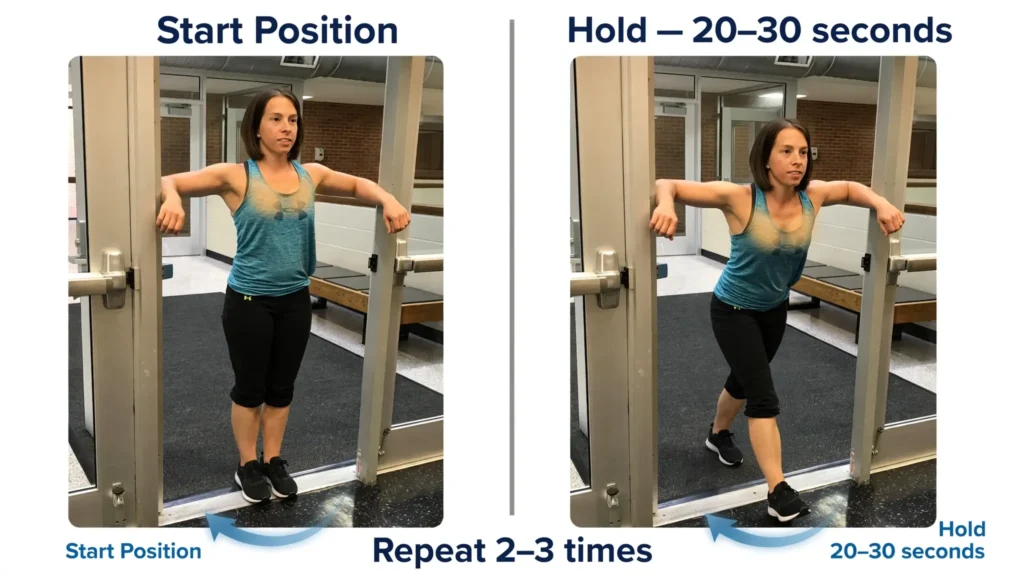
Standing in a doorway, place your forearms on either side of the frame at shoulder height and gently step forward until you feel a stretch across the chest. Hold 20–30 seconds. This directly releases the tight pectoral muscles pulling the shoulders forward.
Wall Angels
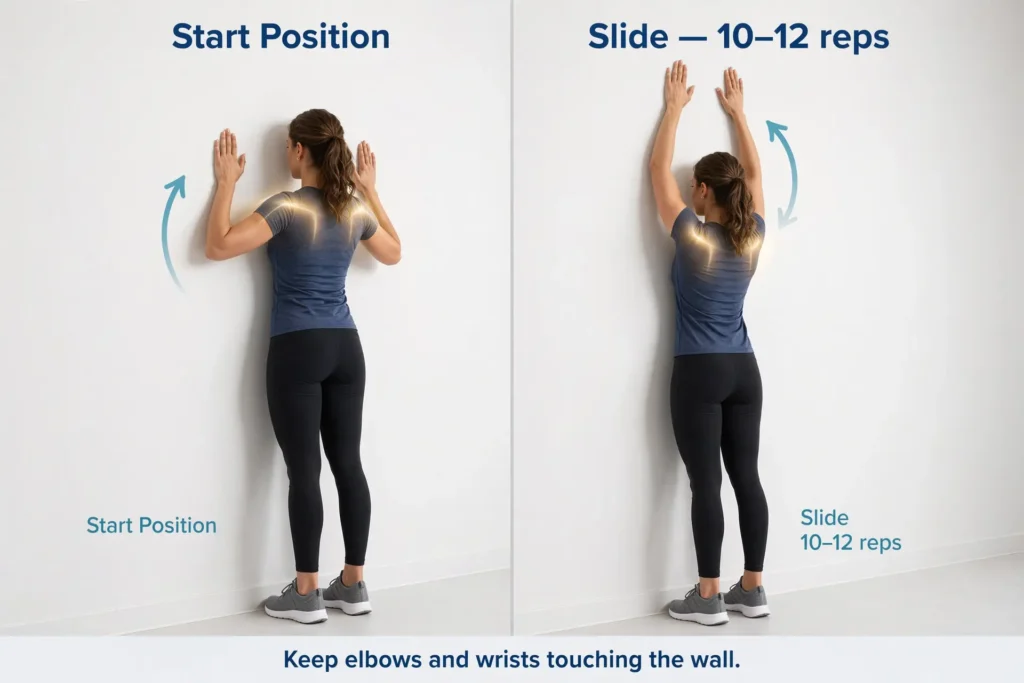
Standing with your back against a wall, arms bent at 90 degrees and pressed against it, slowly slide your arms upward and back down while keeping contact with the wall. 10–12 reps. This trains the upper back to hold a corrected position against real resistance from your own bodyweight and the wall.
Prone Y-T-W Raises (Floor)
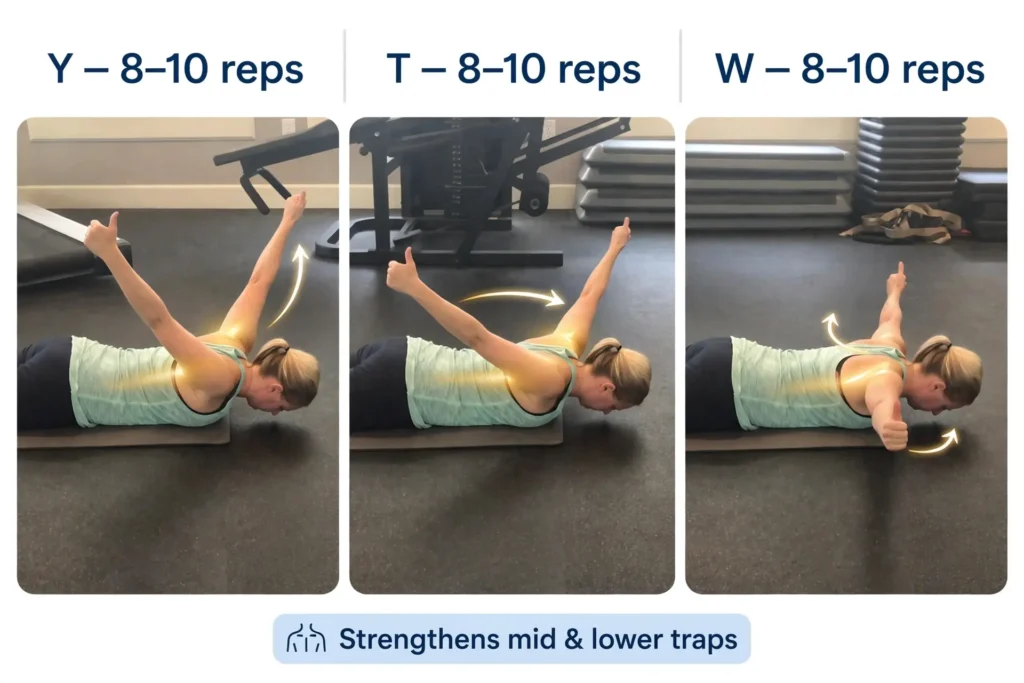
Lying face down, lift your arms into a Y shape, then a T shape, then a W shape, holding each briefly before lowering. 8–10 reps per shape. This strengthens the mid and lower trapezius through their full range, one of the most neglected muscle groups in typical desk-based movement. Zara found this the most physically tiring move of the five, which made sense once we realised how rarely those specific muscles get used during a normal day of sitting and typing.
Chin Tucks
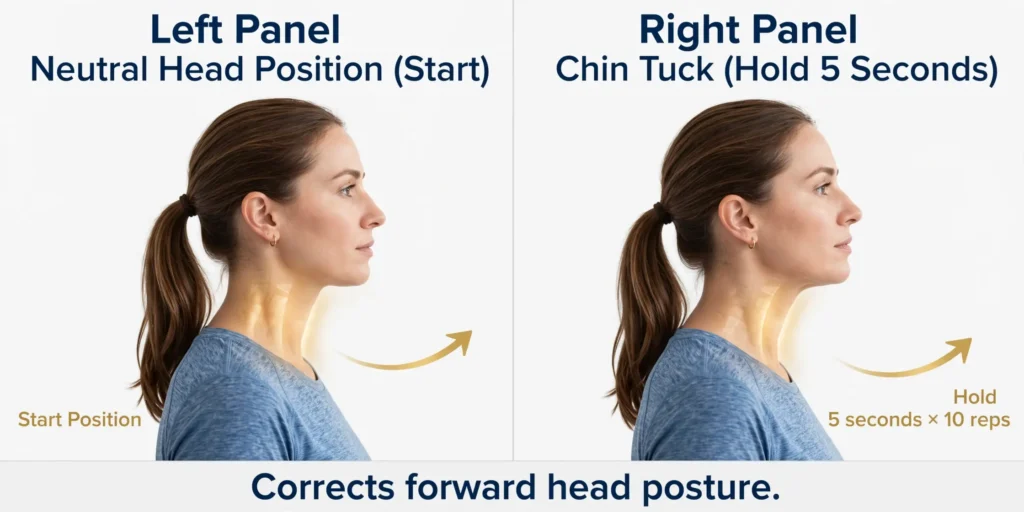
Sitting or standing tall, gently draw your chin straight back, creating a slight double-chin, without tilting the head up or down. Hold 5 seconds, repeat 10 times. This corrects forward head posture, which tends to accompany rounded shoulders and rarely gets addressed by shoulder-focused exercises alone.
Cat-Cow for Thoracic Mobility
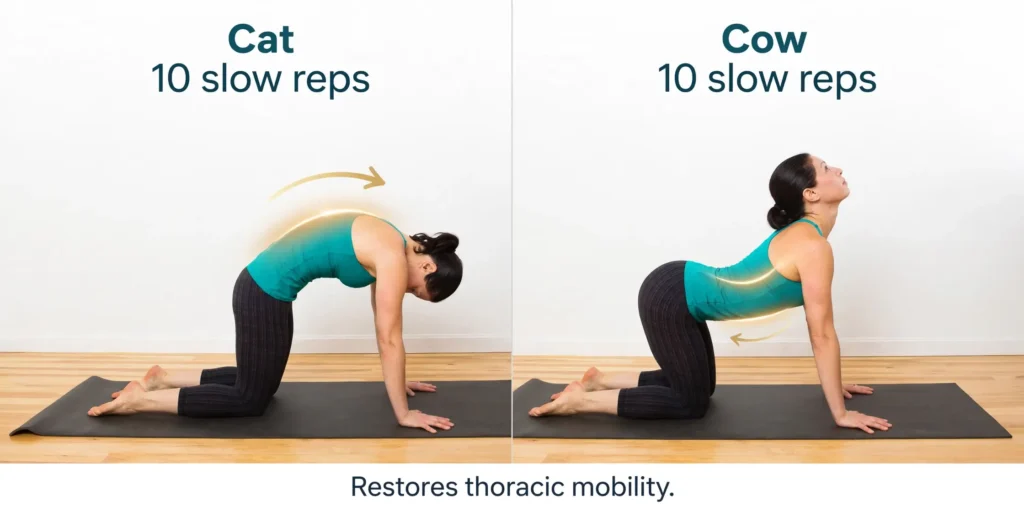
On hands and knees, alternate between arching the back upward and dipping it downward, moving slowly through the full range. 10 slow reps. This restores mobility through the upper spine, which tends to stiffen into a rounded position alongside the shoulders themselves.
“The real shift for Zara wasn’t any single move — it was starting that same evening instead of waiting for a delivery. Bodyweight training removed the last excuse standing between her and actually beginning.”
Quick Reference: The Routine at a Glance
| Exercise | Targets | Equipment Needed |
| Doorway chest stretch | Chest/front shoulders | A doorway |
| Wall angels | Upper back | A wall |
| Prone Y-T-W raises | Mid/lower traps | Floor space |
| Chin tucks | Neck/forward head | None |
| Cat-cow | Thoracic mobility | Floor space |
Building It Into a Weekly Routine
How Often This Needs to Happen Without Equipment to Add Load
Four to five sessions a week, around 8–10 minutes each, worked better for Zara than fewer, longer sessions. Without added resistance to increase intensity, frequency became the main lever for progress instead of load, which meant showing up often mattered more than pushing hard in any single session.
This turned out to suit her schedule better anyway. Short sessions squeezed in before dinner or during a break between video calls were far easier to protect than a single longer weekly session would have been, which is often the case once a routine has to compete with an unpredictable daily schedule.
Why Bodyweight Still Works for This Specific Problem
It’s a fair question whether bodyweight alone is “enough,” and for this particular imbalance, it generally is, at least to start. The same posture and stability principles that come up across resistance-based training apply here too — the muscles need to be reactivated and trained through their proper range, and bodyweight resistance is sufficient for that at a beginner level.
What Changed After a Few Consistent Weeks
By the second week, Zara wasn’t treating the routine as a task to remember — it had folded into her evening the same way brushing her teeth had. That shift, from conscious effort to automatic habit, mattered more for her long-term consistency than any single exercise in the routine.
Mistakes That Slowed the Correction Down
A few habits quietly worked against progress early on, and they’re easy mistakes to make when you’re new to training a specific muscular imbalance and focused mainly on the parts that feel most immediately satisfying.
Doing the Stretches but Skipping the Strengthening Moves
Zara initially gravitated toward the doorway stretch because it felt the most immediately satisfying, and skipped wall angels and the Y-T-W raises more often than not. Stretching alone only addresses half the imbalance, the same limitation that applies regardless of whether bands or bodyweight are being used. It took a conscious effort to treat the strengthening moves as equally important, even though they never felt quite as instantly rewarding as a good chest stretch.
Poor Form on Wall Angels (Losing Wall Contact)
Letting the lower back arch away from the wall, or the arms lift off the wall entirely, reduced how much the upper back muscles were actually working during wall angels. Keeping consistent contact with the wall throughout the movement, even if that meant a smaller range of motion at first, produced noticeably better results. Zara found it helpful to check her form in a mirror for the first week, since it’s genuinely difficult to feel whether contact has been lost without seeing it directly.
Giving Up Too Early Because Bodyweight “Feels Too Easy”
Because none of these moves feel particularly hard, it’s tempting to assume they aren’t doing much. Consistency, not intensity, was the actual driver of change here — something that mirrors how small, sustainable habits tend to outperform occasional intense effort, a pattern that shows up again and again across very different types of fitness goals.
When Rounded Shoulders Need More Than Exercise
Bodyweight exercises help correct the muscular imbalance behind most cases of rounded shoulders, but they aren’t the right response to every case. It’s worth speaking to a doctor or physiotherapist if any of the following apply:
- Numbness or tingling in the arms or hands
- Persistent pain that doesn’t ease with consistent training
- Restricted range of motion that doesn’t improve over several weeks
- A known structural condition such as scoliosis or kyphosis
“Zara didn’t have any injury history, but if you do — a previous shoulder issue, a diagnosed spinal condition, anything like that — it’s worth a quick check-in with a physiotherapist before starting, just to make sure the routine fits your specific situation.”
What Changed After a Few Consistent Weeks
By the end of the first month, Zara’s shoulders sat noticeably further back without any conscious effort to hold them there. She’d also, almost as a side note, finally deleted the resistance band from her cart — not out of stubbornness, but because it genuinely hadn’t been necessary for the progress she’d already made. Friends who hadn’t seen her in a few weeks started commenting on it before she’d even mentioned doing anything differently, which was the clearest outside confirmation either of us could have asked for.
Neither of us treated this as a finished project. Posture correction is ongoing maintenance, not a one-time fix, especially for anyone still spending most of their day sitting — but it’s genuinely sustainable once starting no longer depends on owning the right piece of equipment. Staying generally active over the long term supports this too, something explored in more depth around why ongoing activity protects posture and independence as we get older, which applies just as much to keeping posture gains from quietly slipping back over time.
FAQs
Can rounded shoulders be fixed without equipment?
Yes, for most cases caused by muscular imbalance. Bodyweight exercises can strengthen the weak upper back and stretch the tight chest just as effectively at a beginner level.
What is the best at-home exercise for rounded shoulders?
Wall angels are typically the most effective single exercise, directly training the upper back to hold a corrected position against real resistance.
How long does it take to fix rounded shoulders naturally?
Many people notice their shoulders holding a more upright position without conscious effort within 3–4 weeks of consistent practice.
Are wall angels effective for posture correction?
Yes. Wall angels directly train the muscles responsible for pulling the shoulders back, making them one of the most effective no-equipment posture exercises.
When should rounded shoulders be checked by a doctor?
See a doctor for numbness or tingling in the arms, persistent pain, restricted range of motion, or a known structural spinal condition.
Final Thoughts
None of these require a gym membership, a resistance band, or something ordered online and waiting. A simple set of exercises for round shoulders at home really made a noticeable difference, which I’ve seen delayed starting for months just because of a missing piece of equipment — and it’s worth trying tonight if your own shoulders are also quietly bending forward.
If there’s one thing you can learn from it, it’s that it’s better to start today than to wait for the best setup without anything: the wall and door you already have are enough to get you started. Start the door pull and wall angels together, as this pair addresses both aspects together, and incorporate the rest of the routine over the next week or two.
This article is for general information only and is not a substitute for professional medical advice. Please consult a doctor or physiotherapist if you have persistent pain, numbness, or a known spinal condition.

2 thoughts on “Exercises for Rounded Shoulders at Home I Actually Do”