QUICK SUMMARY
Wall Pilates for bad knees can genuinely help, but only once the depth and range of certain moves are modified — done exactly like the trending videos, some of them load the knee joint just as much as a regular squat. The routine below keeps the low-impact benefits while cutting the parts that actually aggravate sensitive knees.
Introduction
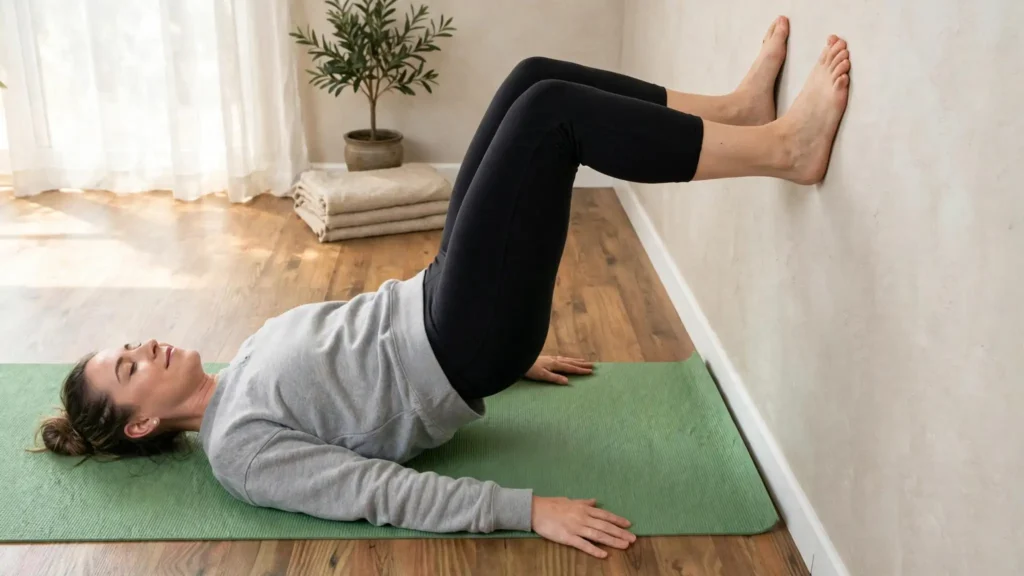
My partner Farah was hooked on the wall palette like most people — videos on her phone, the promise of a full-body workout through just the wall, and an “tomorrow” start date. After three sessions, her knees were worse than before, not better, and she was really confused at my desk, because everything she read called her “low impact” and “joints friendly.” It was this contradiction that led me to thoroughly research wall Pilates for bad knees, as the standard advice did not explicitly include knees that were already sensitive. I tried a modified version of this routine with him for several weeks, and the difference between the version that was helpful and the one that hurt was the details that almost no one mentions. Here’s exactly what we got.
Table of Contents
Why Wall Pilates Gets Recommended for Bad Knees
Low-Impact Doesn’t Automatically Mean Knee-Safe
Wall Pilates gets marketed almost entirely around one word: low-impact. That’s true in the sense that there’s no jumping, running, or sudden jarring movement. But low-impact only describes the absence of shock through the joint — it says nothing about how much sustained pressure a position puts on the knee while you’re holding it.
Farah’s knees weren’t reacting to impact. They were reacting to time spent under load in a position that, held long enough, puts real pressure directly through the kneecap — which is a completely different problem than the one “low-impact” is usually solving for.
This distinction gets lost constantly in how wall Pilates is marketed. Videos and captions lean heavily on “gentle,” “joint-friendly,” and “suitable for all levels,” which is true for a knee with no existing sensitivity. For a knee that already flares up on stairs or after a long walk, the same routine done at the same depth and duration can be genuinely counterproductive, and nothing in the standard messaging warns you about that gap.
What Actually Makes an Exercise Knee-Friendly
A genuinely knee-friendly exercise controls both the range of motion and the angle of load through the joint, not just the presence or absence of impact. That distinction matters a lot once you understand what’s actually happening mechanically when a knee is under sustained pressure, which I’ve covered in more detail separately — the same patellofemoral pressure that builds up from sitting all day can build up just as easily from holding a static Pilates position incorrectly.
Once we understood that, the whole wall Pilates routine looked different. It wasn’t a question of which exercises were inherently good or bad for knees — nearly all of them could be either, depending entirely on the angle and duration Farah chose to hold them at.
The Wall Pilates Mistake Almost Everyone Makes First
Why the Classic Wall Sit Isn’t Always the Right Starting Point
Nearly every wall Pilates video opens with a full wall sit — thighs parallel to the floor, knees bent to roughly 90 degrees, held for as long as possible. For a healthy knee, that’s a solid strengthening move. For a knee that’s already sensitive, holding a 90-degree bend under sustained bodyweight is one of the more demanding positions you can put it in.
Farah’s first few sessions followed the video exactly, full depth, held to failure, exactly as instructed. It wasn’t laziness or bad form that caused the flare-up afterwards — it was doing the move correctly, at a depth that simply wasn’t appropriate for her knees yet.
That’s a genuinely confusing place to land, because most fitness advice assumes the opposite problem — that people aren’t pushing hard enough, not that they’re pushing too precisely into a position their joints aren’t ready for. Wall sits get treated as the beginner-friendly entry point into wall Pilates, when for a sensitive knee, they’re often one of the more demanding moves in the whole routine.
The Wall Pilates Routine That Actually Felt Safe
This is the modified routine that let Farah keep the wall Pilates format without the knee flare-ups. The changes are small on paper, but they made all the difference in practice. Nothing here needs equipment beyond a wall and a bit of floor space, and each move takes under two minutes.
Modified Wall Sit (Shallow Range)
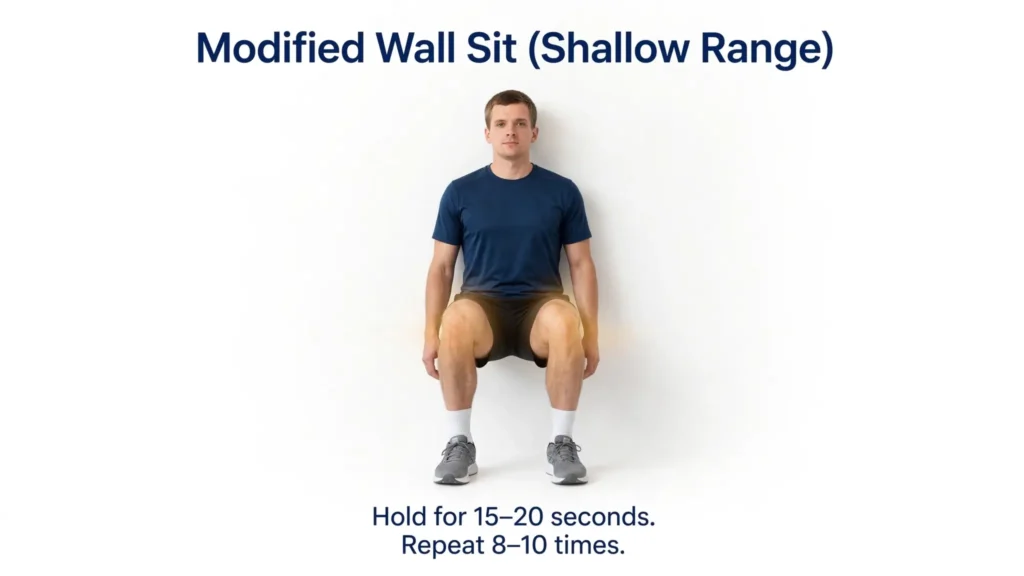
Instead of holding at 90 degrees, stop at a shallow bend, roughly a 30–45 degree angle, well short of parallel. Hold for 15–20 seconds. This keeps the quads engaged without the deep patellofemoral load that the full-depth version creates. As strength and comfort improve over several weeks, the angle can gradually deepen — the point isn’t to avoid wall sits forever, just to earn the depth rather than starting there.
Wall-Supported Pelvic Curl
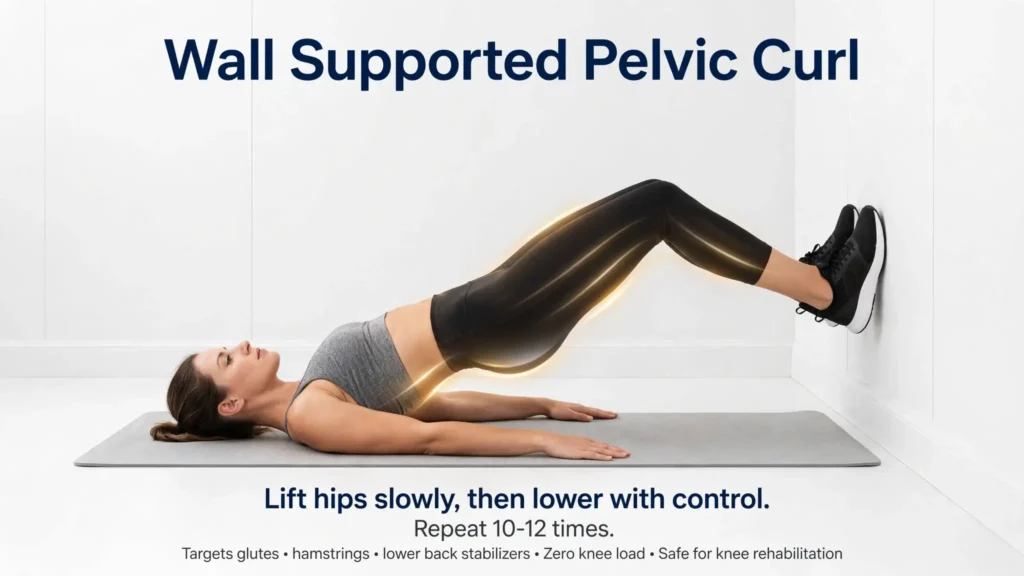
Lying on your back with feet flat against the wall, knees bent, slowly lift the hips into a bridge and lower with control. This strengthens the glutes and hamstrings, which take pressure off the knee joint during everyday movement, without any direct load through the knee itself. Farah found this one felt the most obviously safe from the very first session, which made it a good confidence-builder early on.
Standing Wall Leg Lifts
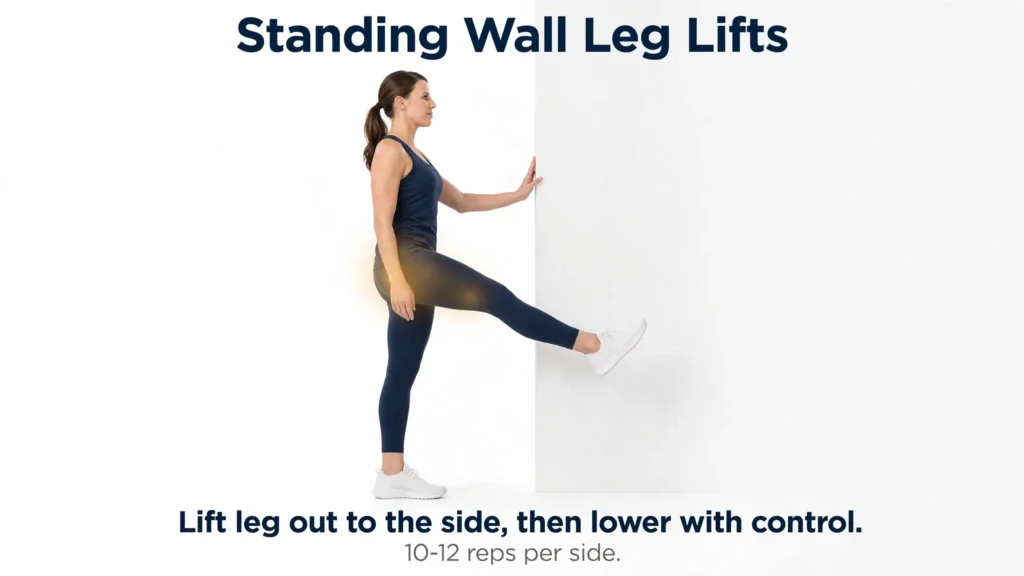
Standing side-on to the wall for support, lift one leg straight out to the side and lower with control, 10–12 reps per side. It builds hip and outer thigh strength that stabilises the knee without bending it under load at all.
Wall Roll-Down
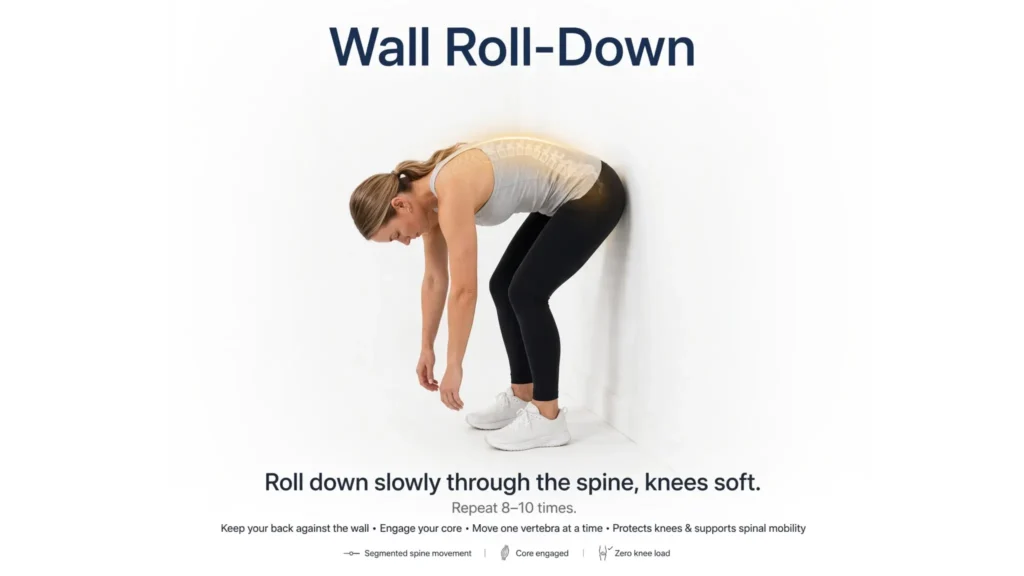
Standing with your back against the wall, slowly roll down through the spine, letting the knees stay soft rather than locked, then roll back up. This works core and posture control while keeping the knees in a relaxed, unloaded position throughout.
Wall-Supported Clamshells
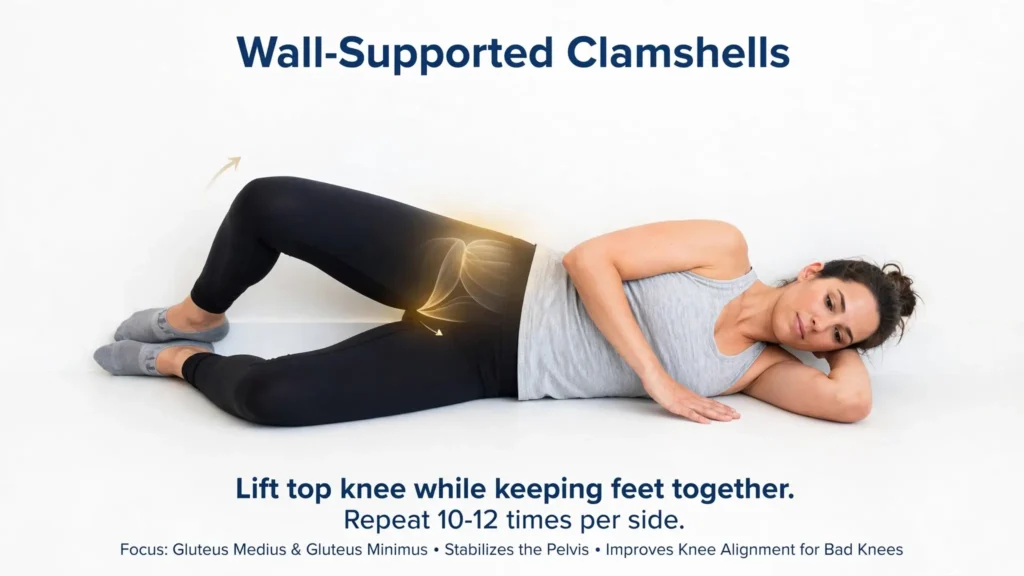
Lying on your side with your back against the wall for stability, knees bent, lift the top knee while keeping feet together. This targets the glute muscles that support knee alignment from the side, an area most standard knee routines overlook entirely.
“The real shift wasn’t cutting exercises out — it was cutting the depth. Every move Farah kept doing, just shallower and slower, and that alone was the difference between flare-ups and actual progress.”
Quick Reference: The Routine at a Glance
| Exercise | Focus | Knee-Safety Note |
| Modified wall sit | Quad strength | Shallow angle only, 30–45° |
| Wall-supported pelvic curl | Glutes/hamstrings | No direct knee load |
| Standing wall leg lifts | Hip stability | Knee stays straight |
| Wall roll-down | Core/posture | Knees stay soft, unloaded |
| Wall-supported clamshells | Glute/knee alignment | No weight-bearing on knee |
Building It Into a Weekly Routine
How Many Days a Week Actually Makes a Difference
Three sessions a week, roughly 15–20 minutes each, gave Farah’s knees enough recovery time between sessions while still building strength consistently. Daily sessions at full intensity were part of what caused the original flare-up — sensitive knees generally respond better to consistent, spaced-out effort than to daily repetition.
This runs against a lot of the trending 28-day challenge format that wall Pilates content usually gets packaged into, which assumes daily sessions from day one. For a healthy knee that structure can work fine. For a knee that’s already sensitive, spacing sessions out isn’t a lesser version of the routine — it’s the version that actually lets the joint recover between sessions rather than compounding irritation day after day.
Supporting Joints Through Diet Too
Reducing background inflammation supports whatever strengthening work you’re doing on top of it. I’ve written before about how omega-3s carry a genuine anti-inflammatory benefit for joint health, and it’s a sensible addition alongside a modified routine like this rather than something that replaces it.
What Changed After Switching to the Modified Routine
Within two weeks of shallowing the wall sit and dropping to three sessions a week, Farah’s knees stopped reacting at all after a session. The routine itself hadn’t changed dramatically — the depth and frequency had, and that was apparently the whole problem.
Mistakes That Made Knees Feel Worse, Not Better
A few habits actively worked against progress early on, and they’re easy mistakes to make when you’re following a trending video exactly as shown and assuming the instructor’s version is simply how it’s meant to be done.
Copying Instagram Form Without Modifying Depth
Most wall Pilates content is filmed by instructors with healthy knees, demonstrating full-depth versions. Copying that depth exactly, without adjusting for a knee that’s already sensitive, is the single most common reason people flare up after starting.
Ignoring Alignment to Chase Reps
Farah initially cared more about matching the video’s rep count than keeping her knees tracking properly over her toes. Poor alignment under repeated load adds up quickly — something that lines up closely with how posture and alignment affect strain through the whole body, not just the knees specifically. Slowing down and watching the knee-over-toe alignment in a mirror for the first week made a noticeable difference, even before the depth was reduced.
Treating It as a Cure Instead of Joint-Friendly Maintenance
Wall Pilates supports knee health, but it isn’t a fix for an underlying issue on its own. Staying consistently active in a broader sense matters just as much — something explored in more depth around why ongoing low-impact activity protects joints over time, which applies directly here too. Wall Pilates works best as one piece of a wider pattern of regular, gentle movement, not as a standalone fix expected to undo months or years of inactivity on its own.
When Wall Pilates Isn’t Enough
A modified routine helps manage day-to-day discomfort, but it’s not a substitute for a proper assessment. It’s worth speaking to a doctor or physiotherapist if any of the following apply:
- Sharp pain during any part of the movement, not just general fatigue
- Swelling that shows up after sessions
- A locking, catching, or grinding sensation in the joint
- Pain that hasn’t settled within 24 hours of a session
“The point where Farah finally spoke to a physio wasn’t the first flare-up — it was realising the pain wasn’t settling the way normal muscle soreness does. That distinction, between soreness and something that lingers, is usually the real signal to get it looked at properly.”
What Changed After a Few Consistent Weeks
By week four, Farah was doing the full modified routine three times a week without any of the discomfort that had put her off the whole idea in the first place. Her knees felt noticeably more stable on stairs, which wasn’t something either of us was specifically training for — it just came along with the strengthening work. She’d also stopped avoiding the stairs at work entirely, something she’d been quietly doing for weeks without either of us really clocking it as a pattern.
Neither of us treated this as a miracle fix. It’s a joint-friendly strength routine — genuinely effective, but only once it’s adjusted to the knees actually doing the exercises rather than the knees in the demonstration video.
What stood out most, watching from the outside, was how little the actual exercises had to change to get there. Every move Farah kept was still recognisably wall Pilates — nothing had been swapped out for something entirely different. The fix wasn’t a different workout, it was the same workout done at a depth and frequency that matched where her knees actually were, not where a fitness video assumed they’d be.
FAQs
Is wall Pilates actually safe for bad knees?
Yes, when the depth and range of certain moves — especially wall sits — are modified. Done at full depth exactly like standard videos, some positions can aggravate sensitive knees.
Which wall Pilates exercises should be avoided with knee pain?
Deep, full-depth wall sits held to failure are the main one to modify or avoid until knee strength and comfort improve.
How often should you do wall Pilates for knee pain relief?
Around three sessions a week, spaced out rather than daily, tends to give sensitive knees enough recovery time between sessions.
Can wall Pilates help strengthen knees over time?
Yes. Modified wall Pilates builds the quad, glute, and hip strength that supports the knee joint without placing direct strain through it.
When should knee pain during wall Pilates be checked by a doctor?
See a doctor for sharp pain during movement, swelling after sessions, joint locking, or pain that hasn’t settled within 24 hours.
Final Thoughts
None of these require a Pilates studio or special equipment. The modified version of Wall Pellets for Bad Knees made a real and lasting difference, for a girl who was genuinely disappointed with the trend after the first try—and if a standard Wall Pellets video has spoiled your knees instead of feeling better, it’s worth trying.
If you take one thing away from it, prefer depth over intensity: A low-depth, controlled motion range protects the sensitive knee rather than pushing it to the full depth of a demonstration video. Start superficially, as the comfort increases, let the depth slowly increase, and treat the frequency in the same way — three sessions a week is a really effective start, not a compromise of routine.
This article is for general information only and is not a substitute for professional medical advice. Please consult a doctor or physiotherapist before starting a new exercise routine with existing knee pain.

1 thought on “Wall Pilates for Bad Knees: My Honest Experience”