THE SHORT VERSION
Peanuts top the list of high protein nuts to boost your diet at 25 to 26 grams per 100 grams, with almonds leading true tree nuts at 21 grams, but the real lesson from switching away from protein shakes wasn’t about any single label, it was about portion control.
Introduction
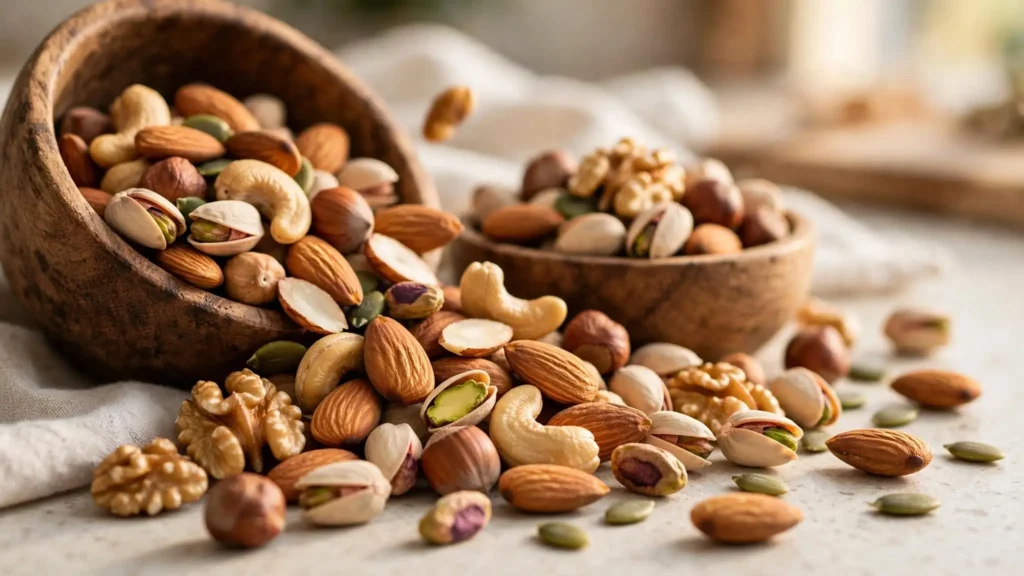
For almost a year, I refilled the protein shaker twice a day, and would quietly get restless whenever the tub started running low. I track these things carefully for work, and yet I had convinced myself that achieving the protein goal meant standing on the kitchen counter and drinking something like chalk instead of actually eating. Then one evening, during the shake and really bored with the taste, I saw a bag of almonds on top of the cupboard and read the nutrition label well for the first time.
What I found led me to do thorough research on high protein nuts to boost your diet, and within a few weeks I stopped buying shakes almost entirely. Here’s the honest, label-by-label version I learned about high protein nuts to boost your diet, including a portion-size error that wiped out almost the entire system.
Table of Contents
Why I Was Relying on Protein Shakes in the First Place
I’d started tracking protein seriously after a period of training where I felt like I was working hard in the gym but not seeing much change to show for it. Someone in a forum, with far more confidence than evidence, told me I needed at least 150 grams of protein a day, and shakes felt like the obvious, low-effort way to hit a number that high without cooking three chicken breasts every evening.
It worked, in the sense that I hit my number most days. But it also meant I was drinking something slightly chalky twice a day, spending more than I wanted to on tubs of powder, and feeling oddly disconnected from food that was supposed to be, you know, food. Looking back, I’d never actually sat down to calculate whether 150 grams was even the right number for me specifically; I’d just absorbed it as gospel the way you do with most gym advice.
Nuts, alongside pulses and fish, are already recommended as part of a balanced diet as a source of protein and fibre[2], which made it slightly embarrassing in hindsight that it took a random Tuesday and a bag of almonds for me to actually notice what was already sitting in my cupboard.
I’d actually written before about the warning signs your body sends when it needs more movement, and looking back, my protein obsession was a similar story: a reasonable goal turned into a slightly joyless routine because I’d never questioned the easiest, most heavily marketed solution.
The Moment I Actually Checked What Was Already in My Kitchen
It happened on an ordinary Tuesday, which feels like it shouldn’t matter, but it’s exactly the kind of unremarkable detail that makes a story like this feel real rather than tidy. I was mid-shake, genuinely a little bored of the taste, when I noticed a bag of almonds in the cupboard behind the blender.
Out of curiosity more than anything, I flipped it over and read the nutrition panel properly, rather than just registering “nuts, healthy, fine” the way I normally would. Twenty-one grams of protein per hundred grams stopped me mid-sip. That was genuinely close to what I was getting from a full scoop of powder, minus the chalky aftertaste and the subscription I’d quietly set up to avoid running out.
That one label sent me looking properly into high protein nuts, rather than treating nuts as a vague “healthy snack” category I never really paid attention to. It’s a slightly embarrassing thing to admit, that a label I could have read at any point in the previous year only actually registered on a random Tuesday, but that’s honestly how most of these realisations seem to happen. I spent the rest of that evening pulling nutrition labels off nearly everything in my cupboard, which is a strange way to spend a Tuesday night, but it’s exactly what led to the comparison that follows.
The 9 High Protein Nuts, Ranked from Highest to Lowest
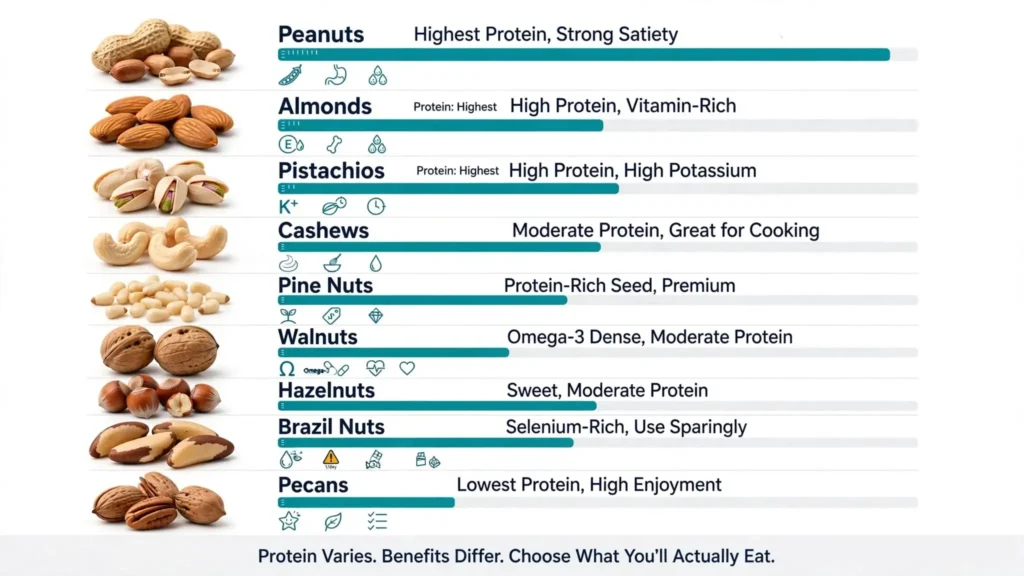
Once I started comparing labels properly, the differences between nuts were bigger than I expected. Here’s what I found, roughly in order from highest protein to lowest.
1. Peanuts — The Surprise Protein Leader
Peanuts came out on top, at around 25 to 26 grams of protein per 100 grams, which is genuinely comparable to a serving of chicken breast by weight. The slightly odd part is that peanuts aren’t technically nuts at all; they’re a legume, more closely related to lentils and soybeans than to almonds or walnuts. They also happen to be one of the most affordable and accessible plant-based protein sources available, which matters more than most gym nutrition advice tends to acknowledge.
That distinction doesn’t really change anything for protein and muscle recovery purposes, and it didn’t stop me from buying a jar of unsweetened peanut butter the same week. What did surprise me was how filling a small handful actually was compared to the same calories in a shake, probably because I was chewing something rather than drinking it in thirty seconds flat. A 30g handful, roughly a small palmful, delivers around 7-8g of protein for well under 20p, which made it the cheapest protein-per-gram option on this entire list once I actually worked out the maths.
2. Almonds — The Highest-Protein True Tree Nut
Almonds, the nut that started this whole thing, sit at around 21 grams of protein per 100 grams, making them the highest-protein option among actual tree nuts. They’re also rich in Vitamin E and calcium, two nutrients a protein shake never gave me.
A 30g handful, about 20-23 almonds, provides roughly 6g of protein alongside a genuine dose of healthy monounsaturated fat. I started keeping a small container at my desk specifically, which turned out to be one of my favourite approaches to healthy snacking during long writing sessions, and it genuinely did more for my afternoon energy than the shake ever managed.
3. Pistachios — The Nut That Slows Down Your Snacking
Pistachios come in close behind almonds at roughly 20 grams of protein per 100 grams, with the added bonus of taking longer to eat, since you have to shell each one individually, which slowed down my snacking in a genuinely useful way without me ever deciding to eat more slowly on purpose.
Pistachios are also unusually high in potassium for a nut, more per 100g than a banana in some comparisons. A 30g shelled portion gives around 6g of protein, and the shelling itself turns out to be a built-in portion-control mechanism that none of the other nuts on this list have.
4. Cashews — The Creamy One That Works in Cooking
Cashews land around 17 to 18 grams of protein per 100 grams, with a softer texture and creamier taste that made them an easy swap into stir-fries, not just a straight snack.
A 30g handful provides around 5g of protein, slightly less than almonds or pistachios, but cashews earned a permanent spot in my kitchen because they blend into sauces and curries in a way drier nuts simply don’t, adding both protein and a creamy texture without needing any dairy.
5. Pine Nuts — The One That’s Technically a Seed
Pine nuts sit in a similar range to cashews, somewhere around 14 to 17 grams of protein per 100 grams depending on the source, and like almonds, they’re technically seeds from a pine cone rather than true nuts botanically.
They’re expensive compared to the rest of this list, which is the honest reason I use them sparingly, toasted into a salad or stirred through pasta for texture and flavour, rather than eaten by the handful the way I do with almonds or peanuts.
6. Walnuts — The Omega-3 Specialist
Walnuts sit around 14 to 15 grams of protein per 100 grams, putting them in the lower-middle of this list for protein specifically. Where they win is omega-3 fatty acids; walnuts contain more than any other nut, which is the actual reason I keep them around rather than their protein content.
A small 30g handful, about 7 whole walnuts, provides roughly 4-5g of protein alongside that omega-3 contribution, making them a good addition to porridge or a salad rather than a primary protein source on their own.
7. Hazelnuts — The One That Pairs Best With Dark Chocolate
Hazelnuts come in at a similar 14 to 15 grams of protein per 100 grams to walnuts. They’re genuinely excellent in small amounts mixed with dark chocolate as a treat that still has some nutritional upside, which is honestly how I eat most of mine.
A 30g handful provides around 4-5g of protein, similar to walnuts, but hazelnuts bring a distinct sweetness that makes them the easiest nut on this list to enjoy without feeling like you’re eating something purely functional.
8. Brazil Nuts — The One-a-Day Selenium Fix
Brazil nuts sit at roughly 14 grams of protein per 100 grams, similar to walnuts and hazelnuts, but their standout feature has nothing to do with protein: a single Brazil nut covers most of your daily selenium needs, which is a genuinely strange but useful fact to know.
Because of that selenium concentration, Brazil nuts are the one item on this list where more isn’t automatically better; I stick to one or two a day rather than a full handful, purely because selenium can build up to unhelpful levels if you overdo it consistently.
9. Pecans — Why I Still Keep Them Around Despite the Lower Numbers
Pecans come in lowest on this list, at around 9 to 10 grams of protein per 100 grams, roughly a third of what peanuts offer for the same weight. If protein were the only thing I cared about, pecans probably wouldn’t make the cupboard at all.
But they’re genuinely one of my favourite-tasting nuts, and I’ve learned that a snack I actually enjoy and stick with consistently beats a theoretically perfect one I quietly stop eating after two weeks. A 30g handful gives around 3g of protein, modest by comparison, but it’s the nut I reach for specifically because I actually want to, which counts for something over the long run.
Quick Reference — Protein per 100g
| Nut | Protein per 100g |
| Peanuts | 25-26g |
| Almonds | 21g |
| Pistachios | 20g |
| Cashews | 17-18g |
| Pine nuts | 14-17g |
| Walnuts | 14-15g |
| Hazelnuts | 14-15g |
| Brazil nuts | 14g |
| Pecans | 9-10g |
Figures are approximate and vary slightly by source and preparation.
What Switching Actually Did to My Snacking Habits
The most noticeable change wasn’t really about protein numbers at all. It was that snacking stopped feeling like a chore I was managing and started feeling like, well, eating.
I stopped getting the mid-afternoon flatness that used to send me straight to caffeine, the same kind of unexplained exhaustion that doesn’t add up I’d written about in a completely different context months earlier, without ever connecting it to how I was snacking.
My shopping list changed too, fewer tubs with scoops, more jars and resealable bags, and I noticed I was spending roughly the same amount of money on healthy snacking options I actually looked forward to, rather than ones I was quietly dreading by the third week of the tub.
I kept tracking my protein intake throughout, which is when the real revelation landed: I was consistently hitting within five or ten grams of my daily target just from nuts, meals, and the occasional piece of fish, without a single scoop of powder involved. The gap I’d assumed shakes were filling had been smaller than I’d ever given myself credit for. Looking back at my old tracking spreadsheet, the difference most days came down to less than one shake’s worth of protein, which felt almost anticlimactic given how central shakes had become to my entire routine.
The One Mistake I Made Early On (Portion Sizes)
Here’s the part I’d rather not admit. For the first couple of weeks, I treated nuts as basically unlimited, because “healthy” had quietly become a synonym for “doesn’t count” in my head.
Nuts are calorie-dense; even a generous handful can run to several hundred calories once you actually weigh it rather than eyeball it. I’d absentmindedly worked through half a jar of mixed nuts while writing one afternoon and only noticed when I went back to log it properly. Portion control with nuts is one of those things that sounds obvious until you realise you’ve completely ignored it for two weeks.
It reminded me of something I’d thought about before in how today’s small choices quietly add up over time, except this time the choice in question was genuinely a literal handful, not a metaphor. Switching to pre-measured portions, roughly a small palmful at a time, fixed it almost immediately.
How I Actually Eat These Nuts Now
None of this required a dramatic kitchen overhaul. It mostly meant paying attention to things that were already sitting on my shelves. These days, I keep a small scale on the counter rather than trusting my eyes, and I rotate between almonds, pistachios, and peanuts most days, with cashews and walnuts mixed in for variety rather than habit.
I’ve also started building them into actual meals rather than treating them only as a snack between meals, stirred into porridge, scattered over a stir-fry, or blended into a sauce, an approach I cover in more practical detail in a full week of meals designed around training.
It’s a small shift, but it’s made protein feel like a normal part of eating again, rather than a number I was anxiously chasing with a scoop and a shaker bottle. That, more than any single nutrition label, is what actually convinced me high protein nuts could genuinely replace most of what I used to get from a shake.
A NOTE ON NUT ALLERGY
Tree nut and peanut allergies are among the most common food allergies and can be serious or, in some cases, life-threatening.[1] A nut allergy can develop at any age, even in adults with no prior history. If you have a known allergy, or are introducing nuts to a child for the first time, speak to your GP or an allergy specialist first rather than relying on this article alone.
What Actually Convinced Me
Looking back, it wasn’t any single label or number that made the difference, it was the accumulation of small realisations over a few weeks: that peanuts nearly matched chicken by weight, that pistachios shelled one at a time slowed down my snacking without me trying, that a jar of mixed nuts could quietly become several hundred unaccounted-for calories if I stopped paying attention.
High protein nuts to boost your diet aren’t a replacement for every gram you’d get from meat, fish, or a shake, and I’m not pretending they are. But for someone who’d built an entire identity around a shaker bottle, discovering that a bag of almonds already sitting in my cupboard was doing almost the same job was a genuinely useful wake-up call. I haven’t bought a tub of protein powder in over a year now, and I don’t miss it. If there’s one thing I’d tell the version of myself who was still refilling that shaker every few weeks, it’s simply this: check the cupboard before you check the tub.
Medical Disclaimer:
This article reflects my personal experience and general nutrition information drawn from published research. It isn’t medical or dietary advice and shouldn’t replace a consultation with your GP or a registered dietitian, especially if you have allergies or an existing health condition.
Frequently Asked Questions
Which nut has the most protein?
Peanuts have the most protein of any commonly eaten nut, at roughly 25 to 26 grams per 100 grams, though they’re technically a legume rather than a true nut; among actual tree nuts, almonds rank highest at around 21 grams.
Are peanuts actually a nut?
No, peanuts are a legume that grows underground in a pod, making them botanically closer to lentils and soybeans than to almonds or walnuts, though they’re grouped with nuts because of how they’re eaten and their similar nutrition profile.
Can nuts replace protein shakes or meat as a protein source?
Nuts can replace some of your protein intake, but they’re calorie-dense and not a complete substitute for lean meat, fish, or dairy, since you’d need to eat a large volume to match the protein in a typical shake or meat serving.
How many nuts should you eat a day to get protein without overdoing calories?
Most guidance suggests around a small handful, roughly 30 grams, per day, which provides a meaningful amount of protein and healthy fats without the calorie count adding up too quickly.
Do roasted nuts have less protein than raw nuts?
No, roasting doesn’t meaningfully change the protein content of nuts, though it can slightly reduce certain heat-sensitive nutrients and may add extra sodium or oil depending on preparation.

3 thoughts on “9 High Protein Nuts to Boost Your Diet, Ranked by Grams”
Comments are closed.