In Short
Olive leaf extract has been studied for its effects on blood pressure, blood sugar, and antioxidant activity, and the research is more substantial than most “ancient remedy” claims. Here’s what got me curious about it after watching a family member try it, and what the actual studies show.
Introduction

My aunt started taking olive leaf extract capsules after her doctor flagged her blood pressure as slightly higher than it should be. She wasn’t looking for a miracle cure — she just wanted something to try alongside the lifestyle changes she’d already been told to make. That’s what first got me reading about the health benefits of olive leaves, rather than dismissing it as another supplement aisle trend.
What I found researching the health benefits of olive leaves surprised me — not because the claims were wild, but because several of them are backed by actual clinical trials, not just tradition. Here’s what the research shows, and what happened when my aunt tried it herself.
I’ve written about plenty of supplements on this site that turn out to have thin or contradictory evidence behind them once you actually go looking. This one was different enough from that pattern that it felt worth writing up properly, rather than folding into a general roundup of “things people take for blood pressure.”
Table of Contents
How I Came Across Olive Leaf Extract
My aunt mentioned it almost in passing over dinner — “the pharmacist suggested I try olive leaf alongside cutting back on salt.” I hadn’t heard of it being recommended that specifically before, and it stuck with me enough that I went looking into whether there was anything behind it once I got home.
What I found wasn’t a single dramatic study, but a fairly consistent pattern across several smaller clinical trials, mostly focused on blood pressure, blood sugar, and antioxidant activity. None of it reads like a cure-all, but it’s a lot more substantial than the “ancient Mediterranean remedy” framing usually suggests.
I’ll admit my first reaction was sceptical. Olive leaf extract has the same slightly suspicious packaging as half the supplements on a health-shop shelf — bold claims, a leaf on the label, a price that assumes you won’t check the research. What kept me reading past that initial scepticism was finding the same effect, blood pressure specifically, showing up across several independently run trials rather than one manufacturer-funded study.
What’s Actually in Olive Leaves That Makes Them Worth Studying

Oleuropein and the Other Key Compounds Researchers Focus On
The main compound researchers keep coming back to is oleuropein, a bitter-tasting polyphenol found in high concentrations in olive leaves. Alongside it, most extracts also contain hydroxytyrosol and other polyphenols, which are studied for their antioxidant and anti-inflammatory properties. When my aunt showed me the label on her bottle, the oleuropein content was listed prominently — clearly the ingredient the manufacturer expected buyers to recognise.
What’s interesting is that oleuropein isn’t unique to the leaf — it’s also present in olive fruit and oil, just in much smaller concentrations. The leaf is used specifically because it delivers a far more concentrated dose than you’d realistically get from eating olives or cooking with olive oil, which is why supplement makers extract from the leaf rather than relying on dietary intake alone.
The Blood Pressure Connection
A Family Member’s Experience Trying It Alongside Their Usual Routine
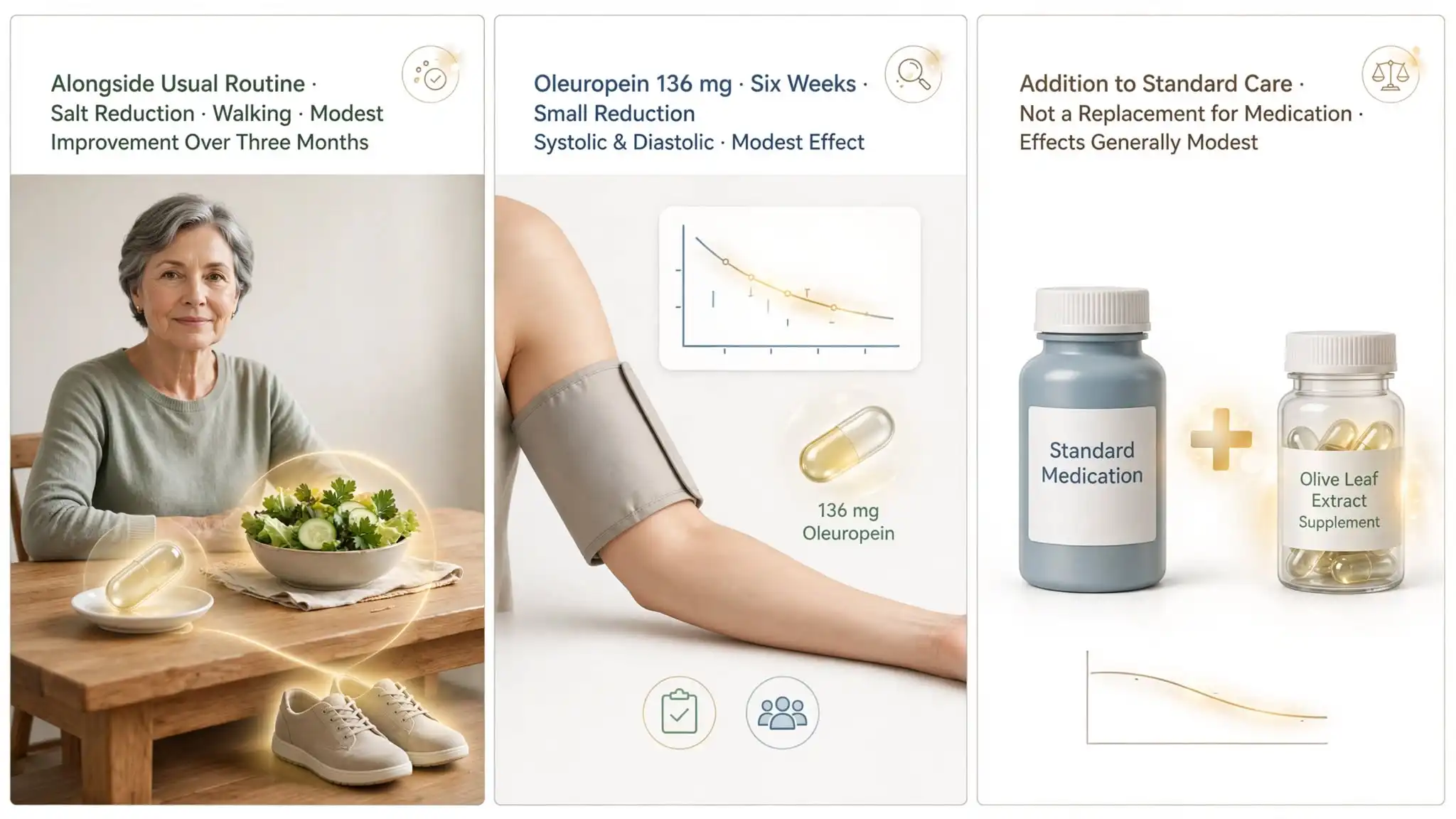
My aunt didn’t stop taking her prescribed medication or make any dramatic changes — she added the extract on top of the salt reduction and the walking her doctor had already recommended. At her next check-up, three months later, her numbers had improved. She was quick to say she couldn’t be sure how much of that was the extract versus the other changes, which I think is a fair and honest way to look at it.
What struck me talking to her about it was how unbothered she was by the ambiguity. “I’m not trying to prove anything to anyone,” she said, “I just want my numbers to go down.” That’s probably the healthiest way to approach a supplement like this — as one plausible contributor among several, rather than the single variable you’re trying to isolate and prove.
What the Research Says About Oleuropein and Blood Pressure
A randomised, double-blind, placebo-controlled crossover trial of 60 people with borderline high blood pressure found that six weeks of olive leaf extract containing 136 mg of oleuropein produced small but measurable reductions in both systolic and diastolic blood pressure1. A separate systematic review pooling several controlled trials found a similar pattern across studies, alongside modest improvements in some other cardiovascular risk markers2. The effect sizes in these trials are generally modest, not dramatic, which lines up with what my aunt described.
If blood pressure is something you’re actively managing, it’s worth reading our full guide to high blood pressure alongside anything you try, since supplements like this are generally studied as an addition to standard care, not a replacement for it.
It’s also worth noting how modest these effects actually are in absolute terms. A reduction of two to three points on a blood pressure reading is meaningful in a clinical trial, but it isn’t the kind of dramatic before-and-after that supplement marketing often implies. Anyone expecting to replace medication with a bottle of capsules is going to be disappointed by what the research actually supports.
Blood Sugar and Metabolic Effects
A Friend’s Story of Adding It In After a Pre-Diabetes Warning
A friend of mine was told at a routine check-up that her blood sugar readings were creeping into pre-diabetic territory. Alongside the dietary changes her GP suggested, she came across olive leaf extract in the same research rabbit hole my aunt had sent me down, and added it to her routine mostly out of curiosity rather than expectation.
What the Evidence Shows So Far
The same systematic review that looked at blood pressure also examined glycaemic markers across the pooled trials, finding some modest improvements, though the evidence here is generally weaker and less consistent than for blood pressure3. My friend was careful to describe her own results the same way — “maybe slightly better, but nothing I’d bet on without the diet changes too.” If insulin resistance is part of what you’re managing, insulin resistance and fatigue covers the broader picture worth understanding alongside any single supplement.
What I’d say to my friend, and to anyone in a similar spot, is that the blood sugar evidence here is genuinely the weakest of the three benefits covered in this article. It’s worth knowing about, but it shouldn’t be the main reason you’d choose to try it — the blood pressure research is considerably stronger and more consistent.
Immune Support and Antioxidant Properties
Why This Is the Benefit Most People Ask About First
Whenever I’ve mentioned olive leaf extract to anyone since researching this, the first question is almost always about immunity, usually phrased as “does it stop you getting colds?” The honest answer is more modest: the polyphenols in olive leaf have antioxidant properties, and antioxidants generally support the body’s defence against oxidative stress, but that’s a different claim to preventing specific illnesses.
If antioxidants generally are what you’re interested in, our guide to antioxidant-rich foods is a good place to see how olive leaf compares to more familiar dietary sources.
It’s a distinction worth being clear-eyed about, because it’s exactly where marketing tends to blur the line. “Supports immune function” and “prevents illness” sound similar but mean very different things, and most of the research behind olive leaf extract only supports the first, more modest claim.
How People Actually Take Olive Leaf Extract
Capsules, Tea, and Tincture — What My Aunt Settled On and Why
My aunt tried both the dried-leaf tea and the standardised capsules before settling on capsules. “The tea tasted like bitter grass,” she said, “and I could never be sure how much oleuropein I was actually getting.” Capsules with a stated oleuropein content, similar to what’s used in the clinical trials, gave her more confidence in the dose she was taking.
How the Common Forms Compare
| Form | Oleuropein Content | Notes |
| Dried leaf tea | Variable, hard to standardise | Bitter taste; harder to match trial doses |
| Standardised capsules | Usually stated on the label (e.g. 100–136mg) | Closest match to doses used in clinical trials |
| Liquid tincture | Varies by concentration | Faster absorption; taste can still be strong |
Seeing this laid out is what helped my aunt choose capsules in the end — she wanted to be able to compare her dose to what was used in the studies she’d read about, which isn’t really possible with a cup of tea brewed to taste rather than to a measured concentration.
She also mentioned taking it with food made a noticeable difference to how her stomach handled it — on an empty stomach, the capsules left her slightly queasy, something she hasn’t experienced since moving her dose to alongside breakfast.
She’s stuck with the same brand and dose for the past year rather than switching around, partly on her doctor’s advice and partly because she didn’t want to introduce a new variable while she was still tracking whether it was actually helping. That consistency, more than the specific brand she chose, is probably the more useful lesson for anyone considering trying it themselves.
What to Watch Out For
⚠ Worth Checking First
Because olive leaf extract can affect blood pressure and blood sugar, it may interact with medications for either condition. Anyone already taking blood pressure or diabetes medication should speak to a doctor or pharmacist before adding it, rather than combining them without guidance.
Does the Evidence Actually Hold Up?
Being honest about the limitations matters here. Most of the trials behind these findings are relatively small — 60 participants, 10 participants, occasionally over 100 — and many run for a matter of weeks rather than years. That’s enough to show a genuine short-term effect, but not enough to draw firm long-term conclusions the way we can for something studied over decades.
What convinced me this deserved a proper article, rather than a dismissive paragraph, is that the effect keeps turning up across multiple independent trials rather than one isolated result. That’s a meaningfully different situation to a supplement with a single small study behind an otherwise bold marketing claim.
It’s also worth saying plainly that not every claim floating around about olive leaf extract holds up equally well. The blood pressure research is the strongest of the bunch, the blood sugar research is genuinely mixed, and some of the more dramatic claims circulating online — about cancer, weight loss, or reversing chronic disease — go well beyond anything the clinical trials actually tested. Being able to tell the difference between “researched” and “researched thoroughly for this specific claim” matters more than it sounds like it should.
I asked my aunt, at one point, whether she’d have started taking it if she hadn’t already trusted the person who suggested it. “Probably not,” she admitted. “I’d have assumed it was another one of those things people sell online.” That’s a fair instinct to have, generally — most supplement claims don’t hold up under scrutiny. This one, at least for the blood pressure claim, is one of the exceptions.
As someone who reads a lot of supplement research for this site, the number of independently replicated trials behind this particular claim is genuinely uncommon — most ingredients I look into have one promising study and a lot of marketing built on top of it. Olive leaf extract’s blood pressure evidence stands out precisely because it doesn’t fit that usual pattern.
Conclusion
My aunt is still taking her olive leaf capsules, alongside her medication and the walking routine her doctor recommended. She’s careful not to credit it with more than its fair share of her improved numbers, and I think that’s the right way to approach it — as one modestly useful piece of a bigger picture, not a standalone fix.
If there’s one thing worth taking from the research, it’s that olive leaf extract has earned a more serious look than most supplements get, without earning the kind of sweeping claims it sometimes receives online. Somewhere between “ancient miracle cure” and “pointless supplement aisle filler” is where the actual evidence sits, and that’s a far more useful place to start from.
Whether or not you end up trying it yourself, that’s probably the most useful lens to bring to any supplement claim you come across — not “does research exist,” but “how much research, for exactly this claim, and how big was the effect.” Applied to olive leaf extract, the blood pressure answer holds up better than most.
This article is for general information only and is not a substitute for professional medical advice. Olive leaf extract may interact with blood pressure or diabetes medication — speak to a doctor or pharmacist before starting it, particularly if you’re already being treated for either condition.
Frequently Asked Questions
What are the proven health benefits of olive leaf extract?
Clinical trials have shown modest improvements in blood pressure and some cardiovascular risk markers, along with antioxidant properties from compounds like oleuropein.
Can olive leaf extract lower blood pressure?
Several small clinical trials have found modest reductions in blood pressure with regular olive leaf extract use, though results vary and it isn’t a substitute for prescribed treatment.
Is olive leaf extract safe to take every day?
It’s generally considered safe for most healthy adults at standard doses, but anyone on blood pressure or diabetes medication should check with a doctor first due to possible interactions.
Does olive leaf extract interact with any medications?
It may interact with blood pressure and blood sugar medications, so speak to a pharmacist or doctor before combining it with existing treatment.
How long does it take to see benefits from olive leaf extract?
Clinical trials showing measurable effects typically ran for six to eight weeks of consistent daily use.
