In Short
Depression doesn’t just affect mood — it can quietly reshape sleep, appetite, work, relationships, and motivation in ways that are easy to miss from the outside. Here’s what I learned watching it happen to a close friend, and what actually helped.
Introduction

A close friend of mine went from replying to messages within minutes to taking days, then weeks, without any obvious reason. It wasn’t one dramatic moment that made me understand how depression affects daily life — it was a slow accumulation of small changes I almost didn’t notice until they’d been going on for months.
This isn’t a clinical explainer written from a textbook. It’s what I actually watched happen, what I researched once I realised something more serious was going on, and how depression affects daily life in ways that rarely look like what most people expect from the outside.
Table of Contents
What Made Me Start Paying Closer Attention
The first thing I noticed wasn’t sadness — it was silence. My friend, normally the one organising group plans, stopped suggesting anything. When I finally asked if everything was okay, the answer was a flat “yeah, just tired,” repeated so often it stopped sounding like an answer and started sounding like a wall.
It took a few more months, and a much more honest conversation, before the word “depression” actually came up. Looking back at everything I’d noticed before that conversation, the pattern was there the whole time — I just hadn’t known what I was looking at.
What made me start reading into it properly wasn’t wanting to diagnose my friend myself — I was very deliberately careful not to do that — but wanting to understand what I was actually seeing, so I could respond to it better than I had been. A lot of what I’d been doing, without realising, was treating each symptom as a separate, unrelated problem rather than pieces of the same picture.
The Parts of Daily Life That Change First

Sleep and Energy — the Exhaustion That Doesn’t Match Effort
My friend described feeling tired in a way that sleep didn’t fix — sometimes sleeping ten or eleven hours and still waking up feeling like they hadn’t rested at all. Other nights, sleep barely came, and they’d be awake at 3am scrolling their phone with no particular reason to be.
What confused me at first was how inconsistent it seemed — some weeks looked almost normal, which made it easy to assume things had improved, only for the exhaustion to return just as heavily a few days later. I later learned that this back-and-forth pattern is common rather than unusual, which would have saved both of us some false hope and false alarm if I’d known it sooner.
Appetite and Eating Patterns
Meals stopped being a fixed part of the day. Some weeks it was forgetting to eat until the evening; others it was eating far more than usual, almost absent-mindedly. Neither pattern was about hunger in the way I’d normally think about it.
What made this one harder to notice from the outside was that my friend still cooked occasionally, still ordered food with friends sometimes — it wasn’t a total collapse of eating, just an erosion of the routine around it. It took actually asking directly, rather than observing from a distance, to learn how irregular it had really become behind the occasional normal-looking meal.
Motivation for Things That Used to Feel Easy
The change that struck me most was watching genuinely enjoyable things — a hobby, a favourite show, plans with friends — become things my friend had to force themselves through, when they managed them at all. “It’s not that I don’t want to,” they told me once, “it’s that I can’t find the part of me that used to want to.”
That line has stayed with me more than almost anything else from that period, because it reframed the whole thing for me. I’d been quietly frustrated at times, wondering why they wouldn’t just push through and do the things they used to enjoy. Hearing it described that way made it clear this wasn’t reluctance — it was closer to the actual machinery of wanting things being temporarily offline.
How It Shows Up at Work or School
Struggling to Concentrate and Keep Up
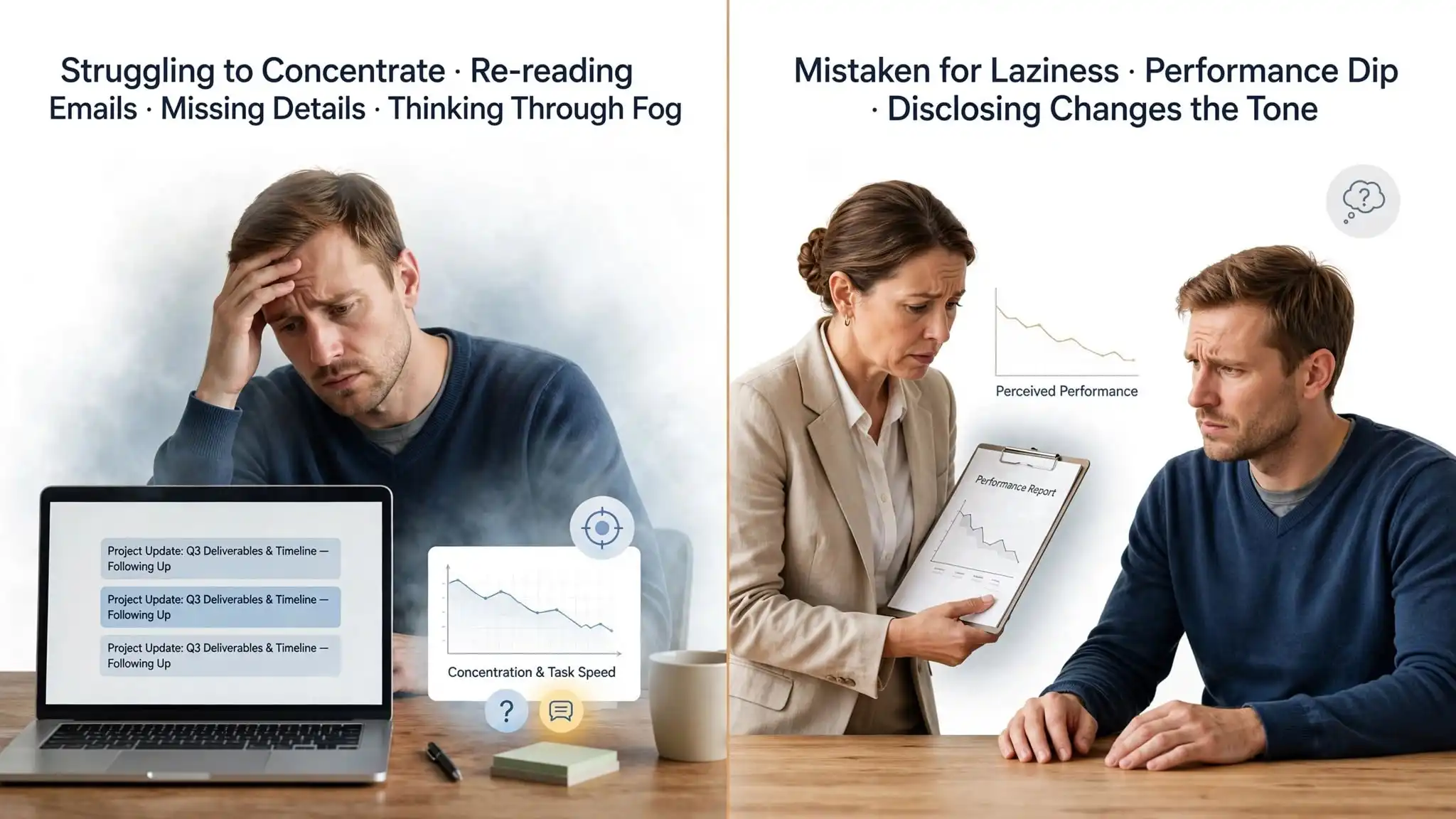
A colleague of my friend’s later told me they’d noticed simple tasks taking far longer than they should have — re-reading the same email three times, missing details that would normally be obvious. From the outside, it looked like a dip in performance. From the inside, my friend described it as “trying to think through fog.”
Why It’s Often Mistaken for Laziness or Poor Performance
This is probably the part that frustrated my friend most. A manager who doesn’t know what’s going on has no way to distinguish reduced concentration caused by depression from simply not trying hard enough, and the two can look identical on paper — missed deadlines, shorter replies, less initiative.
My friend eventually disclosed part of what was going on to their manager, mostly out of necessity rather than choice, once performance conversations started happening. It changed the tone of those conversations considerably, though it came with its own discomfort — a fear, which turned out to be largely unfounded, that being honest would be held against them rather than understood.
The Effect on Relationships and Social Life
Withdrawing From Friends and Family Without Meaning To
My friend didn’t decide to pull away from people. Each individual decision to skip one dinner, cancel one call, leave one message unanswered felt small and justifiable in the moment. It was only looking back over several months that the pattern of near-total withdrawal became obvious.
A Conversation That Revealed How Isolating It Had Become
The conversation that finally broke through the silence happened almost by accident, over a drive neither of us had planned to have a serious talk during. “I didn’t want to be around people because I didn’t want anyone to see how bad it had gotten,” my friend admitted. That single sentence explained months of unanswered texts more than anything I’d guessed at.
What I found hardest, as the friend on the outside, was not taking the silence personally. It’s easy to read a lack of response as a lack of care, when it’s often closer to the opposite — a kind of protective distance put up specifically because the person still cares what you’d think if they let you see the full picture.
It’s also worth distinguishing this from work-related withdrawal that looks similar on the surface — burnout symptoms in women can produce comparable social pulling-back, though the underlying cause and the right response can differ.
The Physical Symptoms People Don’t Expect
Depression is often talked about purely as a mood condition, but it commonly comes with physical symptoms too — unexplained aches, digestive changes, headaches, and persistent fatigue that doesn’t have an obvious physical cause1. My friend had actually seen a doctor about ongoing headaches months before either of us connected them to what else was going on.
If you’re trying to untangle whether physical symptoms might be connected to mood, depression’s effect on memory and concentration and its links to heart health are both worth reading, since the physical side of depression is more far-reaching than most people expect.
Looking back, the headaches were probably the clearest early signal, and also the easiest one to miss entirely, because a headache is such an ordinary, explainable thing on its own. It was only once several “ordinary” symptoms had piled up together — the headaches, the appetite changes, the exhaustion — that any single one of them stopped looking like a coincidence.
How It’s Often Misunderstood by Others
The advice my friend heard most often — “just try to think positive” or “you have so much to be grateful for” — came from a good place but landed badly every time. Depression isn’t a failure to appreciate one’s life, and treating it as a mindset problem tends to make the person feel more isolated, not less.
I made this mistake myself early on, suggesting a weekend away might “snap them out of it.” My friend was gracious about it afterwards, but was honest that the suggestion had felt like one more thing to feel guilty about not wanting to do.
What eventually worked better, on my part, was dropping the urge to suggest fixes altogether and just being consistently present instead — checking in without an agenda, showing up to things without pressure to attend, and not treating every conversation as an opportunity to offer advice. It felt like doing less, but it was clearly more welcome than anything I’d tried to “solve” before.
What Actually Helped the Person I Know
Seeking Professional Support
The turning point was my friend finally speaking to their GP, who referred them for talking therapy. It wasn’t an instant fix — the first few sessions felt, in their words, “like admitting things I’d been avoiding saying out loud even to myself” — but it gave them a structured place to work through what was happening rather than carrying it alone.
The waiting list before that first session was, honestly, one of the harder parts. It’s a gap that doesn’t get talked about enough — deciding to seek help and actually getting seen aren’t the same moment, and the wait in between can feel discouraging if you’re not expecting it. Having something to do in that gap, even something small, mattered more than either of us realised at the time.
Small Daily Changes That Made a Difference
Alongside therapy, small and unglamorous changes helped more than either of us expected: a short walk most days, eating something at roughly the same time daily, and one open conversation a week with someone who knew what was going on. None of it fixed things alone, but together they gave some shape to days that had otherwise felt shapeless.
None of these changes were framed as a treatment plan, which I think mattered. They were framed as small, low-stakes things to try, with no failure if a day was missed. That lower bar for “success” seemed to make it far more likely my friend would actually attempt them on the harder days, rather than avoiding them altogether for fear of doing them imperfectly.
If stress is part of what’s weighing on someone, foods that help with stress relief and a simple morning movement routine are both small, realistic additions worth considering alongside proper professional support, not instead of it.
One thing my friend said stuck with me: the small changes only worked once they’d stopped expecting them to feel meaningful in the moment. “The walk didn’t make me happy while I was doing it,” they said, “but it made the version of me an hour later slightly more able to cope.” That distinction — not expecting an immediate mood lift, just a marginal improvement in capacity — seemed to matter more than the specific activities themselves.
When to Encourage Someone to Seek Help
In hindsight, the signs worth acting on sooner were the ones that had lasted for weeks rather than days: the flat “I’m fine” repeated too often, the cancelled plans becoming the default rather than the exception, and the noticeable change in how someone talks about themselves and their future.
Bringing it up gently, without pressure or ultimatums, was what eventually worked for us — a simple “I’ve noticed you seem different lately, and I’m here whenever you want to talk” did more than any direct confrontation would have. Encouraging a GP visit is a reasonable first step; it doesn’t need to be framed as anything more dramatic than that.
I also learned not to expect one conversation to resolve everything. The first time I brought it up gently, my friend brushed it off completely, and I nearly took that as a sign to drop it. What actually helped was returning to it occasionally, without pressing, until the timing eventually worked. Persistence without pushing turned out to matter more than getting the words exactly right the first time.
Conclusion
Watching depression unfold in someone close to me taught me that it rarely looks like the dramatic version often shown in films — it looks like unanswered messages, skipped meals, and a friend insisting they’re “just tired” for months on end. Recognising those smaller, quieter signs is often what makes the real difference.
My friend is doing better now, though it wasn’t a straight line getting there. What helped most, by their own account, wasn’t one single fix but a combination of professional support and people around them who kept gently showing up, even during the months of silence.
If any part of this sounded familiar — in yourself or in someone you care about — that recognition is worth taking seriously rather than filing away as “probably nothing.” It rarely announces itself clearly. It shows up as tiredness, quietness, and a string of small excuses, exactly the way it did for my friend, for months, before either of us called it what it actually was.
This article is for general information only and is not a substitute for professional medical or mental health advice. If you or someone you know is struggling with depression, please speak to a GP or a qualified mental health professional — support is available, and reaching out is a reasonable first step.
Frequently Asked Questions
How does depression affect daily functioning?
It commonly disrupts sleep, appetite, concentration, motivation, and social connection, often making everyday tasks feel far harder than they used to.
Can depression cause physical symptoms like fatigue or pain?
Yes — depression is frequently accompanied by physical symptoms including fatigue, headaches, digestive changes, and unexplained aches.
How is depression different from ordinary sadness or stress?
Depression tends to be more persistent, lasting weeks or longer, and affects motivation, sleep, and functioning in ways that ordinary sadness or stress usually don’t.
How can I support someone who is struggling with depression?
Gently acknowledging the change without pressure, avoiding advice like “just think positive,” and encouraging professional support tend to help more than trying to fix things directly.
When should someone with depression seek professional help?
If low mood, exhaustion, or withdrawal last more than a couple of weeks and start affecting daily life, it’s worth speaking to a GP or mental health professional.

3 thoughts on “How Depression Affects Daily Life”
Comments are closed.