The Quick Answer: 70-85g of cooked red meat, 100-150g of cooked poultry, or 140g of cooked fish per meal covers most adults’ needs based on NHS and WHO guidance. The palm-of-your-hand rule (roughly 85-100g) is a genuinely useful shorthand — the real problem is that restaurant and habit-driven portions run two to three times larger than this.
Introduction
It was a Sunday afternoon, with four chickens lined up on a breast-cutting board to prepare for the week’s meal, and I didn’t really know if the amount I was cooking was right. I always ate what came out of the pan—sometimes half breast, sometimes two-pound. I’d read so many conflicting instructions over the years that the advice had turned into noise: eat more protein, cut down on red meat, palm-sized servings, 1.6 grams per kilogram of body weight. All of this never turned into a clear and practical answer to the most basic question: how much meat should you eat per meal?
So I decided to actually find out. I sat down and worked on it with NHS Atwell guidance, the WHO’s stance on red and processed meat, and the latest sports nutrition research, until I found a clear answer that I had never had before. What I found is that how much meat to eat at each meal depends on three things: the type of meat, your body weight and individual goals, and what the composition of the rest of the plate is. It’s more specific and far more useful, rather than vague suggestions about dates and portions.
Table of Contents
Why Meat Portion Size Actually Matters
Meat is one of the most nutritionally dense foods available — a complete protein source with all essential amino acids, rich in B12, haem iron, zinc, creatine, and selenium. For many people it forms the backbone of their protein intake and plays a genuine role in energy, cognitive function, and muscle maintenance. The case for including it in a balanced diet is strong.
And yet it’s also one of the most over-consumed foods in Western diets, eaten in portions that bear little relationship to what research actually recommends. The NHS and the World Health Organisation (WHO) both include red and processed meat reduction as a key public health message, based on consistent evidence linking high consumption to increased colorectal cancer risk. But that guidance rarely translates into meal-level advice that makes practical sense for someone standing in front of a frying pan on a Sunday evening.
The stakes go beyond cancer risk — portion size affects saturated fat intake, cardiovascular health, and long-term kidney function, and it shapes the rest of the plate too. I’d already looked at this from the cardiovascular angle when researching how pomegranate juice can actively support cholesterol levels under pressure from a high saturated fat diet. Getting meat portions right is one side of that equation; supporting the cardiovascular system with the right plant foods alongside it is the other.
How Much Meat Should You Eat Per Meal? The Evidence-Based Answer
The General Population Recommendation
For the general adult population, the NHS and the British Dietetic Association (BDA) recommend no more than 70 grams of red or processed meat per day, based on consistent evidence that consumption above this level is associated with increased colorectal cancer risk. Applied to a single meal, a cooked portion of red meat should stay at or below 70 to 85 grams if that’s your one meat meal of the day.
For white meat (chicken and turkey) and fish, there’s no equivalent population-level upper daily limit, since their saturated fat content is lower and the cancer association doesn’t hold in the same way. A practical portion of 100 to 150 grams of cooked poultry or 140 grams of fish covers the protein needs of most adults without the caveats that come with red meat.
The “palm of your hand” rule repeated endlessly in nutrition articles is actually a reasonably accurate shorthand: an average adult palm covers approximately 85 to 100 grams of cooked meat. The problem is that most people’s sense of what counts as a meal portion is shaped by restaurant servings and habit, both of which run considerably larger than this.
How Protein Digestion Actually Changes the Calculation
The widely repeated claim that the body can only absorb 20 to 30 grams of protein per meal is a myth — it absorbs essentially all dietary protein given enough time. The more useful question is what the body does with excess protein in one sitting. Research suggests approximately 0.4 grams of protein per kilogram of body weight per meal is most efficiently used for muscle protein synthesis. Beyond this, excess is converted to energy or excreted, not banked as muscle — a 300-gram steak doesn’t build more muscle than a 130-gram chicken breast, it just adds calories, saturated fat, and kidney load.
| Body Weight | Optimal Protein Per Meal | Approx. Chicken Breast Equivalent (cooked) |
| 60kg | ~24g protein | ~100g cooked chicken breast |
| 75kg | ~30g protein | ~130g cooked chicken breast |
| 90kg | ~36g protein | ~150g cooked chicken breast |
| 105kg | ~42g protein | ~175g cooked chicken breast |
When I ran my own numbers, 78 kilograms at the time, I calculated around 31 grams of protein per meal was my sweet spot for muscle protein synthesis — roughly 130 grams of cooked chicken. I’d been eating considerably more than that and calling it “hitting my protein goals.” In reality, I was just generating unnecessary metabolic heat.
Does It Matter What Type of Meat You’re Eating?

Not all meat carries the same nutritional or risk profile. A grilled chicken breast and a heavily marbled steak need genuinely different portion guidance — treating all meat as equivalent was one of my own biggest mistakes for years.
Red Meat — Beef, Lamb, Pork
Red meat offers the richest source of haem iron, zinc, B12, and creatine, nutrients genuinely harder to obtain adequately from plant sources alone. For people who don’t supplement B12, or who have iron-deficiency anaemia, lean red meat plays a meaningful dietary role. But it also carries the highest saturated fat content and the most consistent colorectal cancer evidence above 70 grams per day. The practical recommendation per meal: 70 to 85 grams of cooked lean red meat, ideally grilled, baked, or braised rather than fried. Frequency matters as much as portion — three to four times per week in appropriate portions is where most major guidelines comfortably land.
Poultry — Chicken and Turkey
Poultry is the most flexible category from a portion perspective. Lower in saturated fat than red meat with similar protein density, chicken and turkey carry no population-level upper daily limit from the WHO or NHS. A cooked portion of 100 to 150 grams per meal is the practical target. Preparation makes a significant difference too — the same 130-gram chicken breast baked with herbs is a fundamentally different nutritional proposition from a battered, deep-fried equivalent. Skinless, grilled or baked is the standard I aim for.
Fish and Seafood
Fish is the category with the strongest positive evidence, not just for what it provides (protein, omega-3 fatty acids DHA and EPA, iodine, selenium) but for what those nutrients do at the population level: reduce cardiovascular risk, support brain health, and lower inflammatory markers. The NHS recommends at least two portions of fish per week, at least one of which should be oily. The standard NHS fish portion is 140 grams cooked weight, which is also roughly the portion that delivers the most meaningful omega-3 contribution per sitting — the same cardiovascular-protective mechanism explored above.
Processed Meat — Bacon, Sausages, Deli Meats
This is the category that requires the most direct honesty. The International Agency for Research on Cancer (IARC) classifies processed meat as a Group 1 carcinogen — meaning there’s sufficient evidence it causes cancer, specifically colorectal cancer. The absolute risk increase per 50 grams of processed meat per day is around 18%, meaningful at a population level even if the absolute numbers remain relatively modest for individuals.
The IARC Group 1 classification places processed meat in the same evidence category as tobacco smoking and asbestos for causing cancer — not the same magnitude of risk, but the same strength of evidence that a causal link exists. This is worth taking seriously: keep processed meat to occasional use, ideally below 25 grams per meal occasion and no more than two to three times per week at most.
Meat Portions for Different Goals — It’s Not One-Size-Fits-All
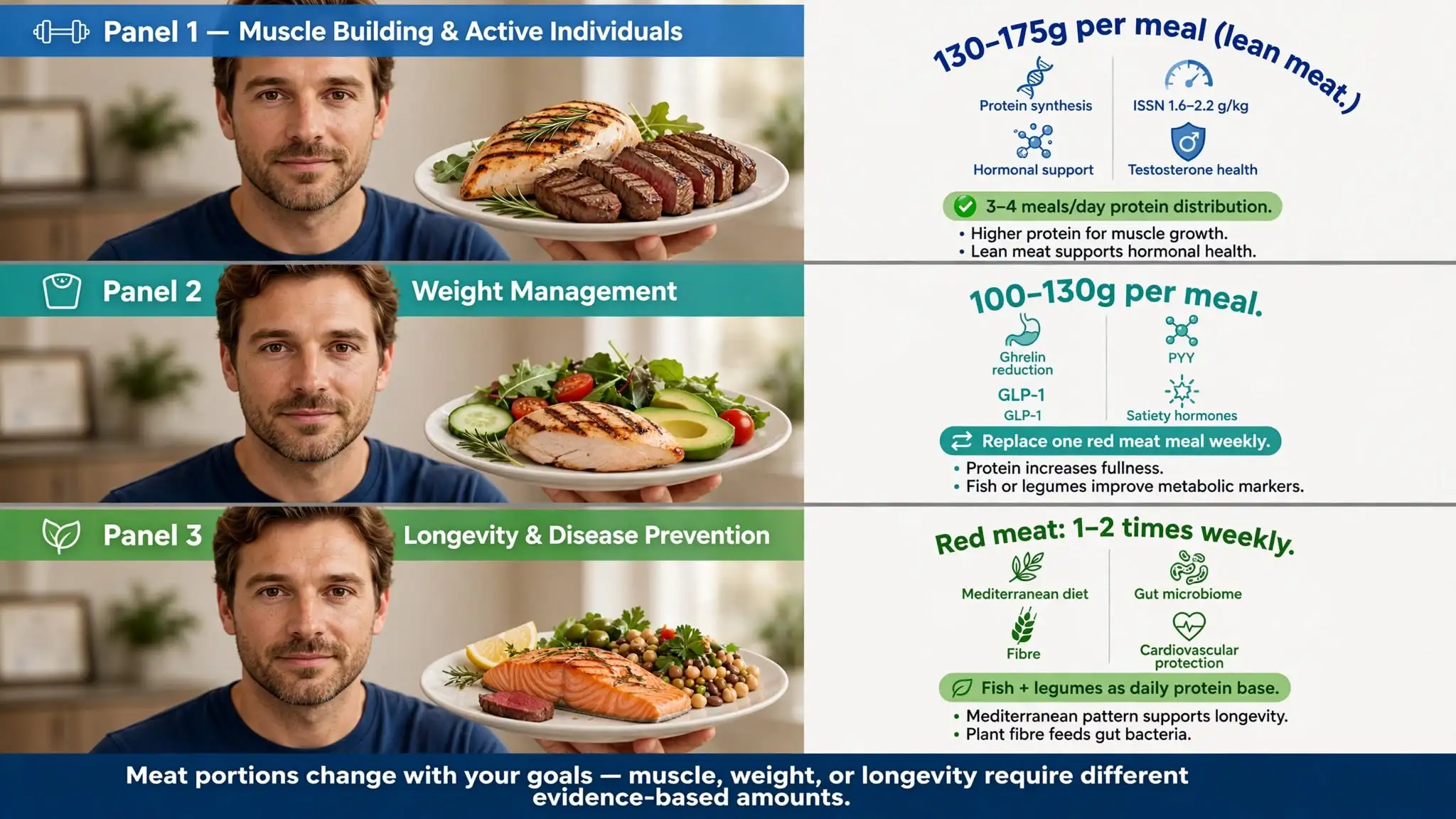
The right portion also depends on what you’re trying to achieve — muscle-building and longevity guidance genuinely point in slightly different directions.
For Muscle Building and Active Individuals
The International Society of Sports Nutrition (ISSN) recommends 1.6 to 2.2 grams of protein per kilogram of body weight daily for maximising muscle protein synthesis in resistance-trained individuals, distributed across three to four meals rather than loaded into one. A lean meat portion of 130 to 175 grams per meal, depending on body weight, is the practical range. I’ve also looked at how dietary protein choices interact with hormonal health in how diet supports or undermines natural testosterone production.
For Weight Management
Protein reduces ghrelin (the hunger hormone) and increases satiety hormones including PYY and GLP-1, making it one of the most powerful tools for managing hunger. For weight management specifically, 100 to 130 grams of lean cooked meat per meal is the most efficient portion. Replacing one red meat meal per week with fish or legumes is consistently associated with lower body weight and improved metabolic markers, tying into the role of chronic inflammation in weight gain that I’ve covered elsewhere.
For Long-Term Health and Disease Prevention
The Mediterranean dietary pattern, with the strongest evidence base for longevity and cardiovascular protection, treats red meat as genuinely occasional (once to twice per week), with fish as the primary animal protein and legumes as the backbone of daily protein intake. What supports this pattern is as much about what you eat more of as what you cut — plant foods and fibre that feed the gut microbiome, a principle I’ve explored in how fibre from plant sources supports gut bacteria diversity alongside a meat-containing diet.
What a Well-Portioned Meat Meal Actually Looks Like
The most useful thing I ever did was weigh my portions for two weeks. After that, I could estimate accurately without a scale.
- 85g cooked beef: roughly a deck of playing cards, or the flat of your palm without fingers — smaller than most restaurant steaks by a significant margin
- 100–130g cooked chicken breast: a medium breast, slightly larger than your palm — reliably eyeballed after a few days of weighing
- 140g cooked salmon fillet: a standard supermarket fillet — larger than many people assume, making it the most generous-feeling of the evidence-based amounts
- 25g processed meat: roughly two thin rashers of bacon or three thin slices of deli ham — considerably less than most people put in a sandwich without thinking
Restaurant and takeaway portions routinely run at 180 to 300 grams of meat, two to three times the evidence-based recommendation. Not every meal out needs weighing and logging, but understanding the gap between standard serving culture and evidence-based portions is genuinely useful context.
Building the Rest of the Plate Around Your Meat Portion
Getting the meat portion right is only half the equation. The NHS Eatwell Guide recommends that meat or protein occupy approximately one quarter of the plate, not half, and not the centrepiece. The remaining three quarters split between complex carbohydrates (one quarter) and vegetables and salad (half). This ratio reflects the macronutrient and fibre distribution that consistently tracks with the best long-term health outcomes in population studies.
The reason vegetables and fibre matter so much alongside meat specifically is the gut microbiome. A high-protein, low-fibre diet can shift gut bacteria composition in ways that increase inflammatory markers and reduce beneficial microbe diversity. Prebiotic plant foods alongside a meat-containing diet actively counteract this shift, which is why plate composition matters as much as the protein portion itself.
Combinations that work well in practice: a 100-gram chicken breast with roasted vegetables and quinoa; 140-gram salmon with steamed broccoli and brown rice; an 85-gram lean beef stir-fry with plenty of vegetables over white rice. In each case the meat is present, appropriately portioned, and embedded in a plate that gives gut bacteria something useful to work with. Regular animal protein intake also has long-term kidney implications — which foods can raise or lower kidney stone risk applies directly here.
Conclusion
After this research, my weekly meat pattern has come to be something I’ve been following consistently for almost a year: lean 130g chicken cooked three to four times a week, 140g fat fish at least twice, lean red meat 85g once or twice a week, and plant-based proteins, pulses, tofu, eggs, the rest filled. Processed meat has effectively been removed from my weekly rotation — not as a strict rule, but because the decision is made on your own when you understand the evidence.
The biggest difference was not in quantity — but in the composition of the plate. Limiting the meat portion to evidence-based amounts naturally made room for more vegetables and fiber. My digestion improved, my energy stabilized, and the plate that used to consist of large chicken breasts is now half vegetable, with no protein deficiency.
The answer to how much meat to eat in each meal has never been a puzzle, just not well defined. The guidelines are clear, the quantity is specific, and when you see 85 grams of meat or 130 grams of chicken on a plate, you can reliably judge the rest with the eyes. Good habits, when they are based on real evidence and not vague principles, endure.
Medical Disclaimer: This article is for general informational and nutritional guidance only and does not constitute medical advice. Individual dietary needs vary depending on health status, medications, and specific conditions. Always consult a qualified healthcare professional or registered dietitian before making significant changes to your diet.
Frequently Asked Questions
How much meat should you eat per meal?
For most adults, 85 to 150 grams of cooked meat per meal is the evidence-based range depending on meat type — up to 70g of red meat per day, 100 to 150g of poultry, or a 140g NHS-standard fish portion.
Is it bad to eat a large portion of meat every day?
For red and processed meat, yes — daily consumption above 70 grams is consistently linked to increased colorectal cancer risk, while excess white meat mainly means wasted protein rather than added muscle.
How much protein can the body use from meat in one sitting?
Approximately 0.4 grams of protein per kilogram of body weight per meal is most efficiently used for muscle protein synthesis, which is around 30 grams, or 130 grams of cooked chicken, for a 75kg adult.
How often should you eat red meat per week?
Most major guidelines recommend a maximum of three to four portions of red meat per week, kept below 70 grams per serving, with processed meat minimised to occasional use only.
What is the healthiest meat portion for weight management?
100 to 130 grams of lean cooked meat, such as chicken breast, turkey, or white fish, per meal provides enough protein to trigger satiety without the excess calories of larger portions.

14 thoughts on “How Much Meat Should You Eat Per Meal? Full Guide”