🟢 THE SHORT VERSION
Screen fatigue symptoms rarely show up as just one thing. They cluster into dry or tired eyes, blurry or slow-focusing vision, headaches, and neck or shoulder tension, all driven by the same root cause: staring at a screen makes you blink far less and hold your focus muscles tense for hours at a stretch.
Introduction

For months, I considered headaches at the end of my day to stress and blurred vision to fatigue. It wasn’t until a particularly heavy week of continuous video calls that I realized that the pattern was so consistent that it didn’t seem like a coincidence. That’s when I looked at the screen fatigue symptoms properly, rather than treating each one as a separate problem. When I understood the screen fatigue symptoms properly as a coherent cluster and not as a few unrelated complaints, I stopped looking at each symptom individually and started looking at the root cause, which turned out to be easier and more treatable than I expected.
Table of Contents
The Three Categories of Screen Fatigue Symptoms

Digital eye strain, also called computer vision syndrome, affects an estimated 50 to 66 percent of people who use screens regularly. Understanding which category your symptoms fall into makes it much easier to find the right fix, rather than guessing at random remedies that only address part of the problem.
Visual and focus symptoms
Blurry vision after screen time, slow refocusing when you look up from your screen, or a tight, strained feeling around your eyes all fall into this category. These come from your ciliary muscle, the muscle responsible for focusing, working continuously on a fixed near distance for far longer than it’s designed to. Unlike glancing between near and far objects throughout a normal day, screen work asks this muscle to hold a single focal length for minutes or hours at a stretch, with almost no natural variation built in.
Ocular surface symptoms
Burning, stinging, or a persistent gritty feeling are classic signs of dryness, and they’re extremely common with screen use specifically, more so than with reading a printed page. Some people also notice their eyes water more than usual, which sounds contradictory but is often your eye’s overcorrection response to underlying dryness, not a sign of too much moisture. This particular symptom trips a lot of people up, since watery eyes feel like the opposite of dry ones.
Systemic symptoms
Headaches, often across the forehead or behind the eyes, along with neck and shoulder tension, round out the third category. These are usually a downstream effect of the first two, compounded by posture, since squinting or straining to focus tends to pull your head and shoulders forward without you noticing.
Why Screens Cause This More Than Reading a Book Does
You blink far less while looking at a screen
On average, people blink around fifteen times a minute. While concentrating on a screen, that rate can drop by half or more. Blinking spreads tears across your eye’s surface, keeping it lubricated, so a lower blink rate means faster evaporation and a drier, more irritated surface by the end of the day.
This drop happens without you noticing, which is part of why the fix isn’t as simple as “remember to blink.” Your brain treats blinking as automatic, and concentration on a screen specifically seems to suppress that automatic rate more than other focused tasks do. Reading a physical book involves natural pauses, page turns, and shifts in gaze that a scrolling screen simply doesn’t offer in the same way.
Screens sit closer and demand constant refocusing
Screens are typically closer than a book or a distant view would be, and video calls in particular force your eyes to constantly track movement and shift focus between speakers, shared screens, and your own image, which is more taxing than reading a single static page. A book holds still. A screen rarely does.
💡 WHAT THE RESEARCH SHOWS
Studies on visual display unit use have found blink rate can fall by up to 66 percent during focused screen work, directly increasing tear film evaporation and driving the dry, gritty sensation so many screen users describe by mid-afternoon.
The Week I Finally Connected the Dots
It was a week with four days of back-to-back video calls, more screen time than usual even for me. By Wednesday, I had a dull headache sitting right across my forehead, my eyes felt like they’d been rubbed with sand, and my neck ached in a way that had nothing to do with how I’d slept.
I almost booked an appointment assuming something was wrong with my eyes specifically. What stopped me was noticing that on the one day that week I’d worked mostly from notes rather than a screen, none of it showed up, not the headache, not the dryness, not the neck ache. That was the moment the pattern became too obvious to keep blaming on stress or bad sleep.
Once I started actually paying attention, I realised I’d been treating each symptom as its own isolated complaint for months, a headache here, dry eyes there, never once stepping back to notice they always arrived together, and always on the same kind of day.
It’s Not Just Your Eyes
Tech neck and posture
Screens positioned below eye level encourage you to tilt your head forward and down, straining your neck and shoulders in a pattern often called tech neck. Over a full workday, this adds up to real muscular tension, the same kind that posture-focused training is often aimed at correcting, just from a different starting cause. Your head weighs roughly the same as a bowling ball, and every degree it tilts forward multiplies the load your neck muscles have to support.
How blue light in the evening compounds the problem
Screen use late in the evening adds another layer on top of the physical strain, since blue light exposure at night can interfere with your natural wind-down process. This connects to the two-way link between poor sleep and low mood, since poor sleep the night before makes every one of these symptoms feel more pronounced the next day. It becomes a loop: strained eyes and a tense neck make it harder to wind down, and poor sleep makes the next day’s screen work feel harder on your eyes than it otherwise would.
What I’ve Noticed in Other People
A colleague of mine assumed her recurring afternoon headaches were migraines for the better part of a year, until she noticed they only ever showed up on days packed with video calls, never on the quieter days she spent mostly on the phone or in meetings without a screen.
A friend fixed most of his eye strain with one change: raising his laptop onto a stand so the top of the screen sat at eye level instead of well below it. He hadn’t touched anything else about his setup, and within a couple of weeks, the tension headaches that used to show up by 4pm most days had largely stopped.
A neighbour who works in graphic design told me she’d normalised dry, sore eyes as just part of the job for years, until an optician pointed out during a routine check that her blink rate during a screen test was noticeably lower than it should be. Something as simple as being told the number made the habit of deliberately blinking during breaks finally stick for her.
What Actually Helped
None of these changes required buying anything special or overhauling my whole day. They were small adjustments, applied consistently, that added up faster than I expected.
The 20-20-20 rule, and being honest about its limits
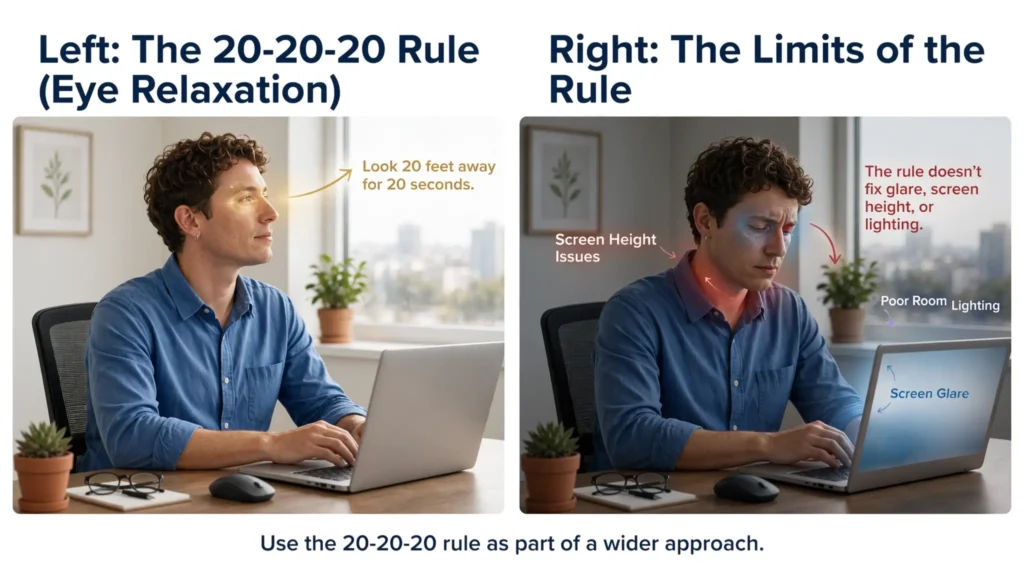
Every 20 minutes, looking at something roughly 20 feet away for 20 seconds gives your focusing muscles a genuine chance to relax and encourages a few full, natural blinks. It’s well supported by research and costs nothing, but it’s not a complete fix on its own, it doesn’t address glare, screen height, or a room that’s poorly lit. Treating it as one piece of a wider approach, rather than the whole solution, is what made the difference for me.
Deliberate, full blinks during breaks
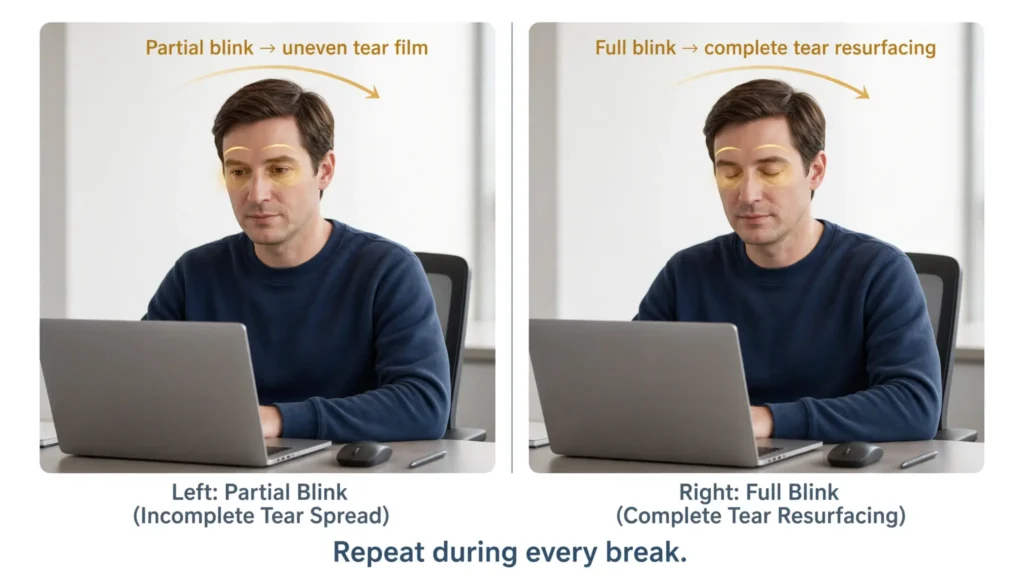
Beyond the 20-20-20 rule itself, consciously blinking fully a few times during each break helps resurface your tear film directly, addressing the dryness side of things rather than just the focus fatigue. A quick, complete blink, not just a partial one, is what actually spreads tears evenly across the eye’s surface.
Screen distance, height, and lighting
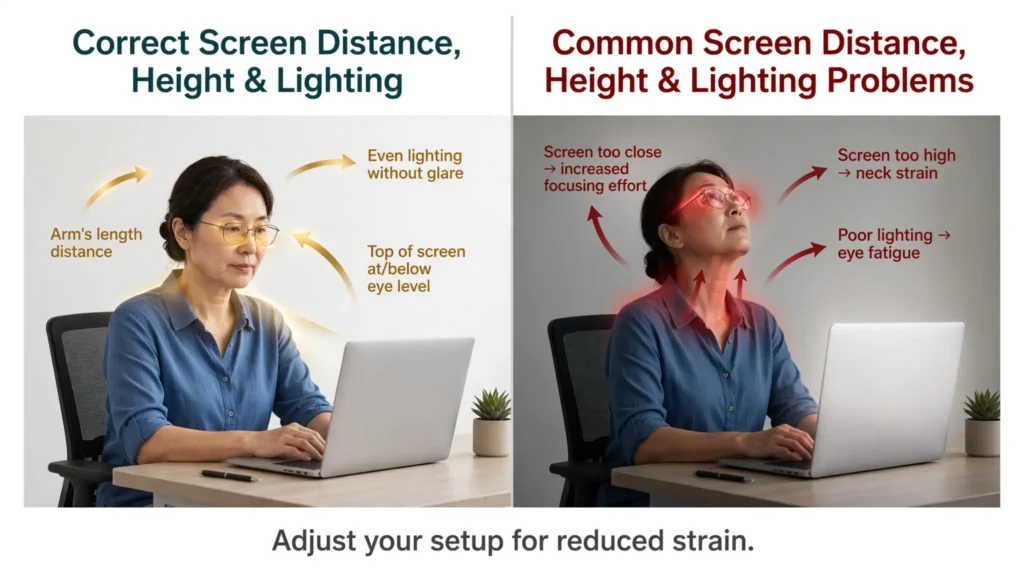
Sitting roughly an arm’s length from your screen, with the top of it at or slightly below eye level, reduces both the muscular strain in your neck and the focusing effort your eyes have to make. Good, even lighting without harsh glare also makes a bigger difference than most people expect, since your eyes work harder to compensate for high contrast between a bright screen and a dim room. Staying properly hydrated matters here too, since the hydration side of this genuinely affects how well your body can maintain a stable tear film in the first place.
| Symptom | Likely Cause | Quickest Fix |
| Dry, gritty eyes | Reduced blink rate during screen use | Deliberate full blinks, artificial tears if needed |
| Blurry or slow-focusing vision | Ciliary muscle fatigue from sustained near focus | 20-20-20 rule |
| Headaches | Eye strain and sustained muscle tension around the orbits | Regular breaks, check lighting and glare |
| Neck and shoulder tension | Forward head posture while viewing a screen | Raise screen to eye level, posture check |
Why skipping breaks doesn’t actually save time
It’s tempting to push through a long stretch of screen work without stopping, especially when a deadline feels close. In practice, symptoms like blurry vision and headaches slow you down more than a short break would, since reading and concentrating both get harder as strain builds. A few seconds of looking away every 20 minutes costs almost nothing against a full afternoon of fighting through discomfort.
A Word of Caution
🔴 IMPORTANT
Screen fatigue symptoms are common and usually improve with the changes above within a couple of weeks. If your symptoms are severe, sudden, affect one eye more than the other, or don’t improve despite consistent changes to breaks, posture, and lighting, it’s worth booking a proper eye exam rather than assuming it’s just screen fatigue, since an outdated prescription or an underlying eye condition can sometimes be the real driver.
My Honest Screen Routine Now
None of this is complicated or expensive. It’s mostly about doing a few small things consistently, rather than occasionally remembering to when a symptom flares up.
- I keep my laptop on a stand so the top of the screen sits at eye level.
- I follow the 20-20-20 rule during focused work, with a timer rather than relying on memory.
- I blink deliberately and fully a few times during each break, not just glance away.
- I cut back on screen use in the last hour before bed where I can manage it.
- I pair my breaks with a simple five-minute noticing habit rather than switching straight to my phone.
- If symptoms persist despite all of this for more than two weeks, I treat that as my cue to book an eye exam rather than pushing through.
Final Thoughts
Screen fatigue symptoms stopped feeling like a mystery once I stopped treating my headaches, dry eyes, and neck tension as three separate problems. They’re one pattern, driven by the same handful of causes, and most of it responds well to a few genuinely small changes. I still spend most of my day on a screen. I just don’t spend it the same way I used to.
If any of this sounds familiar, the first useful step isn’t a new gadget or a special pair of glasses. It’s simply paying attention for a week to whether your symptoms actually line up with your heaviest screen days, the way mine did once I finally looked.
Frequently Asked Questions
What are the main symptoms of screen fatigue?
Dry or tired eyes, blurry or slow-focusing vision, headaches, and neck or shoulder tension are the most common, often appearing together rather than alone.
Does the 20-20-20 rule actually work for screen fatigue?
It genuinely helps relax focusing muscles and encourage blinking, but it works best combined with good posture, lighting, and screen distance, not as a standalone fix.
Can screen fatigue cause headaches?
Yes. Sustained eye strain and forward head posture while viewing a screen commonly trigger tension headaches, often across the forehead or behind the eyes.
Why do my eyes feel dry after using a computer?
Screen use significantly reduces your blink rate, which lets your tear film evaporate faster, leaving your eyes dry, gritty, or irritated.
How do I know if it’s screen fatigue or something more serious?
Screen fatigue usually improves within a couple of weeks of better breaks, posture, and lighting. Symptoms that persist, worsen, or affect one eye more than the other are worth a proper eye exam.
Medical disclaimer: This article is for general information only and is not a substitute for professional medical advice. Please consult a qualified healthcare provider for guidance specific to your health.
