The Short Version: My father-in-law Tariq has had a glass of tomato juice every morning for thirty years, and it took a passing comment from his cardiologist to send me down a research rabbit hole into the real health benefits of drinking tomato juice. What I found was four genuinely well-evidenced benefits — heart health, inflammation, cancer risk, and blood sugar support — plus one sodium catch most people miss entirely.
Introduction
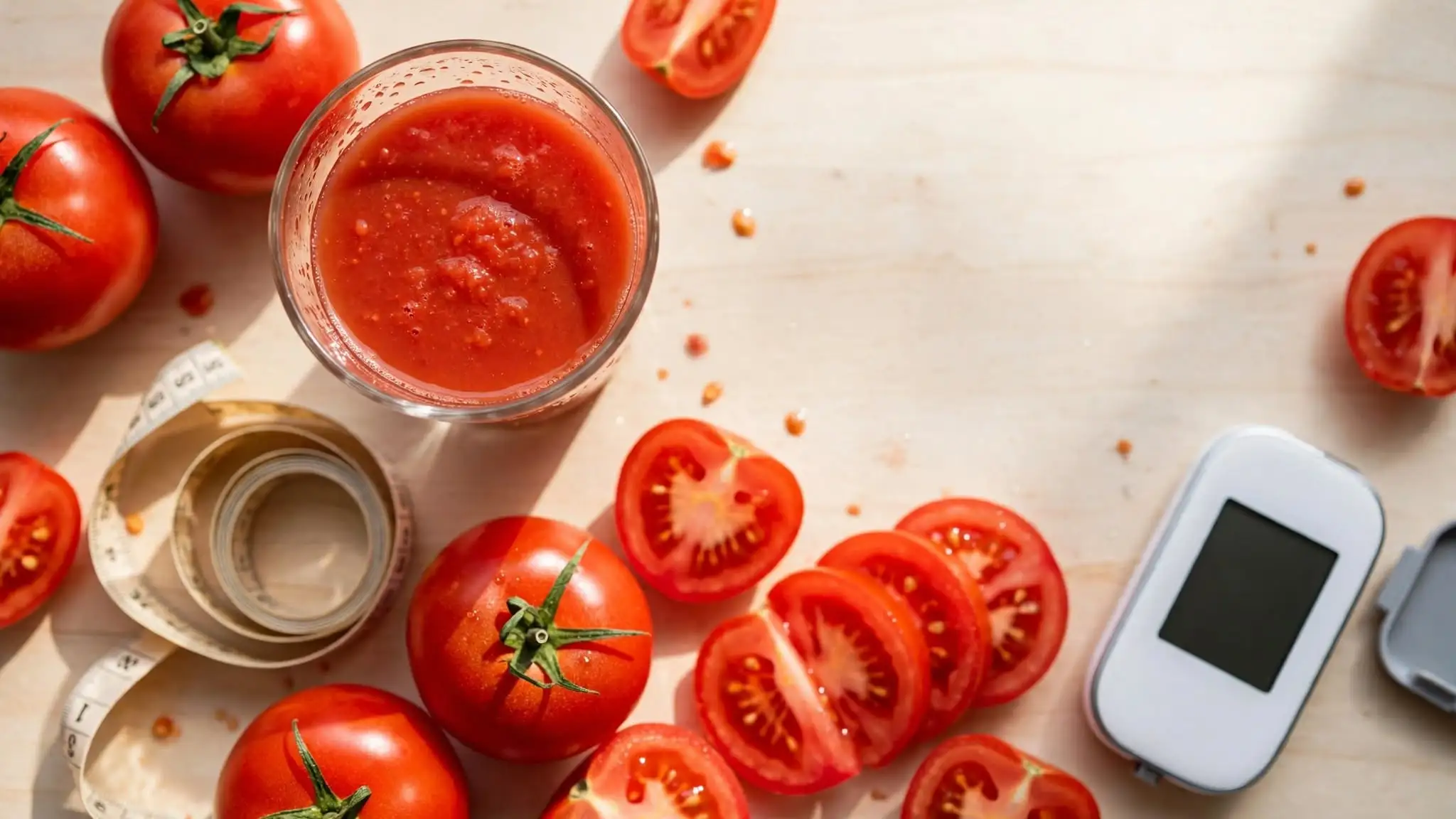
My father-in-law Tariq has been drinking tomato juice with breakfast every morning since I have known him. I always thought it was one of those old habits that people adopt decades ago and never question. I never thought about it again, even after his recent check-up, when he almost casually mentioned that his cardiologist had particularly appreciated his cholesterol stats.
“I don’t even think about it anymore,” he said. “It’s just breakfast I eat.” That stuck in my mind, and I went home and started looking at what was actually inside that plain red glass.
What I found really surprised me. The health benefits of drinking tomato juice are proven by extensive research covering cardiovascular health, inflammation, cancer risk, and blood sugar management. I went with skepticism, expecting a few weak and exaggerated claims. Instead, I saw four specific, well-documented benefits that completely changed my view of the health benefits of drinking tomato juice.
I admit that I came into it with half the expectation that I would write a gentle and disingenuous article. Tomato juice has always felt like one of those quiet and unappealing beverages that no one talks about—no marketing campaign, no wellness influencer moment, just a can that has been lying on the same supermarket shelf for decades. This lack of hype has nothing to do with the actual support of the research.
Table of Contents
What’s Actually in a Glass of Tomato Juice?
One cup — roughly 240ml — of unsweetened tomato juice provides meaningful amounts of vitamin C, vitamin A (as beta-carotene), and potassium, all in around 40 to 50 calories. But the compound that drove most of my research interest is lycopene — the carotenoid responsible for tomatoes’ red colour, and the nutrient behind most of the cardiovascular and cancer research I found.
One fact stopped me mid-scroll: Americans get more than 80% of their dietary lycopene from tomatoes in various forms. Tomato juice isn’t a minor source — it’s one of the most concentrated and accessible sources most people have in their diet.
Here’s the detail that surprised me, because it contradicts the “raw is always best” assumption I’d carried for years: cooked and processed tomato products, including juice, often contain more bioavailable lycopene than raw tomatoes. Heat breaks down plant cell walls and releases the compound in a form the body absorbs more readily. My father-in-law’s daily glass of processed tomato juice may, in this specific respect, be doing more for him than a fresh tomato salad would. I mentioned this to him and he just laughed — thirty years of habit, and it turns out the boring, convenient version was quietly the better choice the whole time.

Benefit 1 — Heart Health and Blood Pressure Support
How Lycopene Protects Blood Vessels
Lycopene is a powerful antioxidant that protects blood vessels and reduces the oxidation of LDL (“bad”) cholesterol — a critical step in preventing plaque buildup and atherosclerosis. Oxidised LDL is considerably more damaging to artery walls than LDL in its normal state.
A 2026 umbrella review published in Food & Function confirmed that lycopene intake from tomatoes significantly improves blood pressure indices, with average reductions of approximately 2 to 3 mmHg in systolic blood pressure. The researchers described this as modest, but noted every 5 mmHg reduction carries meaningful clinical implications at a population level.
This is where Tariq’s story made sense to me. His cardiologist’s comment about his cholesterol numbers lined up directly with what the lycopene research shows. Thirty years of a daily glass is a genuinely long intervention period, far beyond the three-to-four-week windows most clinical studies use. The LDL oxidation mechanism reminded me of similar research I’d looked into when writing about pomegranate juice and its effect on cholesterol — a different fruit, but an overlapping cardiovascular pathway.
A Useful Caveat Worth Knowing
I want to be honest about the limits here. Research on lipid profiles specifically — total cholesterol and LDL numbers directly — remains somewhat inconsistent, even though blood pressure improvements are more consistently observed. Lycopene helps the cardiovascular system in real ways, but it isn’t a guaranteed fix for an individual’s cholesterol panel, and it doesn’t replace medication where that’s been prescribed. When I raised this caveat with Tariq, he shrugged it off — he’s still on his usual medication, and sees the juice as one small habit among several, not a replacement for anything his GP has prescribed. That balance seems like the sensible way to treat this evidence generally.
Benefit 2 — Reduced Inflammation and Antioxidant Protection
The Inflammation-Lowering Effect
One study found that tomato juice consumption had a restorative effect on biochemical markers of inflammation and oxidative stress — including CRP, LDH, and CPK — in physically trained individuals recovering from intense exercise. A more recent study on tomato-soy juice in adults with obesity found that lycopene inhibits key pro-inflammatory markers from the NF-κB pathway in fat and liver tissue specifically.
I’d been dealing with joint stiffness after longer training sessions for a while before I came across this research. Tomato juice wasn’t on my radar at all until I saw the CRP and oxidative stress data — at which point it earned a regular spot in my post-workout routine. This is the same NF-κB signalling pathway that’s central to how chronic inflammatory and autoimmune disease develops, and seeing it show up independently in tomato research reinforced how central this one pathway is across a huge range of conditions.
DNA Protection — the Finding That Surprised Me Most
A pilot study on irradiated human lymphocytes found that participants who drank tomato juice daily for three weeks showed measurably reduced DNA damage when their blood samples were later exposed to X-ray radiation in a lab setting. Researchers attributed this to lycopene and beta-carotene quenching reactive oxygen species — the unstable molecules responsible for much of the cellular damage from radiation exposure and everyday oxidative stress. It’s a small pilot study and shouldn’t be overstated, but it’s a striking illustration of how active lycopene is at a cellular level. I read that particular study twice, mostly because I couldn’t quite believe something as ordinary as juice from a can was showing up in radiation-damage research at all.
Benefit 3 — Cancer Risk Reduction, Particularly Prostate Cancer
What the Research Actually Shows
This is the area where the evidence base is oldest and most extensively studied. A landmark Harvard School of Public Health study found that men eating 10 or more servings of tomato products per week were 34% less likely to develop prostate cancer. Follow-up research found men over 65 with a family history of prostate cancer who had higher blood lycopene levels had approximately half the risk of those with lower concentrations.
Separate research from the University of Milan found people consuming at least one tomato-based product daily had a 50% lower chance of developing digestive tract cancers. A comprehensive review covering 24 studies confirmed an 11% reduction in prostate cancer risk associated specifically with tomato and tomato juice consumption.
My wife’s uncle Naveed had a prostate health scare two years ago — nothing serious in the end, but enough of a fright that it became a topic of conversation at every family gathering for months afterward. Reading this research was the first time I had something concrete to tell Naveed beyond the usual “eat more vegetables” advice everyone gives without much conviction. Naveed actually asked me to send him the studies afterward, which isn’t something that usually happens when I bring up nutrition research at family dinners. I want to be honest about what this evidence is and isn’t: it’s epidemiological association, not proven direct causation. But the consistency across independent research groups, in different countries, over several decades, is genuinely one of the more credible nutrition-and-cancer links in the field.
Benefit 4 — Blood Sugar Management and Weight Support
The Blood Sugar Connection
Unsweetened tomato juice has a low glycemic index, meaning it doesn’t cause a rapid spike in blood sugar on its own. A small study found that drinking a cup of tomato juice 30 minutes before a carbohydrate-rich meal helped improve post-meal blood sugar levels — a genuinely practical, low-effort habit.
My mother-in-law Shabana has been managing borderline blood sugar for a few years, and when I mentioned this study to her, she started having a small glass of tomato juice before her larger evening meal as a simple experiment. She’s not making any scientific claims from one person’s experience — but she’s kept the habit going for months now, which tells me she noticed something worth continuing. This ties directly into the same principles I built around avoiding energy crashes during a calorie deficit: a pre-meal habit that blunts a blood sugar spike is exactly the kind of small adjustment that compounds over months without requiring willpower.
Weight Management — Filling, Low-Calorie, and Practical
Tomato juice is low in calories — roughly 40 to 50 per cup — but surprisingly filling due to its fibre and fluid content. Research has linked daily tomato juice consumption to reductions in body weight and waist circumference in overweight women specifically. Replacing sugary, calorie-dense drinks with tomato juice is an easy swap that supports a calorie deficit without the hunger that often comes with aggressive restriction. It fits naturally alongside the approach I cover in easy ways to eat more protein and build a more nutrient-dense plate — a low-calorie, nutrient-rich addition rather than an empty-calorie drink.
How Much Should You Drink, and What About Sodium?
Most of the research supporting these benefits uses daily intakes of 190ml to 240ml — roughly one cup. The practical guidance that comes out of this body of research is simple: one glass per day is a reasonable, evidence-aligned target for most adults, not licence to drink it by the litre. A documented case study found a woman who drank about two litres daily over several years developed a temporary orange tint to her skin from excessive carotenoid accumulation, which fully resolved once she cut back.
Here’s the catch I almost missed entirely. Many commercial tomato juices are surprisingly high in added sodium — some brands containing 500 to 700mg per serving. This matters because the cardiovascular benefits of lycopene can be partially offset by excessive sodium from the very same glass. I checked the brand Tariq had been drinking for thirty years, fully expecting it to be packed with salt. It turned out he’d switched to a low-sodium variety years ago without ever mentioning it. The practical guidance: choose low-sodium or no-salt-added varieties, or make fresh tomato juice at home for full control.
One Glass a Day: the practical takeaway from all four benefits is the same simple habit — roughly 190–240ml of low-sodium tomato juice daily, ideally with a meal rather than on its own. Nothing more elaborate than that is needed to see the effects the research describes.
4 Benefits at a Glance
| Benefit | Key Mechanism | Evidence Strength |
| Heart health & blood pressure | Lycopene reduces LDL oxidation, lowers BP 2–3 mmHg | Strong — 2026 umbrella review |
| Reduced inflammation | Lycopene inhibits NF-κB pathway, lowers CRP | Moderate to strong |
| Cancer risk reduction | Antioxidant protection, particularly prostate cancer | Strong epidemiological link |
| Blood sugar & weight support | Low glycemic index, blunts post-meal glucose spikes | Moderate |
Conclusion
I started this research with the hope that I would find a thinner and overused case for an old-fashioned beverage. Instead, I saw four truly proven benefits, each of which was proven by different research: cardiovascular protection through the effect of lycopene on LDL oxidation and blood pressure, measurable reductions in inflammatory markers, decades-old association with reduced risk of prostate cancer, and help with functional blood sugar and weight management.
The benefit that felt most relevant to me personally was the inflammation research, as I had the stiffness of the joints related to my own training—but the cardiovascular angle is the one that stood out the most in my mind, especially because it was directly related to Tariq’s 30-year habit. I now keep low-sodium tomato juice in my fridge and often drink a glass in the morning, occasionally with a little lemon. His daily glass, which I always quietly thought was just an old habit with no real substance behind it, was working real, evidence-based the whole time. The health benefits of drinking tomato juice are real, specific, and worth taking seriously — a decent glass daily, with a sodium deficiency, is enough. It’s a rare occasion when that unfabulous, decades-old habit turns out to be truly imitated, not this month’s new drink.
This article is for general informational purposes only and does not constitute medical advice. Always consult a qualified healthcare professional before making significant changes to your diet, particularly if you have an existing health condition or are managing blood pressure, blood sugar, or cardiovascular risk.
Frequently Asked Questions
What are the main health benefits of drinking tomato juice?
Tomato juice offers four well-evidenced benefits: heart health and blood pressure support, reduced inflammation and oxidative stress, reduced prostate cancer risk, and improved blood sugar and weight management.
How much tomato juice should I drink per day?
Most research supporting these benefits uses approximately 190ml to 240ml — roughly one cup — of tomato juice per day.
Is tomato juice good for blood pressure?
Yes — a 2026 umbrella review confirmed that lycopene intake from tomatoes modestly but measurably improves blood pressure, with average reductions of 2 to 3 mmHg systolic.
Does tomato juice help reduce cancer risk?
Research suggests it may, particularly for prostate cancer — a review of 24 studies found high tomato and tomato juice consumption associated with an 11% reduction in prostate cancer risk.
Is tomato juice high in sodium?
Many commercial tomato juices are high in added sodium, sometimes 500 to 700mg per serving, so choosing a low-sodium or no-salt-added variety is important.

1 thought on “4 Health Benefits of Drinking Tomato Juice”
Comments are closed.