Introduction
🟢 Quick Take
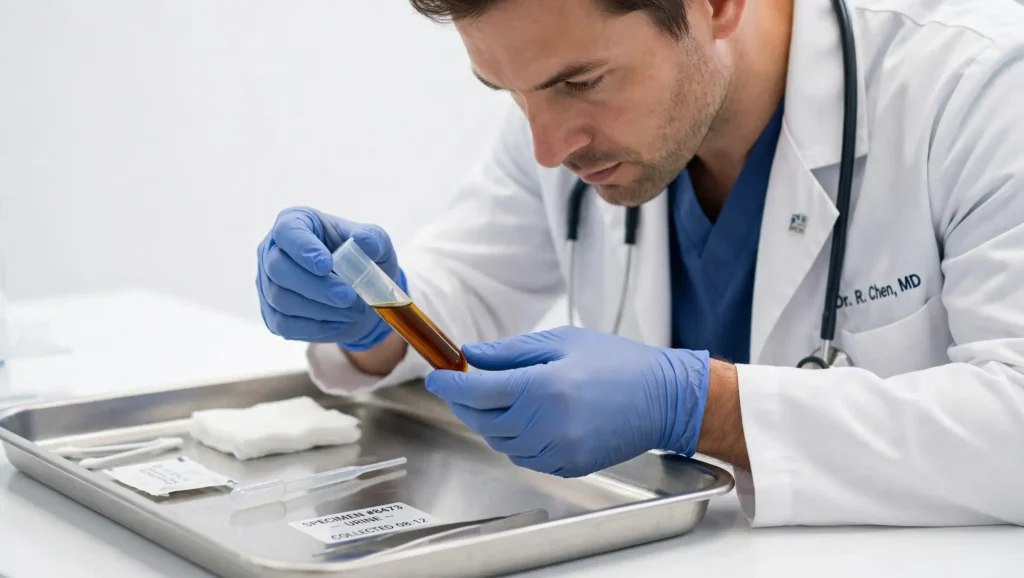
Obstructive jaundice urine color turns dark, tea-like, or brown because bile flow is physically blocked, forcing bilirubin to spill into the bloodstream and out through the kidneys instead.
It usually shows up alongside pale, clay-coloured stool — a combination that’s a strong clue for doctors that something is obstructing the bile duct, most often a gallstone.
A close friend of mine went through exactly this, and the urine colour was the detail that finally got him to a doctor.
A friend of mine called me one night half-jokingly and said that his urine had been “like hot tea” for the past few days. At first, she thought it was a joke, blaming it for the lack of water, but when she mentioned that her eyes looked light yellow on the bathroom mirror that morning, the joke stopped working for both. It was this call that introduced me to the obstructive jaundice urine color, which was a real, specific medical indication, not just a strange detail to ignore. What I learned in explaining to him really changed the seriousness with which I now take small changes.
Table of Contents
Why Urine Turns Dark in Obstructive Jaundice
Urine colour is not a coincidence in jaundice cases — it is a direct reflection of what is happening inside the bile ducts. Understanding the mechanism made the whole situation feel far less mysterious once my friend’s doctor walked us through it.
Before this, I had always assumed dark urine was simply a dehydration thing, full stop, which is honestly why my first instinct was to tell my friend to just drink more water. It turns out dehydration and obstructive jaundice can look deceptively similar at a glance, but the underlying reason is completely different, and knowing which one you’re dealing with matters a great deal.
What Conjugated Bilirubin Is Doing When Bile Can’t Flow
Normally, the liver processes bilirubin into a water-soluble form called conjugated bilirubin and sends it into bile, which flows down to the intestines. When something physically blocks that pathway, conjugated bilirubin has nowhere to go, so it backs up into the bloodstream instead. Because it is water-soluble, the kidneys filter it out and excrete it through urine, which is exactly what turns urine dark or tea-coloured.
Why Urobilinogen Disappears at the Same Time
Under normal conditions, some bilirubin gets converted by gut bacteria into a compound called urobilinogen, part of which is reabsorbed and shows up in urine in small amounts. When bile flow is blocked, bilirubin never reaches the intestines to begin with, so urobilinogen production drops sharply. This is actually one of the details doctors use to distinguish obstructive jaundice from other types.
🔎 The Two-Symptom Combo Doctors Look For
Dark, tea-coloured urine + pale, clay-coloured stool together is a strong signal of a bile duct blockage, rather than a purely liver-cell or blood-related cause.
The Phone Call That Started This
When my friend first mentioned the urine colour, my instinct was to suggest he just drink more water and see if it settled. It was only when he added the detail about his eyes that something clicked — dark urine plus yellowing skin together is a very different situation than dark urine on its own, which can genuinely just mean mild dehydration.
I pushed him to call his GP the next morning rather than wait the weekend out, and looking back, that was probably the most useful thing I did in this whole story. He later admitted he would have talked himself out of it if I hadn’t kept bringing it up. Sometimes the most important part of a health scare is simply not letting a friend downplay it.
What Causes Obstructive (Posthepatic) Jaundice
Obstructive jaundice, sometimes called posthepatic jaundice, happens when something physically blocks the bile ducts after bile leaves the liver. Unlike prehepatic or hepatic jaundice, the liver itself is often working perfectly fine — the problem is downstream.
Gallstones Blocking the Common Bile Duct — the Most Common Cause
The most frequent cause by far is a gallstone lodging in the common bile duct, a condition called choledocholithiasis. In my friend’s case, this turned out to be exactly what happened. I had actually written about gallstones from a completely different angle before, in whether oranges are safe to eat with gallstones, and revisiting that article with this new context made the connection between diet, gallbladder health, and bile flow click into place for me in a way it hadn’t before.
Tumors, Strictures, and Pancreatitis as Less Common Causes
Less commonly, obstructive jaundice can result from tumors pressing on the bile duct, scarring or strictures from previous procedures, or pancreatitis causing swelling that compresses the duct nearby. These causes are taken seriously precisely because they are less common and often need more urgent imaging to rule out.
Hearing this list for the first time was honestly a little unsettling, mostly because a gallstone felt like the least alarming explanation on it. His GP reassured us early on that his age, symptom pattern, and initial bloodwork all pointed toward a straightforward gallstone rather than anything more serious, which made the imaging appointment feel far less daunting once we understood why they were being thorough rather than dramatic.
How Obstructive Jaundice Differs From Prehepatic and Hepatic Jaundice
One of the more useful things I picked up during this whole experience was how differently each type of jaundice tends to affect urine and stool colour, even though all three can cause the same yellow skin.
Why Prehepatic Jaundice Rarely Changes Urine This Way
In prehepatic jaundice, red blood cells break down faster than usual, but the liver itself processes bilirubin normally, so urine colour typically stays close to normal. I looked into this more closely after a separate experience within my own family, which I wrote about in prehepatic jaundice treatment, and the contrast with my friend’s case couldn’t have been clearer.
Why Hepatic Jaundice Urine Color Is Less Predictable
Hepatic jaundice sits somewhere in between, since the liver is damaged but not necessarily blocked, meaning urine and stool colour can vary depending on how much liver function remains. I explored this in more detail in hepatic jaundice stool colour, which turned out to be a genuinely useful reference point while my friend’s own results were coming back.
How Doctors Confirmed the Blockage
Liver Function Tests (ALP, GGT, Bilirubin Split)
The GP ordered a liver function panel that measured alkaline phosphatase (ALP) and gamma-glutamyl transferase (GGT), both of which tend to rise sharply when bile ducts are blocked, along with a bilirubin split confirming that conjugated bilirubin was elevated. These specific markers pointed toward an obstructive cause rather than a hepatic one almost immediately.
Ultrasound and Why Imaging Matters More Here
An abdominal ultrasound followed within days, since imaging is essential for locating and confirming a physical blockage in a way blood tests alone cannot. In my friend’s case, the ultrasound clearly showed a dilated bile duct along with a gallstone sitting exactly where the bloodwork had suggested trouble was happening.
He described the wait between the blood test results and the ultrasound appointment as the most anxious few days of the whole experience, mostly because dark urine and yellow eyes are visible, daily reminders that something is wrong, even while you’re waiting for answers.
Sitting with him in that waiting room, I noticed how differently this diagnostic process felt compared to the usual blood-test-and-wait routine most of us are used to for other health concerns. Watching the ultrasound screen with the sonographer pointing out the dilated duct in real time made the whole abstract explanation about bile blockages suddenly feel concrete in a way that reading about it never had.
How Obstructive Jaundice Is Actually Treated
Removing the Blockage (ERCP, Stone Extraction, Stenting)
Once the gallstone was confirmed, treatment focused on physically clearing the blockage. My friend underwent an ERCP (endoscopic retrograde cholangiopancreatography), a procedure that allows doctors to locate and remove the stone from the bile duct directly, often avoiding more invasive surgery.
Why Symptoms Resolve Once Bile Flow Is Restored
Once bile could flow normally again, there was no separate treatment needed for the jaundice itself. The yellowing, the dark urine, and the pale stool were all downstream effects of the blockage, and they began resolving on their own within days of the procedure.
💧 Urine Colour as a Recovery Marker, Not a Treatment Target Watching urine gradually return to its normal pale yellow is a useful sign that bile flow has been restored — but it’s a marker to track, not something to try to fix directly.
During his recovery, we also ended up talking about broader liver and blood health topics, and I pointed him toward something I’d written about autoimmune disease, mainly because so many of the liver panel markers involved overlapped with what his own bloodwork had shown, even though his underlying cause was completely different.
What Recovery Looked Like for Him
Within about a week of the procedure, my friend’s urine had returned to its usual pale yellow, and the faint yellow tint in his eyes was gone not long after. His follow-up appointment confirmed his liver enzymes had normalised, which was a genuine relief for both of us after weeks of him downplaying how uncomfortable the whole thing had actually made him feel.
He also mentioned that his appetite came back noticeably in that first week, something neither of us had connected to the blockage until his doctor pointed out that bile plays a direct role in digesting fatty foods. Meals that had felt unappealing during the worst of it suddenly seemed normal again, which turned out to be one of the clearest everyday signs that things were genuinely improving, well before any bloodwork confirmed it.
What stayed with me afterward was how quickly things resolved once the actual blockage was addressed, compared to how long he had quietly ignored the early symptoms beforehand. It reinforced something I keep coming back to in these situations: the sooner the cause is identified, the shorter and simpler the fix tends to be.
When Dark Urine and Jaundice Need Emergency Care
Most cases of obstructive jaundice, like my friend’s, are serious but manageable once diagnosed. There are situations, though, that call for urgent care rather than a routine GP visit.
🚨 Seek Emergency Care If You Notice
- Fever or chills alongside jaundice, which can signal a serious bile duct infection (cholangitis)
- Severe or worsening abdominal pain, particularly in the upper right side
- Confusion, extreme drowsiness, or difficulty staying alert
- Rapidly worsening yellowing of the skin or eyes over hours rather than days
Frequently Asked Questions
Why does urine turn dark in obstructive jaundice?
Bile flow is blocked, so conjugated bilirubin backs up into the bloodstream and is filtered out through the kidneys into urine, turning it dark or tea-coloured.
Does obstructive jaundice always cause pale stool too?
Yes, typically. Since bile can’t reach the intestines, stool loses the pigment that normally colours it, often appearing pale or clay-coloured alongside dark urine.
How is obstructive jaundice urine color different from hepatic jaundice?
Obstructive jaundice reliably produces dark urine because of complete bile blockage, while hepatic jaundice urine color is more variable, depending on how much liver function remains.
Can dark urine from obstructive jaundice go back to normal?
Yes. Once the blockage is cleared and bile flow is restored, urine colour typically returns to normal within days to about a week.
When should dark urine and jaundice be treated as an emergency?
If dark urine or jaundice appears alongside fever, severe abdominal pain, or confusion, it should be treated as a medical emergency and evaluated immediately.
Medical Disclaimer: This article is for general information only and is not a substitute for professional medical advice, diagnosis, or treatment. Dark urine and jaundice should always be evaluated by a qualified healthcare provider.
Looking back, that half-joking phone call turned into one of the more useful health lessons either of us has been through. What stuck with me most is how much a simple detail like urine colour can reveal about what’s happening deep inside the body, long before anything feels seriously wrong. If there’s one thing I’d want anyone reading about obstructive jaundice urine color the way I once researched it late at night to take away, it’s this: don’t talk yourself out of getting a strange symptom checked, because the fix is often far simpler than the worry leading up to it.
