Quick Summary: Hemolytic jaundice happens when red blood cells break down faster than the liver can process the bilirubin released, rather than the liver itself being damaged. Common causes include G6PD deficiency, sickle cell disease, and autoimmune conditions, and certain foods or medications can trigger sudden episodes in people who carry these conditions.
The Phone Call About My Friend’s Yellow Eyes and a Bowl of Beans
My friend called me in a very worried voice. He had eaten a bowl of fava beans at the family dinner the night before, which he had eaten several times as a child, and the next afternoon his eyes were visibly yellow. He felt tired, his urine had intensified, and he was headed to the emergency room, half sure that there was something more to the food poisoning that night.
It was not food poisoning. Blood tests showed that he was deficient in G6PD — a condition he had never diagnosed, although at times in his life he had ingested fava beans without an initial reaction — and that, according to doctors, the fava beans had developed a hemolytic episode. I had never heard the term hemolytic jaundice before that call, and when I understood what I was really going through, I wanted to do it right, rather than just nodding the next time the topic came up.
This article is everything I learned about hemolytic jaundice, written in a way I wish I had understood before that call, rather than being able to understand it all in a hurry afterward.
Table of Contents
What Makes Hemolytic Jaundice Different
Three Types of Jaundice, Briefly
Doctors generally group jaundice into three categories, based on where the problem in the bilirubin process actually sits: hepatic (a problem within the liver itself), obstructive (a blockage stopping bile from draining, often gallstones or a tumour), and hemolytic (too much bilirubin being produced in the first place, faster than even a healthy liver can keep up with). All three produce the same visible yellowing, which is exactly why blood tests, not just appearance, are needed to tell them apart.
When the Liver Is Healthy But Overwhelmed
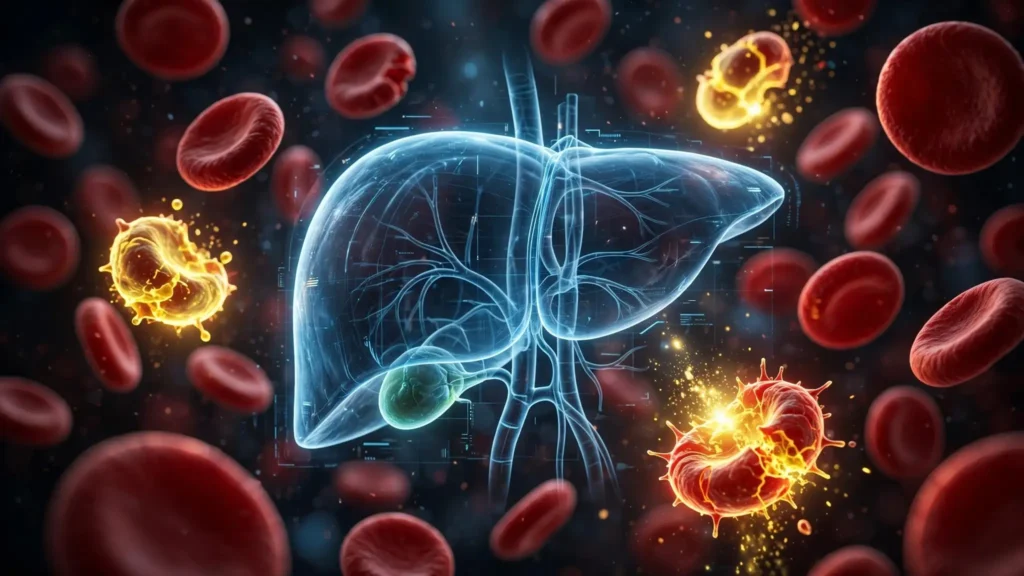
This was the part that reframed everything for me. My friend’s liver wasn’t damaged at all — it was working exactly as it should, at full capacity even. The problem was upstream: his red blood cells were breaking down far faster than normal, flooding his system with more bilirubin than even a perfectly healthy liver could process in time. Understanding how jaundice caused by actual liver damage looks and behaves differently helped me see just how different this was from what I’d read about after my uncle’s own jaundice scare — a completely different mechanism producing the same visible yellow tint, and requiring an entirely different set of tests and treatment.
Hemolytic jaundice isn’t a liver problem at its core — it’s a red blood cell problem that a normal liver simply can’t keep pace with. That distinction changes both the diagnosis process and the treatment entirely.
Why Some Ethnic Groups Are More Affected
This was one of the more genuinely interesting things I learned, and it explained a lot about why this condition isn’t more widely known despite affecting hundreds of millions of people worldwide.
G6PD deficiency is thought to persist at such high rates in certain populations because carrying the gene offers some natural protection against malaria, similar to the evolutionary story behind sickle cell trait. It’s estimated to affect over 400 million people globally, with notably higher rates across South Asia, the Mediterranean, the Middle East, and parts of Africa. Most carriers, like my friend, go their entire lives without a single symptom unless they happen to encounter a specific trigger — which is exactly why it so often goes undiagnosed until an episode like his forces the question. Newborn screening programmes in some countries test for it routinely, but adults who were never screened as infants can go decades without ever finding out.
Common Myths About Hemolytic Jaundice
- Myth: it’s always genetic and present from birth. While inherited conditions like G6PD deficiency and sickle cell disease are common causes, autoimmune hemolytic anemia and drug- or infection-triggered hemolysis can develop at any point in life in someone with no prior family history at all.
- Myth: if you’ve eaten fava beans before without issue, you’re safe. Reaction severity with G6PD deficiency can vary depending on the specific variant of the condition, the amount consumed, and other factors like concurrent illness — a mild or absent reaction previously doesn’t rule it out as a genuine risk going forward.
- Myth: hemolytic jaundice always requires a blood transfusion. Many episodes, including my friend’s, resolve with monitoring and supportive care alone once the trigger is removed, and the body’s own bone marrow ramps up production to compensate. Transfusions are reserved for more severe or rapidly worsening drops in red blood cell count.
Living With G6PD Deficiency Day to Day
Once my friend had his diagnosis, the day-to-day reality turned out to be far less restrictive than either of us initially assumed.
He avoids fava beans entirely now, checks with a pharmacist before starting any new medication, and mentions his condition whenever he’s prescribed something for an infection. Beyond that, his life looks completely normal — he still exercises regularly, travels, and eats a broad, varied diet with just that one specific exclusion. He’s had no further episodes in the time since, precisely because avoiding known triggers is genuinely effective once you know what they are. He’s also told his GP to flag it clearly on his medical record, so it comes up automatically whenever a new prescription is considered.
What Actually Causes Hemolytic Jaundice
G6PD Deficiency and Trigger Foods Like Fava Beans
G6PD deficiency is an inherited condition affecting an enzyme that normally protects red blood cells from oxidative stress. Without enough of it, certain triggers — fava beans (a reaction known as favism), specific medications, and even some infections — can cause red blood cells to break down rapidly. It’s more common in people of South Asian, Mediterranean, Middle Eastern, and African descent, and most people with it have no symptoms at all until they encounter a genuine trigger, exactly as happened with my friend. Symptoms typically appear within two to three days of exposure, which made it genuinely tricky to connect back to that specific dinner at first.
Sickle Cell Disease and Hereditary Spherocytosis
In sickle cell disease, abnormally shaped red blood cells break down and get trapped in small blood vessels far more readily than normal cells, which can also cause painful blockages alongside the jaundice itself. Hereditary spherocytosis is a separate inherited condition where red blood cells are oddly shaped and fragile, leading to a similar pattern of ongoing, excessive breakdown, often diagnosed in childhood once a pattern of recurring mild jaundice and fatigue emerges.
Autoimmune Hemolytic Anemia
In autoimmune hemolytic anemia, the immune system mistakenly identifies red blood cells as a threat and destroys them directly — the same broad mechanism behind how the immune system can mistakenly target the body’s own cells in other autoimmune conditions, just applied specifically to red blood cells rather than joints, skin, or other tissue. It can develop on its own or alongside another autoimmune condition, an infection, or occasionally certain cancers, which is why doctors investigate broadly once it’s confirmed rather than stopping at the diagnosis itself.
Medication Triggers and Infections
Certain antibiotics, some antimalarial drugs, and — in rare cases — mismatched blood transfusions can also trigger hemolysis. Infections themselves can sometimes act as a trigger too, independent of any medication being taken to treat them. This is part of why doctors ask detailed questions about recent medications and illnesses when hemolytic jaundice is suspected, rather than assuming it’s automatically genetic or diet-related from the outset. Anyone with a confirmed G6PD diagnosis is generally given a written list of medications to avoid, which is worth keeping somewhere easy to find, like a phone note, rather than trying to remember it from memory during a pharmacy visit.
| Cause | What’s Actually Happening |
| G6PD deficiency | Enzyme deficiency leaves red cells vulnerable to oxidative triggers |
| Sickle cell disease | Abnormally shaped cells break down and get trapped in vessels |
| Hereditary spherocytosis | Fragile, oddly shaped red cells break down prematurely |
| Autoimmune hemolytic anemia | Immune system mistakenly destroys red blood cells |
| Medications/infections | Certain drugs or illnesses trigger sudden red cell breakdown |
Symptoms Beyond Yellow Skin
Fatigue, Pale Skin, and Rapid Heartbeat
Because red blood cells carry oxygen, losing them faster than the body can replace them causes classic anemia symptoms alongside the jaundice: fatigue, pale skin, shortness of breath, and a noticeably rapid heartbeat. My friend described feeling like he’d run a race while sitting completely still, and said climbing a single flight of stairs left him more breathless than a full gym session normally would.
Dark Urine and an Enlarged Spleen
Dark urine, from excess bilirubin being excreted that way, is common, and the spleen — which filters damaged red blood cells from circulation — can become enlarged and tender during a significant hemolytic episode, since it’s working overtime to clear the unusually high volume of damaged cells. Abdominal discomfort tied to this kind of organ working overtime is worth taking seriously; abdominal discomfort tied to an organ working overtime covers a related but distinct picture of upper abdominal pain, and it’s worth knowing the difference between ordinary digestive discomfort and pain tied to an enlarged spleen or liver specifically.
How Doctors Diagnose Hemolytic Jaundice
Blood Smear and Bilirubin Tests
A blood smear examined under a microscope can reveal telltale signs depending on the cause — sickle-shaped cells, spherical cells, or “bite cells” characteristic of G6PD-related damage. Bilirubin blood tests confirm the overall picture, alongside a marker called reticulocyte count, which shows the bone marrow working overtime to replace lost red blood cells. My friend’s reticulocyte count was significantly elevated, which the doctors explained was his bone marrow’s way of trying to keep up with the losses.
The Coombs Test for Autoimmune Causes
When autoimmune hemolytic anemia is suspected, a Coombs test (also called a direct antiglobulin test) checks for antibodies attached to red blood cells, which helps confirm the immune system is the cause rather than an inherited enzyme or structural issue. This test wasn’t needed in my friend’s case once the G6PD deficiency was confirmed through more specific enzyme testing, but it’s a standard part of the diagnostic process when the cause isn’t already clear.
When It Becomes a Medical Emergency
Most hemolytic episodes, while frightening, resolve without lasting harm. But certain patterns cross the line into genuine emergency territory.
Seek emergency care for rapid-onset jaundice alongside: severe fatigue or breathlessness, a very fast heartbeat, dark urine with fever, or symptoms that develop and worsen within hours rather than days. A sudden, severe hemolytic episode can drop red blood cell counts dangerously fast.
What My Friend’s Recovery Actually Looked Like
He was kept in hospital for two days for monitoring and supportive care while his body recovered, and his bilirubin and blood counts were tracked closely until they stabilised. No transfusion was ultimately needed, though the doctors told him that had been a real possibility depending on how his numbers moved over those first 24 hours. He now carries a card listing his G6PD deficiency and knows exactly which foods and medications to avoid, which has made the whole condition feel manageable rather than frightening. Looking back, the two days in hospital were the hardest part — the ongoing management afterward has genuinely been straightforward.
What I’d Tell Anyone With a Family History of This
If G6PD deficiency, sickle cell disease, or hereditary spherocytosis run in your family, a simple blood test can confirm whether you carry it too, often before any symptoms ever appear. Knowing in advance means avoiding known triggers deliberately, rather than finding out the hard way, the way my friend did. It’s a five-minute conversation with a GP that can genuinely prevent a hospital admission down the line.
Understanding hemolytic jaundice changed how I think about jaundice generally — it’s not always a liver story, and knowing which kind you’re dealing with genuinely changes what happens next, from the tests ordered to the treatment offered.
Frequently Asked Questions
What is hemolytic jaundice?
It’s jaundice caused by red blood cells breaking down faster than the liver can process the bilirubin released, rather than by liver damage itself.
What causes hemolytic jaundice?
Common causes include G6PD deficiency, sickle cell disease, hereditary spherocytosis, autoimmune hemolytic anemia, certain medications, and some infections.
Is hemolytic jaundice the same as liver-related jaundice?
No. In hemolytic jaundice the liver is usually healthy but overwhelmed by excess bilirubin, whereas liver-related jaundice stems from damage to the liver itself.
Can hemolytic jaundice be cured?
It depends on the cause. Trigger-based episodes like G6PD deficiency are managed by avoiding known triggers, while some underlying conditions require ongoing medical management.
What foods or medications trigger hemolytic jaundice in G6PD deficiency?
Fava beans are a well-known trigger, alongside certain antibiotics and other medications, which is why anyone diagnosed is usually given a specific list to avoid.
This article is for informational purposes only and does not constitute medical advice. Sudden jaundice, especially alongside fatigue, breathlessness, or dark urine, should be assessed by a doctor promptly.
