GOOD TO KNOW
The Quick Answer: Guava and milk together isn’t dangerous for most healthy adults, but the combination can cause bloating, gas, or a heavy stomach in people with sensitive digestion, lactose intolerance, or acid reflux. Ayurvedic tradition warns against mixing the two because guava’s mild acidity can curdle milk protein, though curdling on its own isn’t harmful. Spacing them by roughly two hours, or skipping the pairing if dairy or fibrous fruit already disagrees with you, is the simplest way to avoid discomfort.
Introduction
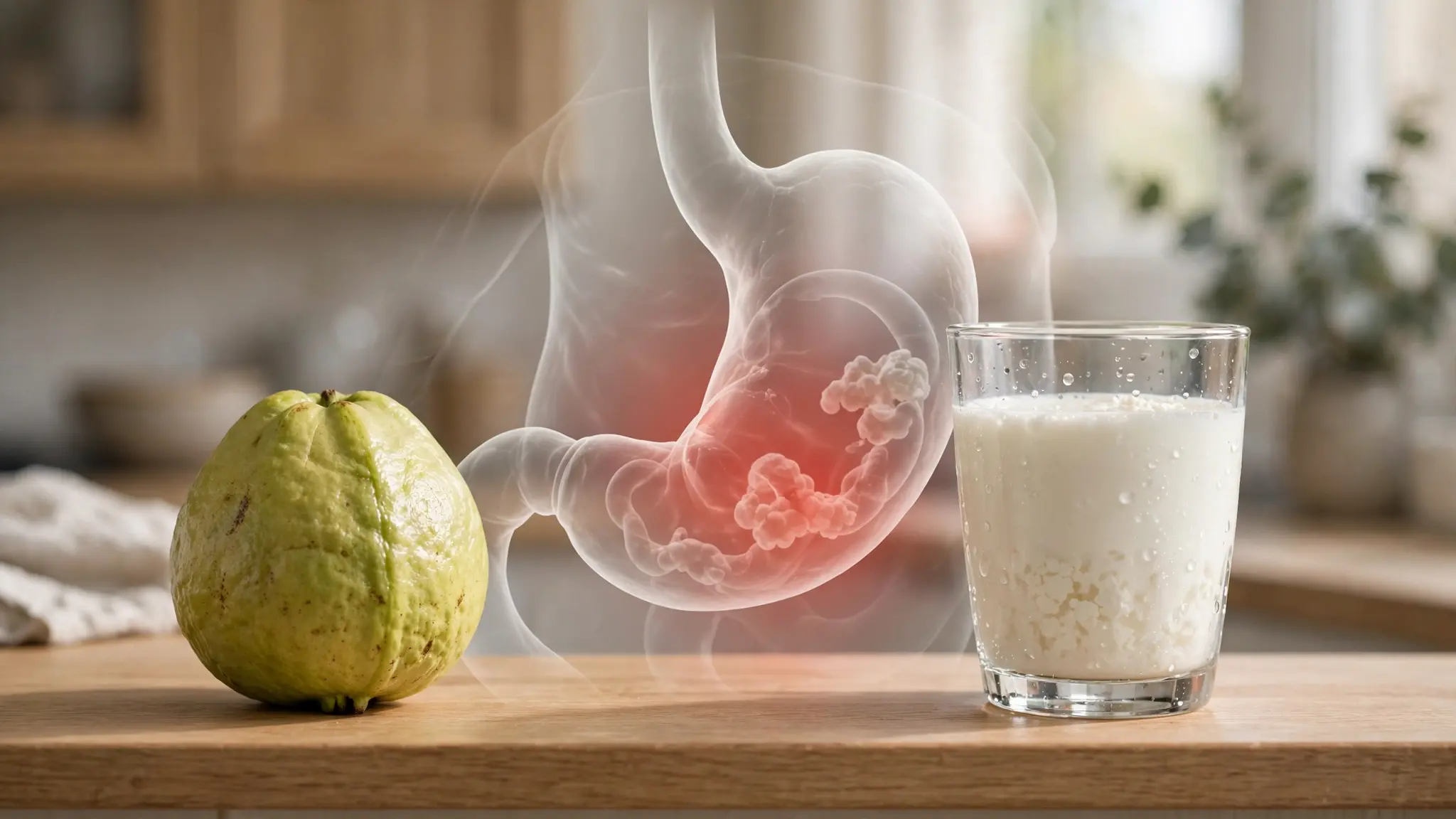
For as long as I can remember, my uncle has often eaten a sliced guava and a glass of hot milk in the mornings. When I once asked him if he had heard that guava and milk should not be eaten together, he laughed and kept eating. This spontaneous comment put me on a deeper journey of research, as I realized that I didn’t actually know that putting guava and milk together was really a concern or that it was just a misconception of another food combination that no one checked.
This is not a lab report. That’s what I found when I watched a very stubborn man consume this combination for decades, questioned it, and read the real reason behind the warning — not just repeat it. If you’ve typed “guava and milk together” into the search bar because someone gave you a stern warning at a family breakfast, or simply because you just want to know if your own habit is okay, then that’s what I did for the answer I really trust.
Let me be clear: there is no dramatic decision here. What I’ve found is more useful than a simple yes or no — understanding who this combination actually affects, why this warning exists, and what to do with the information that depends on your own digestion.
Table of Contents
The Question My Uncle Asked Me Over Breakfast
My Uncle’s Thirty-Year Breakfast Habit
It started on a visit home a few months ago. I sat down to breakfast and found my uncle doing what he always does — slicing a ripe guava into a bowl and topping it with a splash of milk, the way some people top cereal. I mentioned, half as a joke, that a colleague of mine won’t touch fruit and dairy in the same meal, convinced it ‘confuses digestion.’
He shrugged and said something I’ve thought about since: “People have been telling me this will upset my stomach for thirty years. It hasn’t yet.”
Why I went looking into it properly
That stuck with me. Not because he was necessarily right, but because so much of the advice around food combining gets repeated without anyone actually checking where it came from, or whether it applies to the person hearing it. My colleague had never actually looked into why she avoided fruit with dairy — it was just a rule she’d inherited, the same way my uncle had inherited his habit of ignoring it. So I decided to look into guava and milk together properly, instead of just accepting either side of the argument.
That meant going back to basics: what’s actually happening nutritionally and chemically when these two foods meet, where the warning originated, and whether real digestive evidence backs it up.
What’s Actually in Guava and Milk, Nutritionally
Guava’s fibre, vitamin C, and acidity
Guava is mostly known for its vitamin C and fibre content, along with a modest amount of natural plant acids that give it a slight tang, even when fully ripe. A single medium guava can contain more vitamin C than an orange, which is part of why it’s held in such high regard nutritionally. The fibre content is just as notable — roughly 3 grams per 100 grams — and it’s exactly what makes guava filling, but also what means it’s digested at its own, fairly deliberate, pace.
That combination of soluble and insoluble fibre is generally good for digestion over the course of a day, helping regulate bowel movements and slow down sugar absorption. But it also means guava arrives in your stomach with its own digestive workload already attached, before milk even enters the picture.
Milk’s protein, calcium, and lactose digestion timeline
Milk brings something different to the table: protein, calcium, and lactose, a sugar that some adults digest easily and others don’t process well at all as they age. Milk protein, mainly casein, is also structured in a way that responds to acidity — it can thicken or clump when it meets something acidic, which is the entire basis of how paneer and ricotta are made at home.
Digestion of milk is comparatively slow and steady, largely because of its protein and fat content, which take longer to break down than most fruit sugars. That slower pace is normal and by design — it’s what makes milk feel satiating rather than because something has gone wrong.
Put simply: one food is fibrous and mildly acidic and moves at its own pace, the other is protein-heavy and needs a steady digestive rhythm of its own. Neither is a problem on its own. The question is only what happens when they’re eaten close together, and that’s what actually varies from person to person.
The Ayurvedic Rule Behind the Warning
The warning against combining fruit with milk isn’t new, and it isn’t random internet advice either. It traces back to Ayurvedic principles around what’s called viruddha ahara, broadly translated as incompatible food combinations. Fruit and dairy is one of the most commonly cited pairs in that tradition, alongside things like fish and milk.
The reasoning, as I understand it after reading through several explanations, isn’t really about acute danger. It’s about the idea that some food pairings place more strain on digestion than others, particularly when eaten in large quantities or on a regular basis, potentially contributing to sluggish digestion or a build-up of what Ayurveda calls toxins over time. That’s a very different claim from “this combination is harmful,” and it’s worth keeping that distinction in mind before assuming the worst.
What I found genuinely interesting is that this tradition isn’t uniquely fixated on guava. Fruit paired with dairy in general — mango lassi being an obvious cultural exception that seems to escape the rule entirely — has long been treated with more caution than most other food pairings. That inconsistency, where one fruit-and-dairy combination is a beloved dessert and another is a warned-against pairing, is part of what made me want a clearer, less selectively-applied answer.
Does Guava Curdle Milk — and Does That Actually Matter?
Why Guava’s Acidity Curdles Milk
This was the part I actually wanted an answer to. Guava does contain enough natural acidity to theoretically cause milk proteins to curdle, in the same basic way lemon juice curdles milk when you’re making paneer at home.
But curdling by itself isn’t dangerous. It’s just protein changing shape in response to acid — the same thing your stomach does to every glass of milk you drink, guava involved or not.
Comparing it to the milk-and-citrus myth
I’d actually looked into a near-identical myth before, when I checked whether milk and citrus fruit combinations were genuinely risky, and the underlying chemistry turned out to be almost identical to what’s going on with guava.
The discomfort some people report after guava and milk isn’t really about curdling, then. It’s more likely tied to the combined digestive load — a fibrous, mildly acidic fruit alongside a slower-digesting dairy protein, eaten in the same sitting, asking the stomach to manage two fairly different digestive processes at once.
For someone with an already efficient, unbothered digestive system — like my uncle, it turns out — that combined load barely registers. For someone whose stomach is already working harder than average, whether from stress, an existing condition, or simple sensitivity, it can be the difference between a comfortable morning and a bloated one.
Who Actually Notices a Problem — and Who Doesn’t
Sensitive stomachs, lactose intolerance, and acid reflux
My uncle has never had an issue with this combination, and after thirty years, that’s not really a coincidence — some people simply tolerate it fine. But when I asked around further, a clearer pattern showed up.
GOOD TO KNOW
People most likely to notice discomfort after guava and milk together include those with lactose intolerance, acid reflux or GERD, or a generally sensitive digestive system. For everyone else, the combination is more a matter of comfort than risk.
What happened when my uncle tried spacing it out
I also asked my uncle to try spacing the two apart for a week, mostly out of curiosity rather than any real concern. He noticed no difference either way, which lines up with something I’d already read while looking into eating guava on an empty stomach — tolerance to guava, on its own or paired with other foods, varies enormously from person to person, and a lot of it comes down to how sensitive your digestion already is to begin with.
For contrast, I also asked a neighbour who’s lactose intolerant whether she’d ever tried the combination. She had, once, out of curiosity, and described exactly the kind of bloating and discomfort you’d expect — though she was equally quick to point out that plain milk alone does the same thing to her, guava or no guava. That’s a useful reminder that it’s often the milk doing the damage, not the fruit it happens to be paired with.
Why timing matters more than avoidance for most people
Put those two experiences side by side and a pattern emerges: it’s rarely guava itself causing trouble, and it’s rarely the pairing in isolation either. It’s the underlying sensitivity a person already has, with guava and milk simply being one of many combinations that can surface it.
Practical Guidance — How Long to Wait, and Better Pairings
The general spacing window
If you want to be cautious without overthinking it, spacing guava and milk apart by roughly two hours is the most commonly recommended window, and it’s a reasonable one. It gives each food time to move through the earlier stages of digestion without competing for the same digestive resources.
What I tell people who ask me this now
If you don’t already know how your stomach handles this pairing, there’s no harm in testing it cautiously with a smaller portion first, rather than assuming either the worst-case warning or your neighbour’s dismissal of it applies to you specifically.
A few practical adjustments that help, based on what I’ve read and what my uncle inadvertently confirmed over thirty years:
- Choose fully ripe guava rather than firm, green guava — riper fruit is generally gentler on digestion and less acidic-tasting.
- Keep portions moderate rather than a very large bowl of guava alongside a full glass of milk.
- If you’re prone to bloating generally, try the two foods separately for a week and see whether it makes any noticeable difference for you specifically.
- Room-temperature milk tends to sit more comfortably than very cold milk straight from the fridge, for guava or any other pairing.
- Pay attention to your own pattern over a few occasions rather than judging it from a single meal — digestion can vary day to day for reasons that have nothing to do with guava or milk at all.
A note on children and more sensitive digestive systems
One group I’d be more careful with is young children, whose digestive systems are still developing. When I looked into introducing guava to babies, the guidance was clear that new foods, including fruit-and-dairy combinations, should be introduced slowly and one at a time, watching for any reaction rather than assuming an adult’s tolerance applies.
IMPORTANT Seek medical advice if guava, milk, or any food combination is followed by severe abdominal pain, repeated vomiting, or blood in your stool — these are not typical reactions to this pairing and warrant a doctor’s assessment rather than a home remedy.
Other Food-Pairing Myths Worth Knowing
Guava and milk isn’t the only fruit-and-dairy combination with a reputation. While looking into this, I also came across the belief that cold banana milkshakes worsen a cough or cold, which I’d separately looked into after researching fruit-and-dairy combining myths — and found a similar pattern: a kernel of genuine caution, wrapped in a rule that gets applied far more broadly than the evidence supports.
The common thread across most of these myths is temperature, quantity, and individual sensitivity mattering far more than the specific pairing itself.
Conclusion
If my uncle had asked me today, I would have told him the same thing I told some friends: guava and milk are not to be feared together, but it is not an unimportant issue at all. For most healthy adults, it’s just a matter of comfort, not safety. If you already know that you don’t like milk or fibrous fruits, then it is beneficial to keep them apart. If you’ve been eating them for years without a problem, as he does, there’s no particular reason to change now.
What has changed for me is not my uncle’s breakfast habit — he is not going to listen to me in that matter. What has changed is that I generally consider food combination warnings to be understandable, not indiscriminately obeyed or ignored. Guava and milk proved to be a good example of a principle that is grounded in real, albeit trivial, and which applies much more rigorously than basic logic in conversation.
This article is for general informational purposes and reflects personal experience alongside publicly available nutritional information. It is not a substitute for professional medical advice. If you have a diagnosed digestive condition or ongoing symptoms, speak with a doctor or registered dietitian.
Frequently Asked Questions
Can guava and milk be eaten together safely?
Yes, for most healthy adults guava and milk together is safe; some people may experience mild bloating or discomfort due to differing digestion speeds.
How long should you wait between eating guava and drinking milk?
Spacing them roughly two hours apart is the commonly recommended window, though many people tolerate them together with no gap at all.
Does guava curdle milk in the stomach?
Guava’s mild acidity can cause milk protein to curdle, but this is a normal digestive process and not harmful on its own.
Is guava and milk bad for lactose intolerant people?
The milk component, not the guava, is the likely trigger for anyone with lactose intolerance, regardless of whether it’s paired with guava.
Can children eat guava and milk together?
Young children can generally have both, but new food combinations should be introduced slowly and one at a time, watching for any reaction.

3 thoughts on “Can You Eat Guava and Milk Together”