GOOD TO KNOW
The Quick Answer: Pomegranate, especially the juice, can cause diarrhea in some people, mainly due to its natural fructose and sorbitol content, both of which draw water into the intestines and speed up digestion. For most healthy adults, a moderate portion causes no issue at all — loose stools tend to show up specifically with large amounts of juice, an empty stomach, or an existing sensitivity like IBS or fructose malabsorption.
Introduction
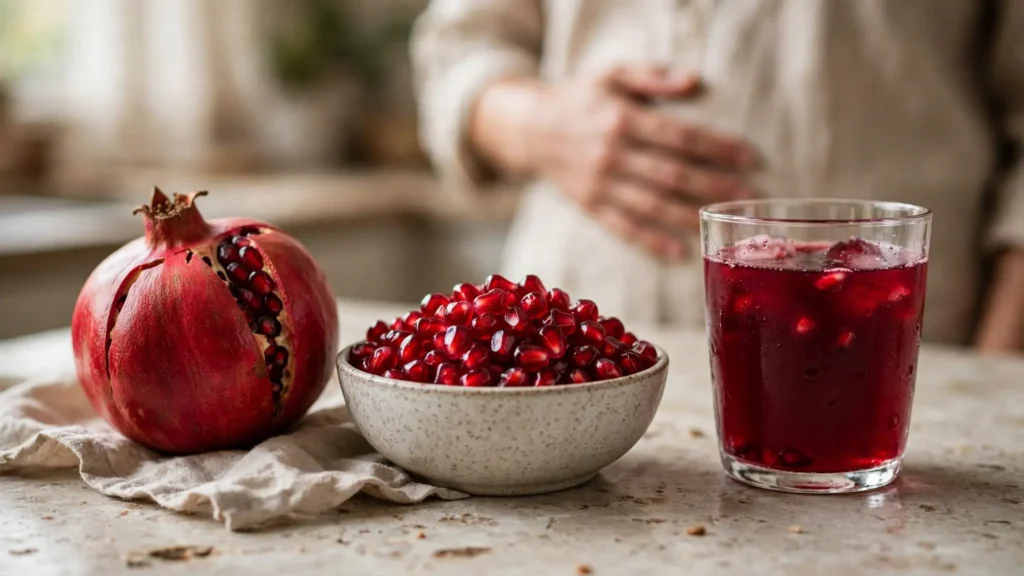
My acquaintance Sana, whom I know from the same fitness class, drank a large glass of pomegranate juice three times a day, as a “detox” she read about online, and ran to the bathroom the rest of the weekend. It was the first time I seriously thought about Can Pomegranate Cause Diarrhea, rather than assuming that she had just a gastrointestinal ailment that matched her new juice habit.
It made me wonder if pomegranate could properly produce diarrhea, rather than accept its earlier assumption that it was food poisoning, or dismiss juice as an unexpected coincidence.
This is not a lab report. That’s what I heard about her weekend, when I asked a few careful questions about how much and when she ate, and read about the actual digestive mechanisms — fructose, sorbitol, and fiber — that combine a fruit that’s mostly known for its antioxidants to something as disruptive as loose stools. If you’ve ever had a weekend like this after pomegranate, that’s what I did to get a reasonable explanation.
There is not a single dramatic decision waiting here. What exists is what is actually going on in your intestines when pomegranate causes diarrhea, why juice is the biggest cause compared to the whole fruit, and what a reasonable amount looks like for everyone else.
Table of Contents
Why My Acquaintance Sana Blamed Pomegranate Juice for a Rough Weekend
The Detox Juice She Drank Three Times in One Day
Sana had read that pomegranate juice was a good way to “reset” digestion and decided to drink a large glass first thing in the morning, another at lunch, and a third in the evening — all on a day she otherwise ate fairly lightly. By that evening, she was dealing with cramping and diarrhea severe enough that she cancelled plans entirely.
“I thought I was being healthy,” she told me a few days later, still slightly annoyed at herself. “I didn’t think juice could actually do that.”
Why She Assumed It Was Food Poisoning at First
Her first instinct was to blame something else she’d eaten, or a stomach bug going around — diarrhea doesn’t immediately scream “fruit juice” to most people, especially a fruit as widely marketed for health benefits as pomegranate. It took walking back through her entire day, meal by meal, before the sheer volume of pomegranate juice she’d had stood out as the obvious outlier.
Once we actually added it up — three large glasses in one day, nothing else unusual in her diet — food poisoning started to look like a far less likely explanation than the juice itself.
It reminded me how easy it is to overlook a genuinely healthy food as the cause of digestive upset, precisely because it’s marketed as healthy. Nobody walks away from a rough day assuming the antioxidant-rich superfood juice was the problem — until you actually count how much of it was involved.
What in Pomegranate Can Actually Cause Diarrhea
Fructose and Sorbitol, Explained
Pomegranate contains both fructose and a smaller amount of sorbitol, a natural sugar alcohol also found in fruits like apples and peaches. Both compounds draw water into the intestines through osmosis, and both can be poorly absorbed by the small intestine when consumed in large amounts — leading directly to looser, more frequent stools.
This mechanism is well established for sorbitol specifically, which is why it’s sometimes used deliberately as a mild laxative in other contexts. In pomegranate, it’s present naturally rather than added, but the digestive effect works the same way once you’ve had enough of it.
What makes pomegranate a slightly more notable example than some other fruits is the combination — meaningful fructose alongside meaningful sorbitol, in the same fruit at the same time. Individually, either compound in a moderate amount is rarely a problem. Together, in a large enough quantity, they compound each other’s water-drawing effect.
Neither compound is unusual or dangerous in ordinary amounts. Fructose is present in virtually every fruit, and sorbitol shows up naturally across a wide range of produce. It’s specifically the combined dose, delivered quickly and without much else to slow it down, that tends to overwhelm the gut’s absorption capacity.
Why Excess Fibre Can Speed Up Digestion Too Much
Pomegranate seeds also carry a meaningful amount of fibre, which is broadly beneficial for digestion in normal amounts but can have the opposite effect in excess — speeding up transit time through the intestines rather than supporting a normal, gradual rhythm. Combined with fructose and sorbitol’s water-drawing effect, a large amount of pomegranate can push digestion from “regular” into “too fast” fairly quickly.
Does Pomegranate Juice Cause Diarrhea More Than the Whole Fruit?
Why Juice Delivers Sugar Faster Than Seeds Do
Juicing concentrates pomegranate’s natural sugars while removing much of the fibre that would otherwise slow their absorption. A large glass of juice can deliver the fructose and sorbitol content of several whole pomegranates almost instantly, without the fibre that comes from actually chewing and eating the seeds. This is close to the opposite problem to the one I found while researching pomegranate and constipation — there, concentrated juice caused problems through tannins slowing things down too much; here, concentrated sugar without fibre speeds things up too much. Same juicing process, opposite digestive outcome, depending on which compound ends up dominating.
What I Found Comparing Juice Amounts on Sana
A few weeks later, out of curiosity, Sana tried a single small glass of pomegranate juice with breakfast rather than three large glasses spread through an empty-ish day. No issues at all. That single comparison lined up closely with what I’d read: the effect scales heavily with both quantity and concentration, not with pomegranate juice as a category being inherently problematic.
It wasn’t a controlled experiment by any means — one person, two very different days — but the contrast was stark enough to be convincing on its own. Same fruit, same juice, wildly different amount and context, wildly different outcome.
How Much Pomegranate Is Enough to Cause Loose Stools
What a Comfortable Portion Actually Looks Like
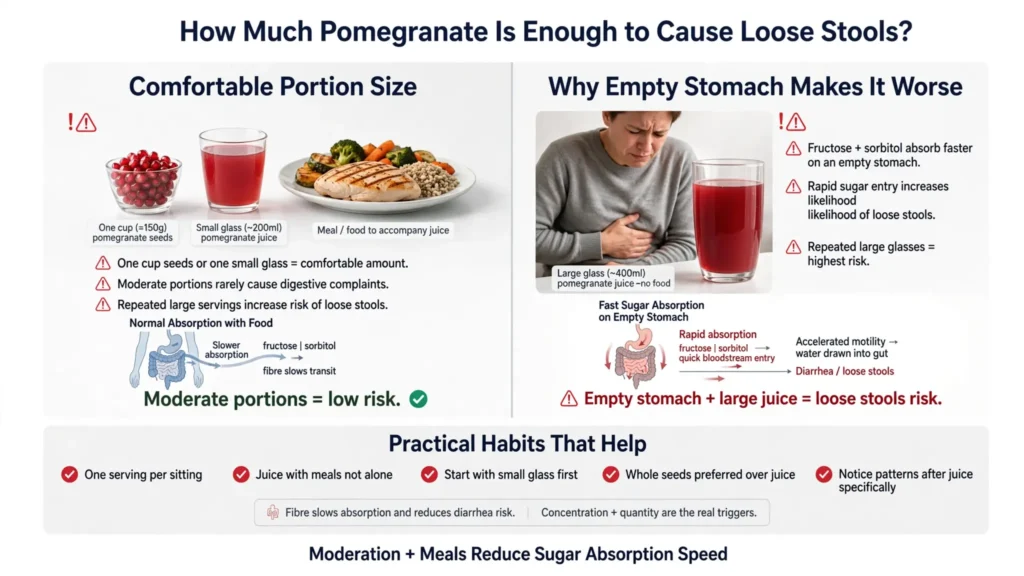
Most nutrition guidance points to around one cup of pomegranate seeds, or a single small glass of juice, as a comfortable amount for most people in one sitting. This is broadly consistent with what I found while researching pomegranate and gas, where moderate portions were rarely linked to any digestive complaint at all — it’s specifically larger, repeated amounts that tend to cause trouble.
Why Drinking It on an Empty Stomach Made It Worse
Sana’s first, problematic day involved drinking pomegranate juice largely on an empty stomach, with little else to slow its absorption. Fructose and sorbitol both hit the gut harder and faster when there’s no other food present to moderate the pace — a pattern that shows up consistently across most sugar-related digestive complaints, not just pomegranate specifically.
GOOD TO KNOW
As a general guideline, one small glass of pomegranate juice, or a cup of seeds, alongside a meal is a comfortable amount for most people. Repeated large glasses, especially on an empty stomach, are the combination most likely to cause loose stools.
A few practical habits that help
- Stick to one serving of pomegranate juice or seeds per sitting rather than repeating it multiple times across the day.
- Drink juice alongside a meal rather than on an empty stomach, to slow down how quickly the sugars are absorbed.
- If trying pomegranate juice for the first time in any quantity, start with a smaller glass and see how your body responds.
- Favour whole seeds over juice when possible — the fibre naturally slows absorption and reduces the likelihood of loose stools.
- If you notice a pattern after juice specifically, that’s a useful clue pointing toward concentration and quantity as the cause.
Who Is More Likely to Get Diarrhea From Pomegranate

IBS, Fructose Malabsorption, and Sensitive Digestion
People with IBS or diagnosed fructose malabsorption tend to react to considerably smaller amounts of pomegranate than most people, since their gut is more reactive to fermentable, osmotically active sugars generally. This mirrors almost exactly what I found while separately researching mango and diarrhea — different fruit, same underlying fructose and sorbitol mechanism, and the same pattern of sensitive individuals reacting to amounts that wouldn’t register for most people.
Children and People New to Pomegranate
Children, and adults trying pomegranate for the first time in any quantity, are both worth introducing gradually rather than starting with a large portion. A smaller first serving makes it much easier to gauge individual tolerance before committing to a larger daily habit.
This is fairly standard advice for introducing any new high-fructose food, not something specific to pomegranate. The fruit’s reputation as universally gentle can make people skip the usual caution they’d apply to something less familiar, which is part of why a first encounter with a large portion sometimes catches people off guard.
What Sana Changed, and What Happened Next
Sana didn’t give up on pomegranate juice entirely — she’d genuinely enjoyed how it made her feel on the days she didn’t overdo it. She switched to one small glass, always alongside breakfast rather than on its own, and stopped repeating it multiple times in a single day regardless of how “healthy” it felt.
Weeks later, she hasn’t had a repeat of that particular weekend, even on days she’s had pomegranate more than once. The lesson that stuck with her wasn’t “avoid pomegranate” — it was “more of a healthy thing isn’t automatically healthier,” a distinction she’s since applied to a couple of other juices and supplements too.
What struck me most was how disproportionate her original approach had been to the actual goal. She’d wanted a mild digestive boost, and instead landed on a quantity that overwhelmed her gut entirely — a reminder that with fruit and juice specifically, the effective amount and the excessive amount can be closer together than people assume.
How Pomegranate Compares to Other Fruit-Related Digestive Reactions I’ve Looked Into
Pomegranate’s fructose-and-sorbitol-driven diarrhea risk sits alongside a very similar pattern I found in peaches, where sorbitol specifically was identified as the dominant factor behind loose stools in sensitive individuals. Seeing the same mechanism repeat across genuinely different fruits made it clear this isn’t a pomegranate quirk — it’s a broader pattern about how certain natural sugars behave once you exceed what your gut can comfortably absorb.
That consistency is reassuring in its own way. It means the fix isn’t fruit-specific either — moderate portions, pairing with other food, and paying attention to your own pattern work as well for pomegranate as they do for peaches, mangoes, or most other high-fructose fruit.
It’s also a useful filter for evaluating new fruit-related warnings as they come up. If a claim about a specific fruit causing digestive upset lines up with this same fructose-and-sorbitol pattern, it’s likely a genuine, quantity-dependent effect. If it doesn’t fit that pattern at all, it’s worth a closer look before accepting it at face value.
Conclusion
If Sana asks me today, I’ll tell her what I said later: pomegranate juice wasn’t secretly dangerous this weekend, three large glasses a day had more fructose and sorbitol on an empty stomach than her stomach could easily absorb at the same time. For most healthy people, a moderate amount of pomegranate — juice or whole seeds — produces little more than the occasional slight change in gut habits.
What has changed for me is how quickly I now think about concentration and quantity before I assume that a “healthy” meal is unexpected. Pomegranate proved to be a good example of how a single fruit can support digestion in one form and spoil it in another, depending on how much of it reaches your intestines and in what form.
Sana still drinks pomegranate juice most weeks. I do the same sometimes. None of us consider a large glass, repeated throughout the day, to be a harmless health habit anymore — just something that is worthy of the same basic part of awareness that we would give to something really good.
This article is for general informational purposes and reflects personal experience alongside publicly available nutritional information. It is not a substitute for professional medical advice. If you have diagnosed IBS, fructose malabsorption, or ongoing digestive symptoms, speak with a doctor or registered dietitian.
Frequently Asked Questions
Can drinking pomegranate juice cause diarrhea?
Yes, especially in large amounts, since pomegranate’s natural fructose and sorbitol can draw water into the intestines and speed up digestion.
Does pomegranate cause diarrhea more than whole seeds?
Yes, juice concentrates the sugars while removing the fibre that would normally slow their absorption, making diarrhea more likely than with whole seeds.
How much pomegranate is safe to eat without loose stools?
Around one cup of seeds, or a single small glass of juice, is a comfortable amount for most people in one sitting.
Is pomegranate-related diarrhea a sign of fructose intolerance?
Not necessarily, but people with fructose malabsorption or IBS tend to react to smaller amounts of pomegranate than most people.
Can drinking pomegranate juice on an empty stomach make diarrhea worse?
Yes, an empty stomach allows fructose and sorbitol to be absorbed faster, increasing the likelihood of loose stools.

1 thought on “Can Pomegranate Cause Diarrhea? My Honest Findings”