The Short Version
You can eat watermelon at night — the fruit itself isn’t the problem. What actually causes trouble is portion size and timing: a large bowl eaten right before you lie down is what triggers bathroom trips and bloating, not watermelon in general. Keep it to a modest serving an hour or so before bed and most people won’t notice any difference in their sleep at all.
Introduction

My uncle has kept a watermelon in his fridge every single summer for as long as I can remember. It’s practically a ritual — he cuts a few slices after dinner, sits on the balcony, and eats it while the evening cools down. So when he mentioned, almost as an aside, that he’d started waking up around 2am needing the bathroom, I didn’t think much of it at first. Then he said it had been happening most nights that week, right around the time the summer watermelon habit had picked back up.
That’s what actually sent me down the rabbit hole of whether can i eat watermelon at night without it working against you. I wanted a proper answer — not the kind of vague “everything in moderation” line you get from half the internet, but something rooted in what watermelon actually does inside your body after dark. Here’s everything I found, including what my uncle changed and what happened afterward.
Table of Contents
So, Can You Eat Watermelon at Night? My Short Answer
Yes — for the vast majority of people, eating watermelon at night is completely fine. There’s nothing in the fruit itself that becomes unhealthy once the sun goes down. What changes is how your body handles a large amount of water and natural sugar right before you go horizontal for eight hours, which is a very different situation than eating the same watermelon at 2pm while you’re up and moving around.
The short version: watermelon at night is a portion-and-timing question, not a “good food, bad food” question. And it’s a genuinely common one — it sits right alongside similar questions people ask about oranges, pomegranate, and peaches.
What’s Actually in Watermelon That Affects You After Dark

It’s About 92% Water
Watermelon lives up to its name. The flesh is roughly 92% water, which is exactly why it’s so refreshing on a hot evening — and exactly why a large serving close to bedtime tends to send people to the bathroom. Your kidneys don’t stop processing fluid just because you’re asleep, so a big dose of water in the last hour before bed becomes a bigger dose of urine a few hours later. This is really the single biggest thing to understand about watermelon and nighttime eating — almost every downside people report traces back to this one property.
Why This Is Actually a Hot-Weather Question
It’s worth noticing that this question spikes in summer, and that’s not a coincidence. Watermelon is at its best exactly when temperatures are highest, which is also when people are naturally drinking more water, iced tea, or squash throughout the evening to stay cool. Watermelon rarely arrives on its own — it’s usually one more source of fluid stacked on top of everything else you’ve already had that day, which is part of why this question comes up more in July and August than in January.
Natural Sugars, in Context
A cup of diced watermelon carries around 9 to 11 grams of natural sugar. That sounds like a lot until you remember it’s diluted through all that water — the actual sugar density per bite is low compared to something like dried fruit or juice. For most people, this isn’t something to worry about at night. If you’re managing blood sugar closely, it’s worth being a little more deliberate about portion size and pairing it with a source of protein or fibre, which is standard advice for any higher-glycaemic fruit rather than something specific to nighttime eating.
The Vitamins, Antioxidants, and Electrolytes Are Still There After Dark
Watermelon doesn’t lose its nutritional value just because you’re eating it in the evening. You’re still getting vitamin A, vitamin C, and the amino acid citrulline, which your body converts into compounds that support healthy blood vessel function. It also carries a modest amount of potassium, which plays a role in muscle and nerve function overnight. None of that changes based on the clock. In fact, once I started reading into this properly, I learned that eating watermelon seeds is actually fine, and that even the rind turned out to be worth eating rather than tossing — the parts of the fruit most people discard are quietly some of the most nutrient-dense.
The Night My Uncle Started Waking Up at 2am
When my uncle first told me about the 2am wake-ups, his exact words were something like, “I don’t even feel thirsty, I just wake up needing to go.” That detail stuck with me, because it’s such a textbook description of what happens when your body processes a large fluid load overnight — you don’t necessarily feel it building up, you just feel the result.
I asked him how much he was actually eating. It turned out to be a genuinely large bowl — easily two or three cups’ worth — eaten around 10:30pm, not long before he went to bed. He wasn’t doing anything unusual or extreme. It was simply a big portion, eaten late, on top of the cup of tea he was already having after dinner. Once I laid it out like that, the pattern was obvious, even though it hadn’t occurred to either of us at the time.
The Real Risks of Eating Watermelon Late at Night
Frequent Urination and Interrupted Sleep
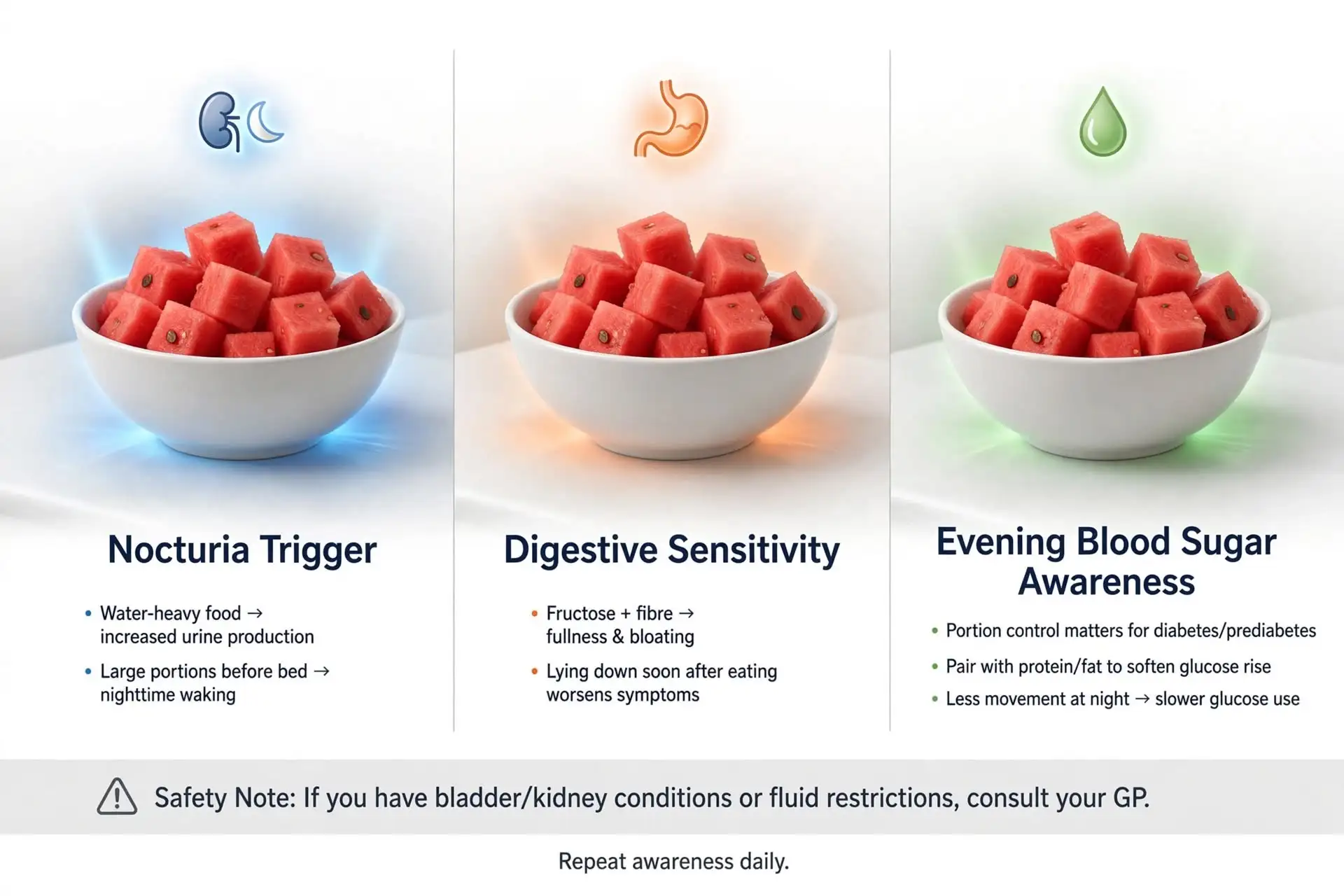
This is the big one, and it’s exactly what my uncle was experiencing. Waking up two or more times a night to urinate has a name — nocturia — and one of its most common everyday triggers is simply drinking or eating something water-heavy in the hours before bed[1]. Watermelon, being almost entirely water, is one of the more obvious foods that can tip someone into this if the portion is large enough. Occasional nocturia from a big fruit bowl is very different from ongoing nocturia caused by an underlying condition — the pattern usually clears up quickly once the habit changes, which is exactly what happened with my uncle.
Bloating and Mild Digestive Discomfort
Watermelon also contains fructose and fibre, and eating a large amount quickly — especially lying down soon after — can lead to bloating or a feeling of fullness that makes it harder to settle into sleep. This tends to affect people with sensitive digestion more than most, and it’s rarely severe, but it’s a real and common complaint. Sitting upright for a while after eating, rather than heading straight to bed, tends to reduce this considerably.
A Note for Anyone Managing Blood Sugar
If you’re living with diabetes or prediabetes, watermelon isn’t off-limits at any time of day, including the evening. The general guidance is the same as it is for daytime: keep the portion reasonable and consider pairing it with protein or fat to soften the impact on blood sugar. This isn’t unique to nighttime eating — it’s just more noticeable if watermelon is the last thing you eat before several hours of inactivity, since there’s less everyday movement afterward to help use up that glucose.
A Note Worth Taking Seriously:
If you have a diagnosed bladder condition, kidney condition, or you’re on a fluid-restricted diet, it’s worth speaking with your GP before making watermelon — or any water-heavy food — a regular part of your evening routine. This article is general information, not a substitute for advice tailored to your own health situation.
Does Eating Watermelon at Night Cause Weight Gain?
No — and this one comes up constantly. There’s a persistent myth that eating anything after a certain hour automatically turns into fat, but weight gain comes down to total calories and overall eating patterns, not the time on the clock. A cup of watermelon is only around 45 to 50 calories, which makes it one of the lighter snack options available if you want something at night without derailing anything. If anything, a small bowl of watermelon is a far lower-calorie choice than most late-night snack alternatives, and its water and fibre content can genuinely help with feeling satisfied rather than reaching for something heavier an hour later. If weight management is part of why you’re reading this, sensible portioning without cutting out fruit entirely is generally the better long-term approach than avoiding foods outright.
How Much Watermelon Counts as a Sensible Nighttime Portion
A standard adult fruit portion is 80g, which for watermelon works out to roughly a 5cm-thick slice, or a small bowl of cubed pieces[2]. That’s a genuinely useful benchmark for nighttime eating specifically, because it’s enough to satisfy a craving for something cool and sweet without loading your system with the volume of water that causes bathroom trips.
The other piece of the puzzle is timing. Eating that portion an hour or so before bed, rather than in the ten minutes before you lie down, gives your body a head start on processing the fluid while you’re still upright and moving around. If you know you’re prone to disrupted sleep already, pushing your watermelon slightly earlier in the evening — straight after dinner rather than as a separate bedtime snack — tends to make the biggest practical difference.
What My Uncle Changed — and What Happened Next
After we talked it through, my uncle didn’t cut watermelon out. He just changed two things: he brought his portion down to something closer to a single cup, and he moved his watermelon time earlier in the evening, right after dinner instead of right before bed. He also cut the cup of tea he’d normally have alongside it, since that was adding to the same fluid load without him really registering it as part of the equation.
Within a few nights, the 2am wake-ups had mostly stopped. He still keeps the watermelon in the fridge every summer — he just treats it differently now, and he’s mentioned since that he barely thinks about it anymore because the smaller, earlier portion has just become the new habit.
How Watermelon Compares to Other Fruit People Eat at Night
Watermelon isn’t the only fruit that raises this exact question. Oranges carry their own nighttime trade-offs, mainly around acidity and reflux rather than fluid volume, which makes them a different consideration for anyone prone to heartburn rather than anyone worried about bathroom trips. Pomegranate tends to be gentler at night, since its fibre and antioxidant profile doesn’t come with anywhere near the same water load, though its own fibre content means it’s still worth eating in a measured portion. And if you want something that’s almost universally considered a safer late-evening pick, a peach is often the better choice — lower water content, similar sweetness, and less likely to disturb sleep for most people thanks to its muscle-relaxing magnesium.
The pattern across all of these is the same one that applies to watermelon: it’s rarely the fruit itself that causes problems at night. It’s the portion, the timing, and — for a handful of people — an individual sensitivity worth paying attention to rather than a reason to avoid fruit at night altogether.
| Fruit | Main Nighttime Consideration | Best Timing |
| Watermelon | High water content — bathroom trips if overeaten | Small portion, 1 hour before bed |
| Oranges | Acidity, possible reflux for sensitive stomachs | Earlier evening, avoid right before lying down |
| Pomegranate | Fibre and antioxidants, generally gentle | Fine closer to bedtime in a normal portion |
| Peach | Low water content, muscle-relaxing magnesium | One of the safer late-evening choices |
Conclusion
Watermelon at night isn’t something to avoid. It’s something to eat sensibly. A modest portion, eaten with a bit of a buffer before bedtime, gives you the hydration, vitamins, and refreshment without the disrupted sleep. My uncle’s fridge still has a watermelon in it every summer — the only thing that changed was how much he was scooping into the bowl and when. If you’re curious to browse more nutrition breakdowns like this one, the pattern tends to repeat across most fruit-and-timing questions: it’s rarely the food, and almost always the portion.
Medical disclaimer: This article is for general informational purposes only and is not a substitute for professional medical advice, diagnosis, or treatment. Always speak with a qualified healthcare provider about any health concerns, including changes in urination, sleep, or blood sugar.
Frequently Asked Questions
Is it bad to eat watermelon right before bed?
Eating a small portion isn’t harmful, but a large amount right before lying down can lead to bloating and more frequent trips to the bathroom overnight.
Does watermelon at night cause frequent urination?
It can, simply because watermelon is about 92% water — a large serving close to bedtime increases overnight urine production for most people.
Can watermelon at night affect sleep quality?
Only indirectly, through bloating or bathroom trips caused by a large portion; the fruit itself has no stimulating ingredients that would keep you awake.
How much watermelon is a safe portion to eat at night?
Around 80g, roughly a 5cm slice or a small bowl of cubes, eaten an hour or so before bed is a sensible nighttime portion for most adults.
Does eating watermelon at night cause weight gain?
No — weight gain depends on total daily calories, and a cup of watermelon is only around 45 to 50 calories regardless of when it’s eaten.

7 thoughts on “Can I Eat Watermelon at Night? Here’s What I Found”
Comments are closed.