The Quick Answer:
During the low-residue phase (3-5 days before), peeled peach flesh in small amounts is generally fine — the skin isn’t. On the clear liquid day (day before), no solid peach is allowed at all; only clear, pulp-free, non-red peach juice may be acceptable, and only if your doctor confirms it. Always follow your own endoscopy unit’s written instructions over any general guide, including this one.
Introduction
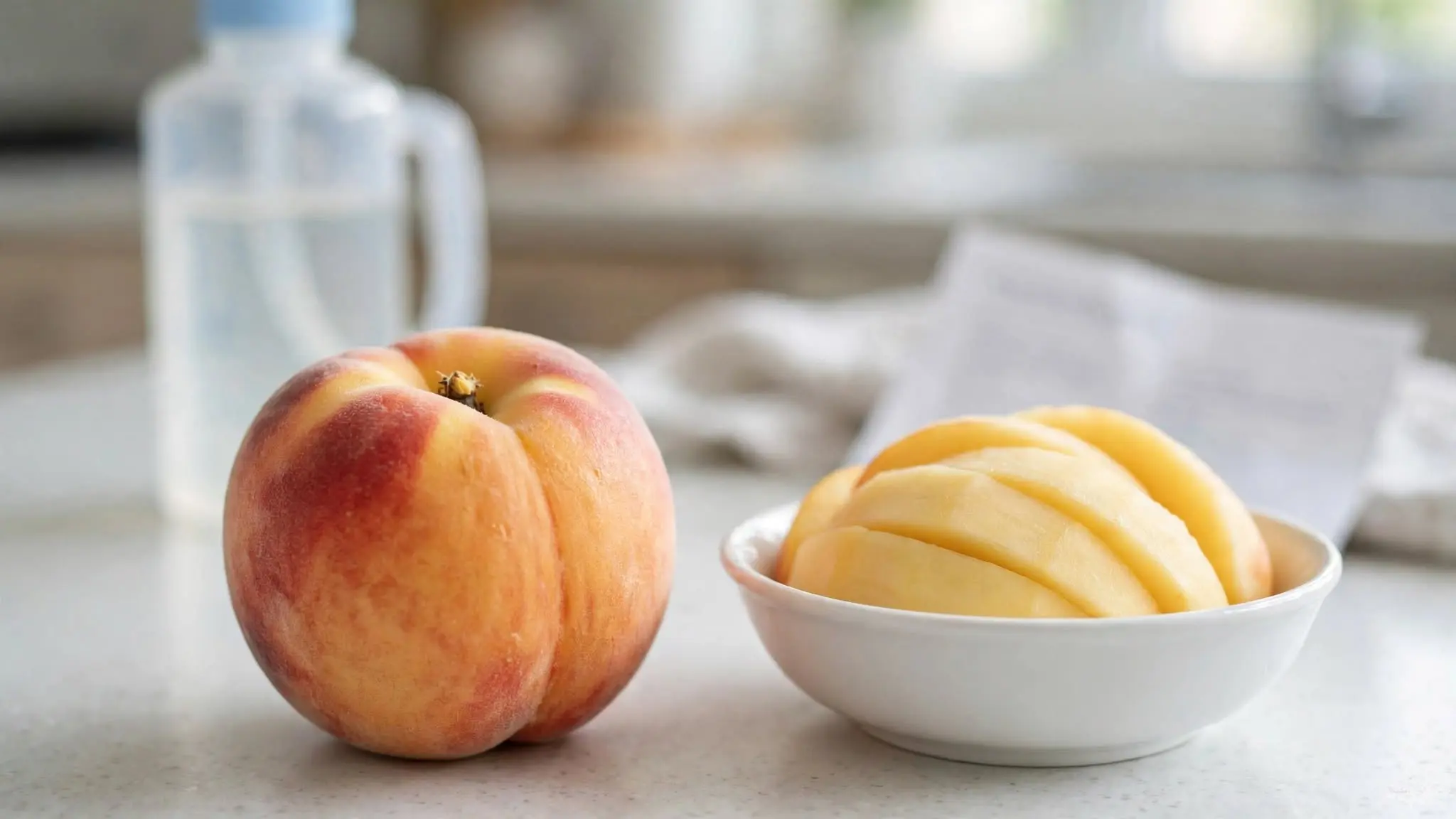
The appointment letter arrived on Thursday. My Uncle Rizwan, who had been postponing a routine check-up for a long time, finally got his colonoscopy booked. Less than an hour after the letter landed on his doormat, he called me, standing in his kitchen holding a peach he had just pulled out of a bowl of fruit. He wanted to know one very specific thing: can I eat peaches before a colonoscopy? It was such a valid and practical question that I didn’t want to give him a vague answer. So, I sat down and actually inquired.
What I’ve found is that the answer to can I eat peaches before a colonoscopy depends entirely on what stage of preparation, you’re in, and most importantly, whether or not the peaches are peeled. Here’s a clear, step-by-step answer, and eating in the days leading up to it is more important than most people realize—if the preparation of the cologne is poor, the process may be incomplete or have to be repeated. This is the guide I’ve developed for Rizwan, and the one I’d like for myself.
Table of Contents
Why What You Eat Before a Colonoscopy Matters So Much
A colonoscopy is one of the most effective screening tools available for detecting colorectal cancer, polyps, ulcers, and inflammation in the large intestine. For the gastroenterologist to see the colon lining clearly, it has to be completely clean. Any undigested food residue left behind can obscure polyps or lesions, forcing the procedure to be cut short or repeated entirely — another day off work, another round of prep, and a delay in detecting anything that actually needs treatment. The dietary restriction isn’t bureaucratic caution. It has a direct clinical purpose, which is exactly what I explained to Rizwan when he asked whether the skin question was really worth worrying about. It genuinely is, and I’d already covered why peach skin matters nutritionally in a separate piece on the nutritional case for eating peach skin, which made this exception feel worth explaining properly rather than just as a blanket “no.”
Most colonoscopy preparations follow a two-phase dietary restriction: a low-residue diet typically 3 to 5 days before, designed to gradually reduce residue building up in the colon, followed by a clear liquid diet the day before, and sometimes the morning of, where only transparent fluids with no pulp, solids, or red/purple colouring are permitted. What Rizwan hadn’t understood from his letter, and what most people don’t until they ask, is that these two phases have very different rules. Treating them as the same thing is where most prep mistakes happen.
Can I Eat Peaches Before a Colonoscopy? The Direct, Phase-by-Phase Answer
During the low-residue diet phase (3–5 days before): peeled fresh peaches and canned peaches in juice, with no skin, are generally permitted in moderate amounts on most low-residue diet guidelines. The flesh of a ripe peach is soft, digests thoroughly, and leaves minimal residue. Peach skin, however, is not permitted — its high insoluble fibre content leaves significant residue in the colon.
During the clear liquid phase (the day before): no solid peach in any form is permitted. Clear, pulp-free peach juice may be acceptable in some protocols, but only if it’s transparent, contains no pulp, and isn’t red or purple. This must be confirmed directly with your doctor or endoscopy unit.
On the morning of the procedure, follow your hospital’s specific instructions. Most units require nothing by mouth except water from a certain point, and some allow clear fluids up to a defined cut-off time.
The headline rule I told Rizwan immediately: peel the peach and eat the flesh if you’re in the low-residue phase, avoid the whole fruit once you move into the clear liquid day, and always follow whatever your own doctor has told you — these are general guidelines, and your unit’s instructions take precedence.
Understanding the Low-Residue Diet Phase
The term low-residue refers to foods digested so completely that they leave very little undigested material passing through the large intestine. The focus is on reducing insoluble fibre — the type that doesn’t dissolve, adds bulk to stool, and can linger in the colon for days. The goal isn’t eating as little as possible; it’s eating foods that leave minimal bulk so the laxative solution can do its job efficiently.
What This Means for Fruit — and for Peaches Specifically
On a typical low-residue diet, the fruit rules are:
- Generally permitted: canned peaches in juice (not syrup), peeled fresh peach flesh, ripe banana, melon without seeds, peeled soft pear
- Not permitted: peach skin, any fruit skin, berries with small seeds (blueberries, strawberries, raspberries), dried fruits, high-fibre fruits in large amounts
Portion size matters too, even for permitted fruits. Eating a single peeled peach is sensible. Eating four or five on the basis that they’re technically permitted isn’t — moderation in total volume is part of what makes the low-residue phase actually work.
A Clear Traffic-Light Guide for Peaches Across Each Prep Phase
| Peach Form | 3–5 Days Before | Day Before | Morning Of |
| Fresh peach WITH skin | Not permitted | Not permitted | Not permitted |
| Fresh peach flesh (peeled) | Generally permitted | Not permitted | Not permitted |
| Canned peaches in juice | Generally permitted | Not permitted | Not permitted |
| Peach juice (clear, no pulp) | Permitted | Permitted (confirm) | Check hospital rules |
| Peach skin | Not permitted | Not permitted | Not permitted |
These guidelines reflect general medical consensus. Your specific endoscopy unit may have different protocols — always prioritise the written instructions that came with your appointment.
The Clear Liquid Day — What the Rules Actually Mean in Practice
The day before a colonoscopy is the hardest part of prep for most people, not the procedure itself. You’re hungry, you can’t eat solids, and the laxative solution is doing uncomfortable work. “Clear liquid” means something specific: any fluid through which you can see light. Hold a glass of it up, and if it’s transparent, it counts. If it’s cloudy, milky, or has particles, it doesn’t.
- Water: drink plenty — dehydration during prep is a genuine risk
- Clear apple juice or white grape juice: no pulp, not red or purple
- Clear, pulp-free peach or pear juice: check it’s transparent when poured into a glass
- Plain jelly: not red or purple — yellow, orange, or green are generally acceptable
- Clear vegetable or chicken broth: no solids or cream
- Black tea or coffee: without milk, cream, or sweetened creamers
One of the most overlooked colonoscopy prep rules, and one that genuinely matters clinically: avoid anything red or purple, including red jelly, grape juice, cherry-flavoured drinks, and red sports drinks. These colourings can stain the bowel lining and appear as blood or active inflammation on the colonoscope camera, potentially leading to unnecessary intervention or a repeat procedure.
Rizwan hadn’t known about the red and purple rule at all. When I mentioned it, he admitted he’d been planning to drink cranberry juice because it seemed like a sensible fruit-based option. “I genuinely thought I was doing the healthy thing,” he said. That’s exactly the kind of well-intentioned mistake that creates problems on the day — the colour rule isn’t arbitrary, and it has a direct impact on what the gastroenterologist actually sees.
What You CAN Eat Safely During Colonoscopy Prep
Low-Residue Phase — Safe and Satisfying Choices
- Proteins: white fish, chicken (no skin), turkey, eggs, tofu — all digest cleanly
- Carbohydrates: white bread, white rice, plain pasta, plain crackers, white potato without skin
- Dairy: plain yoghurt with no seeds or fruit pieces, mild cheese, milk in moderate amounts
- Fruit: peeled fresh peach, canned peaches in juice, ripe banana, melon without seeds, peeled soft pear
Foods to actively avoid: wholegrains and brown rice, seeds and nuts, raw vegetables, fruit with skin or small seeds, legumes, and popcorn, bran, or high-fibre cereals — these are the most common culprits behind problems during colonoscopy imaging.
Clear Liquid Phase — Managing the Difficult Hours
The clear liquid day requires strategy more than willpower. I told Rizwan to keep a jug of apple juice, a flask of clear broth, and a glass of water on the kitchen counter all day, and alternate between them every hour. The variety helps psychologically as much as physically — drinking only water for 18 hours is far harder than rotating between four permitted options.
Common Prep Mistakes Around Food — and Why They Matter
Researching this thoroughly, I found the same mistakes coming up repeatedly in accounts of people whose colonoscopies had to be rescheduled or cut short. Most are entirely avoidable with clear information.
- Eating fruit with the skin on during the low-residue phase: the most common food mistake — people assume “soft fruit” means fine, but it’s specifically the skin that causes the problem
- Eating seeds or nuts thinking “a small amount won’t matter”: seeds can travel through the digestive system intact and collect in folds of the colon — even a sprinkle from a bread roll can cause visibility problems
- Consuming red or purple coloured foods on the clear liquid day: the rule most people simply haven’t heard about, and the one with the most direct clinical consequence
- Under-hydrating during the clear liquid phase: the laxative solution causes significant fluid loss — not replacing it adequately can lead to dizziness and headaches
- Ignoring hospital-specific instructions in favour of general internet guidance: protocols differ between NHS trusts, private units, and individual gastroenterologists — your written instructions always take precedence
After the Colonoscopy — When Can Peaches Come Back?
This is a question worth thinking about as much as the pre-procedure restrictions, because what you eat afterwards matters for gut recovery in a way that isn’t always discussed. For most people having an uncomplicated colonoscopy, a normal diet can resume within 24 hours. If polyps were removed during the procedure, your gastroenterologist may recommend a soft, low-fibre diet for 24 to 48 hours first, to let the bowel settle before reintroducing more fibrous foods.
For peaches specifically: start with peeled, soft peach flesh in the first day or two, then reintroduce the skin once your digestive system has fully recovered, typically within 48 hours. The peach skin you had to avoid before the procedure is actually one of the best foods you can eat after it — the antioxidants and prebiotic fibre are genuinely valuable for gut recovery.
The bowel prep solution causes significant disruption to the gut microbiome, washing out both harmful and beneficial bacteria. Returning to a diet rich in prebiotic fibre and diverse plant foods as quickly as your gastroenterologist permits is one of the most evidence-supported things you can do for recovery — the same principle I’ve written about in how certain foods support gut bacteria recovery, which applies just as directly here. For anyone rebuilding an evening eating routine once they’re cleared, it’s also worth reading whether peaches are a sensible thing to eat at night, since timing questions tend to come up again once normal eating resumes. And if you also manage acid reflux alongside prep, how peaches specifically interact with reflux is worth reading before reintroducing them fully.
Conclusion
After setting it all up for Rizwan, the answer I gave was clear: Yes, he can eat those peaches, but peel them first, be sensible about the amount, and keep the fruit bowl completely separate when he arrives at a clear, liquid day. The dosage for colonoscopy preparation isn’t designed to make things difficult — it’s designed to give the gastroenterologist the clearest view of the colon, and every dietary decision 3 to 5 days before the appointment contributes to that.
Peeled peaches are fine in the low residue phase. Peach juice, clean, no pulp, no red, clear liquid is fine on the day. The peel, as nutritious as it is, is removed from the plate for the rest of the year until after the procedure. And always follow the specific written instructions of your endoscopy unit — they know your case, not the usual guide.
Rizwan’s colonoscopy was good and came clean. When he got home that afternoon, the first thing he did was eat a peach, peeled, thoroughly washed, completely. He said he never valued a piece of fruit so much. I think that’s true of most of the things you’re asked to give up temporarily.
Medical Disclaimer: This article is for general informational purposes only and does not constitute medical advice. Colonoscopy preparation protocols vary between hospitals and individual patients. Always follow the specific written instructions provided by your doctor or endoscopy unit, and consult your healthcare provider with any questions about your personal prep diet.
Frequently Asked Questions
Can I eat peaches before a colonoscopy?
During the low-residue phase (3–5 days before), peeled peaches or canned peaches in juice are generally permitted in small amounts, but peach skin must be avoided and no solid peach is allowed on the clear liquid day.
Can I eat fresh peaches with the skin on during colonoscopy prep?
No — peach skin is high in insoluble fibre and leaves residue in the colon, exactly what colonoscopy prep is designed to eliminate, so it must be removed entirely even during the more permissive low-residue phase.
Can I drink peach juice before a colonoscopy?
Clear, pulp-free peach juice that isn’t red or purple is generally permitted during both prep phases, but always confirm it meets your specific instructions before drinking it.
Why are red and purple foods avoided before a colonoscopy?
Red and purple food dyes can stain the bowel lining and appear as blood or inflammation on the colonoscope camera, potentially leading to a repeated procedure.
When can I eat peaches again after a colonoscopy?
Most people can return to a normal diet within 24 hours of an uncomplicated colonoscopy, and once cleared, peaches, including the skin, are an excellent recovery food.

3 thoughts on “Can I Eat Peaches Before a Colonoscopy? Full Guide”