The Quick Answer: For most healthy people, no — pomegranate seeds are a low-to-moderate oxalate food (14-20mg per 100g), well below genuine risk foods like spinach or almonds, and animal research even suggests they may protect against the crystal formation that causes most kidney stones. The exception is people with a stone history, certain digestive conditions, or chronic dehydration, who should get personalised guidance from their GP.
Introduction
My colleague, Naila, came back from a GP appointment a few months ago, a little upset. His doctor had mentioned his oxalate levels during a routine check-up and almost bluntly said that it was beneficial to look for foods containing “oxalate”. That evening she messaged me about can pomegranate seeds cause kidney stones, as she was often eating a bowl of them in the afternoon and she didn’t know if it was a habit to worry about.
I didn’t have an immediate convincing answer to this, which bothered me so much that I spent the next few days looking at the original research — peer-reviewed studies, NIH data, and dietary literature on oxalates — before I could properly tell it. What I found was an answer to the question can pomegranate seeds cause kidney stones, which was more accurate than we both expected, and it wasn’t the smooth yes or no she was waiting for.
What impressed me the most was how uncomfortable she had become on a line from her GP. It wasn’t specifically asked to cut pomegranates, nor was there a clear diagnosis given—just a general note about looking at oxalate. Often that’s why these health concerns kick in: a cursory comment reaches home and applies to every meal that seems somewhat relevant, without anyone checking to see if the relevant food is really important.
Table of Contents
What Are Kidney Stones and Why Does Diet Play a Role?
Before I could tell Naila anything useful, I needed to properly understand how kidney stones form in the first place. They occur when substances in urine — mainly calcium, oxalate, and uric acid — become too concentrated and crystallise. According to the National Institutes of Health (NIH), roughly 80% of all kidney stones are calcium oxalate stones, formed when oxalate — a compound found naturally in many plant foods — binds with calcium inside the kidneys.
Diet matters because it influences how much oxalate reaches the kidneys in the first place. But the amount of oxalate in a food is only one part of the picture — gut absorption, hydration levels, how much calcium is eaten alongside it, and any pre-existing digestive conditions all factor into actual risk. That context changed how I approached Naila’s question entirely.
It also explained why she’d been getting conflicting advice online in the meantime. Some sites treated oxalate as something to avoid almost entirely, while others barely mentioned it at all. Neither extreme was particularly useful, because the real answer depends on comparing pomegranate’s specific oxalate load against the foods genuinely known to drive stone formation — which is exactly where I went next.
Do Pomegranate Seeds Actually Contain Oxalates?
Yes — I’m not going to pretend otherwise. Pomegranate seeds do contain oxalates. When I first confirmed that for Naila, it wasn’t the reassuring start either of us wanted. But the actual numbers changed the picture considerably.
The Real Numbers — Where Pomegranate Sits on the Oxalate Scale
Pomegranate seeds contain approximately 14 to 20mg of oxalate per 100 grams, placing them in the low-to-moderate oxalate category — a very different bracket to the foods consistently flagged as genuine kidney stone risks:
| Food | Oxalate (per 100g) | Risk Category |
| Spinach | 750 – 900mg | Very High |
| Rhubarb | ~500mg | Very High |
| Almonds | ~470mg | Very High |
| Beetroot | ~150mg | High |
| Dark chocolate | ~117mg | High |
| Blueberries | ~17mg | Low |
| Pomegranate seeds | 14 – 20mg | Low to Moderate |
| Apples | ~3mg | Very Low |
I showed Naila that table and she said something that summed up the whole misunderstanding: “I’ve been rationing pomegranate while eating almonds every single morning without a second thought.” Context, as it turns out, is everything. Foods that carry genuine, consistent kidney stone risk sit in a fundamentally different category to pomegranate seeds.
This is also where I explained the calcium-binding mechanism to Naila, since it’s the part most people skip over. Oxalate becomes a problem mainly when it travels through the gut unbound and gets absorbed into the bloodstream. Pair it with a calcium source in the same meal, and the two bind together in the intestine instead, passing out of the body rather than making their way toward the kidneys. That single mechanism does more to explain real-world oxalate risk than the raw milligram count on its own.
The Counterintuitive Finding — Pomegranate May Actually Protect the Kidneys

This was the part of the research that surprised us both. Not only are pomegranate seeds a low-oxalate food — there’s animal research suggesting pomegranate juice may actively reduce the formation of the very crystals that cause most kidney stones.
What the Animal Research Found
A study published in the journal Renal Failure tested pomegranate juice on rats given ethylene glycol, a compound reliably used to induce oxalate stone formation in animal models. Rats given medium and high doses of pomegranate juice showed significantly reduced crystal deposition in the kidneys compared to untreated animals, with near-complete protection at the higher doses.
The researchers pointed to reduced reactive oxygen species (ROS), lower inflammatory activity, and decreased oxidative stress in renal tubular cells as the likely mechanisms — exactly the cells damaged when oxalate crystals form and adhere. It’s worth being honest about the limits here: these are animal studies, not human trials, so direct equivalence can’t be assumed. But the direction is notable, and consistent with what’s known about pomegranate’s punicalagins and ellagic acid from other research areas.
When I read Naila the specifics — near-complete protection at the higher doses — her first reaction was disbelief, which was basically my own reaction too. It genuinely runs counter to the assumption most people carry, myself included until that week, that any oxalate-containing food must be pulling in the same direction as a kidney stone risk. The research doesn’t support that assumption in pomegranate’s case.
The Gut Microbiome Connection
There’s another layer I hadn’t expected. Research published in Frontiers in Microbiology has identified certain gut bacteria — particularly Oxalobacter formigenes — that degrade dietary oxalate in the gut before it’s absorbed into the bloodstream. Less oxalate absorbed means less reaching the kidneys.
Pomegranate’s polyphenols are well-established prebiotics that feed and diversify beneficial gut bacteria. It’s biologically plausible, though not yet confirmed in human studies specific to oxalate metabolism, that regular pomegranate consumption could support a gut environment that handles dietary oxalate more efficiently.
So Who Should Actually Be Cautious?
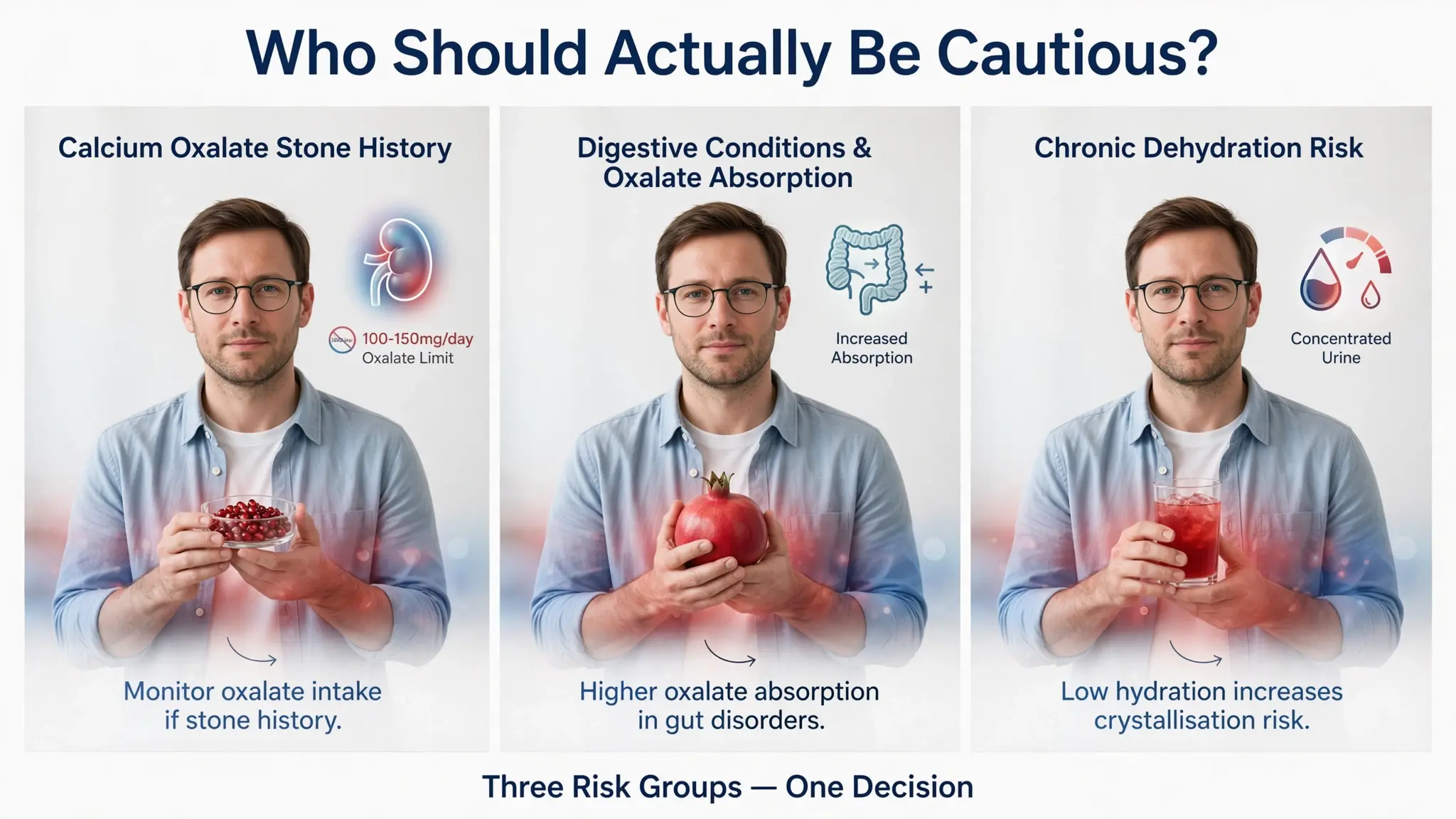
Once I’d gone through all of this, I felt comfortable telling Naila she likely had little to worry about — she has no stone history and drinks water consistently. But her situation isn’t everyone’s, so it’s worth being specific about who genuinely needs to pay closer attention.
People With a History of Calcium Oxalate Stones
If you’ve previously passed a calcium oxalate stone, your urologist will likely recommend a low-oxalate diet, typically keeping total daily oxalate below 100 to 150mg. A typical serving of pomegranate seeds (80–100g) contributes roughly 11 to 20mg — manageable, but it does take up part of that daily allowance if combined with other moderate-oxalate foods that day.
My strong recommendation for anyone in this group is to discuss pomegranate consumption directly with their GP or a registered dietitian rather than self-managing based on a general oxalate chart. Stone composition varies from person to person, and a low-oxalate diet plan is usually built around your specific stone analysis, not a generic list.
People With Certain Digestive Conditions
This is the group I hadn’t initially considered, and it turned out to matter medically. People with Crohn’s disease, inflammatory bowel disease, or a history of bowel surgery absorb significantly more dietary oxalate than healthy individuals, since a compromised gut lining or reduced bowel length means less oxalate binds to gut calcium before absorption. If this applies to you and you’re considering a daily pomegranate habit, it’s worth understanding how pomegranate seeds affect your digestive system first, and separately whether pomegranate can cause gas or bloating, both of which are worth flagging to your gastroenterologist alongside the oxalate question.
People Who Are Chronically Dehydrated
This is the risk factor almost nobody talks about in the context of specific foods — and it’s arguably the most important one. Chronic dehydration is the single most common lifestyle driver of kidney stone formation, regardless of diet. When urine becomes too concentrated, even modest oxalate amounts can trigger crystallisation.
If you have a personal history of kidney stones or a digestive condition affecting oxalate absorption, don’t self-manage your pomegranate intake based on this article. Speak to your GP or a registered dietitian, who can account for your specific stone type and medical history.
The Real Risk Factors for Kidney Stones — Putting Pomegranate in Perspective
The evidence-based hierarchy of kidney stone risk factors, ranked by research significance:
- Chronic low fluid intake: the most powerful and consistent risk factor across all stone types
- Very high oxalate foods in large quantities: spinach, rhubarb, beetroot, almonds, and dark chocolate eaten regularly and in significant amounts
- Excess dietary sodium: raises urinary calcium excretion, directly increasing stone risk
- Very high animal protein intake: raises uric acid and urinary calcium while reducing citrate, a natural stone inhibitor
- Paradoxically, low dietary calcium: less calcium means more dietary oxalate is absorbed rather than bound and excreted
Pomegranate seeds don’t feature prominently in any of these categories. Their oxalate content is low, their antioxidant properties are well-documented, and the animal research points toward a kidney-protective rather than kidney-harmful effect.
How I’d Now Suggest Eating Pomegranate Seeds Safely
This is roughly what I passed back to Naila once I’d finished reading through everything:
- Pair with calcium-rich foods: calcium and oxalate bind together in the gut and are excreted rather than absorbed — pomegranate seeds over Greek yoghurt is an easy, genuinely effective combination
- Stay consistently well-hydrated: aim for 2 to 2.5 litres of fluid daily — dilute urine is the single most effective protection against stone formation
- Eat a sensible serving size: 80–100 grams a day is a normal, healthy portion — proportion matters with any food
- Choose whole seeds over large quantities of juice: juice removes the fibre and concentrates the sugar without the same benefits
Naila ended up doing exactly what I do now — buying pomegranates in bulk while they’re in season and keeping a portioned supply ready. If keeping a daily stash feels impractical, my guide on freezing pomegranate seeds covers exactly how to do that without losing texture or nutrients.
Why Pomegranate Still Earns Its Place Beyond Kidney Health
It would be a disservice to end here without acknowledging that pomegranate seeds are, for most people, an exceptionally nutritious food. The kidney stone question is important, but it shouldn’t overshadow the fruit’s broader evidence base.
Pomegranate’s punicalagins, anthocyanins, and ellagic acid are among the most studied antioxidants in any fruit, with substantive evidence for their role in reducing inflammation and supporting cardiovascular health. I’ve explored that angle in more depth in whether pomegranate juice can lower cholesterol, which is worth reading if cardiovascular health is a concern for you or your family.
Conclusion
So, can pomegranate seeds cause kidney stones? For most healthy people, eating a balanced diet and drinking plenty of water, no—not in a meaningful way. Pomegranate seeds fall into the category of low to moderate oxalate, and animal research points to a protective rather than harmful relationship with the kidneys.
Anyone who has a personal history of calcium oxalate stones, or any digestive issues that affect the absorption of oxalate, this is for your GP or registered dietitian, not a blog post to self-care. For everyone else, this most useful outcome isn’t actually about the pomegranate — it’s about the water supply. Naila’s question when I explained it was no longer about pomegranates; the issue was whether she was drinking enough water in general. This is what increases the risk of kidney stones more than any one dose.
She still eats pomegranate seeds most of the afternoon. The only real change is that she now pairs the bowl with a glass of water and doesn’t think twice about it — which, for all the research, was always the right level of concern.
Medical Disclaimer: This article is for informational purposes only and does not constitute medical advice. If you have a history of kidney stones or any kidney-related condition, always consult a qualified healthcare professional before making changes to your diet.
Frequently Asked Questions
Can pomegranate seeds cause kidney stones?
For most healthy people, no — pomegranate seeds contain only 14 to 20mg of oxalate per 100 grams, well below the level associated with meaningful kidney stone risk.
Are pomegranate seeds high in oxalates?
No, they’re considered a low-to-moderate oxalate food, far below high-risk foods like spinach, rhubarb, or almonds.
Can pomegranate juice protect against kidney stones?
Animal studies suggest it may, by reducing calcium oxalate crystal formation in the kidneys, though human trials are still needed to confirm this.
How much pomegranate can I eat if I have kidney stones?
A standard 80‑00g serving contributes around 11–20mg of oxalate, which can fit into a carefully planned low-oxalate diet, but you should get personalised guidance from your GP or dietitian.
What is the most important thing I can do to prevent kidney stones?
Drink enough water — chronic dehydration is the single most common lifestyle driver of kidney stone formation, more significant than any individual food.

2 thoughts on “Can Pomegranate Seeds Cause Kidney Stones? Truth”