Quick Summary
Feeling flooded and on edge the moment you wake up usually isn’t a mood problem — it’s your natural cortisol spike colliding with your alarm, phone light, and noise all at once. Reducing that first-second flood, not fighting your mornings, is what actually calms it down.
Introduction

Some mornings when my eyes open and my heart is beating before I sit down, my mind is already noisy, and I feel strangely restless—as if something has gone wrong, even though nothing has happened yet. For a long time I felt overstimulated when I wake up and put it down to just not being a “morning person.” It wasn’t until some particularly difficult mornings that I realized that there is a real, well-documented physical reason why some people feel overstimulated when I wake up more intensely than others — and it’s not laziness, bad behavior, or something that just willpower can fix.
What I want to share here is what’s going on in your body in those early waking moments, why it affects some of us more, and the little changes that have really calmed my mornings — not perfect, but more relaxing. Most online advice focuses on sleep and sleep retention, and almost none of the advice addresses a few seconds immediately after you open your eyes, and that’s the real problem.
Table of Contents
What Overstimulation Upon Waking Actually Means
Overstimulation at this time of day happens when your nervous system goes from near-total quiet during sleep to a flood of sensory and cognitive input almost instantly — an alarm sound, phone light, a partner already talking, traffic outside, and your own mental to-do list, all arriving within seconds of each other. There is no gradual ramp-up. Your brain simply doesn’t get the transition time it’s built to expect.
It’s Not Just “Not Being a Morning Person”
I used to lump this in with general morning grumpiness, but they aren’t the same thing. Disliking mornings is a preference. Feeling genuinely overstimulated — racing heart, tight chest, mental noise — is a physical stress response happening in your body whether you like mornings or not.
The Cortisol Awakening Response — Your Body’s Built-In Morning Alarm
Research referenced by health bodies including the NHS and NIH describes something called the cortisol awakening response — a natural spike in cortisol that occurs in the 30 to 45 minutes after you wake, designed to help mobilise energy and alertness for the day ahead. For most people, this rise is smooth and barely noticeable. For others, particularly under higher baseline stress, that same natural spike can feel like a jolt rather than a gentle nudge — closer to a small internal alarm going off than a quiet handoff into wakefulness.
Layer sensory triggers on top of that same cortisol spike — a blaring alarm, a bright phone screen inches from your face, noise from another room — and you get a compounding effect. Your body is already surging with the hormone that prepares you for action, and then it’s immediately handed several unrelated demands for attention at once. That combination is what I now understand as morning overstimulation, rather than just a rough start to the day.
The size and shape of this cortisol spike also isn’t fixed — it varies day to day depending on how much sleep you got, how stressed the previous day was, and even what time of week it is, which is part of why some mornings feel manageable and others feel like being ambushed by your own body. Understanding that the intensity fluctuates, rather than assuming every bad morning means something is permanently wrong, was itself a useful piece of reassurance.
Sleep Inertia vs. Overstimulation — Two Different Feelings Often Confused
These two get mixed up constantly, and I mixed them up myself for years. The table below is the clearest way I’ve found to separate them:
| Sleep Inertia | Morning Overstimulation | Morning Anxiety | |
| Main feeling | Grogginess, slow thinking, heavy limbs | Alertness overload, racing heart, mental noise | Dread, worry, catastrophic thinking |
| What triggers it | Waking mid deep-sleep cycle | Alarm, light, noise hitting at once | Anticipating the day’s specific stressors |
| What helps | A few extra minutes, gentle movement | Reducing input, slower transition | Reassurance, addressing the specific worry |
The Morning That Made Me Actually Look Into This
It was an ordinary Tuesday. My alarm went off, my phone screen lit up the second I silenced it, my partner’s radio was already on in the kitchen, and a bin lorry was reversing somewhere outside. All of it landed inside about four seconds. My chest went tight before I’d even swung my legs out of bed. I remember sitting on the edge of the mattress feeling genuinely overwhelmed by a day that hadn’t started yet.
I snapped at a completely harmless question about breakfast, then immediately felt guilty about it, which made the whole morning feel worse before 7am. Nothing dramatic had happened. I just felt like I was already behind, already flooded, already reacting to a day I hadn’t even stepped into.
What struck me later was how consistent the pattern was. Mornings where I woke naturally, a few minutes before the alarm, in a quiet room, felt completely different — calm, even slow. Mornings where sound and light hit me abruptly felt like being shaken awake by the day itself. That contrast is what sent me looking for an actual explanation, rather than just accepting “I’m not a morning person” as the final answer.
Over the following weeks, I started paying closer attention, almost like keeping an informal log in my head. The mornings that went badly nearly always shared the same features: an abrupt sound, immediate light exposure, and no gap at all between sleep and demand. The mornings that went well shared the opposite — even just two or three quiet minutes before anything asked anything of me. That pattern, more than anything I read afterwards, was what convinced me this was fixable rather than just something to endure.
“I used to think I was reacting badly to my morning. Really, my body was reacting normally to being flooded with input it hadn’t been given time to prepare for.”
The Signs I Didn’t Realise Were Morning Overstimulation

Physical Signs
A racing heart the moment you wake, a tight chest, warmth or flushing, and restlessness before you’ve even stood up. Some people also notice a tension headache forming within the first hour, or a wired, jittery feeling that’s disproportionate to how much sleep they actually got.
Emotional Signs
Instant irritability at ordinary requests, a sense of dread before the day has properly begun, or feeling “behind” and rushed within the first few minutes, regardless of how much time you actually have.
Cognitive Signs
Racing thoughts and a mental to-do list flooding in before your feet touch the floor, or difficulty focusing on the first simple task of the day. If these physical signs ever tip into something sharper — a pounding chest, genuine breathlessness, a sense of losing control — I’ve written in detail about what a full panic attack actually feels like, and it’s worth knowing the difference.
Why Mornings Hit Some of Us Harder
How Your Alarm, Phone, and Light Exposure Compound the Effect
A loud, jarring alarm combined with an immediately bright phone screen essentially stacks two abrupt sensory inputs on top of a nervous system that’s still transitioning out of sleep. Each one alone is manageable. Together, in the same few seconds, they compound.
It isn’t just the alarm and the phone either. A radio switching on somewhere else in the house, a partner already talking, curtains letting in bright light all at once — each additional input adds another demand for your still-waking brain to process. On mornings where several of these stack together, the effect is noticeably worse than on mornings where even one of them is removed.
The Role of Baseline Stress and Poor Sleep Quality
Your overall stress load matters here more than people expect. During a genuinely demanding period at work, my mornings became noticeably harder to face, even with the same sleep duration — which lines up with what I learned researching how chronic stress reshapes your body over time. A higher baseline stress load leaves less room before the natural cortisol spike tips into feeling overwhelming. Poor sleep quality compounds it further — I found the same connection while looking into how disrupted sleep affects mood and cortisol regulation, where the hormonal overlap between bad sleep and a harder morning became obvious.
A Friend Who Wakes Up Completely Differently
A friend of mine wakes up, checks her phone in bed for ten minutes, has the radio on immediately, and says she feels perfectly fine. Same kind of alarm, same kind of noise, same kind of morning rush. The difference isn’t discipline — it’s how sensitive each of our systems is to that first flood of input, and that varies enormously from person to person.
What I Tried That Made Mornings Worse
Reaching for my phone within the first thirty seconds only added another layer of input on top of an already overloaded system — notifications, headlines, messages, all before my eyes had properly adjusted to the room. Repeatedly hitting snooze didn’t help either; it just meant re-triggering the same abrupt jolt three or four times instead of once. And rushing straight into the day without any transition left me reactive and irritable for hours, not minutes.
What Actually Helped Me Wake Up Calmer
The First 60 Seconds Rule Before Reaching for My Phone
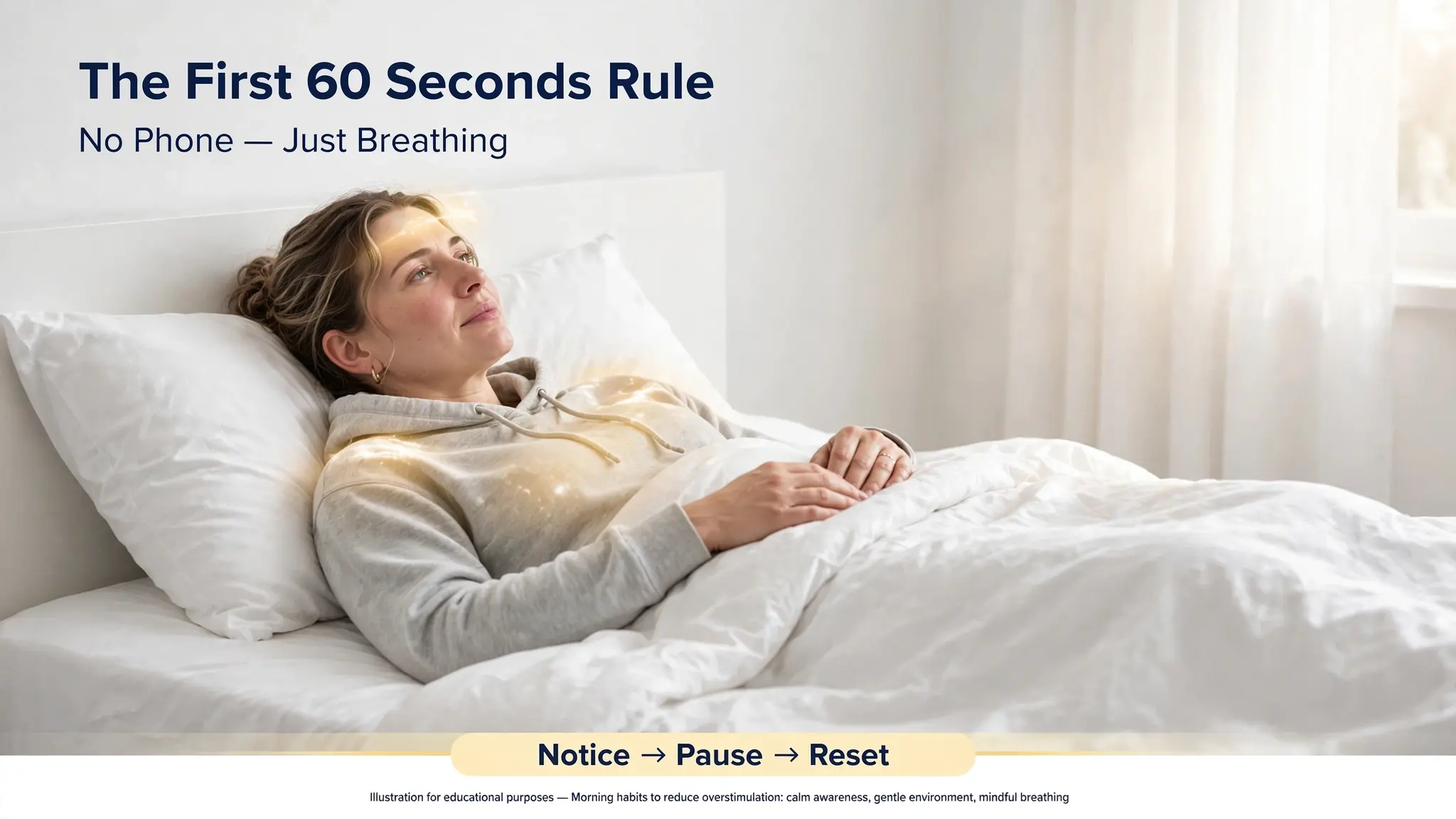
I now give myself a full minute before touching my phone — just lying still, noticing my breathing, and letting my eyes adjust to the room. It’s a small version of a practice I wrote about in more depth in training your mind the way you train your body, which includes simply noticing a few things you can see, hear, and feel the moment you wake — no app, no equipment, just sixty seconds of not reacting yet.
Changing How My Alarm and Room Are Set Up
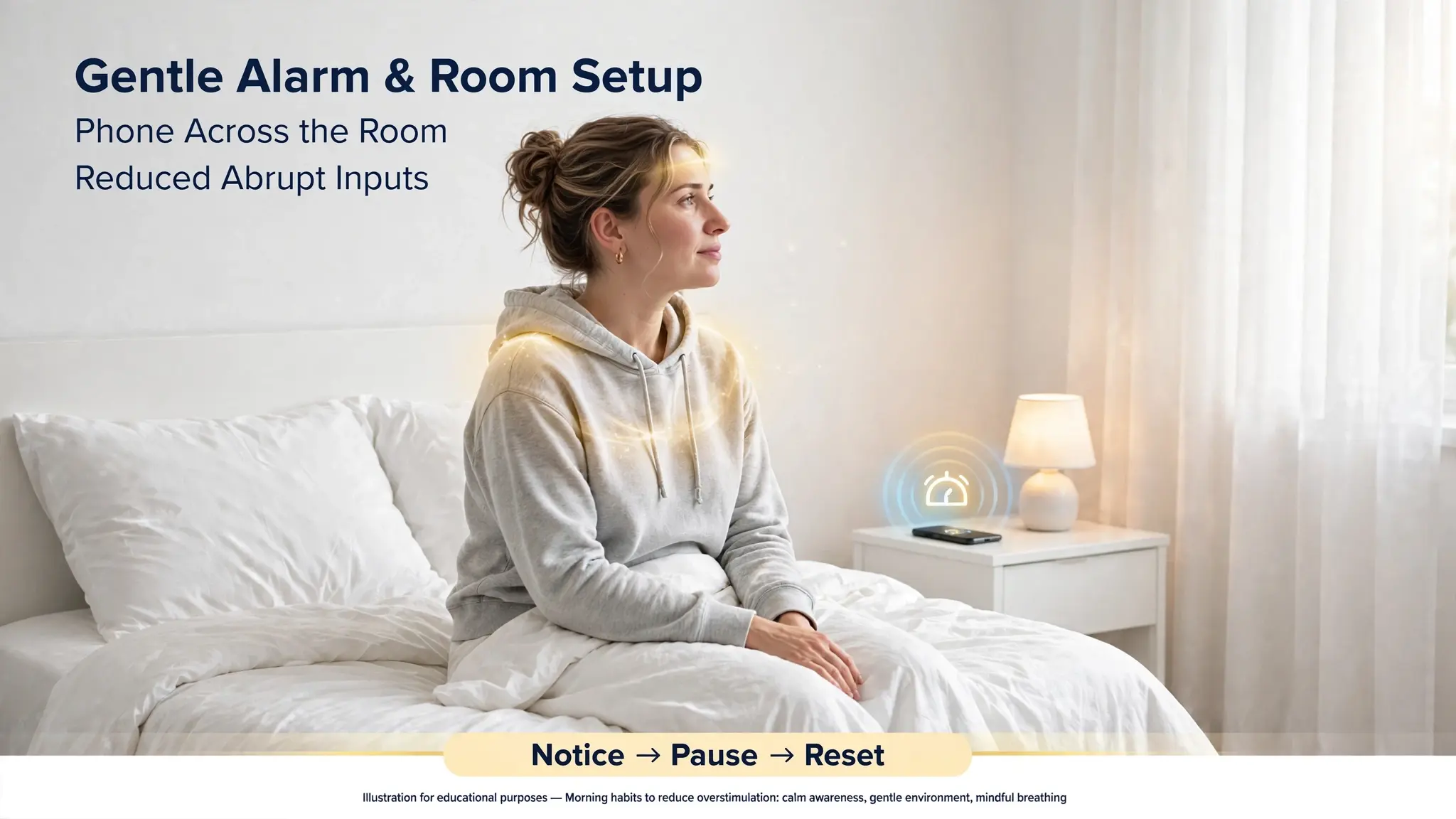
A gentler, gradually increasing alarm tone replaced the sudden blast I used to wake up to, and my phone now stays across the room rather than beside the bed. Both changes reduce how many abrupt inputs hit me in the same instant.
A Small Morning Habit That Changed Everything
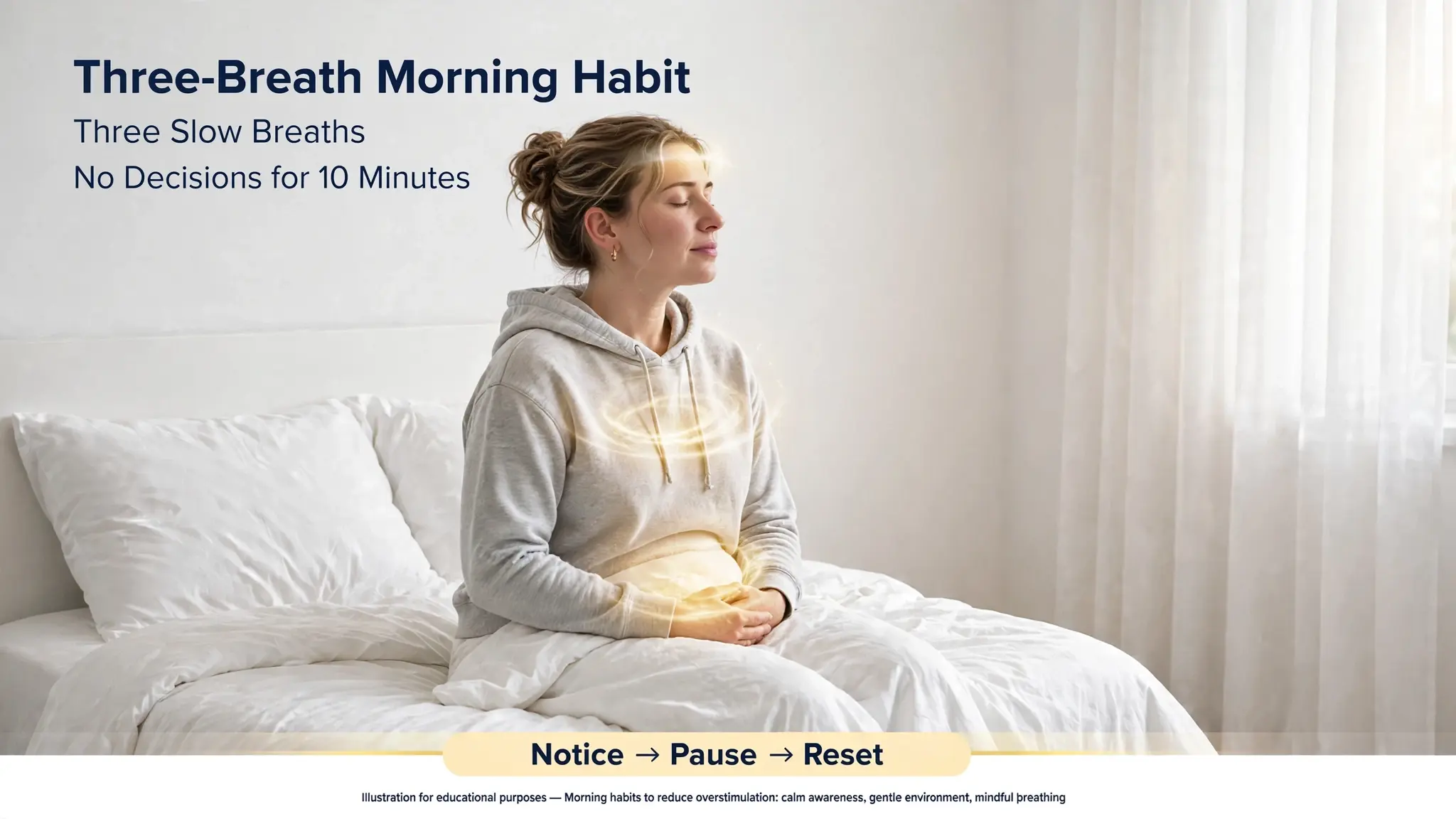
I now sit up slowly and take three unhurried breaths before my feet touch the floor, before any conversation, before any screen. It sounds almost too simple to matter, but that short pause has done more for my mornings than any single other change — it gives my nervous system a few seconds it was never getting before.
I’ve also started keeping the first ten minutes of my morning free of any decision-making — no picking an outfit, no planning the day, no replying to messages. Just the breathing, then getting up, then a slow first task like making tea. Removing decisions from that window turned out to matter almost as much as removing noise.
“My mornings didn’t need to be silent and empty. They just needed one calm minute before the noise was allowed in.”
When It’s More Than Just Morning Overstimulation
Signs It Might Be Morning Anxiety Instead
If what you feel on waking is specific dread tied to a particular worry — a difficult meeting, an unresolved conflict, a looming deadline — rather than a general flood of sensory alertness, that pattern points more towards morning anxiety than overstimulation. Overstimulation tends to be about input; anxiety tends to be about anticipation.
When to Talk to a GP
If this is happening most mornings, affecting your ability to function, or accompanied by a persistent low mood, it’s worth speaking to a GP rather than managing it alone. You’ll find more on emotional wellbeing and mental health topics like this one on the blog, but a professional conversation matters more than any article, mine included.
How My Mornings Look Different Now
I still wake up to an alarm most days — I just don’t let it be the first thing my nervous system reacts to without any buffer. A minute of stillness, a softer alarm tone, and my phone out of arm’s reach have replaced what used to be an instant flood the second my eyes opened.
None of these changes cost anything or took more than a few days to build into a habit. What changed wasn’t the world around me — the alarm still goes off, the day still starts at the same time — it was the half-minute gap I built in before I let any of it in. That gap is doing more work than I expected it to.
Understanding why I felt overstimulated when I wake up didn’t turn me into a naturally cheerful early riser. It gave me one genuinely useful thing instead: the knowledge that my body was reacting normally to real input, not malfunctioning — and one small pause that actually makes a difference.
Frequently Asked Questions
Is it normal to feel overstimulated right when you wake up?
Yes. It’s commonly linked to the natural cortisol awakening response combined with sudden sensory input like alarms, light, or noise.
What is the cortisol awakening response?
It’s a natural rise in cortisol in the 30–45 minutes after waking that helps mobilise energy and alertness for the day.
Why do I wake up anxious for no reason?
It’s often the cortisol awakening response combined with a higher baseline stress load, rather than a specific external cause.
How long does morning overstimulation usually last?
For most people it eases within the first 30 to 60 minutes as cortisol levels stabilise and the body settles into the day.
What helps you calm down quickly after waking up overwhelmed?
A slower alarm, delaying your phone, and a minute of stillness before moving all reduce the intensity noticeably.
This article is for general information only and is not a substitute for professional medical or mental health advice. Please consult a doctor or qualified therapist for personal concerns.

1 thought on “Why Do I Feel Overstimulated When I Wake Up?”