Quick Guide:
No single food prevents cancer, and any article claiming otherwise is overselling it. But broccoli, berries, turmeric, and cooked tomatoes have the strongest, most consistent research behind them of any common foods — and none require a special diet to include weekly.
Introduction
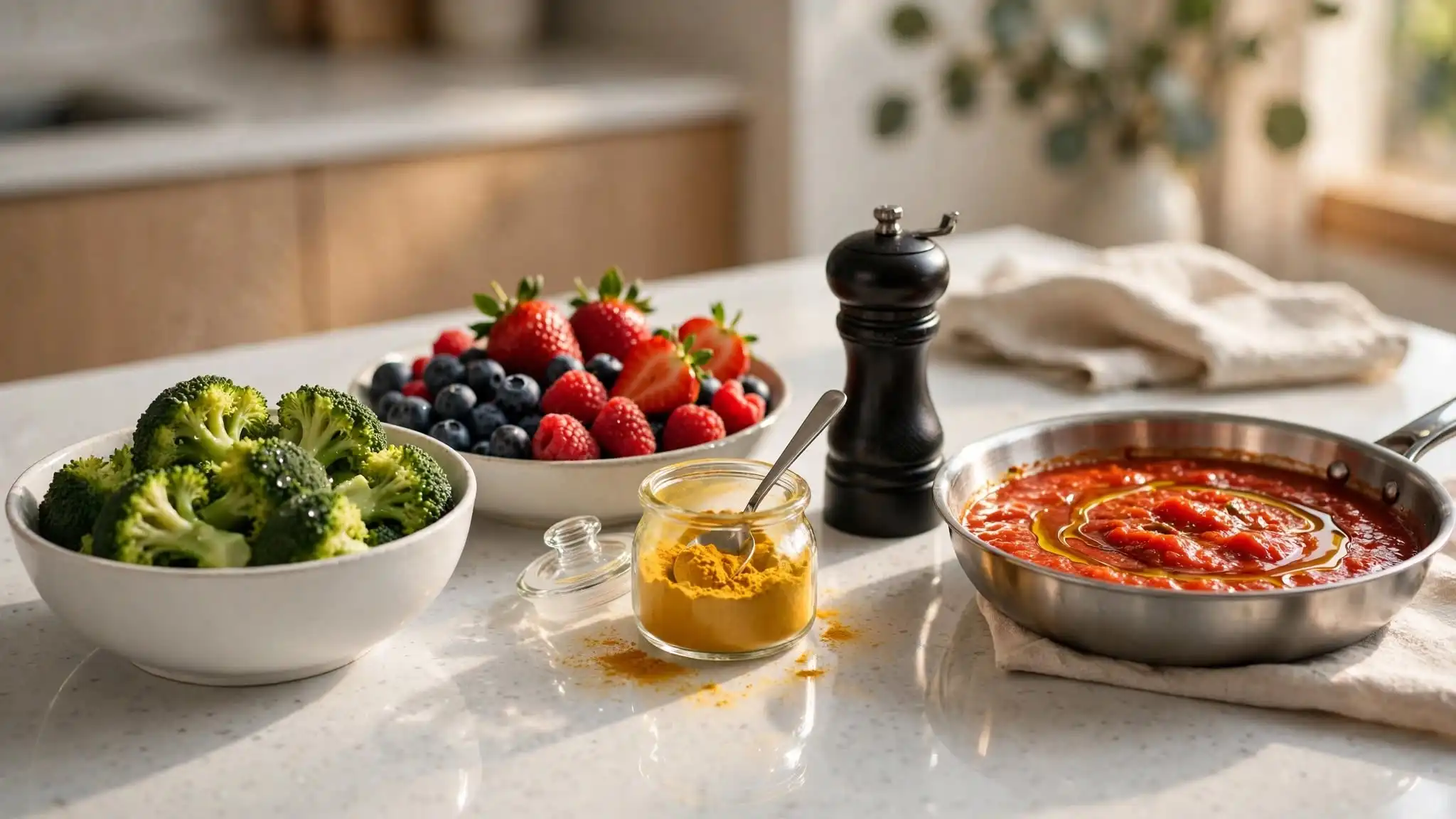
Three years ago my cousin was diagnosed with colorectal cancer at 41. He didn’t smoke, wasn’t overweight, and exercised regularly. That diagnosis is what sent me looking properly into cancer-fighting foods — not as a cure, but as one of the few genuinely controllable pieces of cancer risk.
What follows is what the research actually supports, not what sounds impressive in a headline. Four foods came up consistently, backed by real evidence rather than hype, and I’ll be honest throughout about where that evidence is strong and where it’s still early.
It’s a longer read than most of what I write, and deliberately so — cancer is exactly the kind of topic where oversimplifying does real harm. I’d rather walk through what the evidence actually shows, food by food, than hand you a tidy list that quietly overstates what any of this can promise.
Table of Contents
The Diagnosis That Sent Me Looking Into This
He was young, fit, and the last person any of us expected this from. There was no family history anyone knew of. His diagnosis landed the way these things often do — completely unprepared, because nobody thought he needed to be.
“I did everything you’re supposed to do,” he told me a few weeks in, still processing it. “It still happened anyway.”
That sentence is what pushed me to actually read the research rather than accept a vague sense that “eating healthy helps.” I wanted to know specifically what diet could and couldn’t do, and I wanted the honest version, not the inspirational one. I also spent time reading about how much exercise actually moves the needle on cancer risk, since diet was never going to be the only lever worth pulling.
What made this harder to sit with, honestly, was how little anyone in the family could point to as an explanation. There was no obvious lifestyle culprit to blame, which meant no clean lesson to take from it either — just a genuine, uncomfortable reminder that risk isn’t fully within anyone’s control, diet included.
First, What Does “Cancer-Fighting” Actually Mean?
How Cancer Begins, and Where Food Enters the Picture
Cancer begins with mutations in DNA that cause cells to grow uncontrollably. Diet interacts with that process mainly through three mechanisms: antioxidant activity (neutralising free radicals before they damage DNA), anti-inflammatory effects (chronic inflammation is understood to be a significant driver of cancer development), and supporting normal cell death in cells that would otherwise become abnormal.
What the Research Honestly Supports vs. Doesn’t
Around 40% of cancer cases could be prevented through lifestyle changes, including diet, physical activity, and not smoking [1]. That’s a genuinely significant figure, and it’s the real one — not the inflated “30 to 50 percent from a 2025 NIH review” figure that gets thrown around in less careful health content, mine previously included.
His oncology dietitian told him that what he ate going forward mattered — not as treatment, but as part of managing his long-term risk environment. That’s the frame I’ve used ever since: informed and deliberate, not fearful.
That distinction — risk management rather than treatment — is one I wish had been clearer to me from the start. It would have saved me from the handful of overhyped claims I nearly repeated to him early on, before I’d actually checked any of them properly.
Food 1: Broccoli and Sulforaphane
What Makes Cruciferous Vegetables Different
Broccoli belongs to the cruciferous family alongside cauliflower, kale, and Brussels sprouts. What sets it apart is glucoraphanin, which converts into sulforaphane when the vegetable is chopped or chewed. Sulforaphane is one of the most laboratory-researched natural compounds in cancer biology, shown in cell studies to encourage abnormal cell death and interfere with the blood supply tumours need to grow.
Why Preparation Method Matters
Here’s the honest caveat that most articles skip: Cancer Research UK’s own position is that there’s currently no firm evidence sulforaphane prevents cancer in humans, despite genuinely promising lab and animal data [2]. That doesn’t make broccoli pointless — it makes the claim more honest than “broccoli fights cancer.”
What genuinely surprised me is that high heat destroys the enzyme that converts glucoraphanin into sulforaphane. Boiling broccoli hard, which I’d done my whole life, meaningfully reduces the compound. Lightly steaming or eating it raw preserves far more, and broccoli sprouts contain considerably more glucoraphanin than mature florets. I now steam mine for four to five minutes, not longer.
It’s a genuinely small change — the difference between a rolling boil for fifteen minutes and a gentle steam for five — but it’s exactly the kind of detail that gets lost in most “eat more broccoli” advice. The vegetable is the same. How you cook it changes what you actually get from it.
Food 2: Berries and Their Polyphenols
Why Berries Punch Above Their Weight
Blueberries, strawberries, raspberries, and pomegranate are among the most researched fruits in this space. Their deep colour signals anthocyanins, polyphenol pigments studied across dozens of laboratory studies for their interaction with inflammatory signalling and cell growth pathways. Pomegranate specifically has drawn attention for its ellagitannin content alongside anthocyanins.
Frozen vs. Fresh — What Actually Changes
Frozen berries retain broadly equivalent polyphenol content to fresh — the freezing process doesn’t meaningfully degrade anthocyanins. That matters practically: fresh berries are seasonal and expensive, while a bag of frozen mixed berries is available year-round for a fraction of the cost and keeps for months.
I have a portion daily now — on oats, in a smoothie, or with yoghurt. It took about a week to become automatic. My cousin adopted the same habit during his recovery, on his dietitian’s suggestion rather than mine, which told me it wasn’t just something I’d talked him into.
The variety matters more than any single berry, from what I’ve read — different berries carry different specific anthocyanin profiles, so a rotating mix of blueberries, raspberries, blackberries, and pomegranate seeds covers more ground than committing to just one on repeat.
Food 3: Turmeric and Curcumin
Why It’s Studied Alongside Pharmaceutical Compounds
Turmeric’s active compound, curcumin, has genuinely impressive laboratory effects — it appears to interfere with several of the same signalling pathways cancer cells use to survive and evade the immune system. That’s real, and it’s part of why it’s been the subject of ongoing clinical trials, including some run by Cancer Research UK itself.
The honest caveat matters just as much here as it did with broccoli: Cancer Research UK states plainly that there is currently no clear evidence in humans that turmeric or curcumin prevents or treats cancer, despite some early-phase trials showing promising, if limited, results [3]. Lab-dish results and human outcomes are two different things, and conflating them is exactly the kind of overclaiming I’m trying to avoid here.
The Real Bioavailability Story
Curcumin on its own is poorly absorbed — most of it passes through the digestive system without reaching the bloodstream in meaningful amounts. A well-known 1998 human pharmacokinetics study found that combining curcumin with piperine, the active compound in black pepper, substantially increased how much curcumin the body actually absorbed. It’s a genuinely useful, low-cost pairing regardless of where the cancer research eventually lands, since turmeric itself is simply a safe, flavourful spice either way.
When I was growing up, turmeric went into almost everything my family cooked. I’d drifted away from it once I started cooking for myself. After my cousin’s diagnosis, I noticed the compounds now being studied in oncology labs were staples of the food culture I’d partly walked away from — a quietly significant realisation. Turmeric goes back into soups, curries, and scrambled eggs regularly now, always with a pinch of black pepper.
Food 4: Tomatoes and Lycopene
The Prostate Cancer Research, Honestly Stated
Lycopene, the carotenoid behind a tomato’s red colour, is one of the more studied dietary compounds in cancer prevention research, with the strongest signal for prostate cancer specifically. The evidence here is largely observational — associations between higher lycopene intake and lower risk — rather than definitive proof of cause and effect, which is an important distinction to hold onto rather than gloss over.
Why Cooked Beats Raw Here
Cooked and processed tomatoes deliver meaningfully more bioavailable lycopene than raw ones. Heat breaks down the tomato’s cell walls and releases lycopene from protein complexes, making it easier for the body to absorb — and since lycopene is fat-soluble, cooking with a little olive oil enhances that further.
A pasta sauce made from tinned tomatoes and olive oil is, in terms of lycopene delivery, genuinely a step up from a fresh tomato salad. Tinned tomatoes are now a weekly staple in my kitchen rather than an occasional convenience — soups, stews, and sauces, used specifically because of what cooking does to the lycopene, not just because they’re quick.
It’s a genuinely counterintuitive finding for anyone who’s absorbed the general “raw is always better” assumption around vegetables and fruit. Here, the opposite is true, and it’s a good reminder that blanket food rules rarely survive contact with the actual chemistry involved.
What These Four Foods Have in Common
The Shared Mechanisms, Without Overstating Them
All four — broccoli, berries, turmeric, and tomatoes — interact with overlapping biological pathways: reducing oxidative stress, calming chronic inflammation, and supporting the body’s own mechanisms for clearing abnormal cells. None of them does this perfectly or provably in isolation. A diet that consistently includes all four, across a normal week of real meals, is a reasonable, low-cost way to lean on every one of those pathways at once.
My cousin has made similar changes since his recovery, guided specifically by his oncology dietitian rather than anything he read online. Food and cancer risk has become part of ordinary conversation in our family in a way it never was before, and it connects directly to what I’ve written elsewhere about the antioxidant-rich foods that protect cells daily — broccoli sits at the top of that list every time.
What the Science Cannot Promise
I want to be honest about the limitations here, because that honesty is what makes any of this trustworthy. Much of the foundational evidence comes from epidemiological studies — they show associations between diet and cancer incidence, not the kind of direct causation a drug trial would establish. Laboratory and animal studies show strong, consistent effects from these compounds; translating that to human biology at normal dietary doses is a genuinely ongoing scientific challenge, not a settled question.
None of that diminishes the case for eating these foods regularly. They carry no downside, they’re widely affordable, and the direction of evidence — even where it falls short of proof — is consistent across multiple independent research groups. That’s a reasonable basis for a habit, even without a guarantee attached to it.
I’d rather be the person who tells you honestly where the evidence is thin than the person who oversells a vegetable to get a click. That standard applies to everything on this site, but it matters most here, on a topic where false certainty genuinely costs people something.
Conclusion
My cousin is in remission. He walks most mornings, eats considerably more plants than before his diagnosis, and his kitchen smells of turmeric and garlic in a way it never did three years ago. I’m not claiming the food saved his life — that was the surgery, the chemotherapy, and a genuinely excellent oncology team. But the dietary changes he made during recovery were real, evidence-based, and his own choice.
What I keep coming back to, writing this, is how much better “informed and deliberate” feels than “frightened and vague.” Neither of us can undo his diagnosis. What changed is how we both think about the food on our own plates going forward — not as protection with a guarantee attached, but as one of the few genuinely controllable pieces of a much bigger picture.
None of these four foods need a protocol or a supplement aisle. Add frozen berries to breakfast. Steam broccoli instead of boiling it. Keep tinned tomatoes on hand. Add a pinch of black pepper to the turmeric already in your cupboard. If you want to understand more about how chronic disease develops and where diet fits into that picture more broadly, what’s known about the mechanisms behind long-term conditions like autoimmune disease is a reasonable next read — not to create anxiety, but to make informed choices about the one diet you get to eat for the rest of your life.
If a diagnosis has already touched your own family, what determines whether cancer caught early can be cured is worth reading too — screening and early detection matter at least as much as anything on this list, and neither should get overshadowed by a conversation about food.
Medical Disclaimer: This article is for informational purposes only and does not constitute medical advice. No food or dietary change replaces cancer screening, medical treatment, or professional healthcare guidance. If you have a personal or family history of cancer, please consult your GP or a qualified oncology dietitian before making significant dietary changes.
Frequently Asked Questions
What are the best cancer-fighting foods backed by research?
Broccoli (sulforaphane), berries (anthocyanins), turmeric (curcumin), and cooked tomatoes (lycopene) have the strongest and most consistent research behind them among common foods, though none is proven to prevent cancer on its own.
Can eating certain foods actually reduce cancer risk?
Diet is a significant, controllable risk factor — around 40% of cancers could be prevented through lifestyle changes including diet — but no single food prevents cancer by itself.
Why is cooked tomato better than raw for cancer prevention?
Cooking breaks down the tomato’s cell walls and releases lycopene from protein complexes, making it considerably more absorbable than lycopene from raw tomatoes.
Does turmeric actually help prevent cancer?
Turmeric’s compound curcumin shows promising effects in lab and early-phase human trials, but Cancer Research UK states there is currently no clear evidence in humans that it prevents or treats cancer.
Is broccoli really effective at reducing cancer risk?
Broccoli’s sulforaphane has strong laboratory and animal evidence, but Cancer Research UK notes there’s no firm evidence yet that it prevents cancer in humans specifically.

3 thoughts on “4 Cancer-Fighting Foods the Research Actually Backs”
Comments are closed.