The Quick Answer
No — apple cider vinegar doesn’t need refrigeration at any stage, before or after opening. Its natural acidity makes it self-preserving, and the only real exception is once you dilute it into a tonic or dressing, which needs the fridge and a 2-3 day window. The full explanation, and the storage mistakes I made myself, are below.
The Fridge Door Moment That Started This

I can tell you when this question became important to me. I had just returned from a health food store and brought a large bottle containing raw, unfiltered apple cider vinegar — the faded variety that showed mother’s threads, which I was particularly looking for because of its enzyme and digestive properties.
I was going to keep it in the fridge, just habitual. It was a liquid, it was a health product, and the fridge is where health products come in—right? Then I stopped. I checked the label. Nothing. I saw it online. There are conflicting answers everywhere. I read 10 minutes of conflicting suggestions when I actually just wanted a well-researched answer as to should apple cider vinegar be refrigerated.
The answer, as I eventually discovered, is not clear and well-proven—and the reason is more interesting than expected. It’s the same chemistry that makes ACV a tonic for health. Science not only says that refrigeration is unnecessary, but room temperature is actually specific reasons for better storage. I want to share all of this clearly and practically so that you don’t have to spend ten minutes confused at the fridge door yourself.
Table of Contents
Should Apple Cider Vinegar Be Refrigerated? The Direct Answer
No — And Here Is the Science Behind Why
Apple cider vinegar does not need to be refrigerated — before opening, after opening, or at any point during its life. This isn’t a matter of opinion or brand-specific guidance. It’s a function of what ACV fundamentally is and how its chemistry works.
ACV is made through a two-stage fermentation process. First, yeast converts the natural sugars in apple juice into alcohol. Then, acetobacter bacteria convert that alcohol into acetic acid — the compound responsible for ACV’s sharp, tangy smell and taste, and the one most associated with its health benefits.
The high acidity of ACV — typically 4% to 8% acetic acid concentration — creates an environment actively hostile to harmful bacterial growth. Dangerous microorganisms simply cannot survive in a medium that acidic. This is the same principle that made vinegar a trusted food preservative for thousands of years, long before refrigeration existed. ACV preserves itself.
I found this genuinely elegant once I understood it. The acetic acid tied to blood sugar management, digestion, and antimicrobial function in the body is simultaneously what keeps the bottle safe and stable on your shelf indefinitely.
What Refrigeration Actually Does — and Does Not Do
Refrigerating ACV isn’t harmful. But it isn’t helpful either, and understanding why matters for how you store it going forward.
- Does not extend shelf life: ACV has an indefinitely long shelf life at room temperature. Cold storage adds zero additional preservation because there’s nothing to preserve against.
- Does not improve potency: The bioactive compounds — acetic acid, polyphenols, enzymes, and the mother’s bacterial cultures — are stable at room temperature and aren’t enhanced by cold.
- Does not protect the mother: The probiotic cultures in unfiltered ACV are acid-adapted and thrive in the acetic acid environment regardless of temperature.
- May actually cause minor quality issues: Repeated movement between cold and room temperature can cause condensation inside the bottle, marginally diluting the ACV and potentially affecting flavour over time.
What Happens When You Leave ACV Unrefrigerated?
Nothing Dangerous — But a Few Normal Changes Over Time
Let me be direct about this: leaving ACV at room temperature, even for years, does not make it unsafe. It won’t spoil, it won’t grow mould, and it won’t become harmful to consume. The acetic acid prevents all of that.
What may change gradually, and only in entirely normal, non-concerning ways:
- Flavour mellowing — the sharpness can soften slightly as trace volatile compounds evaporate. Cosmetic, not a safety issue.
- Colour darkening — raw ACV may darken over years, again purely cosmetic.
- Sediment formation — the mother in unfiltered ACV may settle, reform, or appear denser over time. This is completely normal, and actually desirable — it’s the living cultures doing what they do.
- Slight acidity concentration — if the bottle isn’t sealed tightly, slow evaporation can concentrate the acidity fractionally. Not harmful, but another reason to seal tightly every time.
I once found a bottle of ACV at the back of my pantry, forgotten for over a year. It had darkened slightly and had more sediment than I remembered, but it smelled sharp and clean and tasted exactly as it should. I used it without hesitation.
Does Opening the Bottle Change Anything?
This is the part most people are unsure about, because with most food products, “refrigerate after opening” is standard advice. ACV is a genuine exception.
Once opened, apple cider vinegar remains completely stable at room temperature — no change in chemistry, safety, or potency from the moment the seal is broken. The acetic acid continues preventing harmful microbial growth, and the mother in unfiltered varieties continues being active and stable.
The one thing that changes after opening is the importance of keeping the lid tightly sealed between uses. Not because of spoilage risk, but because air exposure causes slow evaporation that concentrates the ACV over time and can gradually affect the flavour.
What About ACV With the Mother? Does It Need Special Treatment?
When I first started buying raw, unfiltered ACV with the mother, I was convinced it was more delicate and definitely needed refrigeration. That murky appearance suggested something alive and fragile. I was completely wrong. The mother isn’t fragile — it’s one of the most resilient things in your kitchen, living contentedly in a highly acidic environment that would destroy most other microorganisms.
What the Mother Is — and Why It Doesn’t Need the Fridge
The mother of vinegar is a naturally occurring culture of proteins, enzymes, and beneficial acetic acid bacteria that forms during fermentation. In unfiltered, unpasteurised ACV, the mother remains present and active, contributing the cloudy appearance and floating strands many people notice.
These bacterial cultures aren’t fragile newcomers to a hostile environment — they evolved in, and are adapted to, the acetic acid environment inside the bottle. Keeping ACV at a consistent room temperature may help maintain the mother’s enzymatic activity better than the fluctuating temperatures involved in moving between fridge and pantry.
The mother will sometimes settle to the bottom and sometimes distribute more evenly — both are normal. Shaking the bottle before use redistributes it and ensures you get its full contribution in every pour.
Filtered vs Unfiltered — Same Storage Rules
Filtered ACV (clear, no visible mother): entirely stable at room temperature, no special requirements.
Unfiltered ACV with the mother (cloudy, strands visible): equally stable, same storage recommendation. The mother doesn’t increase perishability — it simply means a less-processed, more enzymatically active product that deserves the same glass-and-dark-location care.
The Ideal Way to Store Apple Cider Vinegar — The Complete Guide
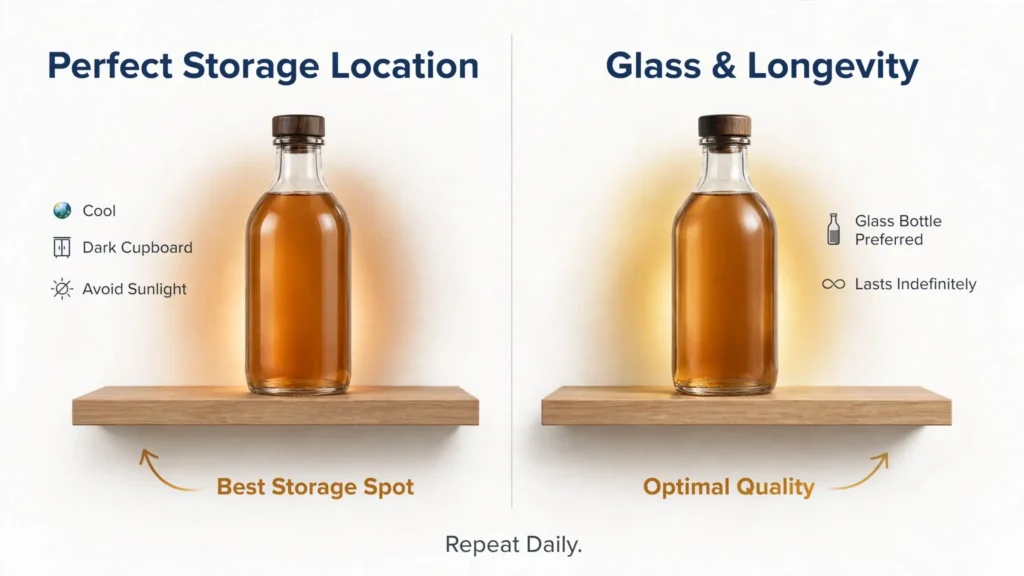
The Perfect Storage Location
The ideal storage spot is simple: a cool, dark pantry or kitchen cupboard, away from the cooker, away from direct sunlight, and away from significant temperature variation. That’s essentially the complete guide.
Avoiding direct sunlight isn’t about microbial risk — it’s the UV exposure that can gradually degrade the polyphenols and volatile aromatic compounds over time, affecting flavour and possibly antioxidant quality. A closed cupboard removes this variable entirely.
My ACV now lives on the second shelf of my pantry cupboard, alongside olive oil, balsamic vinegar, and a few other daily-use kitchen wellness staples. It’s been there for months and is in perfect condition every time I open it.
Glass Over Plastic — Why the Bottle Material Matters
This is worth understanding, because it’s an easy, inexpensive way to keep your ACV at its best. Acetic acid is chemically reactive with certain plastics. Over months and years, it can gradually leach compounds from plastic containers into the vinegar — a process called chemical migration that isn’t dramatically harmful in small amounts, but is entirely avoidable.
Glass is the ideal storage material, particularly for long-term storage. It’s chemically inert — it doesn’t react with acetic acid and doesn’t leach anything into the product over any time period. Dark glass — amber or green — adds a layer of UV protection on top of storing in a dark cupboard.
How Long Does ACV Actually Last?
The honest answer: essentially indefinitely when stored correctly. There’s no official requirement for a use-by date on vinegar products because vinegar doesn’t spoil in the conventional sense. Commercial ACV carries a best-before date not because it becomes unsafe past it, but because the manufacturer can’t guarantee optimal flavour quality beyond that point.
In practice, a properly stored bottle of raw ACV with the mother can remain fully safe and nutritionally functional for five, ten, or more years, with only the cosmetic changes described above.
If you’re using ACV as part of a daily gut health or blood sugar routine, understanding this stability matters practically. I’ve gone into both topics in more depth in foods your gut is begging you to eat, which pairs naturally with a daily ACV habit.
Common ACV Storage Mistakes I’ve Made — And You Might Be Making Too
Mistake 1 — Storing in the Fridge for Two Years Unnecessarily
I did this. For almost two years I kept my ACV in the fridge door alongside condiments that genuinely needed refrigeration. Every time I reached past it for something else, I was reminded it was there, taking up space it didn’t need, subjected to repeated temperature changes as the door opened and closed, serving no useful purpose whatsoever.
The day I moved it to the pantry was, genuinely, a small kitchen liberation. My ACV — placed in a cool, dark cupboard in its original glass bottle with a tight lid — has been in better condition than it ever was in the fridge.
Mistake 2 — Storing in a Clear Glass Bottle on the Kitchen Counter
This is a common aesthetic choice — ACV in a pretty clear bottle on the counter looks nice. The problem is daily UV and light exposure that gradually affects polyphenol quality and flavour, particularly for raw, unfiltered varieties.
If you want ACV accessible on the counter, decant a week’s worth into a small, dark-glass bottle and keep the main supply in the cupboard.
Three rules I now follow without exception: glass bottle, sealed lid every time, dark cupboard away from heat and sunlight. That’s the complete storage protocol. Everything else is overthinking a product that’s been doing perfectly fine in cool, dark places for thousands of years before anyone thought to put it in a fridge.
Mistake 3 — Not Sealing the Lid Properly After Every Use
This is the one mistake that can genuinely affect quality over time, not through spoilage, but through evaporation and oxidation. A loosely replaced lid lets volatile aromatic compounds slowly escape, gradually changing the flavour profile, and allows slow evaporation that concentrates the acidity in ways that can make the vinegar harsher than it should be.
The fix is the simplest possible one: seal the lid firmly after every single use. It takes one extra second. Over months of regular use, that one-second habit preserves the quality and character of your ACV in a way no storage location change can.
For anyone wondering whether the acidity itself is something to worry about long-term, I’ve written separately about whether ACV can affect your stomach lining, which is a related but genuinely different question from storage.
The One Case Where You Actually Should Refrigerate ACV
ACV-Based Preparations and Diluted Tonics
There’s one genuine exception to the no-refrigeration rule. When you mix ACV with water, juice, honey, or other ingredients to make a daily wellness tonic, morning shot, or salad dressing, that preparation needs to be refrigerated and used within 2 to 3 days.
The reason is straightforward: dilution drops the acidity of the mixture below the threshold at which ACV’s self-preserving mechanism works. Once you add water or other ingredients, the pH rises and the antimicrobial protection weakens. The mixed preparation then behaves like a perishable food rather than a self-preserving one.
Pure, undiluted ACV from the bottle: room temperature, indefinitely. Your daily ACV morning shot, pre-mixed in a small jar: sealed and refrigerated, used within two to three days. That distinction covers the complete storage picture.
Some people also notice digestive effects once they start a regular ACV habit, which is worth understanding alongside the storage question. I’ve covered this separately in whether ACV can cause constipation, which is worth a read if you’re just starting out with a daily routine.
⚕ When to See a Doctor
If you use ACV as part of a daily tonic and notice persistent stomach pain, worsening reflux, or digestive symptoms that don’t settle, this goes beyond a storage question — please speak with your GP, particularly if you’re also taking medication for diabetes or blood pressure, since ACV can interact with both.
Conclusion — Simpler Than I Expected, Better Than I Thought
I came to this question with real uncertainty and came away with something I didn’t expect: clarity and simplicity. The Apple Cider Vinegar is one of the most self-sufficient and low-maintenance items in my kitchen. The same acetic acid that makes it a healthy tonic makes it its own preservative. No need for a fridge, no expiry worries, or complicated storage.
My ACV is now housed in a closed glass bottle in the pantry cupboard, away from heat and light, along with olive oil and other everyday health items. I take it every morning for my daily shot, diluted with warm water and a tablespoon of raw honey, and make the mixture fresh each time instead of making it in large quantities. The bottle on the shelf lasts as long as it lasts. It doesn’t end. It doesn’t spoil. It just waits with full force, ready to use.
If someone had told me at the fridge door this year that the answer was so simple, I would have saved myself from scrolling ten really pointless minutes. Now you don’t even have to spend them.
Medical Disclaimer: This article is for general informational and educational purposes only and does not constitute medical or dietary advice. Always consult a qualified healthcare professional before making significant changes to your diet or wellness routine, particularly if you have an existing health condition or take regular medication.
Frequently Asked Questions
Should apple cider vinegar be refrigerated?
No — its high acidity, 4 to 8% acetic acid, prevents harmful bacterial growth, making it self-preserving at room temperature in a cool, dark cupboard.
Does apple cider vinegar need to be refrigerated after opening?
No — once opened, ACV remains fully safe and stable at room temperature as long as the lid is sealed tightly after every use.
How should I store apple cider vinegar?
Store it in a sealed glass bottle in a cool, dark cupboard away from sunlight and heat, since glass avoids the chemical leaching that can occur with plastic.
Does apple cider vinegar with the mother need to be refrigerated?
No — the mother is stable in the acetic acid environment at room temperature and doesn’t require any special refrigeration beyond standard ACV storage.
Can apple cider vinegar go bad?
Not in the conventional sense — it has an indefinite shelf life, though flavour may mellow and colour may darken slightly over time without any safety concern.

2 thoughts on “Should Apple Cider Vinegar Be Refrigerated?”
Comments are closed.