Quick Summary
The fastest way to calm down after being overstimulated is to cut sensory input first, then use grounding and slow breathing to bring your nervous system back down — not force yourself to just relax. This is what my uncle and I both use now, after a phone call from him sent me looking into it properly.
Introduction

My uncle Rafiq called me the evening after my cousin’s wedding, and he seemed really upset. “I just had to get away from everything for a minute,” he said, standing in his driveway, still in his sherwani. He wasn’t injured, and nothing had gone wrong at the wedding—he had enough people, noise, and lights for today, and that’s what his body was telling him. When he asked me how to calm down after being overstimulated, all I had for him was “just try to relax,” which seemed useless advice even then.
That call bothered me so much that I looked for the real answer instead of the vague one. What I found, tested on myself, and later shared with him, is the basis of this article—the specific techniques that really help you calm down after being overstimulated, the ones that don’t, and what is beneficial to do later so that it takes longer to relapse.
What I didn’t expect was that the general advice is either too vague to be used in the moment, or they are meant to prevent more movement and not when you’ve already joined in. Rafiq didn’t need restraining advice while standing in a sherwani in his driveway — he needed something he could do with his hands and breath in the next 60 seconds. This is the gap that this article is trying to fill.
Table of Contents
What “Calming Down” Actually Means for an Overstimulated Nervous System
Why Generic Advice Like “Just Relax” Doesn’t Work
Telling someone to relax when their nervous system is already flooded is a bit like telling a kettle to stop boiling by asking nicely. Overstimulation is a physiological state, not a mood, so it needs a physiological response — specific actions that reduce input and signal safety to your body — rather than a general instruction to feel differently.
This is exactly the trap I fell into on the phone with Rafiq. “Just relax” is the kind of thing that sounds supportive in the moment but gives the other person nothing to actually do. It puts the responsibility for calming down entirely on willpower, when the more useful question is always: what specific, physical thing can this person do right now?
The Goal Is Regulation, Not Suppression
Health bodies including the NHS and APA describe effective calming techniques as working through nervous system regulation rather than suppression. Suppressing the feeling — pushing it down, ignoring it, powering through — tends to leave the underlying activation in place, just delayed. Regulation actually lowers it, which is why the right techniques work quickly and the wrong ones don’t work at all.
The distinction matters practically, not just theoretically. Suppression might get you through the rest of an event looking fine on the outside, but the activation is usually still there afterwards, often surfacing later as irritability, exhaustion, or a poor night’s sleep. Regulation, done properly in the moment, tends to actually clear it rather than just postpone it.
The Wedding Call That Started This
Rafiq described it clearly once he’d calmed down enough to talk properly: the reception hall lights, the sound system, dozens of relatives all wanting a conversation at once, and hours of it without a real break. He said his chest felt tight and his thoughts wouldn’t settle, even standing alone outside. He wasn’t upset about anything specific. He just felt like his whole system had been running too hot for too long.
He’d tried a few things himself before calling — splashing water on his face, telling himself to “snap out of it,” even trying to force a laugh at something to shift his mood. None of it worked, and by the time he called me he sounded more frustrated with himself than anything else, as if not being able to simply decide to feel calmer was some kind of personal failing rather than a completely normal nervous system response.
What struck me on that call was how little I actually had to offer him beyond sympathy. I’d never needed a proper answer before, so I’d never gone looking for one. That gap is exactly what sent me digging into what genuinely helps someone calm down after being overstimulated, rather than what simply sounds comforting.
“He didn’t need me to tell him he’d be fine. He needed something specific to actually do with his hands, his breath, and the next five minutes.”
Immediate Techniques That Work in the Moment

Reducing Input First
Before anything else, the fastest relief comes from reducing the sensory input itself — stepping outside, dimming lights, moving to a quieter room, or simply turning away from a crowd for a few minutes. This is the step Rafiq had already stumbled onto instinctively by standing on his driveway, without realising it was the correct first move.
It doesn’t have to be dramatic. Even turning your back to a busy room, putting in earplugs, or stepping into a hallway for thirty seconds counts as reducing input. The goal isn’t to fully escape the situation, just to lower the volume enough for your nervous system to catch up.
The 5-4-3-2-1 Grounding Technique
This is one of the simplest tools I found, and the one Rafiq now uses at every large family event. Name five things you can see, four things you can feel, three things you can hear, two things you can smell, and one thing you can taste. It redirects your brain from the flood of input to a manageable, specific task, which is often enough to break the spiral.
The reason it works so reliably is that it gives your brain a single, narrow job — counting and naming — instead of the dozens of competing demands it was trying to process a moment earlier. Rafiq said the first time he tried it, standing near the buffet table at a smaller family dinner, it felt almost too simple to actually do anything. It took under two minutes for his shoulders to visibly drop.
Why Timing Matters More Than People Expect
Using any of these techniques earlier, at the first sign of tension rather than once you’re already flooded, makes a noticeable difference to how quickly they work. Waiting until you’re deep into overstimulation means working against a nervous system that’s already fully activated, rather than gently redirecting one that’s just starting to climb.
Slow Breathing Patterns That Actually Calm the Nervous System
Extended-exhale breathing — inhaling for four counts and exhaling for six to eight — signals safety to your autonomic nervous system far more effectively than shallow, fast breathing does. If the physical symptoms ever tip into something sharper — chest tightness that won’t ease, real breathlessness — it’s worth knowing what a full panic attack actually feels like, since the two can look similar in the first few seconds.
This same overstimulated feeling can also show up mentally, not just physically — I’ve written separately about why I replay conversations in my head long after they’re over, and what actually helps interrupt that loop.
What I Tested With My Uncle Afterwards
At the next family gathering, Rafiq and I tried a few of these deliberately. He found the grounding technique easiest to remember mid-conversation, while I found slow breathing worked faster for me once I was already alone. Neither of us needed all of them at once — just one that fit the moment.
What we both noticed was that having more than one option mattered more than finding the single “best” one. On a loud, crowded evening, stepping outside wasn’t always possible, so grounding became the fallback. On a quieter evening with a clear exit, reducing input first worked faster than anything else. The techniques aren’t really competing with each other — they’re better thought of as a small kit you reach into depending on what the moment allows.
| Technique | Best For | How Long It Takes |
| Reducing input | The moment overload starts | Immediate |
| 5-4-3-2-1 grounding | When you can’t leave the room | 1–2 minutes |
| Extended-exhale breathing | Once you’re somewhere quieter | 2–5 minutes |
| Short walk or movement | After the event, to fully reset | 10–20 minutes |
Slower Techniques for Recovering Afterwards
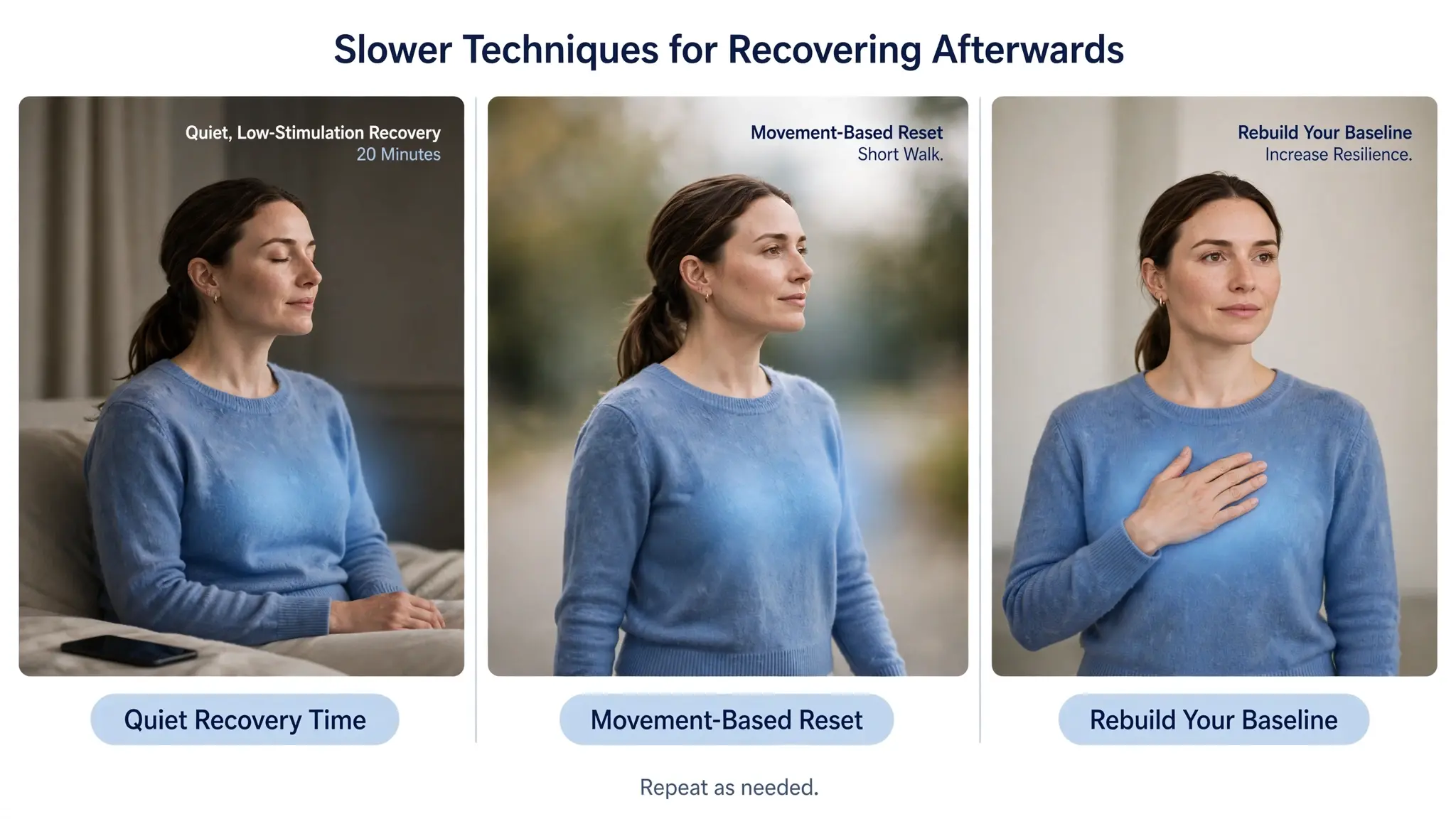
Quiet, Low-Stimulation Recovery Time
Once the immediate flood has passed, genuine recovery still takes a bit longer. Rafiq now builds in twenty quiet minutes after any big event, phone away, before he does anything else. It sounds small, but he says it’s made the difference between a rough hour and a rough day.
This isn’t the same as simply resting in the general sense — sitting in front of a screen doesn’t count, since it introduces more of the same kind of input that caused the overload in the first place. The recovery has to be genuinely low-stimulation: dim light, minimal noise, no new decisions to make.
Movement-Based Resets
A short walk, even just around the block, seems to help discharge some of the physical tension that builds up during overstimulation. It doesn’t need to be exercise in any formal sense — just enough movement to signal to your body that the alert state can stand down.
Rafiq tried this after a different family gathering a few weeks later, walking to the end of his road and back rather than sitting straight back down at the table. He described it as the difference between letting the adrenaline simply sit in his body versus giving it somewhere to actually go.
Rebuilding Your Baseline So You Have More Room Next Time
How much room you have before you tip into overload depends heavily on your overall stress levels, which connects to what I learned researching how chronic stress reshapes your body over time. A lower baseline stress load means a higher threshold before the next event tips you over. Building general mental resilience between events, in the way I explored in training your mind the way you train your body, genuinely widens that margin over time.
Mistakes People Make Trying to Calm Down
Rafiq’s first instinct, before that wedding, was to scroll his phone to “distract” himself — which usually added more input on top of an already overloaded system rather than reducing it. Forcing yourself to “push through” and stay in the overstimulating environment tends to extend the recovery time afterwards rather than shorten it. And reaching for caffeine or a stimulating conversation to “snap out of it” tends to sharpen the restlessness rather than settle it.
Another mistake worth naming is treating a single technique as a magic fix that has to work every time. Some days grounding works instantly. Other days it takes two attempts, or works better paired with reduced input first. Expecting perfect, immediate results every time can turn a genuinely useful tool into another source of frustration when it doesn’t land the way it did last time.
Rafiq also used to apologise repeatedly for needing a minute outside, which added a layer of social pressure on top of the physical overload itself. Simply saying “I need a few minutes” without over-explaining or apologising takes one more demand off an already overloaded system.
“The instinct to distract yourself out of it is understandable — it just tends to make the nervous system’s job harder, not easier.”
When It Connects to the Bigger Picture
Overstimulation doesn’t only show up at big events. If this pattern mainly hits you after socialising, or specifically the moment you wake up in the morning, I’ve written about both of those triggers in more depth, since the underlying causes differ slightly even though the calming techniques here still apply. For broader emotional wellbeing content, there’s more on mental health topics like this one on the blog.
How My Uncle — and I — Handle It Differently Now
Rafiq keeps it simple now: he steps outside earlier than he used to, uses the grounding technique the moment he notices his chest tightening, and gives himself quiet time afterwards without guilt. I’ve adopted most of the same habits, plus the breathing pattern, which has become close to automatic at this point.
Neither of us has stopped going to big family events. We’ve just stopped pretending the overwhelm isn’t real, and started carrying a few specific tools instead of a vague hope that we’ll be fine.
The next time Rafiq calls me after a wedding, I doubt it’ll be to ask what to do — more likely just to tell me which technique worked best that night. That shift, from not having an answer to having several, is really what this whole thing turned out to be about.
Frequently Asked Questions
What is the fastest way to calm down after being overstimulated?
Reduce sensory input immediately — step away, dim lights, or find a quieter space — then use grounding or slow breathing to bring your system down further.
Does the 5-4-3-2-1 grounding technique actually work?
Yes. It redirects attention from overwhelming input to specific, manageable sensory details, which helps interrupt the overload within a couple of minutes.
How long does it take to calm down after sensory overload?
Immediate techniques can ease the peak within a few minutes; full recovery, including the lingering fatigue, often takes 20–60 minutes of quieter time.
Can breathing exercises really stop overstimulation?
Yes. Extended-exhale breathing signals safety to the nervous system and can noticeably reduce physical symptoms like a racing heart within minutes.
What should you avoid doing when you’re overstimulated?
Avoid adding more input — phone scrolling, caffeine, or forcing yourself to stay in the overstimulating environment without a break.
This article is for general information only and is not a substitute for professional medical or mental health advice. Please consult a doctor or qualified therapist for personal concerns.

2 thoughts on “How to Calm Down After Being Overstimulated”