🟢 THE SHORT VERSION
In a UK winter, sunrise can be as late as 8am, so relying on natural light alone often isn’t realistic. The combination that actually works is getting outside for 10 to 15 minutes even under cloud, using a 10,000 lux light therapy box at breakfast time, and taking a vitamin D supplement from October to March, as the NHS recommends.
Introduction

By mid-December, I realised that I had gone to work in the dark and had been coming home in the dark for almost two weeks straight. It wasn’t dramatic — no bad days were noticeable — but I was feeling flatter than usual, and my energy dropped in a way that wasn’t doing quite well. Then I really sat down and thought about How to Get Morning Light in Winter UK conditions, rather than assuming that the habits that worked in April would sustain me until January. It turns out how to get morning light in winter UK weather and daylight hours takes a slightly different approach than the rest of the year, and when I adjusted accordingly the difference became apparent within about a week.
Table of Contents
Why Winter Mornings in the UK Are a Genuinely Different Problem
This isn’t just “it’s darker in winter.” The scale of the change in the UK is bigger than most people realise until they actually look at the numbers, and it’s part of why habits that work fine in spring and summer quietly stop working once the clocks go back.
How late sunrise actually is in December and January
Depending on where you are in the UK, sunrise in late December can be close to 8am, and in the far north of Scotland, later still. Compare that to a typical summer sunrise before 5am, and the UK sees roughly seven hours of daylight in winter against sixteen in summer. If your working day starts at 8 or 9am, there’s a real chance you’re not seeing proper daylight until you’re already at your desk.
Why cloud cover makes it worse, not just darker
UK winters aren’t just short on daylight hours, they’re also disproportionately grey. Heavy cloud cover cuts outdoor brightness further, which means even the daylight hours you do get are often weaker than the same clock time would be on a clear day.
This combination is what makes the UK a particularly tricky place to rely on casual, unplanned light exposure through winter. A short daylight window that’s also frequently overcast leaves a much smaller margin for error than somewhere with shorter but consistently clear winters.
The link between this and Seasonal Affective Disorder
Seasonal Affective Disorder, or SAD, is a recognised pattern of low mood and low energy tied specifically to reduced daylight, and it’s thought to affect a meaningful share of the UK population to some degree each winter. You don’t need a diagnosis to notice the milder version of this — most people I know feel some version of “winter blues,” even if it never becomes anything more serious.
What I found useful was treating this as a spectrum rather than a yes-or-no condition. Somewhere between “totally unaffected by winter” and “clinically diagnosed SAD” is where most people actually sit, and the practical steps in this article are aimed squarely at that middle ground.
The Morning I Realised I Hadn’t Seen Daylight in Days
I commute into an office three days a week, and for a stretch in December, my train left before sunrise and got back after sunset on all three of those days. On the two days I worked from home, I still didn’t step outside properly until lunchtime, if at all.
A colleague pointed out, almost as a throwaway comment, that she’d started taking her lunch break as a walk specifically because she’d noticed the same thing about her own week. That comment stuck with me more than it probably should have. It made me realise I’d been treating daylight as something that would just happen to me, rather than something I needed to actively go and get during a UK winter.
Once I started tracking it properly for a couple of weeks, the pattern was obvious. On days I got outside before 10am, even briefly, my afternoon energy held up noticeably better than on days I didn’t.
What made it click for me wasn’t a single dramatic morning, but looking back over the tracker after two weeks and seeing the same shape repeat itself. It wasn’t a coincidence I could talk myself out of anymore, which is usually the point where a vague feeling turns into an actual habit worth keeping.
What Actually Works When Real Sunlight Is in Short Supply
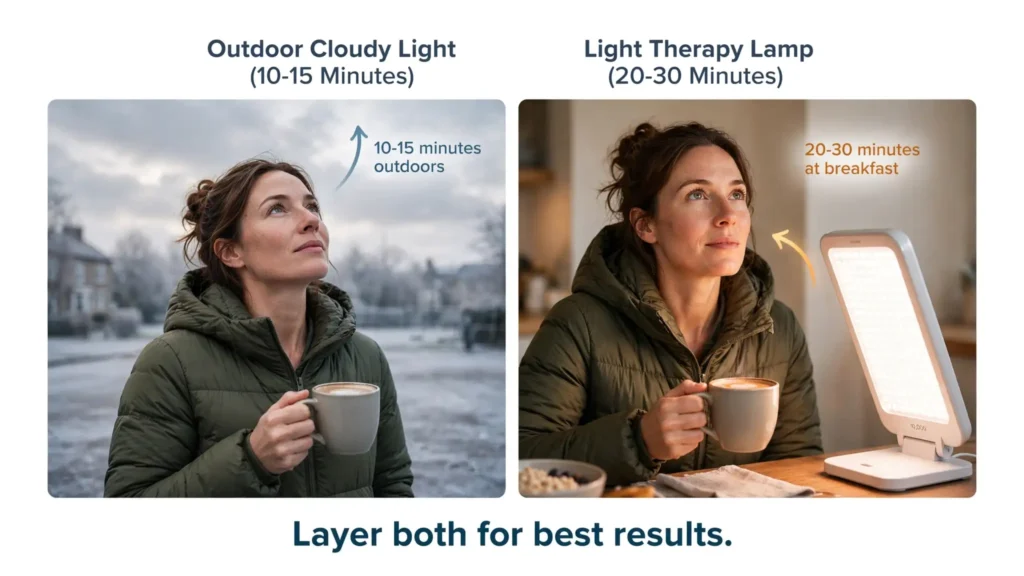
Once I accepted that winter needed a different approach, a few specific things made a real, noticeable difference.
Getting outside for even 10 to 15 minutes, even under cloud
Cloudy daylight is still dramatically brighter than any indoor lighting, often by a factor of ten or more. A short walk, or even standing outside with a coffee, still registers with your body’s internal clock, even on a grey January morning.
Using a light therapy lamp at breakfast time
A 10,000 lux light therapy box, used for around 20 to 30 minutes while you’re having breakfast, is one of the most consistently effective options for UK winters specifically, because it doesn’t depend on the weather cooperating. Timing matters here too, using it earlier in the morning tends to work better than using it later in the day.
A sunrise alarm clock as a gentler wake-up option
Rather than an instant burst of brightness, a sunrise alarm clock gradually lights up your room over 20 to 30 minutes before your actual alarm, mimicking a natural sunrise. It’s a gentler option than a full light box, and several people I know use it specifically for the darkest months.
Combining approaches works better than relying on just one
None of these need to be an either-or choice. My own routine ended up being a light box most mornings, a proper outdoor walk whenever the weather and my schedule allowed it, and a sunrise alarm on the mornings I had to be up before either of those was practical. Layering a few smaller habits together turned out to be far more reliable across a whole UK winter than betting everything on one option and hoping the weather cooperated.
| Option | Effectiveness | Cost | Effort |
| Outdoor walk (even cloudy) | High | Free | Low |
| 10,000 lux light box | High | One-off cost | Low, once set up |
| Sunrise alarm clock | Moderate | One-off cost | Very low |
| Sitting near a window | Low to moderate | Free | Very low |
What Window Light Can (and Can’t) Do on Dark Mornings
On days I genuinely couldn’t get outside, sitting facing a window still helps, even if it’s not a full replacement for real outdoor light or a dedicated light box. In a UK winter specifically, this matters even more, because a closed, north-facing window on a grey December morning is giving you far less than the same window would on a bright day, so it’s worth treating as a genuine backup rather than your main plan.
Don’t Forget Vitamin D
Why winter sunlight in the UK is too weak for vitamin D even at midday
Vitamin D production depends on UVB rays, and in the UK, the sun sits too low in the sky between roughly October and March for your skin to make meaningful amounts, even on a clear day at midday. This is a genuinely different issue from the circadian, mood-related side of morning light, and it needs a separate solution.
It’s easy to assume that if you’re already making an effort to get outside for your mood and energy, you’re probably covering the vitamin D side too. In a UK winter specifically, that assumption doesn’t hold, because the two things depend on different parts of the light spectrum, at different times of day, and only one of them is realistically available for most of the season.
The NHS guidance on supplementing over winter
The NHS recommends that everyone in the UK consider a daily vitamin D supplement between October and March, specifically because winter sunlight isn’t a reliable source. If you want to look at this alongside diet more broadly, our Nutrition section covers it in more depth.
What I’ve Noticed in Other People Coping With UK Winters
A colleague of mine bought a light therapy lamp two winters ago after a particularly grim January, half expecting it to do nothing. She now uses it at breakfast from November through February and describes the difference as “taking the edge off” the worst of the winter slump, rather than eliminating it entirely, which felt like an honest, unexaggerated way to put it.
A friend of mine restructured her commute specifically to walk the last twenty minutes to work instead of taking the bus the whole way, echoing a woman in her 50s who added a short morning walk to her routine that I’d read about — neither of them treated it as a dramatic fix, just a small, repeatable change that stacked up over a full winter.
A neighbour of mine, who works shifts and often starts before sunrise, told me the change that helped most wasn’t any single gadget, but simply making sure his one guaranteed break of the day happened outside rather than in the staff room, whatever the weather was doing. It’s a small adjustment, but it’s the kind that’s easy to actually stick to across an entire winter, which matters more than any option that only works on the best days.
My Winter Morning Light Routine
- I check sunrise time the night before, so I’m not surprised by how dark it still is when my alarm goes off.
- I use my light box at breakfast for about 20 minutes, rather than leaving it until later in the morning.
- On days I can, I get outside for at least ten minutes before lunch, even if it’s raining.
- I take a vitamin D supplement daily from October through March, without relying on sunlight to cover it.
- I pair the light box time with a simple five-minute noticing exercise instead of scrolling through my phone.
- On the darkest weeks, I lower my expectations rather than my routine — some effect most days beats a perfect routine some days.
A Word of Caution
🔴 IMPORTANT
Light therapy and outdoor walks help many people manage the milder end of winter low mood, but they aren’t a substitute for professional support if symptoms are more severe or persistent. If low mood, poor sleep, or loss of interest in things you usually enjoy is affecting your daily life through the winter months, it’s worth speaking to a GP — this can also connect to the well-documented two-way link between poor sleep and low mood, which is worth understanding regardless of the season. Light boxes are also not suitable for everyone — anyone with an eye condition or on certain medications should check with a doctor or pharmacist before starting one.
Final Thoughts
Winter in the UK won’t give you the daylight that summer does, and no one trick can completely replace it. But when I stopped assuming daylight would come on automatically and started actively taking it as a plan, most mornings clearly became easier. If you’re wondering how to get morning light in the winter that the UK weather realistically allows, then the honest answer is a combination, no solution: spending time outside, a box of lights on the darkest days, and not skipping vitamin D. If you haven’t already, it’s also worth reading my full breakdown of exactly how long you need outdoors for the rest-of-the-year version of this habit.
The weather will eventually change, and daylight will automatically return. Until then, the smaller, repetitive version of the routine has done more than I could have waited for.
Frequently Asked Questions
How do you get morning light in the UK during winter?
Get outside for 10 to 15 minutes even under cloud, use a 10,000 lux light therapy box at breakfast time, and take a vitamin D supplement, since winter sunlight alone usually isn’t enough.
What time does the sun rise in the UK in December?
Sunrise is typically between around 7:45am and 8:15am across most of the UK in late December, later still in the north of Scotland.
Do SAD lamps actually work for winter light deficiency?
Yes, for many people. A 10,000 lux light box used consistently in the morning is one of the most evidence-supported options for milder winter low mood and energy dips.
Does cloudy daylight still count if I go outside?
Yes. Even heavily overcast daylight is far brighter than indoor lighting, so outdoor time still helps your body clock, just less strongly than a clear day.
Should I take vitamin D supplements in UK winter?
The NHS recommends everyone in the UK consider a daily vitamin D supplement from October to March, since winter sunlight isn’t strong enough to produce it.
Medical disclaimer: This article is for general information only and is not a substitute for professional medical advice. Please consult a qualified healthcare provider for guidance specific to your health.
