This article is for informational purposes only and does not replace professional medical advice. Please consult a doctor for proper testing and diagnosis of insulin resistance.
Introduction
Quick Summary
After my own insulin resistance diagnosis, I wanted a way to self-monitor between GP appointments, and quickly discovered there’s no genuine diagnostic test you can do at home. This guide covers what an insulin resistance test at home can and can’t actually tell you, the self-assessment tools worth using, and exactly what to do if your results raise concern.
After my own insulin resistance diagnosis, I wanted to be able to monitor the situation between GP appointments, rather than waiting months for the next lab to see if the changes I was making were actually working. My first instinct was to pick up a test kit at home, thinking that something like a glucose monitor at home would give me a similar direct response.
That’s why I thought about what an insulin resistance test at home can and can’t say. I’m not a doctor, but after honest research, instead of going for a product that promises it can’t deliver, I want to share what is really useful for at-home monitoring and where an actual blood test is the only reliable solution.
The search results themselves were a useful warning sign. Many of the products marketed as “insulin resistance test kits” were glucose monitors that were closely examined, using more urgent language, or packages of supplements that were accompanied by a questionnaire. None of them actually measured insulin. This distinction between marketing claims and current science is exactly what I want to clarify here.
It is worth noting that this is more important than just wasting money. Relying on incorrect home tests, whether it gives inaccurate and unsatisfactory results or inaccurate alarming and accurate diagnosis, can greatly delay the diagnosis and lead to beneficial treatment. The right framework from the outset — self-assessment versus evaluation — protects against both outcomes.
Table of Contents
The Honest Answer: No Home Test Replaces a Blood Test
The clearest, most important thing to say upfront: there is currently no validated home device that directly measures insulin resistance. Proper assessment relies on HOMA-IR or a fasting insulin level, both of which require a blood sample processed in a laboratory. No finger-prick device or wearable currently measures insulin itself the way a home glucose monitor measures blood sugar.
This distinction matters more than it might initially seem. Glucose and insulin are two different measurements entirely, even though they’re closely related. Home glucose monitoring technology is genuinely excellent and widely available, which is part of why it’s easy to assume a similar device must exist for insulin. It simply doesn’t, at least not yet in a form validated for reliable home use.
Researchers are actively working on more accessible insulin measurement technology, and it’s genuinely possible this changes within the next several years. For now, though, anyone claiming to sell a validated home insulin resistance test should be treated with real scepticism, since the underlying technology to support that claim reliably doesn’t yet exist in consumer form.
What you can do at home is build genuine awareness, not a diagnosis. Self-checks tell you whether it’s worth requesting a proper blood test — they don’t replace one.
Self-Assessment Tools You Can Actually Use at Home
Waist-to-Height Ratio
Measuring your waist circumference and dividing it by your height gives a ratio that correlates reasonably well with insulin resistance risk, since abdominal fat specifically is closely linked to reduced insulin sensitivity. A ratio above 0.5 is generally considered a signal worth paying attention to, though it’s a risk indicator, not a diagnosis on its own.
Measuring properly matters for this to mean anything useful. Wrapping a tape measure around the narrowest point of the waist, usually just above the belly button, while standing relaxed rather than pulling the stomach in, gives a far more accurate figure than a hurried, inconsistent measurement. I re-measured mine three times over a week, at similar times of day, before trusting the number enough to act on it.
A Symptom Checklist Worth Taking Seriously
Persistent afternoon fatigue, strong sugar cravings, brain fog, and poor sleep despite adequate hours are all worth tracking honestly. This is exactly the symptom pattern I’d been dismissing for months before my own diagnosis, and recognising it as a pattern, rather than several unrelated complaints, is often the first genuinely useful self-assessment step.
Writing symptoms down, rather than relying on memory, changed how I saw my own pattern. It’s easy to underestimate how often something happens when it’s only ever considered in isolation. A simple daily note, even just a word or two each evening, made the actual frequency of afternoon crashes and sugar cravings far more obvious than my vague sense of “sometimes” had suggested.
Visual Signs Worth Knowing (Skin Tags, Darkened Skin Patches)
Skin tags, particularly around the neck and armpits, and darkened, velvety patches of skin called acanthosis nigricans, often at the back of the neck or in skin folds, are both physical signs associated with insulin resistance. Neither is a diagnosis by itself, but both are worth mentioning specifically to a GP if noticed alongside other symptoms.
These visual signs are easy to overlook simply because they develop gradually and are often in places we don’t examine closely, like the back of the neck. A quick check in a mirror, or asking someone else to look, takes barely a minute and costs nothing, which makes it one of the lowest-effort pieces of this entire self-assessment process.
What an At-Home Glucose Monitor Can (and Can’t) Tell You
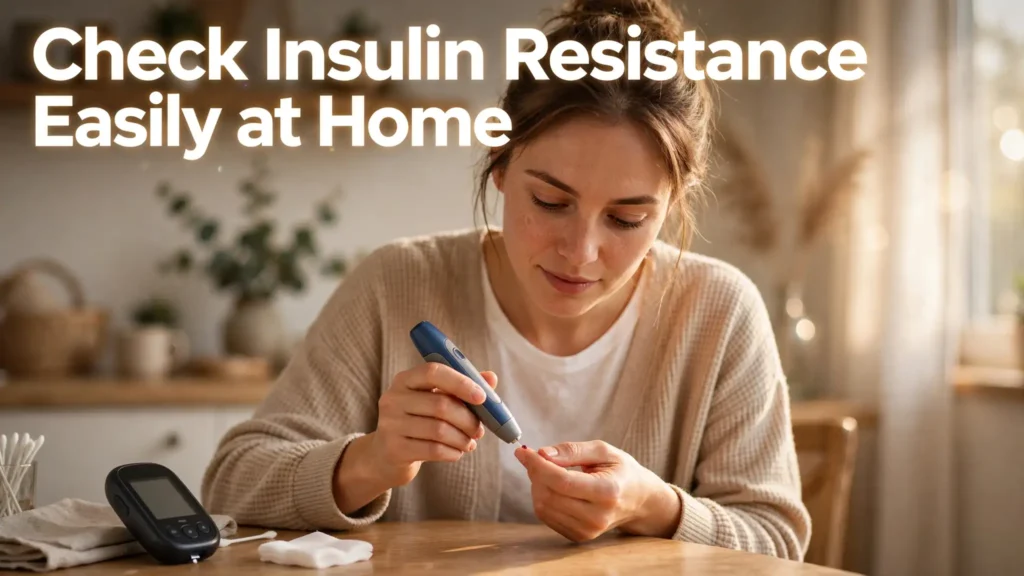
A standard home glucose monitor or continuous glucose monitor can show blood sugar patterns after meals, which is genuinely useful information. What it can’t do is measure insulin levels directly, meaning a normal glucose reading doesn’t rule out insulin resistance, since the pancreas may simply be compensating with extra insulin to keep that number looking normal.
I actually tried a continuous glucose monitor for two weeks during this whole process, mostly out of curiosity. It was genuinely informative for spotting which specific meals caused the sharpest spikes, but I want to be clear that it never told me anything about my insulin levels directly — that information only came from the fasting insulin blood test my GP eventually ordered.
What the CGM did give me was a genuinely useful behavioural tool, separate from diagnosis entirely. Watching a specific breakfast produce a sharp spike on the graph was far more motivating than reading an abstract warning about refined carbohydrates. That immediate, visual feedback made the dietary changes feel like a direct response to real data rather than a vague, generic recommendation.
A glucose monitor shows the result of the compensation, not the compensation itself. Normal glucose readings can still exist alongside meaningful insulin resistance.
Online Risk Calculators — Useful Starting Point, Not a Verdict
Several validated risk calculators, often based on factors like waist circumference, family history, blood pressure, and age, can estimate general metabolic risk. These are reasonable starting points for deciding whether to pursue testing, but none of them are diagnostic, and a low score doesn’t guarantee insulin resistance isn’t present.
I ran my own numbers through two different validated calculators and got a moderate-risk result from both, which lined up reasonably well with what the eventual blood test confirmed. That consistency gave me more confidence in the calculators as a genuinely useful screening step, though I’d still treat any single result as a prompt to investigate further rather than a final answer.
Choosing a calculator from a reputable source matters here too. Several unaffiliated health organisations and university research groups publish free, validated risk calculators online, and these tend to be more reliable than a quiz embedded in a supplement company’s sales page, which often exists primarily to sell a specific product regardless of the actual result.
What I Actually Did With My Self-Check Results
My own waist-to-height ratio came back right at the borderline, and combined with the fatigue pattern I’d already noticed, that was enough to prompt a direct conversation with my GP rather than waiting for my next scheduled check-up. Around the same time, I’d already started adjusting breakfast based on specific low-carb strategies that reduce morning blood sugar demand, which meant I walked into that appointment with genuinely useful context rather than a vague complaint about feeling tired.
Bringing a short written summary to the appointment — the waist ratio, the symptom pattern tracked over a few weeks, the calculator results — turned what could have been a rushed ten-minute conversation into a genuinely productive one. My GP later mentioned that patients arriving with that kind of organised self-tracking tend to get more targeted testing faster, simply because there’s less time spent establishing the basics from scratch.
This is a small, practical tip worth repeating on its own: whatever self-assessment tools you use, write the results down before the appointment rather than trying to recall them from memory under time pressure. A short, organised summary respects both your own time and the GP’s, and makes it far more likely the conversation reaches an actual testing decision rather than ending in a vague “let’s keep an eye on it.”
What to Do If Your Self-Check Raises Concerns
If your waist-to-height ratio, symptom pattern, or visual signs raise any concern, the next step is a specific conversation with a GP, requesting a fasting insulin test or HOMA-IR calculation by name rather than a general check-up. Being specific about which test you’re asking for makes a real difference to whether the appointment actually catches what a standard fasting glucose test alone might miss.
It’s worth mentioning that self-checks pointing toward risk don’t mean panic is warranted. Insulin resistance, caught reasonably early, is genuinely manageable and often reversible through the kind of lifestyle changes covered elsewhere on this site. The purpose of self-assessment is simply to prompt a timely, informed conversation, not to cause unnecessary alarm.
The opposite mistake is worth avoiding too: treating a reassuring self-check as permission to ignore genuine symptoms indefinitely. A borderline waist ratio combined with persistent, unexplained fatigue deserves a conversation with a doctor regardless of what any single measurement suggests on its own. Self-assessment tools work best combined and interpreted together, not read individually in isolation.
| You Can Self-Check at Home | Only a Blood Test Can Confirm |
| Waist-to-height ratio | Fasting insulin level |
| Symptom pattern tracking | HOMA-IR calculation |
| Visual skin signs | HbA1c reading |
| Post-meal glucose patterns | Actual insulin resistance diagnosis |
Lifestyle Factors Worth Tracking Alongside Any Self-Check
Alongside any self-assessment, tracking activity levels and general dietary patterns gives useful context. This connects to the broader research on how movement affects metabolic health, and to the same gut-supportive foods that overlap considerably with improved insulin sensitivity, both of which give a fuller picture than symptoms or measurements alone.
Looking back at that initial search for a home testing kit, I’m genuinely glad I didn’t find one that seemed to work, since it likely would have given me false confidence one way or the other. What actually helped was a combination of honest self-assessment and a properly targeted blood test, and understanding the difference between the two is, I think, the single most useful thing anyone can take from this article.
Frequently Asked Questions
Can you test for insulin resistance at home?
Not directly. There’s no validated home device that measures insulin resistance itself, though self-assessment tools like waist-to-height ratio can indicate whether testing is worth pursuing.
What is a normal waist-to-height ratio for insulin resistance risk?
A ratio below 0.5 is generally considered lower risk, while a ratio above 0.5 is a signal worth discussing with a doctor alongside other symptoms.
Can a home glucose monitor detect insulin resistance?
Not directly. It can reveal blood sugar patterns, but normal glucose readings can still occur alongside meaningful insulin resistance if the pancreas is compensating.
What are visual signs of insulin resistance?
Skin tags and darkened, velvety skin patches called acanthosis nigricans, often around the neck or in skin folds, are both associated with insulin resistance.
How accurate are online insulin resistance risk calculators?
They’re useful for estimating general risk based on factors like waist size and family history, but they aren’t diagnostic and can’t replace an actual blood test.
This article is for informational purposes only and does not replace professional medical advice. Please consult a doctor for proper testing and diagnosis of insulin resistance.
