Short + Direct Answer:
Meningitis symptoms are frequently mistaken for a cold, flu or even a hangover, which is exactly why two separate UK outbreaks this year alone have led to student deaths. Knowing the specific warning signs, and how fast this disease can progress, is genuinely a matter of hours, not days.
The Symptom List I Wish Every Student Actually Read
A reader messaged me shortly after news broke of the second meningitis outbreak in the UK this year, this time at Henley College, following the earlier outbreak in Kent back in March that killed two people connected to the University of Kent. She had a daughter starting university in the autumn and wanted to know, plainly, what she should actually be watching for beyond the vague “seek medical attention if you feel unwell” advice she kept seeing repeated online.
That question stuck with me, partly because I didn’t have a confident, specific answer ready either, despite having written health content for years. Meningitis is one of those conditions everyone has heard of in passing, but very few people could actually describe the early warning signs of if asked directly.
That gap is exactly why I wanted to put this together properly. Two separate outbreaks in one year, in two different educational settings, is not a coincidence worth glossing over with a generic symptom list nobody actually remembers under pressure.
I think generic symptom lists fail people precisely at the moment they matter most, in the middle of the night, half asleep, trying to decide whether a headache and a stiff neck are worth waking someone up over. A list you can actually recall under pressure, built around specific, memorable details rather than a vague checklist, is worth far more than a comprehensive medical glossary nobody reads twice.
Meningitis symptoms are genuinely easy to confuse with far more common, harmless illnesses in their earliest stages, and that confusion is precisely what UK health officials have pointed to as a major factor behind this year’s deaths.
Table of Contents
What Happened in the UK This Year
In March 2026, an outbreak of invasive meningococcal disease began in Canterbury, Kent, eventually linked to a total of 21 confirmed cases and two deaths. One victim was a University of Kent student, and the other a pupil at Queen Elizabeth’s Grammar School in nearby Faversham. Investigators traced the outbreak’s likely origin to a local nightclub, with cases spreading through the close social networks typical of university towns.
The delay in initial reporting during the Kent outbreak was later described by a health expert as “indefensible,” a detail worth sitting with. Even with strong systems in place, the gap between the first suspected case and a formal public outbreak declaration can cost time that genuinely matters once a fast-moving disease like this starts spreading through a densely connected social network.
Quick fact
The outbreak was caused by Neisseria meningitidis serotype B, commonly known as meningitis B. Over 10,500 doses of preventive antibiotics and 4,500 vaccinations were administered in Kent in the weeks following the outbreak, alongside a widened vaccination offer extended to Year 11 pupils in the area.
Then, in May 2026, a second, separate case emerged at Henley College, where a student died after contracting suspected meningitis, with a confirmed case of meningitis B among two others being treated. UK Health Security Agency officials stressed the two outbreaks weren’t linked, but the timing, two serious incidents within a few months of each other, has understandably raised fresh concern about how well the current vaccination programme actually protects the age group most at risk.
Why Students Are Especially at Risk
University and college life brings a specific combination of factors that genuinely raises meningitis risk beyond what most young adults experienced at home. Living in shared halls, socialising in crowded venues, and generally coming into close contact with large numbers of new people from different backgrounds and immunity profiles all increase the chance of encountering the bacteria that causes the disease.
Dr Tom Nutt, chief executive of the Meningitis Now charity, has specifically pointed to this dynamic, noting that university students and young adults face increased risk precisely because meningitis bacteria spread more easily in settings where people live, study, and socialise in close quarters.
It’s worth adding that meningococcal bacteria are actually carried harmlessly in the nose and throat of a significant portion of the population without ever causing illness in the carrier themselves. What changes the picture is transmission to someone without existing immunity to that specific strain, which is exactly the kind of exposure that spreads efficiently through crowded student housing, shared kitchens, and nightlife venues.
The vaccination gap
Since 2015, the MenB vaccine has only been routinely offered to infants in the UK’s childhood immunisation schedule, not to teenagers or young adults, despite meningitis B remaining one of the most common causes of the disease in this exact age group. This gap is part of why health charities have specifically called for MenB protection to be extended to include older teenagers and young adults, rather than infants alone.
I think this policy gap deserves more public attention than it currently receives. Infant vaccination programmes are obviously important, but they don’t retroactively protect the cohort of teenagers and young adults who were already past infancy when MenB vaccination began in 2015, leaving an entire generation moving through the highest-risk years of their lives without that specific layer of protection built into routine care.
Meningitis Symptoms — What to Actually Watch For
This is the section that matters most, so I want to be as specific and memorable as possible.
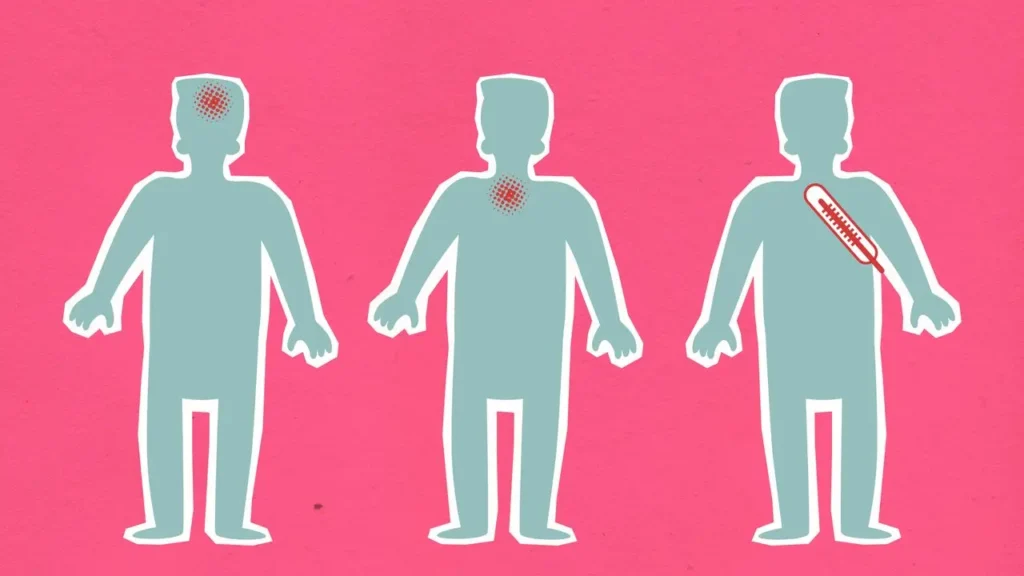
Early symptoms are genuinely easy to dismiss, and this is exactly what UKHSA officials warned about directly following the Kent outbreak. Fever, headache, drowsiness, and general fatigue can look identical to a bad cold, the flu, or, particularly relevant for students, a hangover after a night out. This overlap is precisely why cases can go unrecognised for crucial hours during the most dangerous, fast-moving stage of the illness.
More specific symptoms include a stiff neck, sensitivity to bright light, vomiting, rapid breathing, cold hands and feet despite a fever, and shivering. Septicaemia, blood poisoning that can accompany meningococcal disease, produces a distinctive rash worth knowing specifically.
The glass test
Press the side of a clear glass firmly against the skin where a rash has appeared. If the rash does not fade or disappear under the pressure of the glass, this is a medical emergency requiring immediate attention, regardless of how the person is otherwise feeling. This test works on all skin tones, though the rash itself can be harder to see on darker skin, making it worth checking areas like the palms, soles of feet, or inside the eyelids specifically.
How Fast This Can Actually Progress
This is genuinely the detail that should change how anyone thinks about meningitis. Invasive meningococcal disease can progress from early, mild-seeming symptoms to life-threatening illness within hours, not days. The case fatality rate sits between 8 and 15 percent even with prompt treatment, a sobering figure for a disease that many people assume is far rarer or slower-moving than it actually is.
This speed is exactly why waiting to see if symptoms improve overnight, a perfectly reasonable instinct with most illnesses, can be genuinely dangerous here. If meningitis is even a possibility based on the symptoms present, seeking urgent medical attention immediately, rather than monitoring at home, is the only safe approach.
I think it’s worth being explicit about the psychology at play here too. Most of us have learned, reasonably, that most illnesses respond well to a wait-and-see approach, rest, fluids, paracetamol, and time. That instinct, generally sound advice for the vast majority of everyday illness, is exactly the wrong approach if meningitis is genuinely on the table as a possibility, which is part of why public health messaging around this disease specifically emphasises urgency over the usual patience.
What Treatment and Prevention Actually Look Like
Prompt antibiotic treatment is the primary response to confirmed or suspected meningococcal disease, and speed of treatment is directly linked to outcomes. This is why UKHSA teams move quickly to offer preventive antibiotics, called chemoprophylaxis, to close contacts of confirmed cases, even before further test results come back, as happened in both the Kent and Henley College outbreaks.
Vaccination remains the most effective long-term prevention tool available. The UK’s routine childhood schedule includes protection against several meningococcal strains, but as mentioned, MenB coverage specifically has been limited to infants since 2015. Following the Kent outbreak, the vaccination offer was expanded locally to include Year 11 students and others connected to the affected venues and institutions, an emergency response rather than a permanent policy change.
If you or a family member falls outside the routinely vaccinated age groups and is heading into a university or college environment, it’s genuinely worth having a direct conversation with a GP about your specific risk and vaccination options, rather than assuming the standard childhood schedule has you fully covered.
It’s also worth knowing what to do if you’re a close contact of a confirmed case, even if you feel completely well. Preventive antibiotics offered by health authorities aren’t a formality, they’re specifically designed to stop the bacteria taking hold in people who’ve had significant recent contact, and taking them promptly when offered is a genuinely important part of stopping an outbreak from spreading further through a shared social network.
What I’d Want Every Parent or Student to Know
If I were talking to that reader’s daughter directly before she started university, I think the single most useful thing I’d tell her is this: trust a symptom pattern that doesn’t quite fit what you’d expect from a hangover or a cold, especially if it comes with a stiff neck, light sensitivity, or that specific non-fading rash. Don’t talk yourself out of it because you were out drinking the night before, or because a headache seems explainable some other way.
I’d also encourage her, and any parent reading this, to actually do the glass test if a rash appears alongside any other symptoms, rather than just glancing at it and hoping it looks fine. It takes seconds, and it’s specific enough to cut through the uncertainty that delays so many people from seeking help in time.
If infectious illness and how quickly symptoms can escalate is a topic you want to understand more broadly, our piece on the recent flu strain spreading across the UK covers a similar pattern of a common-seeming illness carrying more risk than expected. And for families with younger children navigating school and nursery illness more generally, our Child and Maternal Health category has further reading worth exploring alongside this.
For broader context on how serious infectious and chronic conditions are approached and managed on this site, our Disease Management category is also worth browsing.
Frequently Asked Questions
What are the first signs of meningitis?
Early signs include fever, headache, drowsiness, and fatigue, often mistaken for a cold, flu, or hangover, followed by more specific symptoms like a stiff neck, light sensitivity, and vomiting.
How can you tell meningitis apart from a hangover or flu?
A stiff neck, sensitivity to bright light, a non-fading rash, cold hands and feet despite fever, and rapid deterioration over hours rather than days are key signs that point toward meningitis rather than a hangover or flu.
How fast does meningitis progress?
Invasive meningococcal disease can progress from mild symptoms to life-threatening illness within hours, making immediate medical attention essential rather than waiting to see if symptoms improve.
Are university students at higher risk of meningitis?
Yes. Close living arrangements, crowded social venues, and contact with large numbers of new people all increase transmission risk among university and college students specifically.
Is there a vaccine that protects against meningitis B?
Yes, the MenB vaccine exists, but in the UK it has only been routinely offered to infants since 2015, leaving a coverage gap among teenagers and young adults that health charities have called to be addressed.
Final Thoughts: Speed Saves Lives With This One
Two outbreaks in one year, in two different educational settings, is a pattern worth taking seriously rather than treating as an isolated tragedy. Meningitis symptoms hide well inside far more common illnesses, and that overlap is exactly what cost precious hours in both the Kent and Henley College cases.
If you or someone you know develops a fever, headache, and stiffness alongside drowsiness or a non-fading rash, don’t wait to see if it passes. Seek emergency medical care immediately. With meningitis, the speed of your response genuinely matters as much as recognising the symptoms in the first place.
Medical Disclaimer
This article is for general information only and is not a substitute for professional medical advice. If you suspect meningitis, seek emergency medical attention immediately rather than relying on this article for diagnosis.