The Short Version
A colleague of mine, someone I’d have described as a genuinely healthy eater, found out through a week of honest food tracking that her “clean” diet was hiding more added sugar than a chocolate bar. Watching her fix it — not all at once, but through 21 small, sequenced changes — taught me more about ways to cut sugar from your diet than any single study has. None of it involved cutting out sugar entirely.
Introduction
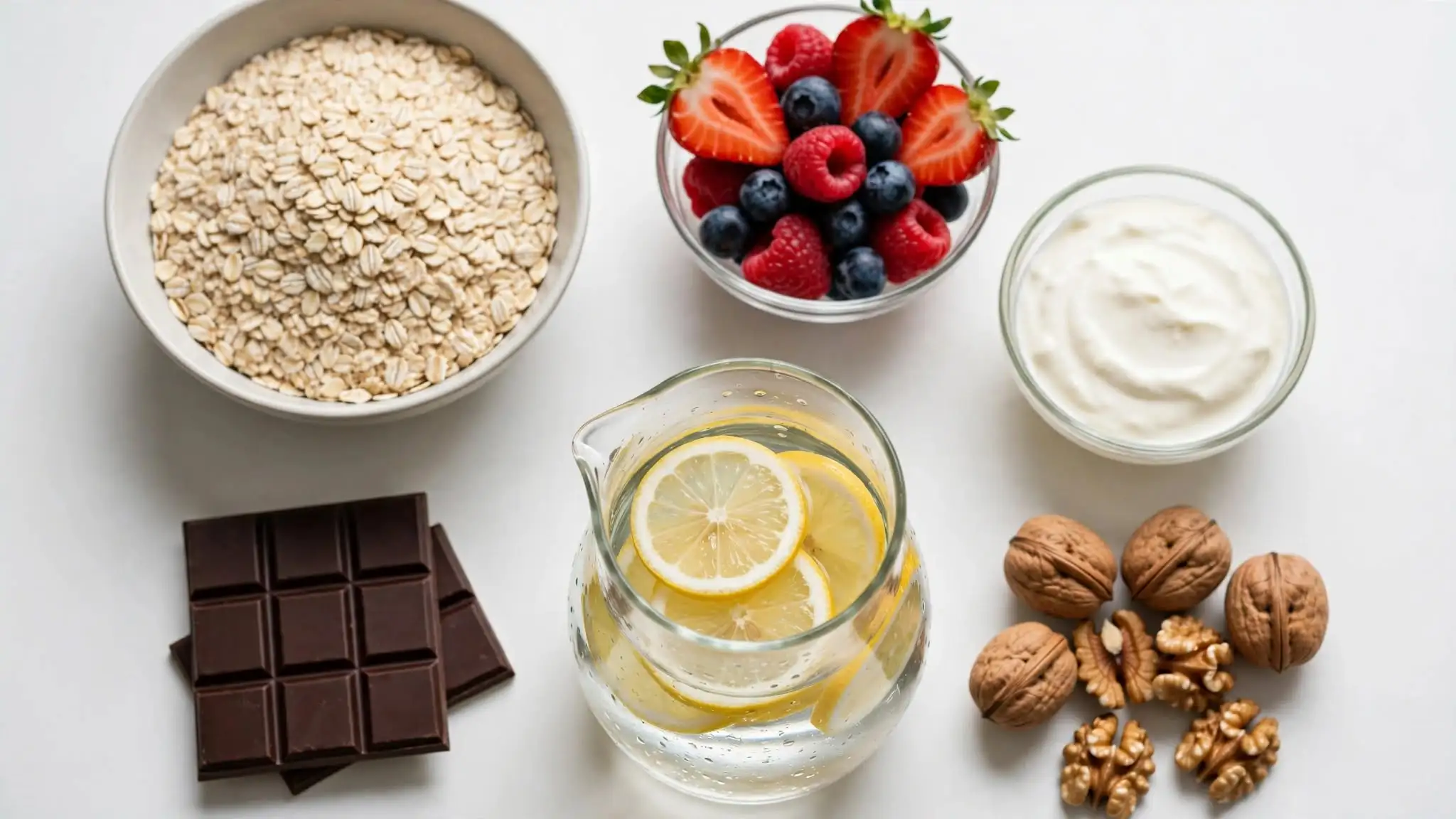
A colleague of mine described her diet as a healthy meal in the office for years. Homemade meals, whole-grain bread, yogurt most mornings, salads most days. Then she downloaded a food tracking app out of curiosity, and within three days she spotted something that really made her uncomfortable: She was eating almost twice the recommended daily limit during that time, without any biscuits, cakes, or fizzy drinks.
I got caught up in it almost by accident, as he started asking me questions that he thought I knew the answers to—after all, I write about health. The next few months were really productive in which I worked with him to find ways to cut sugar from your diet, read the labels together during lunch, and see which changes actually lasted and which he left out in a week.
“I thought I was one of the good guys,” she said with a half-laugh, as the app marked her flavored yogurt as more of an added sugar than a scoop of ice cream. This one phrase is basically the reason for the existence of this article.
Table of Contents
The Week Her Food-Tracking App Flagged Something Odd
The culprits weren’t hidden in anything she’d have called a treat. A low-fat strawberry yogurt she ate most mornings had more added sugar than a similarly sized portion of ice cream. Her go-to granola contained more sugar per serving than a chocolate-coated cereal marketed at children. A stir-fry sauce she used two or three times a week was, by weight, essentially sweetened soy water.
Why It Was the “Healthy” Foods, Not the Treats
What struck me most, hearing her go through this, was how much it matched something I’d already written about — how daily choices quietly shape your health over time, usually without us noticing at the time. None of her individual choices had felt reckless. The problem wasn’t effort or willpower. It was a specific, fixable gap in knowledge about where sugar actually hides in food that gets marketed as healthy.
Why Added Sugar Is So Easy to Underestimate
The Hidden Sugar in Foods Marketed as Healthy
The biggest source of hidden sugar in most people’s diets isn’t the obvious stuff. It’s not the birthday cake or the weekend treat. It’s the foods marketed as health-conscious: low-fat dairy (which often adds sugar to compensate for lost flavour), bottled sauces and dressings, shop-bought smoothies, protein bars, flavoured water, and some savoury snacks. The sugar is there to make the reduced-fat version taste like something you’d actually choose to eat again.
What Food Labels Don’t Make Obvious
Food labels can list more than 50 different names for added sugar — dextrose, maltose, sucrose, high-fructose corn syrup, evaporated cane juice, barley malt, and dozens more. The “total sugars” line on a nutrition panel includes natural sugars from fruit and dairy, which aren’t the concern. The figure worth focusing on is the added sugars line specifically2, which UK labelling now separates out but which most people have never been told to actually look for.
How Much Is Too Much?
NHS guidance recommends adults keep free sugars — sugars added to food and drink, plus those in juices and syrups — to no more than 30g, or around 7 teaspoons, a day1. Most adults in the UK eat well above this without realising it, largely because of where it’s hiding rather than how much they’re deliberately adding.
The 21 Ways She Actually Cut Sugar From Her Diet
She didn’t implement all of these at once. She started with the category causing the most damage — drinks — and worked outward from there over a few months, adding a new group of changes roughly every couple of weeks.
Start With What You Drink (Tips 1–4)

Sugary drinks are consistently identified as the single biggest source of added sugar in the average diet, and also the most impactful category to fix, because sugar in liquid form is absorbed fast and does almost nothing to increase fullness.
1. Swap sugary drinks for sparkling water with citrus: The carbonation satisfies the same craving without any added sugar, and a squeeze of lemon or lime makes it feel like an actual drink rather than a compromise.
2. Switch flavoured coffee drinks for black or unsweetened alternatives: A medium flavoured coffee from most chains can contain as much added sugar as two or three biscuits. Black coffee or an unsweetened latte removes that load without losing the caffeine.
3. Replace fruit juice with whole fruit: Juice strips out the fibre and concentrates the sugar into a fast-absorbing liquid. Whole fruit produces a noticeably gentler blood sugar response and keeps you full for longer.
4. Replace energy drinks with green tea or black coffee: Energy drinks are largely added sugar and caffeine sold at a premium. Green tea offers gentler caffeine alongside antioxidants, with no added sugar if drunk plain.
Read Labels Like It Matters (Tips 5–7)
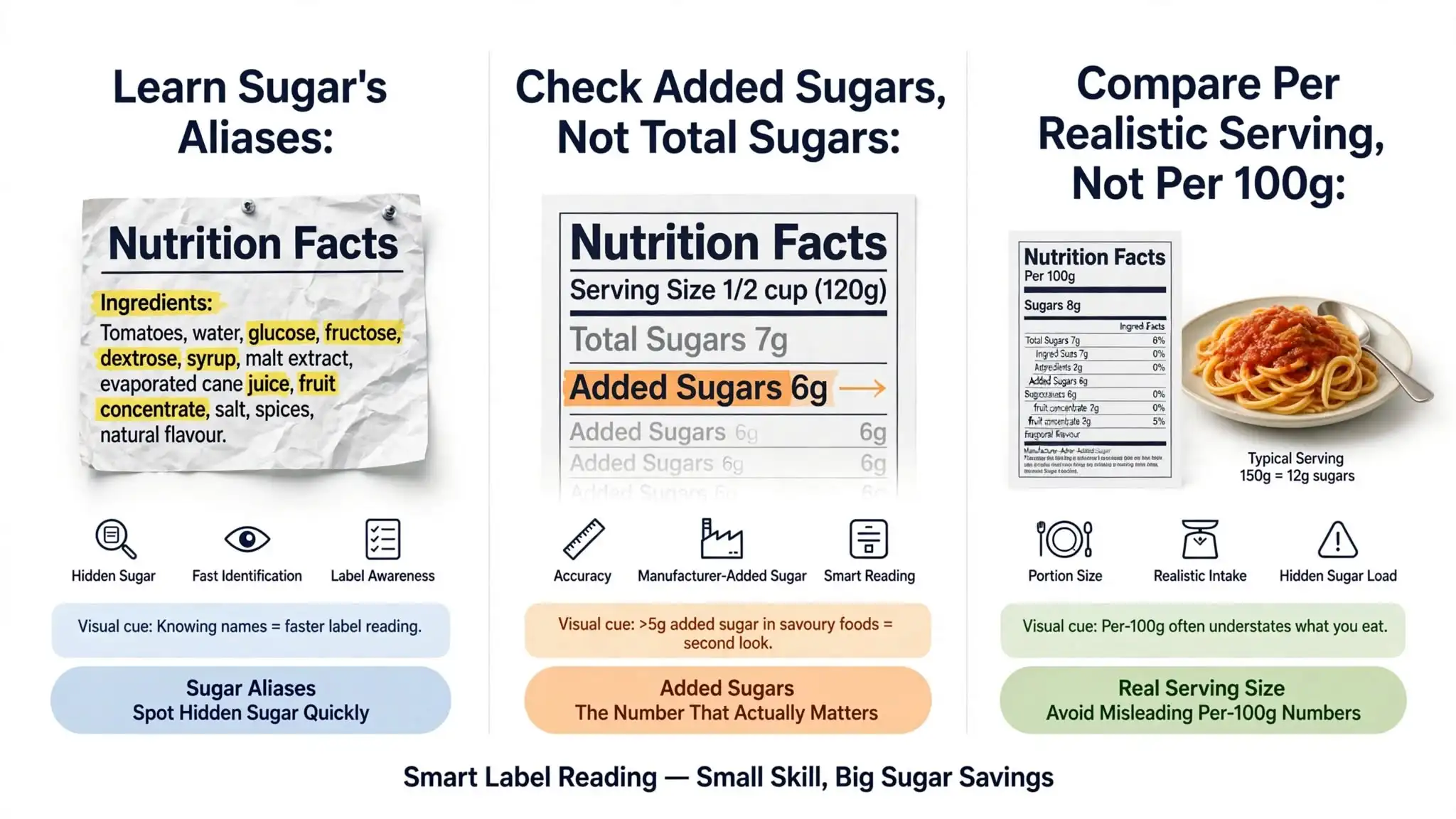
5. Learn sugar’s aliases: Anything ending in ‘-ose’ (glucose, fructose, dextrose) is sugar, as is anything called syrup, malt extract, evaporated cane juice, or fruit concentrate. Knowing these names makes reading labels genuinely faster.
6. Check the added sugars line, not total sugars: Total sugars include natural dairy and fruit sugars. The added sugars figure shows only what the manufacturer put in — more than 5g per serving in a savoury product is worth a second look.
7. Compare per realistic serving, not per 100g: A sauce showing 8g per 100g looks moderate until you realise you’re using 150g in a single meal. The per-100g figure consistently understates what you actually eat.
Fix Breakfast First (Tips 8–11)
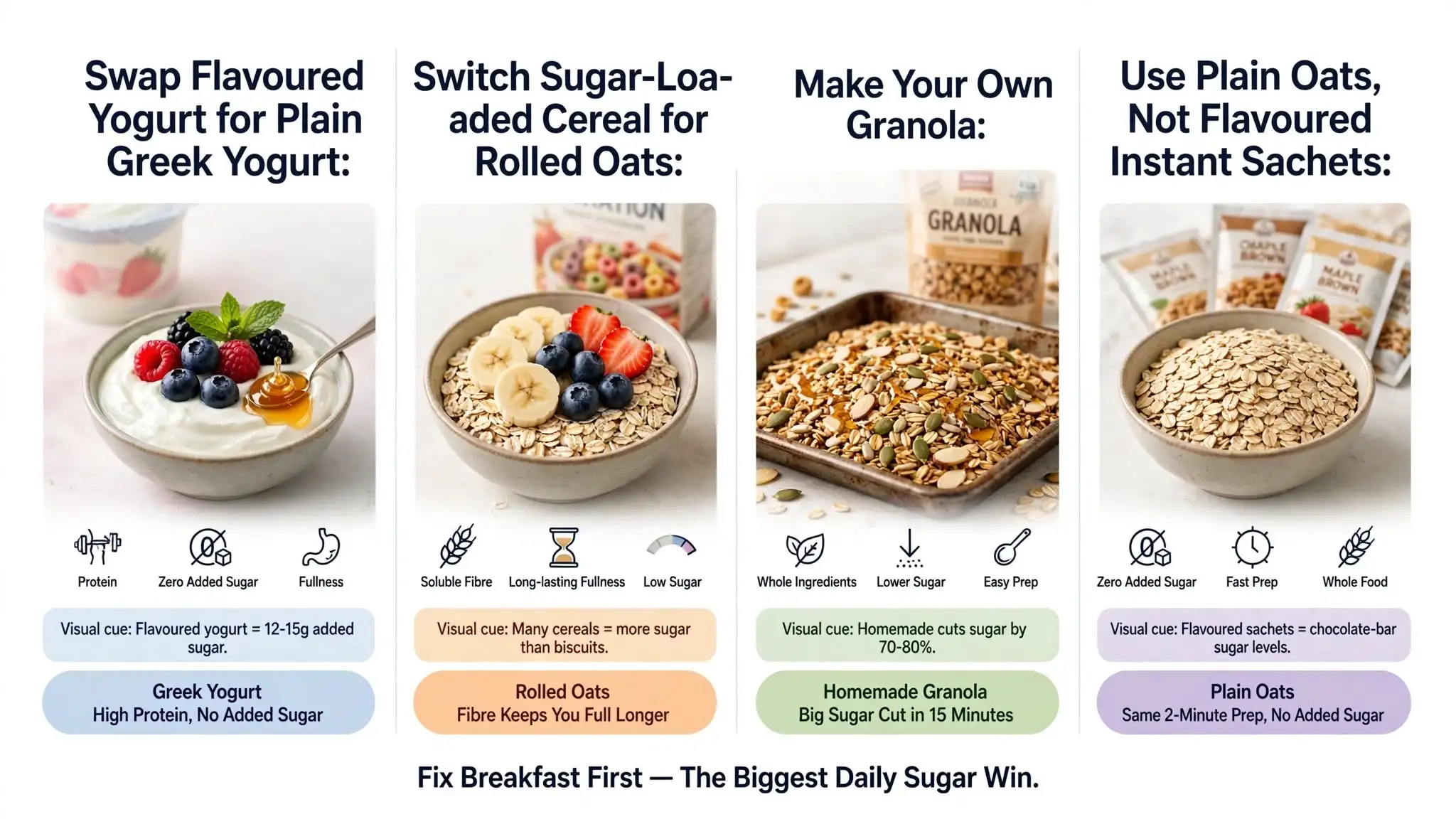
Breakfast turned out to be her single biggest daily sugar source. Four changes cut her morning added sugar by more than two-thirds.
8. Swap flavoured yogurt for plain Greek yogurt: A standard small pot of flavoured yogurt can contain 12 to 15 grams of added sugar. Plain Greek yogurt has none, offers considerably more protein, and a teaspoon of honey or fresh berries adds sweetness at a fraction of the cost — one of the simplest food swaps that make a real difference across the whole day, but the single most effective one at breakfast specifically.
9. Switch sugar-loaded cereal for rolled oats: Many popular cereals carry more added sugar than several biscuits. Plain oats with fruit keep you full for far longer thanks to their soluble fibre.
10. Make your own granola: Most shop-bought granola is oats baked in sugar and oil. A homemade version with oats, a little honey, and seeds takes fifteen minutes and cuts added sugar by 70 to 80 percent.
11. Use plain oats, not flavoured instant sachets: Flavoured instant sachets can match the added sugar of a chocolate bar. Plain oats take the same two minutes to prepare.
Tackle Hidden Sugar in Savoury Meals (Tips 12–15)
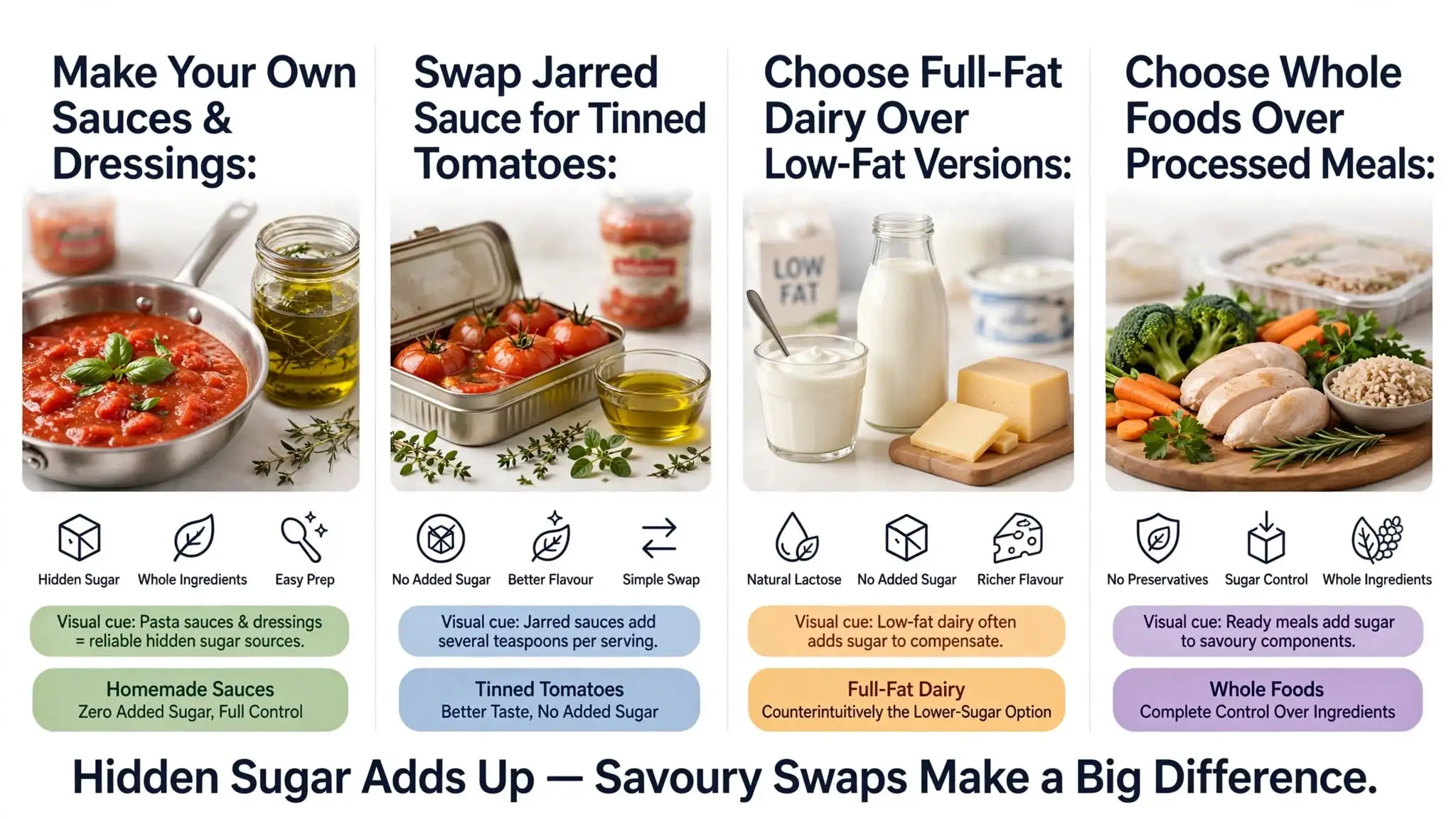
12. Make your own sauces and dressings: Pasta sauces, dressings, and stir-fry sauces are among the most reliable hidden sugar sources in any kitchen. A basic tomato sauce takes twenty minutes; a vinaigrette takes sixty seconds. Neither needs added sugar.
13. Swap jarred sauce for tinned tomatoes: Tinned tomatoes have no added sugar, while most jarred pasta sauces add several teaspoons per serving. A sauce built from tinned tomatoes and olive oil tends to taste better too.
14. Choose full-fat dairy over low-fat versions: Low-fat dairy frequently compensates for the flavour lost with the fat by adding sugar. Full-fat plain yogurt, milk, and cheese contain natural sugar from lactose but no added sugar — counterintuitively, often the lower-sugar option.
15. Choose whole foods over processed meals: Ready meals often add sugar to savoury components as a preservative. Cooking from whole foods, even quickly, gives complete control over what actually goes in.
Manage Cravings Without White-Knuckling It (Tips 16–18)

16. Eat more protein and fat to prevent sugar cravings: Cravings for something sweet are often hunger signals in disguise. Meals built around adequate protein and healthy fat produce steadier blood sugar, which makes mid-afternoon cravings noticeably less intense.
17. Use dark chocolate (70%+) as your default sweet: Dark chocolate above 70% cocoa contains substantially less added sugar than milk chocolate, and the flavour is intense enough that a couple of squares after dinner is genuinely enough.
18. Recognise and manage the stress that drives emotional sugar eating: Stress drives a genuine craving for sugar through the reward response sweet food triggers. I’d already written about how unmanaged stress drives sugar cravings and the wider toll it takes — addressing the stress itself, rather than white-knuckling through the craving it creates, is what finally changed her evening habits.
Make the Kitchen Work Against Sugar, Not for It (Tips 19–21)

19. Clear visible sugar temptations from the counter: Visible food gets eaten more. Moving sugary snacks out of eyeline and replacing them with fruit or nuts shifts the default option without requiring any willpower.
20. Prep whole-food snacks in advance: Processed snacks win at 4pm because they’re fastest. Keeping mixed nuts, cut fruit, or hummus and veg ready in the fridge makes the lower-sugar option the convenient one.
21. Start with one category, not all 21 at once: The most common mistake with any dietary change is attempting everything simultaneously and abandoning it all when willpower runs out. Pick the category responsible for the most sugar in your day — for most people, it’s drinks — and fix that first.
The Five Changes That Made the Biggest Difference for Her
The five that delivered the most change for the least ongoing effort: cutting sugary drinks entirely, swapping flavoured yogurt for plain Greek yogurt, making her own tomato sauce, eating more protein at lunch to head off cravings, and clearing visible sweets from the counter.
All five became automatic within two to three weeks and needed no deliberate thought after that. That’s what tends to separate a genuine habit change from one running purely on willpower.
What Changed in Her Body After Cutting Back
The Afternoon Crash That Disappeared
The first thing she noticed was the end of her 3pm energy crash. She’d been treating it as an inevitable part of adult life — something I’d actually written about before, in the context of feeling inexplicably exhausted for no clear reason, where poor sleep usually gets the blame first. In her case, the daily blood sugar spike from breakfast and lunch turned out to be doing most of the damage. Within about ten days of stabilising her sugar intake, the crash had largely gone.
Sleep, Skin, and What Her GP Noticed at the Follow-Up
Sleep quality improved around four weeks in, and her skin noticeably cleared up within two. The hunger she used to feel constantly between meals largely disappeared, which she’d also assumed was just a normal part of adult life. At a routine GP follow-up a few months later, several of her metabolic markers, which had been borderline the year before, had moved back into a healthier range.
What Watching Her Go Through This Taught Me
Rethinking How I Write About “Healthy” Food Claims
Watching this unfold changed how carefully I now read the word ‘healthy’ on packaging, both as a writer and as someone doing my own weekly shop. It’s easy to assume a product is fine because it’s marketed at people trying to eat well, and that assumption is exactly what the marketing is built to exploit.
Why Sequencing the Changes Mattered More Than the List Itself
What made the real difference wasn’t the length of the list. It was that she tackled one category at a time, in order of impact, rather than trying to overhaul everything at once. That’s consistent with simple food swaps that make a real difference I’ve written about elsewhere — the swaps that stick are almost always the ones introduced one at a time, not all together.
Who Should Be Cautious About Cutting Sugar Quickly
None of the 21 changes above require medical supervision for most healthy adults. But if blood sugar management is already part of your daily life, cutting sugar quickly and significantly is a conversation worth having with a professional first, rather than something to figure out through trial and error.
A Note for Anyone Managing Diabetes or Blood Sugar Conditions
If you have type 1 or type 2 diabetes, pre-diabetes, or any condition affecting blood glucose, speak to your GP or a registered dietitian before making significant changes to your sugar or carbohydrate intake. Some medications are dosed around your usual eating pattern, so changing it quickly can affect how they work.
Conclusion
My partner’s diet didn’t need a complete change. It required extracting 17 invisible spoonfuls of sugar from yogurt, sauce, granola, and flavoured coffee, which she herself never considered a problem. When it was all over, everything else — the occasional dessert, the birthday cake, the actual dessert — was no longer an embarrassment and then became a real choice.
If any of these ways to cut sugar from your diet sound like foods currently sitting in your own kitchen, that’s exactly the point. Pick one category, fix it properly, and let it become automatic before moving to the next. It’s small changes that compound into real results over a few months, not a single dramatic reset over a weekend.
Medical Disclaimer: This article reflects a personal account and general nutrition information drawn from published guidance. It is not medical or dietary advice and should not replace a consultation with your GP or a registered dietitian.
Frequently Asked Questions
How much added sugar should you have per day?
NHS guidance recommends no more than around 30g, or 7 teaspoons, of free sugars a day for adults. [1]
What are the most common hidden sources of added sugar?
Low-fat flavoured yogurt, bottled pasta sauces, salad dressings, shop-bought granola, fruit juice, flavoured coffees, and instant oat sachets are among the biggest hidden sources.
How long does it take to stop craving sugar after cutting it out?
Most people notice a meaningful drop in cravings within one to two weeks, though the first few days can feel harder as the body adjusts.
Is natural sugar from fruit bad for you?
No. Sugar in whole fruit comes packaged with fibre, water, and nutrients that slow absorption, unlike free sugars added to processed foods and drinks.
What happens to your body when you stop eating added sugar?
Steadier energy, fewer afternoon crashes, improved sleep, and reduced cravings typically appear within two to four weeks, with metabolic markers often improving further over time.

1 thought on “21 Simple Ways to Cut Sugar From Your Diet for Good”
Comments are closed.